
Italian Veal Rolls with Turin Breadsticks | Involtini di Vitello con Grissini Torinesi, Toma e Prosciutto

These are Piedmontese veal rolls built around a cheese, and the cheese writes the recipe. Toma Piemontese is a cow's milk cheese with a semi hard paste and a moisture content around forty per cent, too wet to grate and too dry to count as fresh. Inside a rolled and browned piece of veal that middle position becomes a problem: the toma does not run like fontina and does not stretch like mozzarella. It softens evenly, and then it weeps.
What leaves the toma is whey, not fat. Fat greases a pan; whey is water, and water shut inside a roll turns to steam that lifts the veal off the filling and forces the seam open. Everything below exists to deal with that liquid before it appears: the toma is sliced rather than grated, blotted, kept back from the edges of the meat, and used cold, because at room temperature it has already started to give.
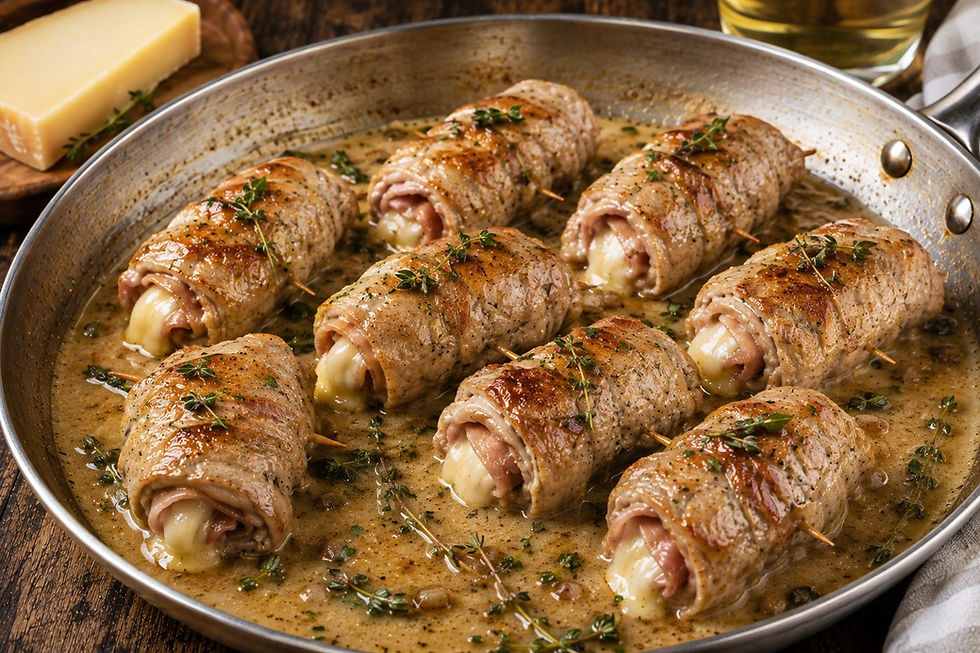
The rest is Turin pantry cooking. Crushed grissini torinesi replace breadcrumbs and absorb the whey the cheese releases, prosciutto supplies almost all of the salt, and the pan is deglazed with white wine into a short glossy jus. The rolls are browned in butter, covered briefly, and served at once.
Yield: 4 servings, 12 rolls. Prep: 35 minutes. Cook: 20 minutes. Total: about 55 minutes. Difficulty: intermediate. Course: secondo. Region: Piedmont, Turin and the alpine valleys behind it.
The Story
Toma is the oldest working cheese of Piedmont and the reason this dish exists. The name covers a family rather than one product, made across the provinces of Turin, Cuneo, Biella, Vercelli, Novara, Asti and Alessandria and recognised as Toma Piemontese DOP in 1996 in two versions, the whole milk one and the semi fat one made from partly skimmed milk. Both are pressed, both are ripened from a couple of weeks for small wheels to two months or more for large ones, and both keep a good deal of water in the paste. That water is not a defect: it is what made toma a cheese for eating rather than grating, sold young and eaten young in the valleys that made it.
Those valleys are the other half of the story. Toma was the cheese of the transumanza, the seasonal move of cattle up to the alpine pastures in early summer and back down to the plain in autumn. Milk that could not travel became wheels at the malga, and the cheese changed with altitude and grazing: a wheel made at fifteen hundred metres on mountain herbs and ripened through the winter tastes nothing like a young wheel made near Cuneo in March. Piedmontese cooks have always treated the two as separate ingredients, in separate quantities.
The grissino came from the city. Turin credits it to the late seventeenth century court of Savoy, where a thin, dry, twice baked stick was made for a young duke who could not digest ordinary bread, and both forms survive: the hand rolled knobbly rubata and the stretched stirato, bone dry, stale within a day of the bag being opened. Grissini past their best were crushed and used as breadcrumbs, and in a filling built around a wet cheese that turned out to be better than a substitute. The veal is the simplest of the three, the thin slice cut to stretch a little meat across a family.
Ingredients
For the veal
Veal top round or loin, cut into 12 thin slices, 1 1/2 lb (680 g) total
Fine sea salt, 1/4 tsp (1.5 g)
Freshly ground black pepper, to taste
For the filling
Toma Piemontese, young, cut into 12 thin slices, 5 oz (140 g)
Grissini torinesi, crushed to coarse crumbs, 2 1/2 oz (70 g)
Prosciutto crudo, thinly sliced, 3 1/2 oz (100 g)
Parmigiano Reggiano, finely grated, 1 oz (30 g)
Whole milk, 3 tbsp (45 ml)
Egg yolk, 1
Flat leaf parsley, finely chopped, 2 tbsp (6 g)
Freshly ground black pepper, to taste
For cooking and the jus
Unsalted butter, 3 tbsp (42 g)
Extra virgin olive oil, 1 tbsp (15 ml)
Fresh sage leaves, 12
Dry white wine, 1/2 cup (120 ml)
Light veal or chicken stock, 3/4 cup (180 ml)
Cold unsalted butter for finishing, 1 tbsp (14 g)
For finishing
Flat leaf parsley, chopped, 1 tsp (1 g)
Freshly ground black pepper, to taste
Wooden toothpicks, for securing the rolls
Preparation
Step 1
Slice and blot the toma. Cut twelve slices a scant 1/8 inch (3 mm) thick, shorter than the veal slices, straight from the refrigerator. Lay them on absorbent paper with a second sheet pressed lightly on top. The paper darkens: that is surface whey, and every drop on the paper is a drop that will not be inside the roll. Keep them cold until you fill.
Step 2
Moisten the grissini. Crush the grissini in a bag with a rolling pin to coarse crumbs, not to flour. Add the milk a tablespoon at a time, turning with a fork between additions, and stop while the crumbs are damp and still separate. If they turn to paste, bring them back with more dry crumbs. Fold in the Parmigiano, the parsley, the egg yolk and pepper.
Step 3
Pound the veal. Lay each slice between two sheets of plastic and work it out to an even 1/8 inch (3 mm) with the flat of a mallet, from the centre outwards. Light pressure, flat blows. A slice thin in one place and thick in another cooks unevenly and splits at the thin spot. Season lightly.
Step 4
Assemble the rolls. Cover a slice with prosciutto, leaving a clear 1/2 inch (12 mm) border all round. Spread a tablespoon of the crumb mixture along the lower third, set one cold slice of toma on it well inside that border, then a sage leaf. Fold in both long sides, roll up firmly and secure with a toothpick through the seam. Firm, not crushed.
Step 5
Brown the rolls. Heat the oil and 3 tbsp (42 g) of butter over medium high heat until the foam subsides. Put the rolls in seam side down, in two batches, with room between them. Brown 2 minutes without moving them, then turn and brown the other sides, 5 to 6 minutes in all. Seam side down first sets the seam closed, the only seal these rolls get.
Step 6
Deglaze and build the jus. Pour off any butter darker than hazelnut. Add the wine and let it bubble hard for a minute, scraping the base until the fond dissolves. Add the stock, return it to a simmer and reduce by a third. Taste it now, before the rolls go back: the cheese and the prosciutto will salt it further.
Step 7
Finish covered, briefly. Return the rolls, lower the heat to medium low and cover for 4 to 5 minutes only, turning once. This is the window in which the toma softens through and gives up its whey, and the crumbs around it take that whey up. Longer and the lean veal turns fibrous while the filling goes past moist into wet.
Step 8
Mount the sauce and rest. Lift the rolls onto a warm plate and rest them 3 minutes. Off the heat, once the bubbling stops, swirl in the cold butter until the jus turns glossy. Never let it boil after that or the emulsion breaks. Remove the toothpicks, return the resting juices to the pan and turn the rolls once through the sauce.
Plating
Serve on hot plates. The jus is a small quantity of butter mounted sauce and it dulls on a cold plate within seconds, so warm them while the rolls rest. Three rolls per person, side by side rather than piled, seams turned down and out of sight.
Spoon the jus over and around the rolls and use less than you want to. There should be a glossy pool no wider than the rolls themselves. Lay the cooked sage leaves against the meat, add a pinch of chopped parsley and a grind of black pepper, and stop there. No cheese goes on top.
For a contorno, stay dry and stay Piedmontese: roast potatoes with rosemary, braised savoy cabbage, or spinach turned in butter and drained hard. Avoid anything wet, and avoid polenta, which takes the same sauce and asks for four times as much.
Professional Technique
Toma Piemontese sits at roughly forty per cent moisture, and that single figure governs everything technical in this recipe. A hard grating cheese holds nearer thirty per cent water and simply dries and browns when heated. A fresh cheese holds well over fifty and collapses into liquid. Toma, in the middle, does neither: heated inside a roll it softens to a smooth even paste without stringing and without breaking into oil, and as it softens it expels whey. Not fat, whey, which is water with milk sugars and soluble proteins in it. Plan for melted cheese here and you get the texture right and the liquid wrong.
So the toma is handled as though it were a wet ingredient, because it is one. Slicing rather than grating keeps the released whey in one place instead of spreading it through the filling. Blotting takes out the surface moisture that would appear first and fastest. Setting the slices well inside the border of the meat puts the whey where the grissini crumbs surround it on every side and can absorb it, which is the real reason the crumbs are there. And the toma goes in cold, because at room temperature the paste has already relaxed and begun to sweat, and a cheese weeping before it reaches the pan will weep through the seam.
Choice of wheel changes the quantities. A young toma of two or three weeks is mild, milky and the wettest of the family, and 5 oz (140 g) across twelve rolls suits it. An aged alpeggio toma, made at altitude and ripened for two months or more, has lost much of that water to evaporation and gained concentration and a frank barnyard depth in exchange. It releases far less liquid and tastes much stronger, so drop to about 3 1/2 oz (100 g) and cut the slices thinner. Use an aged wheel at the young quantity and the rolls taste of nothing but cheese.
Texture and Moisture Control
Three things have to be true at once: the veal tender, the filling cohesive and damp rather than wet, the outside browned. They compete, because browning wants heat and time and thin veal wants neither. So the cooking is divided: hard heat in an open pan for the crust, then five minutes covered on low heat for the interior, and nothing more. These slices are 1/8 inch (3 mm) thick and very lean, and they pass from tender to fibrous in the time it takes to answer a telephone.
Inside the roll moisture moves in one direction: the toma gives up whey, the crumbs take it, and the balance between the two is what the filling feels like. Too wet a cheese and the crumbs saturate into a sodden mass; too little and they fall apart when the roll is cut. The jus carries the last of the moisture control, mounted with cold butter off the heat so that it has body and shine at a volume small enough not to soak the meat.
Professional Mise en Place
The rolls take twenty minutes and the last eight need continuous attention, so everything else is lined up before the pan goes on the heat.
Equipment and tools
Heavy sauté pan wide enough for six rolls with space between them, plus a lid
Meat mallet with a flat face, and plastic sheets for pounding
Sturdy bag and rolling pin for the grissini, plus toothpicks and tongs
Cold plate for the toma, warm plate for the browned rolls
Prepared ahead
Veal pounded and kept flat between plastic sheets, refrigerated, up to 4 hours
Grissini crushed and sealed dry, up to 1 day
Toma sliced, blotted and kept cold, up to 2 hours and no longer
Filling mixed without the yolk, stock warm, sage and parsley ready
Service setup
Rolls assembled and secured on a tray, refrigerated, up to 1 hour
Plates warming from the moment the rolls go into the pan
Cold finishing butter cut, contorno drained and held warm
Chef Tips
Buy the toma in a single piece and slice it yourself. Pre sliced toma has sat on its own moisture in a sealed pack and comes out already limp, with nothing left for the blotting to take away.
Crush the grissini by hand, never in a food processor. The blade turns them to powder in about four seconds and powder makes paste. You want a coarse mixed crumb, because the larger fragments give the filling its structure once the whey is in it.
Assemble one roll first and cook it alone as a test. Cut it open, look at the seam and taste the filling for salt. That tells you whether your toma is wetter than expected before twelve rolls are in the pan.
If toma is unavailable, a young Asiago pressato or a fresh raschera sits in the same moisture range and behaves the same way. Not fontina, which melts to a liquid and runs out of the seam. Not a hard aged cheese, which will not soften through in five minutes.
Common Mistakes
Using the toma at room temperature. It has already relaxed and begun to sweat, and it loses its whey in the first two minutes in the pan rather than the last five.
Grating the toma instead of slicing it. Grated toma spreads its moisture through the filling at once and saturates the crumbs instead of letting them absorb from one point.
Pushing the filling out to the edges. Filling that reaches the border has nothing between it and the seam, and whey under pressure finds that opening.
Working the grissini into a paste. Milk added all at once turns the crumbs into dough that steams rather than absorbs, and the filling comes out heavy.
Covering the pan for too long. Five minutes softens the toma through. Ten turns thin lean veal fibrous and the filling wet.
Salting the filling as though the cheese and the ham were not there. Prosciutto, Parmigiano and toma carry a great deal of salt, and the jus reduces on top of that.
Boiling the sauce after mounting the butter. The emulsion holds only below a simmer. Once it boils it splits into oil and watery stock within seconds.
Wine Pairing
Dolcetto d'Alba DOC: The everyday red of these hills and the one that asks least of the dish. Its tannin is low and soft, so it never scours lean veal, and its dark cherry fruit with a faintly bitter almond finish runs alongside the toma rather than over it. Serve it at 59°F (15°C).
Barbera d'Asti DOCG: The choice when you want the butter cut rather than accompanied. Barbera carries high natural acidity with very little tannin, and that acidity goes at the mounted jus and the fat of the cheese without adding drying grip to the meat. Take a young unoaked bottling.
Nebbiolo d'Alba DOC: A step up in structure and the limit of what these rolls will carry. Tannin and firm acidity arrive with rose and tar aromatics, and the tannin finds work in the browned surface and the Parmigiano. Choose the lighter Alba version, not a Barolo.
Ruchè di Castagnole Monferrato DOCG: The interesting bottle on the list and a genuinely local one. Dry Ruchè is pale and light in tannin but strikingly aromatic, rose petal and wild strawberry, and that perfume runs with the sage as no other Piedmontese red does.
Roero Arneis DOCG: For anyone who would rather drink white with veal, and a well judged answer. Arneis has real body for a Piedmontese white, with moderate acidity and notes of pear and crushed almond, enough weight to sit under the cheese and enough freshness to keep the jus off the palate. Serve it at 50°F (10°C).
Storage & Reheating
Eat these the day they are made. Cooked and refrigerated they keep in an airtight container for up to 2 days, but the toma firms up again as it cools and the crumbs hold on to the whey they absorbed, so the filling is denser on the second day. Keep the jus in a separate container, not over the rolls.
Reheat covered and gently: a pan over low heat with a tablespoon of stock and a lid for 4 to 5 minutes, turning once. An oven dries lean veal quickly and a microwave drives the moisture out of the filling. Assembled raw rolls hold 1 hour at most, since the toma keeps releasing whey, and neither raw nor cooked rolls freeze well: thawed toma turns grainy.
Nutrition
Per serving, based on 4 servings of 3 rolls each:
Calories: 590 kcal
Total Fat: 34 g
Saturated Fat: 16 g
Trans Fat: 0.7 g
Unsaturated Fat: 15 g
Cholesterol: 220 mg
Sodium: 980 mg
Total Carbohydrates: 19 g
Fiber: 1 g
Total Sugars: 2 g
Added Sugars: 0 g
Protein: 48 g
Lactose: 1.8 g
Principal micronutrients: calcium, phosphorus, zinc, selenium, vitamin B12, niacin
These figures are estimates. Sodium varies most, since it depends on the saltiness of the prosciutto and on how far the jus is reduced.




Comments