
Florentine Style Tripe in Tomato with Parmigiano | Trippa alla Fiorentina

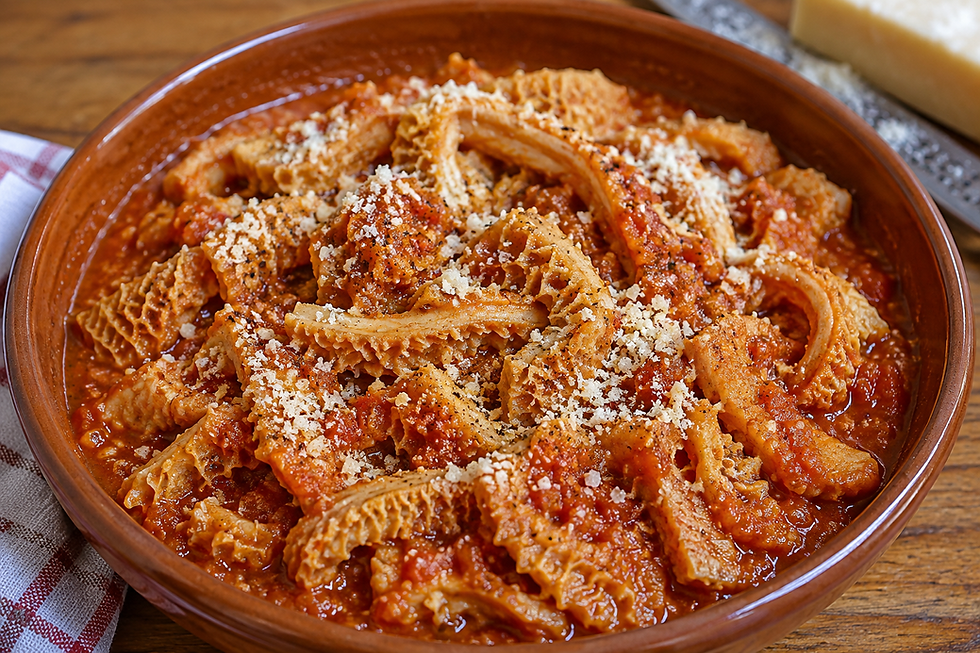
Trippa alla Fiorentina is what Tuscany does with the part of the animal nobody wanted. Beef tripe, cut into strips no wider than a pencil, goes into a slow tomato braise built on a plain soffritto and finished with grated Parmigiano off the heat. It costs almost nothing and takes a great deal of time, which is why it is worth keeping.
This is the trattoria version rather than the museum one. Red wine is reduced hard before the tomato goes in, with a little chilli, oregano and thyme instead of the bare tomato and cheese of the strictest Florentine reading. The wine gives the braise a darker depth that carries the cheese at the end.
Everything that goes wrong with tripe goes wrong in the first twenty minutes or the last twenty. Skip the acid prebolling and the pot smells of the stockyard. Let the braise boil instead of tremble and the strips turn rubbery. Stir the cheese in over a flame and it greases.
Yield: 4 main course servings. Prep: 30 minutes. Prebolling: 30 minutes. Braise: 2 hours 15 minutes. Rest: 20 minutes. Total: about 3 hours 35 minutes. Difficulty: intermediate. Course: secondo. Region: Tuscany, Florence.
The Story
Tripe belongs to what Italian butchers call the quinto quarto, the fifth quarter: everything left once the carcass has been divided into its four commercial parts. In the cities where the slaughterhouses stood, that fifth quarter was often the pay itself: butchers and slaughtermen took offal home instead of wages, and the cooking built around it became the cooking of those neighbourhoods. Rome is the clearest case, at Testaccio, where the Mattatoio opened in 1891 and the trattorie along its walls built whole menus on tail, lung, spleen and tripe. Trippa alla romana with mint and pecorino comes from there, for economic reasons before culinary ones.
Florence built the same tradition on the street. The trippai, the stalls that still stand at Sant Ambrogio and around the Mercato Centrale, have sold tripe and lampredotto for well over a century. Lampredotto, from the abomasum, is simmered in broth and served in a roll dipped in the cooking liquid, eaten standing up at eleven in the morning. Trippa alla fiorentina is its sit down relative: the same offal taken indoors and given tomato, soffritto and cheese. Milan went a third way with busecca, tripe cooked with borlotti beans, and made it such a fixture that Milanese were nicknamed busecconi.
There was even a day for it. In much of central Italy tripe was a Saturday dish, because animals killed at the end of the week gave offal that had to be eaten at once, and because Saturday cooking could absorb three hours on the stove. Trattorie in Florence still print trippa as the Saturday special, and what began as the cheapest plate of meat available is now a marker of identity.
Ingredients
For the tripe
Cleaned and blanched beef tripe, mixed cuffia and croce, 2 1/4 lb (1 kg)
White wine vinegar, 1/4 cup (60 ml)
Lemon, halved, 1
Bay leaves, 2
Coarse sea salt, 1 tbsp (18 g)
For the soffritto
Extra virgin olive oil, 1/4 cup (60 ml)
Yellow onion, finely chopped, 1 large, about 7 oz (200 g)
Carrot, finely chopped, 1 medium, about 3 oz (85 g)
Celery, finely chopped, 2 stalks, about 3 oz (85 g)
Garlic cloves, thinly sliced, 3
Pancetta, finely diced, 2 oz (55 g), optional
For the braise
Dry red wine, 1 cup (240 ml)
Canned peeled tomatoes, crushed by hand, 28 oz (800 g)
Tomato paste, 1 tbsp (17 g)
Light beef or chicken broth, hot, 3 cups (720 ml), plus more if needed
Dried oregano, 1 tsp (1 g)
Fresh thyme sprigs, 3
Crushed red pepper flakes, 1/2 tsp (1 g)
Fine sea salt, 1 1/2 tsp (9 g), plus more to taste
Freshly ground black pepper, to taste
For finishing
Parmigiano Reggiano, finely grated, 2 1/2 oz (70 g)
Flat leaf parsley, chopped, 2 tbsp (6 g)
Extra virgin olive oil, 1 tbsp (15 ml)
Crusty Tuscan bread or soft polenta, to serve
Preparation
Step 1
Wash the tripe and preboil it with acid. Italian tripe is sold already cleaned and blanched, but it still needs rinsing under cold running water, rubbing both surfaces, until the water runs clear. Look at what you have while you do it: honeycomb cuffia, smooth thick croce, the ribbed sheets of foiolo, the centopelli. Then cover it generously with cold water and add the vinegar, both lemon halves, the bay leaves and the coarse salt. Boil steadily for 30 minutes, skimming the grey foam. Nobody should skip this: the acid strips the barnyard smell that clings to even well cleaned tripe. Drain and cool.
Step 2
Trim and cut into strips. Lay each piece flat and cut away any white fat, the one part of tripe that never becomes pleasant however long it cooks. Cut the sheets into strips about 1/4 inch (6 mm) wide and 2 1/2 inches (6 cm) long, against the ribbing where you see one. Width matters: thinner strips dissolve into threads over two hours, wider ones stay chewy at the centre when the sauce is done.
Step 3
Build the soffritto and sweat the tripe. Warm the oil in a heavy Dutch oven over medium low heat and render the pancetta for 2 minutes if using. Add onion, carrot and celery with a pinch of salt and cook 12 to 15 minutes to complete softness, not colour. Add garlic and chilli for a minute, then the strips, and stir 5 minutes over higher heat until each is coated. Season with the fine salt and pepper now, because tripe absorbs salt slowly.
Step 4
Reduce the wine, then cook the tomato. Pour in the wine and let it bubble until the alcohol smell is gone and it has reduced by two thirds, 6 to 8 minutes, scraping the base. Wine left half reduced sits sour under the tomato for the whole braise. Stir in the tomato paste for a minute, then the tomatoes, oregano and thyme, and cook uncovered 10 minutes until the tomato darkens, since once the pot is full of broth it can no longer concentrate.
Step 5
Braise low, adding broth by the ladle. Add about 1 cup (240 ml) of hot broth, bring to the barest simmer, then lower the heat until the surface only trembles. Cover partly and cook 2 hours, adding a ladle of hot broth every 20 to 25 minutes whenever the level drops below the tripe. Never let it boil hard: a boil squeezes water out of the strips, while a trembling simmer turns collagen into gelatin and thickens the sauce.
Step 6
Check the mordente, reduce, finish off the heat. At 2 hours taste a strip: it should cut with the side of a spoon and still resist faintly at the centre. If tough, add broth and continue in 15 minute stretches. Then reduce uncovered 10 to 15 minutes until the sauce coats the strips. Remove the thyme, correct the salt, take the pot off the stove, wait a minute and stir in the Parmigiano in two additions, then the parsley and the last olive oil. Rest 20 minutes.
Plating
Serve it in warm shallow bowls, never flat plates, since the sauce is loose and the dish depends on eating strips and sauce in the same spoonful. Warm the bowls to around 140°F (60°C): tripe holds its heat badly once it leaves the pot.
Ladle about 1 1/2 cups (360 ml) per person, lifting from the bottom so each portion gets strips rather than sauce alone. Add a light scattering of Parmigiano, a little parsley and a thread of raw olive oil. Do not bury it in cheese at the table: the braise already carries 2 1/2 oz (70 g).
Bread is the traditional accompaniment and the better one, a thick slice of unsalted Tuscan bread, grilled. Soft polenta suits a winter table, spooned in first with the tripe over it.
Professional Technique
The technical spine of this version is the red wine reduction, the one stage that sets it apart from the plain tomato and cheese Florentine braise. A cup of dry red taken down to a third leaves glycerol, colour and concentrated fruit acids that give the sauce a darker register beneath the tomato. That matters later: Parmigiano stirred into a purely tomato base tastes of salt against acid, while the same cheese over a wine reduced base reads as savoury depth.
The second point is that liquid goes in here in three deliberate stages rather than one. Wine first, reduced hard; tomato second, uncovered so it concentrates while it still can; broth third and only by the ladle. Pour all the broth in at the start, as most home versions do, and you end up with tripe suspended in thin tomato water. Small increments keep the level just at the tripe, where the sauce thickens throughout the cooking instead of only at the end.
The third is the finishing temperature. Parmigiano is roughly a third fat, held in a protein matrix that breaks above about 175°F (80°C), which is why cheese stirred into a live simmer strings, splits and leaves an oily film. Off the heat for a minute the surface drops below that threshold, and adding the cheese in two additions lets the first melt into the gelatin and emulsify the second.
Texture and Moisture Control
Tripe is almost pure connective tissue, so texture is entirely a question of what happens to its collagen. Below about 160°F (71°C) very little changes however long you wait. Held between roughly 180°F and 195°F (82°C to 90°C) it hydrolyses steadily into gelatin, which is why the target is a trembling surface. A hard boil contracts the fibres between the collagen sheets and forces water out, so the strips finish overcooked and dry at once.
The texture to aim for is soft with a residual bite, what Italians call mordente: yielding to the side of a spoon, with a faint resistance at the centre. That window is perhaps twenty minutes wide, since past about 2 hours 45 minutes the strips begin to shred. The four stomach cuts reach it at slightly different times, which is why a mixture beats a single cut. Cuffia and croce keep more structure, while foiolo softens first and gives body to the sauce.
The gelatin released over two hours is also the thickener, so the sauce needs no flour. It sets further as it cools, and a sauce that looked perfect in the pot can be almost solid the next day. That is a correct braise, not a fault.
Professional Mise en Place
This is a braise, so almost all of it is done in advance and service is only reheating and finishing. In a professional kitchen the tripe is prebolled, cut and braised a day ahead.
Equipment and tools
Large stockpot for the acid prebolling, at least 8 quarts (7.5 litres)
Heavy bottomed Dutch oven with a lid, 6 quarts (5.7 litres)
Sharp thin bladed knife and a large board for the strips
Small saucepan to keep the broth hot, a ladle, a fine grater, warm shallow bowls
Prepared ahead
Tripe washed, prebolled and cut into strips, up to 1 day ahead, refrigerated
Soffritto vegetables chopped fine and held covered, up to 1 day ahead
The whole braise cooked to the doneness point but without cheese, up to 3 days ahead
Broth measured ready to heat, tomatoes crushed by hand, Parmigiano grated on the day only
Service setup
Braise reheating slowly over low heat, covered, loosened with hot broth as needed
Bowls warming, bread ready to grill or polenta held soft over a bain marie
Cheese, parsley and finishing oil within reach
Cheese stirred in only once the pot is off the heat, portion by portion if service is long
Chef Tips
Buy a mixture of cuts and ask the butcher what is in the bag. Unlabelled tripe is usually mostly cuffia, the best single cut but monotonous alone. Some croce and a little foiolo gives three textures instead of one and costs no more.
Never trust the label that says ready to cook and skip the prebolling. Commercially cleaned tripe is pale and safe but still carries the faint ammoniac smell that puts people off the dish for life, and 30 minutes with vinegar, lemon and bay removes it completely.
Cook it the day before you want to eat it. The gelatin sets overnight, the salt distributes into the strips, wine and tomato settle into each other. Stop before the cheese, refrigerate, then reheat gently and finish with Parmigiano off the heat on the day.
Keep a jug of hot broth going and taste the sauce every time you add a ladle. Tripe gives very little of its own flavour to the liquid compared with a bone in braise, so a bland broth gives a bland trippa however long it cooks.
Common Mistakes
Skipping the acid prebolling. Thirty minutes with vinegar, lemon and bay is the difference between tripe that tastes clean and tripe that tastes of the slaughterhouse. Diners who say they dislike tripe are usually describing a dish that skipped this step.
Letting the braise boil. A rolling boil forces water out of the fibres while the collagen is still converting, giving tripe that is rubbery and dry at once. Keep the surface trembling, a bubble breaking every few seconds, for the full two hours.
Adding all the broth at the start. The tomato then never concentrates and the sauce stays thin and raw tasting. Cook the tomato uncovered for 10 minutes first, then add hot broth a ladle at a time.
Stirring the Parmigiano into a simmering pot. The cheese proteins break above about 175°F (80°C) and the fat separates into an oily film with strings through it. Take the pot off the heat, wait a minute, then add the cheese in two additions.
Wine Pairing
Chianti Classico DOCG: The regional answer and the most reliable one. Sangiovese from these hills has high acidity and only medium body, so it meets the tomato on level terms instead of being flattened by it, and its tannin is fine grained rather than gripping. That matters, because a heavily tannic wine clashes with the gelatin and leaves a drying feel behind.
Chianti Rufina DOCG: From the cooler hills northeast of Florence, and the sharper of the two Chianti. Rufina ripens later and keeps even more acidity, with a leaner profile and a faint iron note that suits offal well. Its cut refreshes the palate between spoonfuls of a braise carrying both olive oil and Parmigiano.
Barbera d'Asti DOCG: The classic high acid, low tannin Italian red, close to the ideal specification here. Barbera gives dark cherry fruit and enough freshness to cut the cheese and the rendered pancetta, while its modest tannin leaves the soft gelatinous texture of the tripe untouched. Choose a bottling without heavy oak.
Valpolicella Classico DOC: The lightest bodied wine here and the right call for a smaller portion. Corvina brings sour cherry acidity and an almost bitter almond finish that echoes the oregano and thyme, with very little tannic weight to interfere. Serve it cool, around 57°F (14°C). The Ripasso is too concentrated for this.
Rosso di Montalcino DOC: Where the braise has been made with pancetta and reduced well, this adds structure without tipping over. Sangiovese again but grown warmer, with riper fruit and slightly softer acidity, and the extra mid palate weight stands up to the wine reduction. Avoid Brunello alongside tripe: the tannin and the oak are more than the dish can carry.
Storage & Reheating
This keeps better than almost any other secondo and improves in the refrigerator. Cool it within two hours, transfer it to an airtight glass or ceramic container, press the surface flat so the sauce covers the strips, and refrigerate up to 4 days, without the finishing cheese and parsley.
It freezes well too, again before the cheese goes in. Portion it into flat containers, leave half an inch of headspace because the sauce expands, and freeze up to 3 months. Thaw overnight in the refrigerator, never in a microwave.
Reheat on the stove over low heat, covered, adding hot broth a spoonful at a time until the sauce loosens. It needs about 15 minutes from cold and must not boil, which would tighten the strips that two hours of care made tender. Once hot, take it off the heat and only then stir in fresh Parmigiano, parsley and raw oil. Reheat once only.
Nutrition
Per serving, based on 4 main course portions:
Calories: 480 kcal
Total Fat: 27 g
Saturated Fat: 8 g
Trans Fat: 0 g
Unsaturated Fat: 17 g
Cholesterol: 195 mg
Sodium: 1150 mg
Total Carbohydrates: 18 g
Fiber: 4 g
Total Sugars: 10 g
Added Sugars: 0 g
Protein: 38 g
Lactose: 0.5 g
Principal micronutrients: vitamin B12, selenium, zinc, calcium, phosphorus, potassium, vitamin A
These figures are estimates. Tripe itself is very lean and high in protein, and most of the fat comes from the olive oil, the optional pancetta and the Parmigiano, so leaving out the pancetta cuts both fat and sodium. The bread or polenta alongside is not included.




Comments