
Piedmontese Tapulon with Polenta | Tapulon di Borgomanero con Polenta
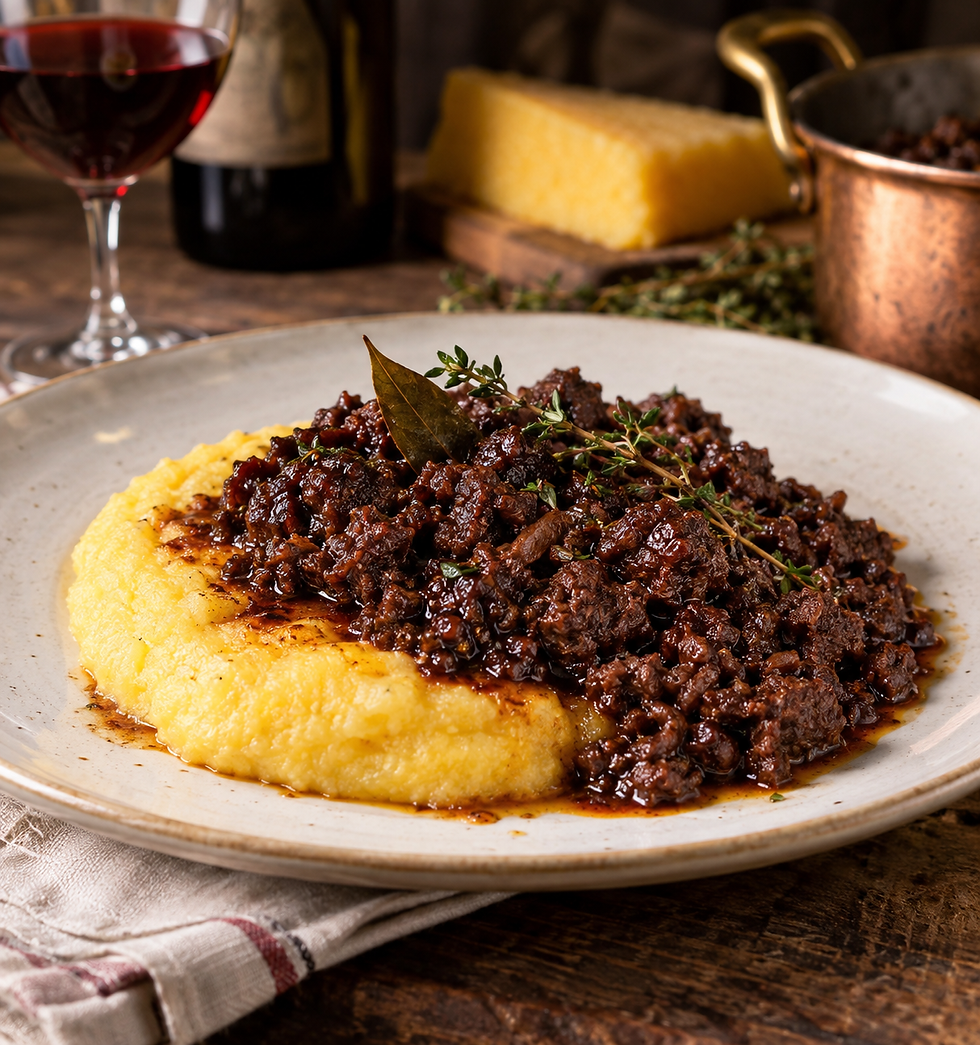
Tapulon belongs to Borgomanero, a town in the province of Novara where a plate of finely chopped meat braised in red wine has been the local signature for eight centuries. It is not a ragù and it is not a stew.
The meat is chopped with a knife and never ground, and the wine is not a splash for deglazing but the whole cooking liquid. What reaches the table beside the polenta is dark, concentrated and savoury enough to need nothing else.
Yield: 4 main course servings. Prep: 45 minutes. Cook: 1 hour 45 minutes. Total: about 2 hours 30 minutes. Difficulty: intermediate. Course: secondo. Region: Piedmont, Borgomanero and the Novara hills.
The Story
Borgomanero was founded in 1194, when Novara planted a fortified settlement on the road toward the Lake Orta valleys and gave land to the families willing to move there. The town tells the story of tapulon as part of that founding: the settlers, having arrived with nothing, killed the donkey that had carried their belongings, chopped the meat down with their knives because there was little of it and it had to feed many, and cooked it in red wine over an open fire. Whether or not a single donkey started it, the name is dialect and it is literal. In the Piedmontese of the Novara plain, tapulè means to chop finely with a blade, and the dish is named after the action rather than the animal.
The economy behind it is easy to read. A donkey on a smallholding in the hills above Novara was a working animal first, hauling wine, timber and fodder along tracks no cart could take, and it went into the pot only at the end of a long life. That meat is lean, dark and tough, closed in connective tissue, and no quick method does anything with it. Chopping it small shortened the work and stretched it further, and the wine the farm already had in the cellar was the obvious liquid because water would have given nothing back. This is recovery cooking in the strict sense, built on the one ingredient nobody would have chosen.
Polenta is the other half, and it is not a modern addition. Maize reached the Novara countryside in the seventeenth century and became the daily meal of the rural poor across the whole of northern Piedmont, so a concentrated meat braise served in small quantity beside a large plate of polenta was simply how the two were eaten. Borgomanero never lost the dish. A local confraternity has looked after the recipe since the early 1970s, the trattorie of the old centre still list it, and the town devotes a festival to it, which is why a peasant braise made from a retired pack animal is now served with some ceremony.
Ingredients
For the tapulon
Donkey meat, shoulder or leg, trimmed, 1 3/4 lb (800 g)
Dry red wine, Nebbiolo or Barbera, 3 cups (720 ml)
Pork lard or unsalted butter, 2 oz (55 g)
Yellow onion, very finely chopped, 1 medium, 5 oz (140 g)
Garlic cloves, finely chopped, 3
Fresh rosemary, chopped, 1 tbsp (3 g)
Fresh sage leaves, 6
Bay leaves, 2
Whole cloves, 2
Grated nutmeg, 1/4 tsp (0.5 g)
Fine sea salt, 1 1/2 tsp (9 g)
Freshly ground black pepper, 1 tsp (2 g)
Beef or veal stock, warm, 1 cup (240 ml), if needed
For the polenta
Coarse stone ground yellow polenta, 1 1/2 cups (240 g)
Water, 6 cups (1.4 litres)
Fine sea salt, 2 tsp (12 g)
Unsalted butter, 2 tbsp (28 g)
For finishing
Extra virgin olive oil, 1 tbsp (15 ml)
Flat leaf parsley, chopped, 1 tsp
Freshly ground black pepper, to taste
Preparation
Chop the meat by hand
Trim the shoulder or leg of silverskin and hard external fat, cut it into strips about 1/2 inch (1 cm) wide and chill them for 20 minutes so the meat firms up and the blade does not drag. Work on a large board with a heavy knife and chop across the strips until the pieces are roughly 1/8 inch (3 mm). Stop there. You want visible grains of meat, not a paste. Never use a processor or a mincer.
Build the aromatic base
Melt the lard or butter in a wide heavy pan over low heat, add the onion with a pinch of salt and cook it gently for 12 to 15 minutes, stirring, until completely soft and pale gold. It must not colour beyond that: the braise takes its darkness from the wine, and scorched onion reads as bitterness at the end. Add the garlic, rosemary and sage for a further 2 minutes.
Seal the chopped meat
Raise the heat to medium, add the meat and break it apart at once with a wooden spoon so it does not set in a single mass. Cook for 6 to 8 minutes, stirring, until the surface has lost its raw red and turned uniformly brown. You are not chasing a crust, which is impossible on meat cut this small without welding it together, only starting the fond on the base of the pan.
Add the wine and set the braise
Pour in the wine all at once, enough to cover the meat by about half an inch, and scrape the base clean as it comes up to heat. Add the bay, cloves, nutmeg, salt and pepper. Let it boil openly for 3 or 4 minutes so the sharpest volatile alcohol leaves, then drop the heat until the surface only trembles. Set the lid slightly ajar.
Simmer for an hour and a half
Cook at that bare simmer for 90 minutes, stirring every 20 minutes and scraping the corners. The meat loosens, the liquid darkens and thickens, and the volume falls by about half. If it tightens before the meat is tender, add warm stock a quarter cup at a time, never cold water, which would seize the meat and dull the wine. It is ready when the juices coat the meat rather than pool around it.
Cook the polenta
Start the polenta 50 minutes before the braise is due. Bring the water to a boil with the salt, then rain the meal in through your fingers while whisking steadily so no lumps form. As soon as it thickens, switch to a wooden spoon, drop the heat to its lowest setting and cook for 40 to 45 minutes, stirring often and reaching into the corners. Beat in the butter at the end. It should fall thickly from the spoon.
Rest and correct
Take the pan off the heat, remove the bay leaves and cloves, and let the tapulon stand covered for 10 minutes. The juices settle and thicken in that time and the seasoning changes with them, so taste only now: correct the salt, grind in more pepper and stir in the olive oil for gloss. If it looks dry, loosen it with two tablespoons of warm stock off the heat.
Plating
Serve on warm plates, never hot ones. Polenta holds heat for a long time and a plate from the oven keeps cooking the surface and sets a skin on it before the dish reaches the table. Warm them to hand temperature and no more.
Spoon a generous bed of polenta slightly off centre and let it settle into its own shape rather than pushing it flat. Set the tapulon against it in a compact spoonful, so the two touch along an edge but the polenta stays visibly yellow beside the dark meat. The proportion is the point in Borgomanero: more polenta than meat, always.
Pull the remaining juices over the meat only, never over the polenta, which would turn grey and lose its own flavour. Finish with a little chopped parsley and a last grind of pepper. Nothing else belongs here: no cheese, no oil over the polenta, no garnish. A spoon and a fork are the correct service.
Professional Technique
The knife is the whole technique, and it is not nostalgia. A mincer works by crushing and extruding: the meat is forced through a plate, cells rupture, juices are pressed out before cooking begins, and what emerges is a paste whose fibres are already broken down. Chopping cuts instead of crushing. Each stroke severs the fibre and leaves the piece otherwise intact, so the grain survives 90 minutes of braising and the tapulon still reads as meat under the teeth. One pass through a grinder loses that permanently.
The second consequence of chopping is geometry. Hand cut pieces are irregular and of different sizes, so they cannot pack down the way extruded mince does. Ground meat compresses into a dense bed that the wine sits on top of and wets only at the surface. A battuto keeps thousands of small gaps and rough cut faces between the pieces, and that uneven surface draws the wine in by capillary action and holds it. Colour, acidity and aromatics travel through the whole mass, which is why the meat tastes of wine at the end and not merely of the sauce around it.
Then there is the wine, and here tapulon breaks the rule that governs almost every other braise. It is not a deglaze and not a quarter of the liquid: it is the entire cooking medium, three cups against under two pounds of meat, and it stays in the pan for the full hour and a half. That length of time is what makes it work. The alcohol is gone within 15 or 20 minutes, carrying the harsh volatile notes with it, and what remains is acid, glycerol, colour and tannin. Those tannins bind to the meat proteins and the gelatin, and their astringent grip softens into body.
Texture and Moisture Control
Donkey meat is leaner than beef and carries almost no marbling, so none of the moisture in the finished dish comes from melting fat. It comes from two places: the wine still in the pan, and the collagen converting to gelatin. That conversion begins in earnest around 160°F (71°C) and needs time rather than heat, which is why the simmer must stay bare. At a rolling boil the fibres contract hard and squeeze out what little juice they hold, and nothing brings it back.
The finished consistency is specific: the juices should coat the meat and cling to the back of a spoon, never flood the plate and never disappear. Judge it in the last 20 minutes, lid off if it needs concentrating. A dry tapulon is the commoner failure and the harder to fix, since stock added late thins the flavour, while a loose one needs only a few minutes uncovered.
The polenta has its own rules. Coarse stone ground meal needs 40 minutes and roughly six parts water to one of meal to gelatinize fully, and shortcuts show up as a gritty centre. Stir often enough that it never catches, and keep it looser than looks right, because it sets further in the pot and again on the plate.
Professional Mise en Place
This is a two part service with a long unattended middle, so the only timing question is the polenta, started 50 minutes before the braise comes off the heat.
Equipment and tools
Large heavy chopping board and a well sharpened heavy knife, or a pair of them
Wide heavy based braising pan with a lid, about 10 inches (26 cm)
Thick bottomed pot for the polenta, plus a whisk and a long wooden spoon
Bain marie or a second pan of hot water for holding the polenta
Prepared ahead
Meat trimmed, cut into strips and chilled, the day before
Meat chopped, up to 4 hours ahead, kept covered and refrigerated
Onion, garlic and herbs chopped and held separately
Braise cooked entirely, up to 2 days ahead, since it improves overnight
Service setup
Polenta started 50 minutes out, held loose over hot water
Braise at a bare simmer, lid ajar, warm stock within reach
Plates warm to the hand, never hot from the oven
Parsley, olive oil and the pepper mill beside the stove
Chef Tips
Order the meat from a butcher who handles equine properly and ask for shoulder or leg, never anything from the loin. The lean working muscle is the right cut precisely because it is full of collagen, and it rewards a long braise in a way a tender cut cannot.
If donkey is unavailable, horse meat substitutes with no change at all. Failing that, use lean beef chuck and shorten the simmer to about 70 minutes. Say what you have made: it is a beef tapulon, and it tastes sweeter and rounder than the original.
Use a young wine you would actually drink. The three cups in this pan reduce to a glass and a half of finished sauce, so everything wrong with a tired bottle arrives concentrated at the table. Anything oxidized is unusable.
Cook it the day before if you can. Tapulon is measurably better after a night in the refrigerator, because the gelatin sets and redistributes and the tannins finish integrating. Rewarm it gently with a spoonful of stock and make the polenta fresh.
Common Mistakes
Using a mincer or a food processor. It crushes the fibres and presses the juices out before cooking, and the result braises into ragù. The knife is the reason the meat stays perceptible after 90 minutes.
Boiling instead of simmering. A rolling boil contracts the lean fibres and drives out the little moisture they hold, leaving the meat dry and grainy while the sauce reduces too fast. Keep the surface barely moving throughout.
Cutting the wine with water or stock from the start. The wine is the cooking medium and the quantity is deliberate. Diluting it at the outset gives a pale, thin braise that never develops depth or colour. Stock belongs here only as a correction near the end.
Browning the onion. Colour taken on the onion turns bitter over an hour and a half in an acidic liquid and cannot be removed later. Sweat it soft and pale gold over low heat, nothing further.
Rushing the polenta. Coarse meal given 15 minutes is gritty in the middle however smooth it looks, and instant polenta gives a slack, flavourless bed. Give it the full 40 minutes.
Wine Pairing
Ghemme DOCG: The wine of the same hills, grown a few miles from Borgomanero on the Novara side of the Sesia, and the pairing the dish was built around. Nebbiolo here is firm and high in acidity, with rose and tar aromas and a fine insistent tannin that meets the gelatin in the braise and turns silky against it. Its brightness lifts a deliberately dark, savoury plate.
Gattinara DOCG: Nebbiolo from the volcanic porphyry on the opposite bank, more mineral and austere than Ghemme, with a smoky iron note that runs alongside the long reduced wine in the pan. Its drier tannin wants the fat of the lard and the sweetness of the polenta to soften it, which is what this plate provides.
Barbera d'Asti DOCG: The everyday choice, and a good one if Barbera was also the wine in the pan. Very high acidity, dark cherry fruit and almost no tannin, so it cuts the richness without adding astringency to a braise that already carries plenty. Serve it cool, around 61°F (16°C).
Nebbiolo d'Alba DOC: The lighter framed reading of the same grape, from the Langhe rather than the north. Less tannic grip and more red fruit, which suits a tapulon made with beef or served in a smaller portion, yet still enough structure to stand up to the concentrated juices.
Valtellina Superiore DOCG: Alpine nebbiolo from terraced granite across the Lombard border, leaner and more herbal than the Piedmontese versions, with a dusty tannin and a sage and dried flower character that echoes the herbs in the braise. A good bottle holds its line against an hour and a half of reduced wine.
Storage & Reheating
The braise keeps in an airtight container in the refrigerator for 4 days and is better on the second day than the first, which is worth planning around. Cool it uncovered to room temperature, cover it only then, and use the smallest container it fits so little surface is exposed to air.
Rewarm it covered over low heat with two tablespoons of warm stock, stirring occasionally, and stop as soon as it is hot through. Never microwave lean chopped meat: uneven heating tightens the fibres in patches and the texture goes stringy. It freezes well for 3 months and should be thawed overnight in the refrigerator.
Polenta does not reheat as polenta, so make it fresh. Leftovers set firm within a couple of hours, and the correct use for that block is to cut it into slabs and grill or pan fry them the next day, as the Novara kitchens have always done, with the rewarmed tapulon on top.
Nutrition
Per serving, based on 4 main course portions:
Calories: 610 kcal
Total Fat: 22 g
Saturated Fat: 10 g
Trans Fat: 0 g
Unsaturated Fat: 11 g
Cholesterol: 125 mg
Sodium: 780 mg
Total Carbohydrates: 55 g
Fiber: 4 g
Total Sugars: 3 g
Added Sugars: 0 g
Protein: 46 g
Lactose: 0.3 g
Principal micronutrients: iron, zinc, selenium, vitamin B12, niacin, phosphorus, potassium
These figures are estimates. Most of the alcohol and a good deal of the wine volume cook away, and the sodium depends on the stock used.


Comments