
Italian Leek and Turin Breadstick Flan | Sformato di Porri e Grissini Torinesi

A sformato is a savory custard that keeps its shape, and this one lets the leek do the talking. Sweet leeks are stewed slowly in butter, folded into eggs, cream and Parmigiano Reggiano, and thickened with crumbled Turin grissini instead of flour. It bakes gently in a water bath and turns out whole, tender at the edges and silky at the center.
Yield: 6 servings. Prep: 30 minutes. Cook: 1 hour 15 minutes. Rest: 15 minutes. Course: antipasto or light main course. Region: Piedmont.
The Story
The sformato belongs to the Piedmontese antipasto, the long opening parade of small dishes that once marked a proper Sunday table in Turin and the Langhe. The name means unmolded, and its lineage runs through the Savoy court, whose kitchens spoke French for two centuries and left Piedmont with flans, timbales and vegetable custards baked in buttered molds. What began as court cooking moved down into the trattorie and farmhouse kitchens, where a few leeks, some eggs and the end of the cheese became a dish that looked far grander than its cost.
The leek has its own Piedmontese pedigree. The porro di Cervere, from the plain near Cuneo, is grown deep in sandy soil and earthed up until its white shaft is long, tender and almost sweet, and it is protected as a Slow Food Presidio. Piedmontese cooks have always treated it as a vegetable for the pot and the oven rather than a simple flavoring, stewing it in butter until it collapses into something closer to a confit than a salad.
The grissini give the dish its Turin signature. Tradition says the breadstick was born in 1679, when the baker Antonio Brunero of Lanzo Torinese was asked to make a lighter, drier bread for the sickly young Duke Vittorio Amedeo II, on the advice of the court physician. The stretched, thin rods, called rubatà, baked hard and stayed light, and Napoleon is said to have been so fond of them that he had them sent to him in Paris. In this sformato they return to their original job, which is to be dry, and to drink up whatever water the leeks leave behind.
Piedmont has sformati for almost every vegetable of the season: cardoons in winter, peppers and zucchini in summer, spinach and chard whenever the garden allows. The leek version is the quiet one, gentler than the peppers and sweeter than the cardoon, and it suits the cold months when the porri come out of the ground. Nobody in Turin thinks twice about breaking a grissino into a soup or a custard. Dry bread has never been waste in this cooking, it is an ingredient, and that habit of putting the bread basket to work is the same thrift that built the whole antipasto tradition. This recipe keeps that thrift and adds precision.
Ingredients
Choose leeks of similar thickness, about 1 inch (2.5 cm) across, so they stew evenly. Use dry, brittle grissini and full fat cream, because low fat cream changes the egg to liquid ratio.
For the leeks
Leeks, white and light green parts, cleaned, 2 lb (900 g)
Unsalted butter, 2 tbsp (30 g)
Extra virgin olive oil, 1 tbsp (15 ml)
Fine sea salt, 3/4 tsp (4 g)
Dry white wine, 2 tbsp (30 ml)
Fresh thyme leaves, 1 tsp (2 g)
For the custard
Large eggs, 4 (200 g)
Egg yolk, 1 (18 g)
Heavy cream, 3/4 cup (180 ml)
Whole milk, 1/2 cup (120 ml)
Parmigiano Reggiano, finely grated, 2 oz (55 g)
Turin grissini, crumbled, 2 oz (55 g)
Freshly grated nutmeg, 1/8 tsp
Freshly ground white pepper, to taste
For the molds and finishing
Soft butter, for six 6 oz (180 ml) ramekins, 1 tbsp (15 g)
Turin grissini, finely crushed, 1/2 oz (15 g)
Unsalted butter, for browning, 2 tbsp (30 g)
Fresh sage leaves, 6
Parmigiano Reggiano shavings, 1 oz (30 g)
Whole grissini, 6, for serving
Chives, finely cut, 1 tbsp (3 g)
Flaky sea salt, 1 pinch
Freshly ground black pepper, for finishing
Hot water, for the water bath, about 4 cups (950 ml)
Preparation
Step 1

Clean the leeks. Trim the roots and the dark green tops, keeping the white and light green parts. Slice each leek in half lengthwise, fan the layers under cold running water to wash out the sand hidden between them, then cut into thin half moons about 1/4 inch (6 mm) thick. Thin slices collapse faster and give up their water evenly.
Step 2

Stew the leeks until they stop steaming. Melt the butter with the olive oil in a wide heavy pan over medium low heat. Add the leeks and the salt and cover the pan for the first 10 minutes so they wilt in their own moisture. Then remove the lid, add the wine and keep cooking for 15 to 20 minutes, stirring often. The leeks are ready only when they are soft, pale gold and no longer release visible steam when you lift the spoon. If steam still rises, keep going. Add the thyme in the last 2 minutes.
Step 3

Squeeze and cool the leeks. Tip the leeks into a fine mesh sieve and press hard with the back of a ladle, then wrap them in a clean kitchen towel and squeeze until no more liquid comes out. You should end with about 9 oz (250 g) of leek pulp. Spread it on a plate and let it cool to room temperature, so it does not start to cook the eggs on contact.
Step 4

Prepare the molds and the oven. Heat the oven to 325°F (165°C) and put a kettle of water on to boil. Brush the six ramekins generously with soft butter, then roll the crushed grissini around the inside of each one so the crumbs coat the butter, tapping out the excess. Set the ramekins in a deep roasting pan lined with a folded kitchen towel. The towel keeps the dish from sliding and protects the ceramic.
Step 5

Mix the custard. Whisk the eggs and the yolk with the cream and milk just until blended, without making foam. Stir in the Parmigiano, the nutmeg, a little white pepper and the crumbled grissini, and let the mixture stand for 5 minutes while the crumbs soften. Fold in the cooled leeks, then poach a spoonful in simmering water for 2 minutes, taste it and correct the salt, remembering that the cheese is already salty. Do not whisk vigorously, because air bubbles turn to holes in the finished custard.
Step 6

Fill and bake in a water bath. Divide the mixture among the ramekins, filling them about three quarters full. Pour hot water into the roasting pan until it reaches halfway up the sides of the ramekins, then slide the pan into the oven. Bake for 30 to 35 minutes, until the surface is set and pale gold and the centers show only a slight tremble. The custard should reach 175°F (80°C) at the center.
Step 7
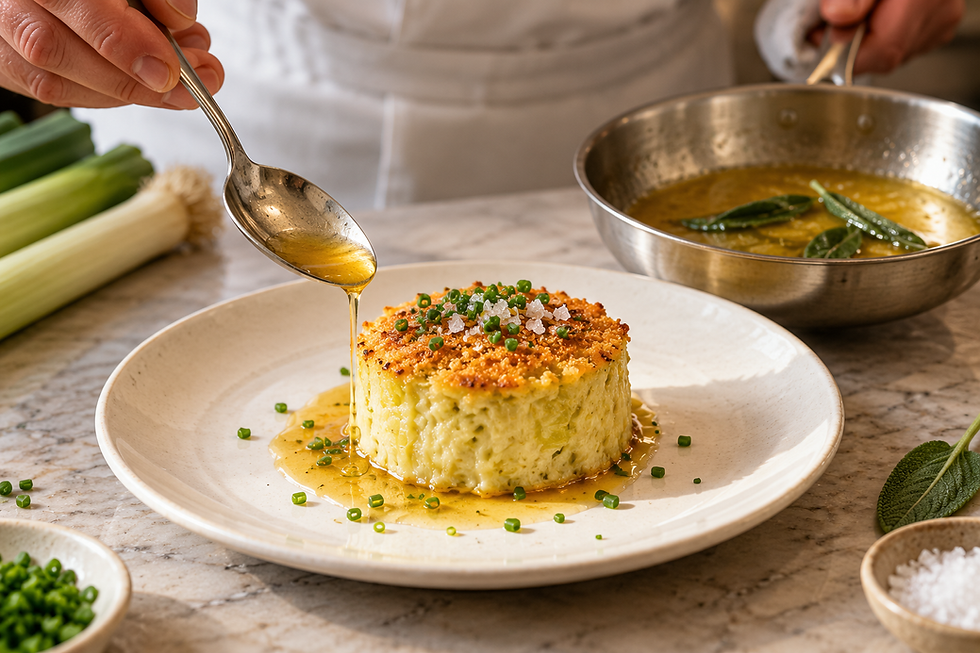
Rest, unmold and brown the butter. Lift the ramekins out of the water and let them rest for 15 minutes on a rack. Run a thin knife around each edge, invert onto a warm plate and give one firm tap. While they rest, melt the butter in a small pan over medium heat until it smells of hazelnut, add the sage leaves for 20 seconds and spoon it around each sformato. Finish with the chives and a pinch of flaky salt and serve at once.
Plating
Serve the sformati warm, not hot, on warm plates, about 15 minutes after they leave the oven. Set one in the center of each plate with its golden grissini crust facing up. Spoon the sage butter around it in a thin pool and lay a few Parmigiano shavings on top, where the residual heat softens them slightly.
Lean a whole grissino against the side so the guest can break it into the custard, and let the crunch and the cream meet at the table. The sage butter is all the sauce this dish needs, and the plate should stay quiet, pale gold and green. Finish with chives and a little black pepper, and keep the plate warm but never hot.
Professional Technique
The whole recipe turns on the ratio between egg and liquid. Egg proteins are the only thing that sets a sformato, and they can hold only so much liquid before the structure gives way. Here the eggs weigh about 8 oz (218 g) against 10 fl oz (300 ml) of cream and milk, roughly 1 part egg to 1.4 parts dairy by weight, or one egg for every 1/3 cup (70 ml). A soft custard for the spoon runs closer to one egg per 1/2 cup (120 ml). Go looser than that here and the sformato slumps the moment it is unmolded.
The leeks are the hidden variable. They are about 90 percent water, and every tablespoon that reaches the bowl is extra liquid that quietly lowers the ratio, so the center stays wet even when the surface looks done. That is why the leeks are stewed until steam stops, squeezed in a sieve and a towel, and cooled before they touch the eggs. The crumbled grissini are the safety net: dry, porous and starchy, they absorb the last of the water and swell, binding it into the structure instead of letting it weep.
The knife test confirms the set. Slide a thin knife into the center of one ramekin and pull it out. A clean blade, warm at the tip and free of wet, cloudy streaks, means the proteins have set. A blade coated with liquid egg means 5 more minutes. Then comes the rest. Coagulated protein keeps tightening as it cools, and 15 minutes lets the center finish setting on residual heat, so the sformato slides out whole instead of collapsing on the plate.
Texture and Moisture Control
The target is a custard firm enough to hold its edge yet still creamy on the tongue, and heat is the control. The water bath keeps the outer layer of custard near the temperature of the hot water, well below the oven's 325°F (165°C), so the eggs set slowly from the outside in. Bake hotter, or without the water, and the proteins tighten, squeeze out liquid and leave a rubbery sponge with a watery puddle at the bottom.
The buttered grissini crust does two jobs. It gives the unmolded surface a thin toasty edge against the soft interior, and it helps the sformato release cleanly. Keep the crumbs fine and fully coated in butter, because dry crumbs will not stick and coarse pieces turn into pebbles. Grate the Parmigiano finely so it melts into the custard instead of forming strings, adding salt, savory depth and a creamy feel.
A sformato straight from the oven is fragile and steamy. Fifteen minutes later it is at its best, warm, sliceable and still moist, and the sage butter adds a shine and a nutty note that the mild leek welcomes.
Professional Mise en Place
Almost everything is done ahead, so service is only a matter of unmolding and browning the butter. Work in this order, and keep the oven rack in the lower middle position so the ramekins sit away from the top element.
Equipment and tools
Six 6 oz (180 ml) ramekins and a deep roasting pan
Wide heavy pan for stewing, fine mesh sieve, clean kitchen towel
Thin paring knife for the knife test, small saucepan for the butter
Kettle of hot water ready for the bath
Prepared ahead
Leeks stewed, squeezed and cooled, up to 1 day ahead, refrigerated
Ramekins buttered and crumbed, up to 4 hours ahead, kept cool
Grissini crumbled and Parmigiano grated, in separate bowls
Custard mixed and chilled up to 1 hour before baking
Service setup
Sformati baked 30 minutes before service and rested in their warm water bath
Plates warmed, whole grissini and shavings within reach
Sage butter browned à la minute, while the first sformato is unmolded
Chives cut, pepper mill and flaky salt on the pass
Spare ramekin of custard baked as a tester, if the oven is unfamiliar
Chef Tips
Wash the leeks twice. Sand hides between the layers, and a single grain in a silky custard is the one thing a guest will remember. Fan the halves under running water, then rinse the cut pieces once more in a bowl of cold water and lift them out, leaving the grit behind. Drain them well before they go in the pan.
Choose crisp, thin, hand stretched grissini, the rubatà kind, with little fat. Soft supermarket sticks made with plenty of oil turn pasty and absorb less. If you only have thick ones, crush them in a bag with a rolling pin.
Poach a spoonful of the raw mixture before filling the molds. Cooked, the seasoning shows itself, and it is the only way to salt a custard accurately. A pinch of salt more or less shows immediately, while the baked sformato cannot be corrected.
If a sformato sticks, dip the ramekin in hot water for 10 seconds before running the knife around the edge. Never use a metal spoon to pry it loose, which scars the crust and tears the custard.
Common Mistakes
Cutting the stewing short. Leeks still bright green keep their water and a raw, sulfurous bite. Cook them until pale, soft and silent. Ten minutes more in the pan costs nothing and saves the dish.
Skipping the squeeze. Even well stewed leeks hold liquid in their fibers, which thins the custard and leaves the center wet. Squeeze until the towel comes away dry.
Baking without the water bath. Direct heat tightens the eggs at the edges before the center sets, giving a rubbery, weeping sformato. The towel under the ramekins also softens the heat from the pan floor.
Whisking in air. Foam puffs in the oven, then collapses and leaves holes and a spongy crumb.
Unmolding straight from the oven. The custard is still setting, so it tears or slumps. Give it the full 15 minutes.
Overbaking until nothing moves. Residual heat finishes the set, so a center that is perfectly still in the oven ends up dry and rubbery on the plate. Pull it while it still trembles slightly.
Adding warm leeks to the eggs. Leeks that are still warm start to cook the eggs on contact and leave scrambled threads in the custard. Cool them fully first.
Wine Pairing
Erbaluce di Caluso DOCG: The Piedmontese answer to a buttery custard. Grown around Caluso, north of Turin, Erbaluce carries a bright, almost electric acidity with a mineral, saline edge. That acidity cuts through the cream and the Parmigiano, while its citrus and white flower notes lift the gentle sweetness of the leek. Serve it well chilled. It also stands up to the nutmeg without turning bitter.
Roero Arneis DOCG: A softer, rounder dry white from the sandy hills across the Tanaro. Its pear, white peach and almond aromas echo the toasted grissini crust and the brown butter, and its moderate acidity refreshes without overpowering the delicate leek. The faint bitter almond finish picks up the nutmeg. Serve it lightly chilled, at about 46°F (8°C).
Gavi DOCG: Made from Cortese, it is lean, dry and flinty, with lemon and green apple fruit and a clean saline finish. The tension between such a tight, mineral white and a rich, creamy custard cleans the palate after every bite, which makes it the best choice when the sformato opens a longer meal. Its tight structure keeps the leek from ever feeling heavy.
Alta Langa DOCG: A dry metodo classico sparkling wine from Pinot Nero and Chardonnay, aged on the lees for at least 30 months. Its fine bubbles and crisp acidity lift the fat of the cream and cheese, while the toasty brioche notes from the lees mirror the browned crumb crust. Serve at 43°F (6°C) in a tulip glass.
Storage & Reheating
Refrigerator: keep the sformati in their ramekins, covered with film, or unmolded in a single layer in an airtight container, for up to 3 days. Freezer: not recommended, because freezing breaks the custard and it weeps and turns grainy on thawing. Cool them fully at room temperature for no more than 1 hour before refrigerating.
Reheat in the ramekins, loosely covered with foil, at 300°F (150°C) for 15 to 20 minutes, until warm at the center. Alternatively, warm an unmolded portion, covered, in the microwave at 50 percent power for 60 to 90 seconds. Full power tightens the eggs and squeezes out liquid. Brown fresh sage butter at serving, and revive a softened crust for a minute in a hot dry pan. Leftover sformati are also good cold, sliced thin and served on a slice of toasted bread.
Nutrition
Per serving, based on 6 servings:
Calories: 330 kcal
Total Fat: 26 g
Saturated Fat: 14 g
Trans Fat: 0 g
Unsaturated Fat: 11 g
Cholesterol: 190 mg
Sodium: 380 mg
Total Carbohydrates: 13 g
Fiber: 1 g
Total Sugars: 4 g
Added Sugars: 0 g
Protein: 12 g
Lactose: 3 g
Principal micronutrients: vitamin K, vitamin A, folate, calcium, riboflavin
These figures are estimates, calculated on the quantities listed and rounded to the nearest whole number, and they vary with the brand of cream and grissini.


Comments