
Sardinian Soft Country Bread | Pane Moddizzosu

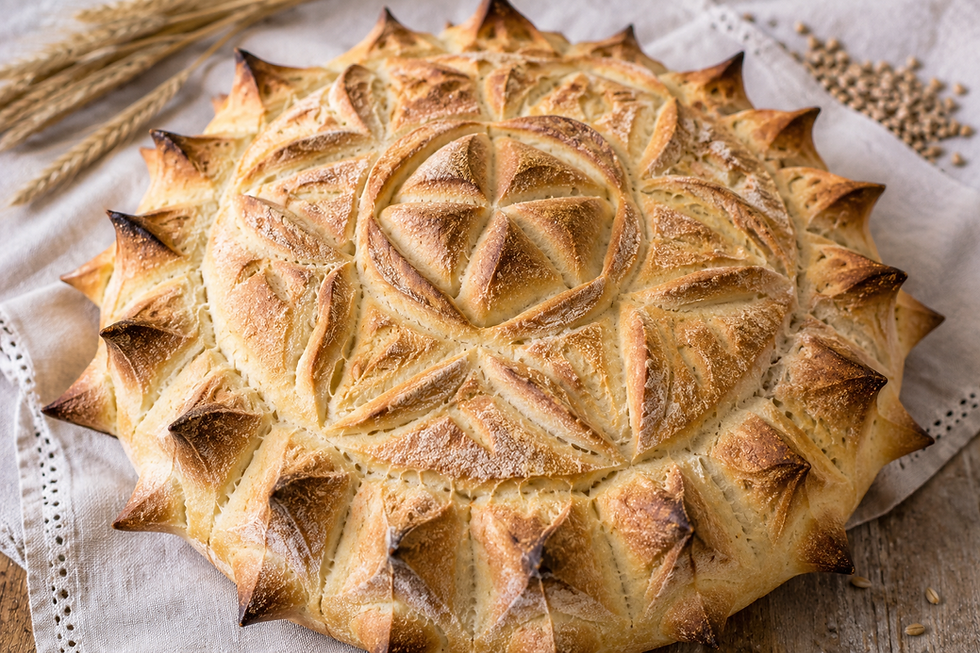
Moddizzosu is the Sardinian word for soft, and this loaf is built around that single adjective. Where the island's bread chases dryness and long keeping, moddizzosu stays wet, tender and faintly sweet, with a thin pale crust that gives under the teeth instead of cracking.
Yield: one loaf of about 2 lb (900 g), 10 to 12 slices. Prep: 40 minutes. Fermentation: 6 hours. Bake: 50 minutes. Cooling: 1 hour.
The Story
Moddizzosu belongs to the Campidano plain and the villages around Cagliari, the flat grain country where durum wheat has been the currency of daily life since antiquity. The name comes from moddi, soft, and it was coined in opposition to everything else on the Sardinian bread board. The island is famous for pane carasau, the paper thin sheet baked twice so that shepherds could carry it for weeks, and for dense round loaves meant to last a family through a week of work.
Moddizzosu was the exception. It was the loaf made when there was no need to hoard, on a Sunday or a feast day, when the wood oven was fired for a communal bake. The order mattered: the hottest early oven took the flat breads, then came the big keeping loaves, and the soft bread went in last as the chamber settled into a gentler heat. Being wet, it did not last, so it was eaten fresh, torn at the table, used to mop sauces or split and filled the next morning.
The flour blend reflects real history. For centuries Sardinian bread was pure durum, because that is what the island grew. When soft wheat flour arrived through mainland trade in the nineteenth and twentieth centuries, Campidano bakers began cutting their semola with a share of it to soften the crumb. The leaven was su fromentu, a stiff natural starter passed between neighbours, which leaves a mild tang under the sweetness of the wheat.
Bakers in Sanluri, Serramanna and Guasila still make it, and today it is the sandwich bread of village festivals across the Campidano, filled with roast pork or fresh pecorino, because the crumb compresses without turning to cardboard and the crust bites through cleanly.
The Campidano matters to the story as much as the oven does. Its alluvial soil, hot dry summers and long harvest tradition made it the granary of the island, and Roman writers already counted Sardinia among the grain provinces of the empire. Milling semola into a fine flour, and blending it with softer wheat, is a craft learned in that landscape. When a Sardinian says a bread is soft, the word carries a note of generosity, because softness meant a household could afford to eat well that day. Bread was never taken lightly on the island, and a soft loaf on the table said that the harvest had been good and the family was fed.
Ingredients
For the dough
Semola rimacinata, finely milled durum semolina, sifted if lumpy, 3 1/4 cups (400 g)
Unbleached bread flour, 3/4 cup plus 2 tbsp (100 g)
Lukewarm water at 80°F (27°C), 1 1/2 cups (360 ml)
Active sourdough starter at 100 percent hydration, refreshed 6 hours earlier, 3.5 oz (100 g)
Fine sea salt, 2 tsp (12 g)
Warm water for wetting your hands during folds, as needed
Reserved water for the bassinage, 3 tbsp (45 ml)
Extra virgin olive oil, for the bowl, 1 tbsp (15 ml)
For shaping and baking
Semola rimacinata, for dusting the couche and the parchment, 1/4 cup (40 g)
Coarse Sardinian sea salt, for the top, 1/2 tsp (3 g)
Boiling water, for the steam tray, 1 cup (240 ml)
For serving
New season extra virgin olive oil, for dipping, 1/4 cup (60 ml)
Young pecorino sardo, 5 oz (140 g)
Salsiccia sarda or thinly sliced cured pork, 4 oz (115 g)
Optional
Boiled floury potato, riced and fully cooled, 3.5 oz (100 g), reducing the water to 1 1/4 cups (300 ml)
Diastatic malt flour, for a warmer crust colour, 1/2 tsp (2 g)
Instant dry yeast, only if baking without a starter, 1 tsp (3 g), reducing the water by 3 tbsp (45 ml)
Preparation
Step 1: Refresh the leaven
Six hours before mixing, feed the starter one part starter, two parts water and two parts of the same semola and bread flour blend. It is ready when it has doubled, smells of yoghurt and green apple rather than acetone, and a spoonful floats in tepid water. A tired leaven is the commonest reason a moddizzosu turns out tight and gummy. If it is still sluggish after 6 hours, give it another hour in a warm spot rather than mixing with it.
Step 2: Mix and autolyse
Whisk the semola and bread flour together, add the water and the leaven and mix by hand until no dry flour remains. Cover and rest 40 minutes. The durum drinks slowly, and this rest lets it hydrate before the salt tightens the gluten. The dough will look shaggy and rough at this stage, and that is exactly right.
Step 3: Add the salt and bassinage
Sprinkle the salt over the dough, add the reserved water and squeeze and fold for 3 minutes until the dough absorbs it. It will feel sticky. Do not add flour, since that water is the softness of the loaf. Wet your hands under the tap between folds to work with the dough instead of fighting it. The dough should turn from ragged to cohesive and slightly glossy.
Step 4: Ferment with folds
Oil a bowl, transfer the dough and cover. Fold four times, once every 45 minutes, then leave it undisturbed until it has grown by half and shows bubbles at the edges, about 4 to 5 hours at 75°F (24°C) in total. Each fold is done by lifting one side of the dough and stretching it over itself, turning the bowl a quarter turn, four times around. Judge by the dough, not the clock: it should feel airy, jiggle when the bowl is shaken and hold a rounded edge.
Step 5: Shape gently
Turn the dough onto a lightly floured surface, fold the edges to the centre without degassing it and form a round loaf. Settle it seam side up in a floured couche or bowl and proof 1 hour 30 minutes, until a floured finger leaves a dent that returns slowly. Handle the dough as though it were full of air, because it is. If it flattens badly on the way out, it has over proofed, so bake it sooner next time.
Step 6: Heat the oven and pot
Thirty minutes before baking, put a lidded cast iron pot into the oven at 475°F (245°C). Tip the loaf onto parchment, sprinkle the coarse salt and slash it once, a single shallow cut about 1/4 inch (6 mm) deep along the top. The pot must be truly hot to give the loaf its first push of rise.
Step 7: Bake under steam, then rest
Lower the loaf into the pot, cover and bake at 450°F (230°C) for 45 to 50 minutes with the lid on the whole time. Lift it out when the crust is pale amber, and wrap it in a clean cloth on a board for 1 hour before slicing. Take the internal temperature before lifting it out, and keep the loaf covered if you are unsure.
Plating
Serve the loaf whole on a wooden board with the cloth folded loosely beneath it, so the crust stays soft on the way to the table. Cut thick slices with a long serrated knife using a gentle sawing stroke, and never press down, because the warm crumb springs back but the shape does not.
Alongside, set a small dish of new season olive oil, a wedge of young pecorino sardo, and thin slices of cured pork such as salsiccia sarda. For a plated version, tear two pieces onto a warm plate beside roast pork or a bowl of legume soup. Tear rather than slice for sauce, and keep everything at room temperature or warm, never hot. The soft crust needs no garnish, and a pinch of coarse salt over the oil is enough decoration for a rustic table.
Professional Technique
A moddizzosu is baked backwards from a crusty loaf. Everything that makes a country boule crisp, an open oven, a dark bake, a rack, is here a fault. The aim is a crust that stays soft, and three decisions deliver it.
First, steam for the entire bake and not just the first ten minutes. A lidded pot traps the moisture the dough gives off, so the surface stays damp and gelatinised and never forms a dry shell. If you bake on a stone, refill a tray of boiling water halfway through, since one burst of steam is spent in minutes.
Second, pull the loaf when the colour is only just amber. Crust colour comes from Maillard browning and sugar caramelisation, and the same reactions dehydrate the surface, so a deep brown crust is by definition a hard one.
Third, wrap the loaf in a cloth on a board while it cools. Moisture migrates out of the hot crumb towards the drier crust, and under a cloth it is caught and returns to the crust, softening it. On an open rack that steam escapes to the room, the crust dries, cracks and stales by evening.
Without crust colour to judge by, read the inside. Probe the centre with a thermometer: 205 to 208°F (96 to 98°C) means the crumb is set. Tap the base for a hollow note, and check that the loaf feels noticeably lighter than when it went in, roughly 12 percent lost. If the centre reads below 200°F (93°C), return the loaf to the pot, lid on, for 5 more minutes, and check again.
Texture and Moisture Control
The crumb should be tender, glossy and elastic, and that comes from hydration. At about 80 percent water the semola swells slowly and the soft wheat relaxes the gluten, which is why the dough should be handled with wet hands and never rescued with extra flour.
Durum starch gelatinises as the centre passes 180°F (82°C), and it holds water more stubbornly than soft wheat, so the loaf stays moist for a day or two. Slicing too early releases that steam and leaves a gummy, compacted crumb, which is why the cooling hour matters as much as the bake.
The crust follows the crumb. Its softness is water put back in, so keep the loaf in the cloth until it is barely warm, then move it to a bread bin or a paper bag. Never store it in plastic while warm, which turns the crust leathery and the crumb damp.
The optional potato adds soluble starch that binds water, and it delays staling by about a day. The semola dust on the crust also matters: a light layer keeps the surface from sticking to the couche and gives the finished crust a matte, floury feel rather than a glossy shell.
If a slice feels damp in the centre once cooled, the loaf was underbaked, not too wet. Next time hold it in the pot 5 minutes longer and let the thermometer decide.
Professional Mise en Place
Equipment and tools
Lidded cast iron pot, 5 quart (4.7 L), or a baking stone with a steam tray
Digital thermometer, lame or sharp razor, bench scraper
Couche or floured cloth, and a clean linen cloth for cooling
Kitchen scale accurate to 1 g, a large bowl and a dough scraper
Oven mitts rated for a pot at 475°F (245°C)
Parchment paper cut to a square larger than the loaf, to lift it in and out safely
Prepared ahead
Leaven fed 6 hours before mixing
Semola for dusting weighed out and the water warmed to 80°F (27°C)
The shaped loaf can retard overnight in the refrigerator, then bake straight from cold with 5 extra minutes
Pecorino brought out of the refrigerator 30 minutes before serving
Olive oil poured into a small dish for dipping
Service setup
Board and cooling cloth ready before the oven opens
Serrated knife, oil, pecorino and cured pork laid out at room temperature
Slice only when guests sit down
Warm plates if serving with roast pork or soup
Chef Tips
Weigh the flour. Cup measures for semola vary by a fifth, and at this hydration that difference decides whether the dough is silky or a puddle.
Wet your hands, not the bench. Water stops sticking without adding flour, so the crumb stays soft.
Check the oven with a thermometer. Many home ovens run 25°F (15°C) cold, and a cool oven gives a pale, dense loaf.
Use the bread within a day for the best crumb. Moddizzosu is at its finest on the first evening, and again toasted with oil the following morning.
For sandwiches, slice after the loaf is fully cool, and use the cut face for the filling so the crust stays whole. A little olive oil brushed inside the slice protects the crumb from moist fillings.
If you bake often, keep a small jar of starter fed weekly. A regular rhythm gives a livelier leaven and a more reliable, sweeter loaf than one revived after a long rest.
Common Mistakes
Adding flour to the sticky dough. It raises the ratio of flour to water and gives the tight, chewy crumb this bread exists to avoid.
Removing the lid halfway. Ending the steam early dries the surface and builds a crisp shell, the opposite of moddizzosu.
Baking to a deep brown. Dark colour means a dry hard crust. Trust the thermometer and pull it at pale amber.
Cooling on an open rack. The steam leaves and the crust hardens. Use a board and a cloth.
Slicing hot. The crumb is still setting, and cutting it releases steam and leaves it gummy.
Using only soft wheat flour. Without the semola the loaf loses its golden colour, its nutty flavour and its sweet wheaty smell, and it becomes an ordinary white bread.
Over proofing the loaf. A dough that has tripled slumps in the pot and bakes flat with a coarse crumb. Watch the dough, and bake when the dent returns slowly.
Salting the leaven. Salt belongs in the dough after the rest, never in the starter, where it slows fermentation and dulls the flavour.
Wine Pairing
Vermentino di Gallura DOCG: A dry Sardinian white with citrus acidity and a saline finish. It cuts through olive oil and fresh pecorino, while its light bitter almond note echoes the toasted durum. Serve it well chilled at 46°F (8°C), which keeps the wine crisp beside the soft bread.
Nuragus di Cagliari DOC: The wine of the Campidano, where this bread is made. Its high acidity and green apple fruit refresh the palate between soft mouthfuls, and its modest alcohol does not compete with the wheat. It is the wine a baker in Sanluri would open with a plate of pecorino and bread.
Cannonau di Sardegna DOC: A dry red for the roast pork sandwich. Soft tannin and dried herb notes meet the fat of the meat, and the bread absorbs the wine without heaviness. Serve it slightly cool, at about 57°F (14°C), so the alcohol stays in balance with the sweet crumb.
Verdicchio di Matelica DOC: A mainland dry white with firm mineral acidity and a clean almond finish. It suits the bread when it is served with soft cheese and vegetables, since its structure supports the tender crumb without covering the flavour of the wheat.
Trento DOC: A dry metodo classico with fine bubbles and brisk acidity. The mousse lifts the richness of cured pork and cheese, and the yeasty, bready notes mirror the fermented crumb. A good choice for a festive table, as an aperitif with the first slices.
Storage & Reheating
Keep the cooled loaf cut side down on a board, or in a paper bag or bread bin, for up to 2 days at room temperature. Plastic softens the crust too far and encourages mould, and the refrigerator stales the crumb quickly, so avoid it.
For the freezer, slice the loaf when cool, wrap the slices tightly and freeze up to 3 months. Thaw at room temperature for 30 minutes.
To refresh a day old loaf, sprinkle it lightly with water and warm it wrapped in foil at 350°F (175°C) for 10 minutes. This restores the softness without crisping the crust, and it also suits toast, since slices toast beautifully on the second day. Bring any frozen slices back to life in a toaster straight from the freezer, without thawing.
Store the leaven separately in the refrigerator, fed weekly, so the next bake starts with a strong culture.
Nutrition
Per slice, based on 12 slices:
Calories: 165 kcal
Total Fat: 1.5 g
Saturated Fat: 0.2 g
Trans Fat: 0 g
Unsaturated Fat: 1.2 g
Cholesterol: 0 mg
Sodium: 390 mg
Total Carbohydrates: 33 g
Fiber: 2 g
Total Sugars: 0.5 g
Added Sugars: 0 g
Protein: 6 g
Lactose: 0 g
Principal micronutrients: iron, selenium, thiamin, folate, magnesium
These figures are estimates and vary with the flour used, the slice size and the optional potato.



Comments