
Italian Hasselback Potatoes | Patate Hasselback al Burro alle Erbe
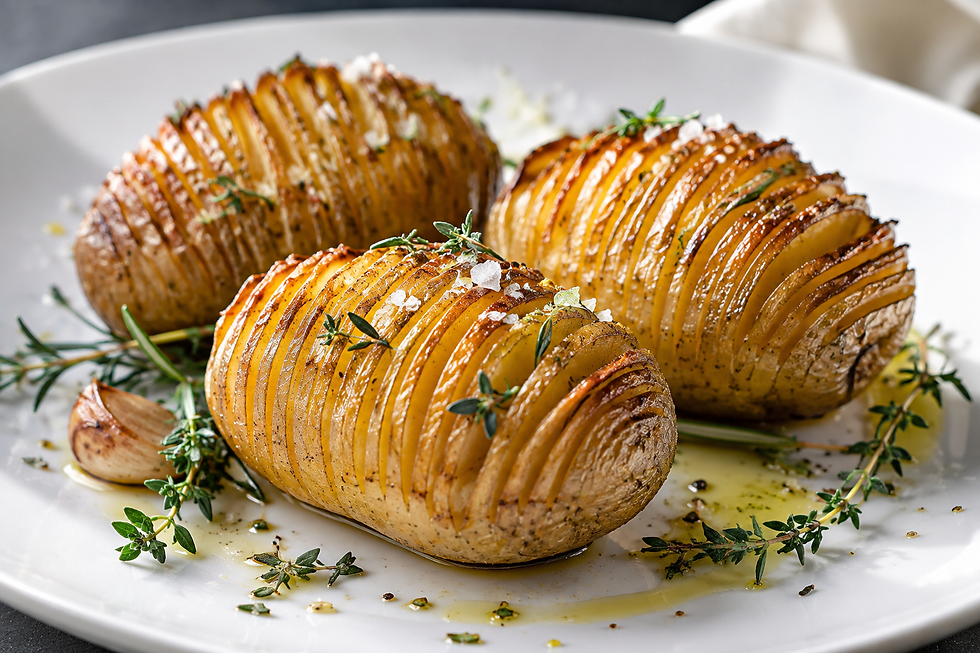
A hasselback potato is a whole potato sliced almost all the way through, thirty or forty times, and then roasted until the slices separate into a fan. Nothing is removed and nothing is added inside. The cut alone converts a smooth oval with very little surface into a piece of food that is almost all surface, and the oven dries and browns every exposed edge while the uncut base underneath stays soft and steamy.
That geometry is the whole trick and the whole risk. Cut too deep and the potato collapses into slices halfway through the bake. Cut too shallow and the fan never opens, the butter never reaches the middle, and what comes out is a baked potato with scratches on it. The depth that works leaves about 1/4 in (6 mm) of solid potato along the bottom.
The Italian version lives in the butter. Melted burro is beaten with rosemary, sage, garlic and lemon zest and brushed into the open cuts in two passes, and grated Parmigiano Reggiano goes on for the last ten minutes only, long enough to set into a lacy crust and not long enough to turn bitter.
Yield: 6 side servings. Prep: 30 minutes. Cook: 1 hour 5 minutes. Rest: 5 minutes. Total: about 1 hour 40 minutes. Difficulty: intermediate. Course: contorno.
The Story
This potato has a date and an address, which is rare. It was created in 1953 at Hasselbacken, a restaurant on Djurgarden in Stockholm attached to the old hotel of the same name, by a trainee cook named Leif Elisson who was working through the kitchen school there. The dish was put on the menu as hasselbackspotatis, potatoes of the Hasselbacken, it was photographed for the Swedish press, and within a decade it had spread through Scandinavian home cooking as the standard potato for a Sunday roast.
It reached Italy through hotel kitchens rather than households, in the years when Italian chefs trained abroad before coming home. What made it stay was that it fitted a habit already here. Italian roasting has always put potatoes under or beside the meat, cut into wedges, dressed with olive oil, rosemary and garlic, so they take on the fat and the roasting juices. The hasselback cut simply gave that tradition more edges to brown.
The herb butter is the Italian contribution and it comes from the arrosto. Burro aromatizzato, butter worked with rosemary, sage, garlic and sometimes anchovy, is brushed over roasting chicken and veal across the north, and Tuscany in particular treats rosemary and sage as the two herbs a roast cannot do without. Bringing that butter into the cuts of a Swedish potato is not fusion, it is the same seasoning logic applied to the vegetable that was already sitting in the same tin.
Ingredients
For the potatoes
Yukon Gold potatoes, even sized, 6, about 7 oz (200 g) each
Extra virgin olive oil, 3 tbsp (45 ml)
Fine sea salt, 1 1/2 tsp (9 g)
Freshly ground black pepper, to taste
For the herb butter
Unsalted butter, 5 tbsp (70 g), melted
Fresh rosemary, finely chopped, 1 tbsp (3 g)
Fresh sage leaves, finely chopped, 6
Garlic cloves, finely grated, 2
Finely grated lemon zest, from 1 lemon
Fine sea salt, 1/2 tsp (3 g)
For finishing
Parmigiano Reggiano, finely grated, 2 oz (55 g)
Flaky sea salt, 1 tsp (4 g)
Fresh rosemary sprigs, small, 6
Freshly ground black pepper, to taste
Preparation
Step 1
Choose the potatoes and give them a flat base. Pick six potatoes of the same size, oval rather than round, and scrub them well. Leave the skin on: it is what holds the fan together for an hour in the oven. Slice a thin sliver off one long side so each potato sits still on the board and on the tray. A potato that rocks while you cut gives uneven slices and a fan that opens on one side only.
Step 2
Cut with a guide, not by eye. Lay each potato in the bowl of a large wooden spoon, or between two chopsticks, cut side down. Slice straight down across the potato at intervals of 1/8 in (3 mm), letting the spoon or the chopsticks stop the blade about 1/4 in (6 mm) from the bottom. Work with a thin sharp blade and do not saw. You should end with 30 to 40 cuts per potato and an uncut spine holding them all together.
Step 3
Soak briefly, then dry with intent. Put the cut potatoes in cold water for 10 minutes to rinse the loose starch out of the cuts, moving them gently so the water gets between the slices. That starch is glue: left in place it seals the slices together and the fan will not open. Drain, then dry them properly by fanning each one over a towel and leaving them on a rack for 10 minutes.
Step 4
Bake with oil only for the first stage. Heat the oven to 400°F (200°C). Set the potatoes on a parchment lined tray, brush olive oil over the tops and into the cuts as far as it will go, and season with the fine sea salt and black pepper. Bake for 35 minutes. Use oil and not butter here: butter contains water and milk solids that burn over a long bake, and the fan has to open before the butter is any use.
Step 5
Make the herb butter while they bake. Melt the butter gently without letting it foam, then stir in the chopped rosemary, sage, grated garlic, lemon zest and salt off the heat and let it stand so the herbs steep. Raw garlic added to hot butter on the stove turns bitter within a minute, while warm melted butter off the heat draws the flavour out without colouring it. Stir again before each use.
Step 6
Open the fan and baste twice. At 35 minutes the slices will have begun to separate visibly. Spoon a third of the herb butter over each potato, working the tip of a small spoon between the slices to push butter down into the cuts. Return to the oven for 15 minutes, then repeat with another third. The potatoes should be deep gold at the tips and clearly fanned by the end of the second basting.
Step 7
Add the Parmigiano last. Brush on the remaining butter, then scatter the grated Parmigiano Reggiano over the tops so that some falls into the open slices. Bake for a final 10 to 12 minutes, until the cheese has melted, set and taken colour at the edges. Cheese added earlier than this will scorch and turn acrid over a full hour. Rest the potatoes 5 minutes, then finish with flaky salt, pepper and a small rosemary sprig tucked into each fan.
Plating
Serve them hot, one whole potato per person, on a warm plate. This dish is meant to be recognised as a potato, so it is never cut up in the kitchen and never piled into a bowl where the fans press against each other and go soft. Five minutes of rest lets the cheese set so the fan holds its shape when it is lifted.
On a shared platter set them in a single row with the fans facing the same direction, slightly tilted so the open slices catch the light, and spoon any butter and browned cheese left on the tray over the tops. That tray residue is the best part of the dish. A single small rosemary sprig per potato is the only garnish needed.
As a contorno it belongs beside roast chicken, pork loin, veal or beef, and it takes a pan sauce well because the open cuts hold it. Spoon the sauce at the base rather than over the top, which would soften the crust.
Professional Technique
The technique here is geometric. An uncut potato of 7 oz (200 g) offers roughly 25 square inches of surface to the oven. Cut into 35 slices it offers close to five times that, and browning happens only at surfaces. Every extra edge is another site where water can leave, where the Maillard reaction can run and where fat can sit. That is why a hasselback tastes nothing like a baked potato despite being the same thing.
The two stage bake exists because oil and butter do different jobs at different moments. For the first 35 minutes the potato is still closed and needs dry radiant heat and a fat that tolerates it, so olive oil goes on alone. As the slices lose water they shrink and curl away from each other, and only then is there a gap for butter to travel into, carrying the herbs, garlic and lemon zest into places a brush could never reach.
Cutting depth decides whether any of this works. Leave less than about 1/4 in (6 mm) at the base and the spine gives way under the weight of the fan, usually around the fortieth minute. Leave much more and the slices stay hinged too tightly to separate. The wooden spoon is the fastest way to make thirty five identical cuts at an identical depth without measuring any of them.
Texture and Moisture Control
A finished hasselback delivers two textures at once from a single piece of vegetable, produced by the same hour of heat doing opposite things at the top and the bottom. At the tips, the thin edges of the slices lose water fast and dry into something brittle. At the base, below the cut line, the solid potato is steaming inside its own skin and finishes soft enough to eat with a spoon.
Water has to leave through the cuts, which is why the tray is never covered and the potatoes are never crowded. Set them at least 2 in (5 cm) apart, because a tray packed edge to edge holds a cushion of steam around the fans and the slices stay pale and floppy however long the bake runs. If the tips darken faster than the middle cooks, drop the oven 25°F (15°C) rather than covering anything.
The drying step after the soak is the one most people rush, and it costs them the fan. Water sitting between the slices has to boil off before those surfaces can brown, and while it does the slices stay stuck together by surface tension. Yukon Gold is the right variety for the same reason it suits most roasting: enough starch for a floury interior, enough structure that the spine survives an hour.
Professional Mise en Place
This is an oven dish with three timed interventions rather than a stovetop one, so the work is in organising the basting and keeping the oven free.
Equipment and tools
Large wooden spoon or two chopsticks to set the cutting depth
Thin bladed sharp knife, and a vegetable brush for scrubbing
Parchment lined heavy baking tray with room for 6 potatoes
Small saucepan for the butter and a pastry brush plus a teaspoon
Microplane for the Parmigiano, the garlic and the lemon zest
Prepared ahead
Potatoes cut, up to 4 hours ahead, held in cold water and dried before baking
Herb butter made, up to 2 days ahead, refrigerated and remelted gently
Parmigiano grated and kept covered and cold
First 35 minute bake done up to 2 hours ahead, then finished from Step 6
Service setup
Oven at 400°F (200°C) and a rack set in the middle position
Butter warm and liquid beside the oven with the brush and spoon
Two basting timers set, at 35 and 50 minutes
Plates warming, since these cool faster than a solid baked potato
Flaky salt, pepper and rosemary sprigs ready for the rest period
Chef Tips
Buy potatoes that are oval and of the same weight, and refuse round ones. A round potato has a short spine and a tall fan, which is the combination most likely to snap in the oven, while a long oval spreads the same number of cuts over a longer base and holds together.
Keep the knife thin. A heavy chef knife wedges the slices apart as it goes down and tears the base, and a serrated blade drags. A thin slicing knife or a sharp santoku cuts cleanly and lets you feel the wooden spoon stop the blade.
Do not salt the herb butter heavily. The Parmigiano is already salty and the potato was seasoned before the first bake, so the 1/2 teaspoon in the butter is there to season the herbs, not the potato, and the flaky salt at the end does the rest where you can taste it.
If you are cooking a roast at the same time, put the potatoes in first and let them share the oven. They want 400°F (200°C) for an hour, which suits most roast birds and pork loins, and a spoonful of the meat juices brushed on with the second basting is worth more than extra butter.
Common Mistakes
Cutting all the way through. Without a guide the blade goes too deep somewhere along the potato and the spine fails midway through the bake. Lay the potato in a wooden spoon or between chopsticks and let the tool stop the knife every time.
Slicing too thickly. Cuts spaced 1/4 in (6 mm) or more apart leave slices too heavy to dry and curl, so the fan barely opens and the inside of each slice stays damp. Aim for 1/8 in (3 mm) and accept that more cuts means a better potato.
Buttering from the start. Butter over a full hour at 400°F (200°C) browns its milk solids past the point of flavour and turns acrid, and it cannot reach the middle anyway while the slices are still closed. Oil first, butter after the fan opens.
Adding the cheese too early. Parmigiano scattered on at the beginning burns long before the potato is cooked and leaves a bitter dark crust. It goes on for the last 10 to 12 minutes only, once everything else is finished.
Crowding the tray or covering it. Potatoes touching each other, or a sheet of foil over the top, trap the steam that has to escape through the cuts and the slices stay soft and pale. Leave 2 in (5 cm) between them and bake uncovered throughout.
Wine Pairing
Soave Superiore DOCG: Garganega from the volcanic hills east of Verona, and the cleanest answer to butter and cheese. Its almond and white flower character sits alongside the Parmigiano rather than competing with it, and the acidity is firm enough to reset the palate after each buttery mouthful. A Superiore has the body needed next to roast meat.
Lugana DOC: Grown on the clay south of Lake Garda, Lugana is rounder and more textural than most northern Italian whites, with a citrus and stone fruit core and a saline finish. That weight matches the melted butter without being erased by it, and the salinity works directly on the aged Parmigiano crust. Serve it at 50°F (10°C).
Franciacorta DOCG: The technical choice, because bubbles and high acidity do to fat what nothing else does. The mousse lifts the butter off the palate between bites, the autolytic bread and hazelnut notes pick up the browned cheese, and the wine stays dry through it all. A Brut, not a Satin, if the potatoes are serving with meat.
Collio Friulano DOC: From the eastern hills of Friuli, with a distinctive bitter almond finish and a pronounced herbal edge that lines up with the rosemary and sage in the butter. It has more grip than its pale colour suggests, and that structure holds against garlic, which flattens softer whites into sweetness.
Alto Adige Santa Maddalena DOC: The red option, and a light one. Schiava gives a pale, low tannin wine with violet and sour cherry fruit, and served cool at 56°F (13°C) it handles the roasted edges without weighing down a side dish. It is also the wine most likely to be on the table already if there is a roast on it.
Storage & Reheating
Hasselback potatoes are at their best within fifteen minutes of leaving the oven and do not improve with keeping. Cooked and cooled, they keep in an airtight container in the refrigerator for 3 days. Do not wrap them in foil or plastic while warm, which steams the fan closed.
Reheat at 375°F (190°C) on a rack over a tray for 12 to 15 minutes, uncovered, with a light brush of melted butter over the tops. The rack matters, because the base is the wettest part and needs air underneath. A microwave turns the whole potato uniformly soft in ninety seconds and the crisp edges never come back.
They can be part cooked and held, which is the useful option for a dinner party. Complete the first 35 minute bake, leave the potatoes at room temperature for up to 2 hours, then start again from the first basting and add 5 minutes to the total. Freezing is not worth it: the slices lose their structure on thawing and the fan will not crisp again.
Nutrition
Per serving, based on 6 side servings of one whole potato each:
Calories: 340 kcal
Total Fat: 17 g
Saturated Fat: 8 g
Trans Fat: 0.4 g
Unsaturated Fat: 8 g
Cholesterol: 32 mg
Sodium: 690 mg
Total Carbohydrates: 38 g
Fiber: 4 g
Total Sugars: 2 g
Added Sugars: 0 g
Protein: 9 g
Lactose: 0.2 g
Principal micronutrients: potassium, calcium and phosphorus from the Parmigiano, vitamin C, vitamin B6, vitamin A from the butter
These figures are estimates. Sodium is the least stable of them, since Parmigiano Reggiano varies with ageing and the flaky salt at the end is applied by hand.


Comments