Italian Veal and Turin Breadstick Meatballs | Polpette di Vitello e Grissini Torinesi
Updated: Oct 24

Almost every Italian meatball begins with stale bread soaked in milk. This one begins with grissini, the long brittle breadsticks of Turin, crushed coarse and softened the same way. The substitution sounds like a joke until you taste it, because a grissino is not bread with the water driven off. It is dough baked twice as long, right through, so it carries toasted flavour to its centre and absorbs milk without turning to paste.
The meat is veal, lean and pale and finely grained, which makes a mild meatball on its own, so the seasoning does real work: Parmigiano for salt and savour, a little nutmeg, garlic, parsley and nothing else competing. The mixture is bound with a whole egg and an extra yolk, which keeps it tender rather than springy.
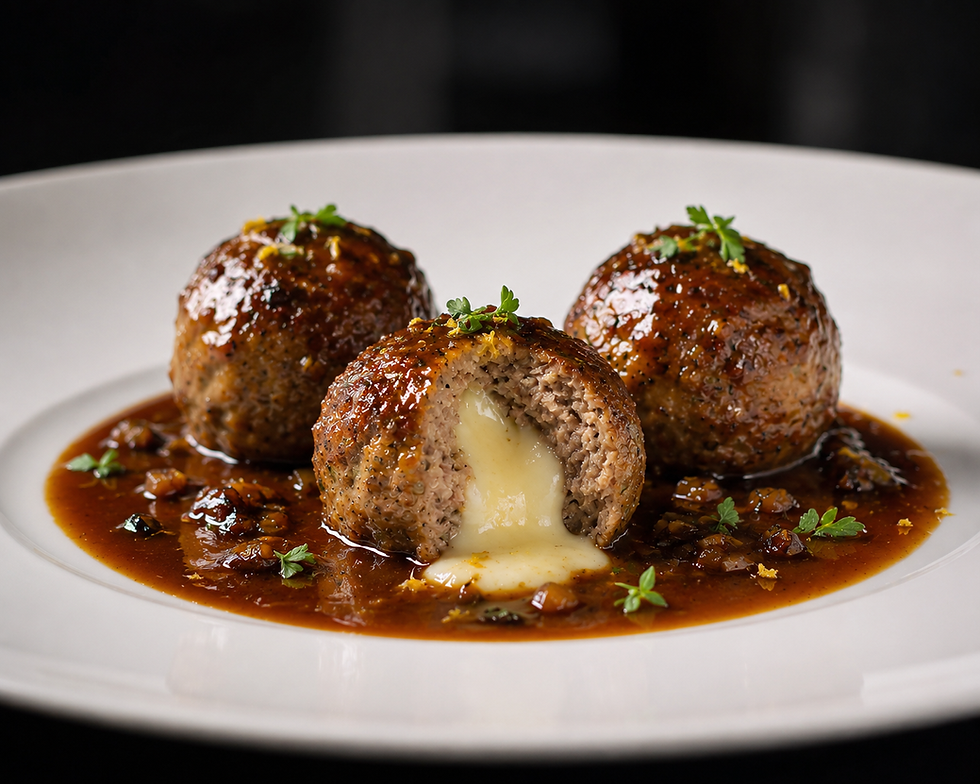
They are browned in butter and oil with sage and rosemary, then finished in the pan with white wine and stock reduced to a glossy fondo mounted with cold butter at the last moment. No tomato goes anywhere near them. This is northern cooking, and the sauce is the browned residue of the meat itself.
Yield: 4 servings, about 20 meatballs. Prep: 30 minutes. Rest: 30 minutes. Cook: 25 minutes. Total: about 1 hour 25 minutes. Difficulty: intermediate. Course: main course. Region: Piedmont, Turin and the Langhe.
The Story
The grissino was invented in Turin in 1679, and unusually for an Italian food we know roughly why. The child duke Vittorio Amedeo II was sickly and could not keep down the soft, damp bread of the period, so the court physician asked the baker Antonio Brunero for something dry enough to digest. Brunero drew the dough into thin sticks and baked them until no moisture was left. The result kept for weeks and spread from the court across the region.
Two kinds survive. The rubatà is rolled by hand on the bench, knobbly and irregular, the older of the two and still the pride of Chieri and the Monferrato. The stirato is pulled rather than rolled, longer, straighter and more brittle, and it is the one Turin puts on every restaurant table. For this recipe the stirato is the right choice, because its open crumb drinks milk quickly and evenly.
Polpette were never a way of using up meat in Piedmont, they were a way of stretching it. Veal was the everyday meat of a region built on dairy farming, and the bull calves that came with the milk had to be eaten. A handful of crushed grissini, a knob of Parmigiano and two eggs turned a modest amount of it into a dish for a family. That the binder was the most Turinese object in the kitchen was simply because there was always a jar of broken grissini on the counter.
Ingredients
For the meatballs
Ground veal shoulder, 1 1/4 lb (570 g)
Grissini stirati, finely crushed, 3 oz (85 g), about 12 sticks
Whole milk, 1/2 cup (120 ml)
Parmigiano Reggiano, finely grated, 2 oz (55 g)
Egg, large, 1
Egg yolk, large, 1
Garlic clove, minced to a paste, 1
Flat leaf parsley, finely chopped, 2 tbsp (7 g)
Freshly grated nutmeg, 1/8 tsp
Fine sea salt, 1 1/4 tsp (7 g)
Freshly ground black pepper, 1/2 tsp (1 g)
For the coating
Grissini stirati, crushed coarser, 1 1/2 oz (40 g)
For the pan and the fondo
Unsalted butter, 3 tbsp (42 g)
Extra virgin olive oil, 2 tbsp (30 ml)
Fresh sage leaves, 8
Fresh rosemary, 1 sprig
Dry white wine, Arneis or Gavi, 3/4 cup (180 ml)
Veal or light chicken stock, 3/4 cup (180 ml)
Cold unsalted butter, cubed, 1 tbsp (14 g)
Finely grated lemon zest, from 1/2 lemon
Fine sea salt and black pepper, to taste
For finishing
Parmigiano Reggiano, shaved, 1 oz (28 g)
Flat leaf parsley leaves, small, 12
Preparation
Step 1
Crush the grissini and soak them. Break the sticks into a bag and crush them with a rolling pin rather than a blender, which reduces them to flour. You want the 3 oz (85 g) for the mixture at the coarseness of fine sand and the 1 1/2 oz (40 g) for the coating closer to breadcrumbs. Pour the milk over the finer crumbs and leave them 10 minutes, until they swell into a soft, damp paste that still holds a little grain.
Step 2
Mix the veal. Put the veal in a wide bowl with the soaked grissini, the Parmigiano, the whole egg and the yolk, the garlic, parsley, nutmeg, salt and pepper. Mix with your fingertips, lifting and folding rather than pressing, and stop the moment it looks even. Veal proteins tighten fast under pressure, and a mixture worked like bread dough gives meatballs with the bounce of a sausage.
Step 3
Rest the mixture. Cover the bowl and refrigerate 30 minutes. The crumbs finish absorbing the liquid, the fat firms up so the meatballs hold their shape in the pan, and the salt dissolves and seasons the meat through rather than sitting on the surface. Before rolling the lot, fry a teaspoon in a little butter, taste it, and correct the salt and nutmeg while you still can.
Step 4
Roll and coat them. With damp hands, roll about 20 balls of roughly 1 1/2 inches (4 cm), a little under 1 1/2 oz (40 g) each. Keep them the same size or they will not cook in the same time. Roll each one lightly through the coarse crumbs and press them on gently. This thin crust is what browns, and it gives a crackle against the soft interior.
Step 5
Brown them properly. Heat 2 tbsp (28 g) of the butter with the olive oil in a wide heavy pan over medium heat; the oil stops the butter burning while the butter does the browning. Add the sage and rosemary, lay the meatballs in with space between them and leave them alone for 3 minutes before turning. Brown all sides over about 8 minutes, then lift them onto a plate. They are coloured, not cooked through.
Step 6
Build the fondo. Pour off any burnt butter but keep the brown residue stuck to the pan, which is where the flavour is. Raise the heat, pour in the white wine and scrape the base clean with a wooden spoon. Reduce the wine by half, until the raw alcohol smell has gone and what is left smells of fruit and caramel. Add the stock and bring it back to a simmer.
Step 7
Finish the meatballs in the sauce. Return them to the pan, lower the heat, cover partly and cook 8 to 10 minutes, turning once and spooning sauce over them, until they reach 160°F (71°C) inside. Lift them out, reduce the liquid until it coats a spoon, then take the pan off the heat and swirl in the cold butter and the lemon zest until glossy. Correct the salt and return the meatballs to coat.
Plating
Warm the plates. A mounted sauce that cools on cold ceramic goes dull and starts to separate, and shallow bowls work better than flats since the fondo is loose and should pool rather than run.
Give each person five meatballs, set close together rather than spread out, and spoon the sauce over them so they are glossed rather than swimming. Lay the sage leaves from the pan over the top; they have crisped in the butter and are worth eating. Shave the Parmigiano over while the meatballs are hot enough to soften it, and finish with a few small parsley leaves.
What goes alongside should soak up the fondo without competing for it: soft polenta, plain mashed potato, or good bread. Serve buttered spinach or braised chard separately if you want a vegetable, but keep it off the same plate so its liquid does not thin the sauce.
Professional Technique
The technical point of this recipe is the panade, the paste of starch and liquid every good meatball is built on, and grissini make an unusually effective one. Their starch granules were fully gelatinised and then dried hard during the long second bake, so when milk hits them they rehydrate quickly and swell into a gel. That gel traps water inside the meatball and gets physically between the muscle proteins, stopping them knitting into the dense network that makes a meatball rubbery.
Because a grissino is drier than stale bread it also absorbs proportionally more liquid for its weight. That is why 3 oz (85 g) of crushed grissini takes only 1/2 cup (120 ml) of milk and still comes out a firm paste rather than a slurry. Use the same weight of ordinary breadcrumbs with that much milk and the mixture will be loose and the meatballs will spread in the pan.
The second technique is the fondo, a pan sauce built in three stages and never a stock reduction poured over meat. Browning leaves soluble proteins and caramelised sugars fused to the pan; the wine dissolves them and its acidity cuts the butter; the stock supplies gelatin for body. Mounting with cold butter off the heat is the last stage and the most fragile, since the emulsion holds only below about 190°F (88°C).
Texture and Moisture Control
Veal has roughly 5 percent fat against 20 percent in the pork and beef mixtures used further south, which is the central problem of this dish. There is little fat to melt and keep the inside moist, so moisture has to be built in and then defended. The panade holds it, the egg and the extra yolk emulsify it, the Parmigiano contributes fat and glutamates, and the butter in the pan supplies what the meat lacks.
Temperature is the other half. Veal proteins contract hard above 160°F (71°C) and squeeze out their held water, so the meatballs come off the heat the moment they reach that point. Finishing them in simmering liquid rather than dry heat is what makes this achievable: the sauce holds just under boiling and they cannot overshoot while they sit in it, which a dry pan or an oven will not guarantee.
The coating manages moisture from outside. Coarse grissini crumbs toast in the butter into a crust that slows moisture loss during browning, and they stay perceptibly crisp through the short braise because their starch is already cooked and cannot turn gummy. This is why the meatballs are browned first and simmered second. Reverse the order and the crust softens into a skin and the browning never happens.
Professional Mise en Place
The mixture must rest and the sauce must be mounted at the last second, so the work splits cleanly into what is done in advance and what is done at the stove.
Equipment and tools
Wide heavy sauté pan or a shallow braising pan with a lid
Rolling pin and a sturdy bag for crushing the grissini
Two wide bowls, one for the mixture and one for the coating crumbs
Digital probe thermometer and a small wooden spoon
Tray lined with parchment for the rolled meatballs
Prepared ahead
Grissini crushed to both grades and kept in sealed jars, up to 1 week
Meat mixture made and refrigerated, up to 12 hours
Meatballs rolled, coated and held on a tray, up to 4 hours
Stock measured and warm, wine measured, herbs picked
Service setup
Cold butter cubed and kept in the refrigerator until the moment of mounting
Parmigiano shaved and lemon zested just before service
Plates warmed, never cold, so the mounted sauce stays glossy
Meatballs browned up to 30 minutes ahead and finished in the sauce to order
Chef Tips
Ask the butcher to grind veal shoulder and to pass it once through a medium plate. Ready ground veal is usually leg, leaner still and dry in a meatball, and it is often ground twice, which packs the fibres and costs the loose texture this dish depends on.
Crush the grissini by hand and by eye. A food processor turns them to dust in three seconds and dust behaves like flour, giving a tight, pasty mixture. The difference between a coarse crumb and a powder is the difference between a tender meatball and a heavy one.
Keep the wine dry and Piedmontese if you can. Arneis and Gavi have the acidity to cut the butter without residual sugar, and sugar in a reduced fondo turns sticky very quickly. Whatever you use should be a wine you would drink, since reducing it by half concentrates every flaw in it.
Fry a teaspoon of the raw mixture before rolling. It is the only chance to judge salt, nutmeg and the balance of Parmigiano. Raw mixtures always taste under seasoned, and veal needs more salt than it looks as though it should.
Common Mistakes
Overworking the mixture. Kneading or squeezing develops the myosin in the veal into an elastic network and the meatballs come out springy and tight. Fold with the fingertips only and stop as soon as the mixture looks even.
Using dried breadcrumbs instead of grissini. Commercial breadcrumbs absorb less, add no toasted flavour and give a mealy interior. If you genuinely cannot get grissini, use torn stale country bread, not a canister of crumbs.
Crowding the pan. Meatballs packed edge to edge drop the pan temperature, release steam and stew instead of browning, and no fondo forms. Brown them in two batches if the pan is not wide enough.
Washing the pan before making the sauce. The brown residue welded to the base is the entire flavour of the fondo. Pour off burnt fat if you must, but never rinse the pan between browning and deglazing.
Mounting the butter over heat. Cold butter swirled into a simmering pan breaks into oil almost instantly and the sauce turns greasy and separated. Take the pan off the heat first and swirl, never whisk hard.
Cooking them to well done. Veal past 160°F (71°C) contracts and expels its moisture, and no amount of sauce disguises it. Use a probe and pull them out on the number.
Wine Pairing
Barbera d'Asti DOCG: The default red of the Piedmontese table and the most reliable match here. Barbera carries high natural acidity with very little tannin, which is exactly what a dish finished with butter needs: the acid cuts the fat and the low tannin leaves the delicate veal alone. Its dark cherry fruit sits comfortably beside the sage.
Dolcetto d'Alba DOC: Lower in acid than Barbera and gently tannic, with a bitter almond note on the finish that plays against the Parmigiano rather than with it. Choose it when you want the wine to stay in the background. Served slightly cool, around 59°F (15°C), it keeps the plate light.
Nebbiolo d'Alba DOC: The step up, and the limit of how much tannin this dish will take. Nebbiolo from the Alba hills is lighter than Barolo but still firm, and its rose and tar aromatics meet the rosemary directly. Its grip works on the browned crust and the reduced fondo, though it would overwhelm the veal without them.
Roero Arneis DOCG: The white to pour if you also cooked with it, which keeps the sauce and the glass in the same register. Arneis is dry, pear scented and quite full bodied for a white, with enough texture to stand next to butter and enough acidity to reset the palate between mouthfuls.
Erbaluce di Caluso DOCG: From the moraine hills north of Turin, the sharpest and most mineral white in Piedmont. Its high acidity and almost salty finish cut a buttery fondo more cleanly than Arneis does, and its restrained green apple fruit adds nothing that competes with the nutmeg and the sage.
Storage & Reheating
These are better the next day, which is not true of most veal dishes. Keep them in their sauce in an airtight container in the refrigerator for up to 3 days. Resting in the fondo lets the sauce penetrate the crust, and the gelatin from the stock sets around them and is reabsorbed when they are warmed. Store them together, never separately, or they dry out.
Reheat in a covered pan over low heat with a splash of stock or water, turning gently until hot through, about 8 minutes. Do not use a microwave, which drives water out of lean veal and leaves it grey and tight. If the sauce has broken on reheating, take the pan off the heat and swirl in a small cube of cold butter.
They freeze two ways. Raw rolled meatballs freeze on a tray and then go into a bag for up to 2 months, to be browned from frozen with an extra 3 minutes in the pan. Cooked meatballs freeze in their sauce for the same period and should be thawed overnight in the refrigerator. Do not freeze them after the sauce has been mounted with butter, since that emulsion separates.
Nutrition
Per serving, based on 4 servings of about 5 meatballs:
Calories: 560 kcal
Total Fat: 33 g
Saturated Fat: 15 g
Trans Fat: 0.6 g
Unsaturated Fat: 16 g
Cholesterol: 230 mg
Sodium: 980 mg
Total Carbohydrates: 22 g
Fiber: 1.2 g
Total Sugars: 3 g
Added Sugars: 0 g
Protein: 38 g
Lactose: 2.5 g
Principal micronutrients: vitamin B12, zinc, selenium, niacin, phosphorus, calcium
These figures are estimates. The sodium is driven by the Parmigiano and the stock, so an unsalted homemade stock lowers it considerably, and the alcohol in the wine cooks off during the reduction.


Comments