
Italian Red Wine Braised Beef Brisket | Punta di Petto di Manzo Brasata al Vino Rosso

Punta di petto is the cheapest serious roast on the carcass and the one most often ruined in the last five minutes. A brisket that has braised perfectly for four hours still reaches the table as a pile of shreds if it is carved hot, and one carved straight across its full width comes out tender on half the plate and stringy on the other half, from the same knife stroke.
The braise itself is orthodox northern practice: salted a day ahead, dried, browned on every surface, then cooked slowly with red wine reduced hard, tomato, root vegetables and rosemary until the collagen turns to gelatin. Then it is cooled in its own liquid, opened along the seam of fat that divides it in two, sliced cold against two different grains and warmed back through in the strained jus.
Yield: 8 servings. Prep: 40 minutes. Salting: 12 hours. Cook: about 4 hours 30 minutes. Chilling: overnight. Braising temperature: 325°F (165°C). Difficulty: intermediate. Course: secondo piatto. Region: northern Italy, and the Jewish kitchens of Rome and Ferrara.
The Story
Punta di petto sits at the front of the animal, over the ribs, a slab of hard working muscle wrapped in a fat cap that the butcher leaves on because without it the piece is worth almost nothing. It is forequarter meat, which in Italy has always meant cheap meat, and Italian cooking put it into water long before it put it into wine. In Piedmont it is one of the canonical cuts of the gran bollito misto, simmered for hours alongside the other tagli and served off the trolley with bagnetto verde. In Liguria and Lombardy the breast was boned out, filled and rolled, because a pocket of stuffing made a small quantity of beef feed a large table.
The red wine braise is the other Italian answer to the same problem, and it belongs to the north, where wine was the one acidic liquid every household had in quantity and where a covered pot could sit all afternoon beside the fire. Punta di petto also became a centrepiece of Jewish cooking in Rome and Ferrara, for a reason that has nothing to do with flavour. Kosher butchery requires the sciatic nerve to be removed from the hindquarter, a slow and specialised job that many Italian communities did not undertake, so the hind end was sold on to other butchers and the forequarter stayed. Generations of cooks in the Roman Ghetto therefore built their festive beef around the breast, and they braised it.
Behind all of it is the working animal. Beef in Italy was for centuries a by product of oxen used for ploughing and hauling, slaughtered old, with dense fibres and connective tissue that no short cooking could reach. The breast did the heaviest work of any cut on the front of the animal and it carries the consequences: long parallel fibres, a great deal of collagen, and two separate muscles that pull in different directions. Modern beef is younger and softer, but the geometry of the cut has not changed, and neither has the only method that answers it.
Ingredients
For the beef
Whole beef brisket, punta di petto, point and flat still attached, 5 lb (2.25 kg)
Kosher salt, 2 1/2 tsp (15 g)
Freshly ground black pepper, 1 tsp (2 g)
Extra virgin olive oil, 2 tbsp (30 ml)
For the braising base
Yellow onion, small dice, 1 large, about 8 oz (225 g)
Carrots, small dice, 2 medium, about 7 oz (200 g)
Celery stalks, small dice, 2, about 3 1/2 oz (100 g)
Garlic cloves, crushed, 3
Double concentrated tomato paste, 2 tbsp (35 g)
Dry red wine, full bodied, 3 cups (720 ml)
Beef stock, unsalted, 2 cups (480 ml)
Rosemary sprig, 1 large
Bay leaves, 2
Black peppercorns, whole, 6
For finishing
Flat leaf parsley, finely chopped, 1 tbsp
Extra virgin olive oil, a few drops per plate
Fine sea salt, to taste
Freshly ground black pepper, to taste
Preparation
Use a heavy oval Dutch oven or braising pan only slightly larger than the meat, with a lid that seals properly. Read all five stages before you begin, and note that the brisket is cooked on one day and carved on the next.
Step 1

Trim the fat cap down to about 1/4 inch (6 mm), leaving it continuous, and take off any silverskin and hard exterior fat. Do not cut into the seam of fat inside the piece: that seam is how you will take the brisket apart later. Season the meat on every surface with the kosher salt and black pepper, set it uncovered on a rack over a tray and refrigerate it for 12 hours. Take it out 45 minutes before cooking, heat the oven to 325°F (165°C) and blot the whole surface completely dry with paper towels.
Step 2

Heat the olive oil in the pot over medium high heat until it shimmers. Lay the brisket in fat side down and leave it alone for 5 minutes, until the crust is dark mahogany and the meat releases from the base without being pulled. Turn it with tongs and give the second side 4 minutes, then hold it up on each edge long enough to colour the ends. Lift it onto a clean tray. Never pierce it with a fork. The fond stuck to the bottom of the pot is the entire flavour of the finished sauce.
Step 3

Pour off all but about 2 tablespoons (30 ml) of the fat and lower the heat to medium. Add the onion, carrot and celery and cook for 12 minutes, stirring, until soft and lightly caramelised. Add the garlic for 1 minute, then the tomato paste, and keep stirring for 2 minutes until it darkens and begins to stick to the base. Pour in the red wine and scrape every browned particle loose with a wooden spoon. Bring it to a steady simmer and reduce by half, about 15 minutes, until the smell is vinous and concentrated with no raw alcohol left in it.
Step 4

Add the stock, rosemary, bay leaves and peppercorns. Return the brisket to the pot fat side up. The liquid should come halfway up the meat and no further; add a little more stock only if the shape of the pot demands it. Bring it to the barest simmer, cover tightly and move it to the oven. Braise for 3 1/2 to 4 hours, turning the meat once at the halfway point. It is ready when a thin skewer slides into the thickest part with almost no resistance, at an internal temperature around 200°F (93°C), and the roast still holds its shape.
Step 5

Take the pot out and let the brisket cool in its liquid, uncovered, for 1 hour, then refrigerate the whole pot overnight. The next day lift the cold brisket out in one piece. Strain the liquid through a fine mesh sieve into a saucepan, pressing the vegetables gently, and discard the solids. Lift off the plate of set fat from the surface. Simmer the jus until it coats the back of a spoon, about 12 minutes, and season it only then. Carve as described below, then warm the slices through in the jus without ever letting it boil.
Plating
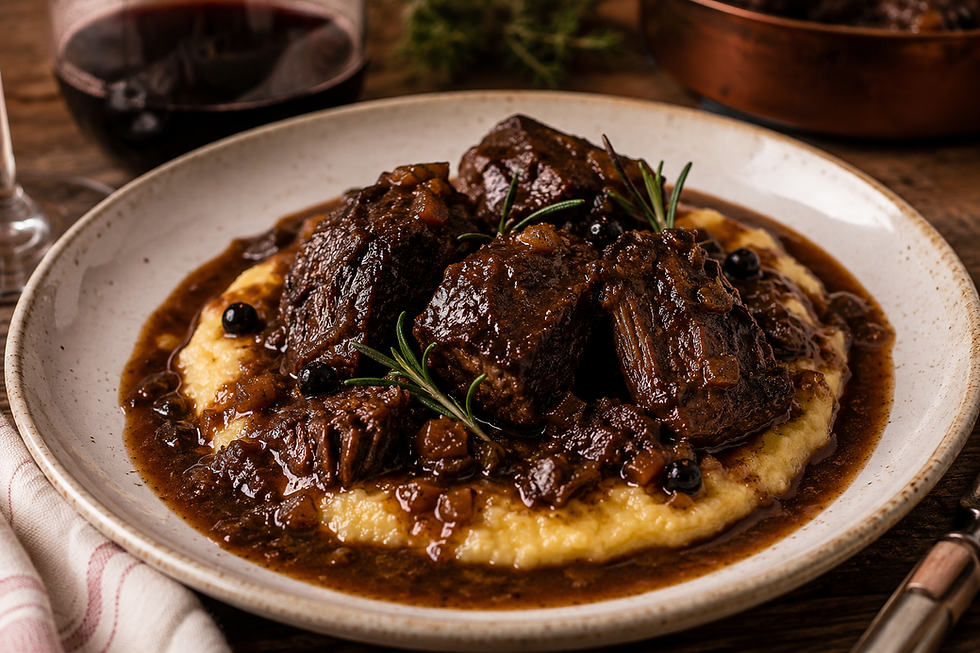
Warm the plates. Cold china chills a gelatin rich jus into a dull film within seconds, and this sauce sets faster than most. Take the slices out of the pan with a fish spatula, keeping each one flat and in the order it was cut, and lay two or three overlapping down the centre of the plate rather than fanning them apart. Overlapping keeps the interior warm and hides nothing worth seeing.
Spoon the jus over the meat so it glazes the surface and pools shallowly at the base, leaving the browned edge of the fat cap visible above the sauce. Do not flood the plate: the jus is concentrated and a thin coat says more than a pool. A small amount of chopped parsley and a few drops of good olive oil go on last. Soft polenta, mashed potato or braised lentils belong beside it. Anything crisp does not.
Professional Technique
Punta di petto is not one muscle, and every carving mistake made with it follows from assuming that it is. Two masses lie one on top of the other: a flat, even sheet underneath and a thicker, fattier dome above it, and the two are separated by a lamina of internal fat that runs the length of the piece. Their fibres do not run parallel. They meet at an angle of roughly thirty to forty five degrees, which means a slice taken straight across the full width of the roast crosses the grain correctly on one mass and runs along it on the other. Half of every plate is tender and half of it is stringy, and the cook almost always blames the braise.
The correction is mechanical. Once the meat is cooked, slide your fingers or the tip of a boning knife into the fat seam and lift the upper mass away from the lower one. They part cleanly, because the fat is a natural plane of release. Square off each piece, read its grain separately and slice each one across its own fibres. The lower sheet gives even rectangular slices; the upper dome is shorter and richer and takes a slightly thicker cut.
The other half of the problem is temperature, and almost nobody says it out loud. A brisket taken hot from the pot cannot be sliced at all, because the collagen that held it together has become gelatin and that gelatin is still fluid at cooking temperature. Nothing is supporting the fibres, so the blade pushes them apart instead of cutting them and the slab crumbles. Chill the brisket in its own braising liquid until it is cold and firm, and the gelatin sets and holds the meat together like glue. Slice it cold, with a long thin blade and no serration, into pieces about 1/4 inch (6 mm) thick, then lay the slices in the warm jus and bring them back to temperature there. They reach the table whole, glossy and intact, which is not achievable any other way.
Texture and Moisture Control
Three separate things happen inside the pot, at different temperatures, and all three have to finish. The seared crust supplies the Maillard compounds that the braising liquid then carries into the sauce. Collagen starts converting to gelatin above about 160°F (70°C) and needs hours at that temperature rather than minutes, which is why the target reading of 200°F (93°C) has to be held and not merely reached. Intramuscular fat in the upper mass renders across the same period and bastes the leaner sheet below it.
The flat is where moisture is lost, because it has little internal fat to defend itself. Keeping the liquid at a bare simmer and the fat cap facing up are the two defences that matter. A hard boil contracts the fibres and squeezes moisture out faster than gelatin can replace it.
Cooling the meat in its liquid reverses part of that loss. The muscle reabsorbs liquid as it cools, so a brisket chilled in its jus is visibly moister the next morning than one chilled dry on a tray.
Professional Mise en Place
Spread over two days, this becomes a straightforward service dish rather than a difficult one. Everything except the final warming is finished before anyone sits down.
Equipment and tools
Heavy oval Dutch oven with a tight lid, only slightly larger than the meat
Long thin slicing knife without serration, plus a boning knife for the fat seam
Fine mesh sieve, ladle and a wide saucepan for reducing the jus
Instant read thermometer and a thin metal skewer
Fish spatula for lifting the warmed slices
Prepared ahead
Brisket salted and refrigerated uncovered, 12 hours before cooking
Brisket braised and chilled in its liquid overnight, up to 3 days ahead
Jus strained, defatted and reduced, refrigerated separately
Brisket separated into its two masses and sliced cold, up to 6 hours ahead
Service setup
Slices laid flat and overlapping in a wide pan, jus poured over, lid on
Pan held over the lowest possible heat, never reaching a simmer
Plates warm, parsley chopped at the last moment
Spare jus kept hot and loose in a small pan for finishing the plates
Chef Tips
Buy the whole piece with both masses attached and the fat cap intact, and ask the butcher not to net it or tie it. A netted brisket cannot be opened along its internal seam, and that seam is the one thing this recipe depends on.
Mark the grain direction on each mass with a shallow scratch before searing. Once the crust is dark you will not be able to read the fibres, and guessing at that point undoes four hours of work.
Use a wine you would actually drink, and reduce it properly. A thin, sharp bottle does not improve over four hours, it concentrates, and the finished jus will taste of vinegar rather than fruit.
Weigh the meat before and after braising while you are learning the cut. A loss of around thirty percent is normal. Much more than that means the liquid ran too hot or the lid did not seal.
Common Mistakes
Carving the whole roast in one direction. The two masses have grains that meet at an angle, so a single straight cut is right on one and wrong on the other. Separate them along the fat seam first, then slice each one on its own.
Slicing the brisket hot. Gelatin is still fluid at cooking temperature and nothing holds the fibres together, so the meat crumbles under the blade. Chill it in its liquid and slice it cold.
Trimming the fat cap away. Without it the flat has no protection and dries out inside the first hour. Reduce it to 1/4 inch (6 mm) and leave it continuous across the piece.
Adding the stock before the wine has reduced. The alcohol never cooks off properly under a lid, and the finished jus keeps a thin sour edge that no amount of later reduction removes.
Braising at a boil to save time. Hard heat contracts the fibres and tears the roast apart before the collagen has finished converting. The surface of the liquid should barely move.
Wine Pairing
The jus here is gelatinous, savoury and concentrated rather than fatty, so the question is structure and acidity more than raw tannin. Serve these reds at 61 to 64°F (16 to 18°C).
Montepulciano d'Abruzzo Colline Teramane DOCG: The hillside version has the firmness and length the plain bottlings lack. Its dark plum fruit and soft powdery tannin settle inside the reduced jus rather than standing against it, while the moderate acidity stops the gelatin from coating the palate.
Aglianico del Vulture Superiore DOCG: Volcanic soil in Basilicata, and tannin and acid in equal measure. That combination cuts the rendered fat of the upper mass and leaves the mouth clean, while its smoky iron like savour picks up the seared crust. Give it air first.
Valpolicella Ripasso DOC: Refermented on Amarone skins, it carries a dried cherry sweetness and a glycerol weight that mirrors the sticky texture of the sauce. The bitter twist on the finish is the useful part, keeping the pairing from turning jammy.
Carmignano DOCG: Sangiovese with a legal share of Cabernet, and the Cabernet is why it belongs here. It brings a leafy green note that runs straight into the carrot and celery of the braising base, while the Sangiovese acidity lifts a plate that could sit heavy.
Cannonau di Sardegna DOC: This one works through flavour rather than structure. Its macchia character of myrtle and dried rosemary meets the herbs in the pot head on, and the tannin is moderate enough not to fight the meat. Choose a bottling without heavy oak.
Storage & Reheating
Refrigeration is part of the method here rather than an afterthought. The braised brisket keeps 3 days submerged in its unstrained liquid, and 4 days once sliced and covered with strained jus, at 40°F (4°C) or below. Always store it with liquid: kept dry, the slices lose moisture overnight and no amount of sauce puts it back afterwards.
For the freezer, portion the slices with enough jus to cover them completely and freeze for up to 3 months. Thaw overnight in the refrigerator, never at room temperature. Reheat covered over the lowest heat, or at 300°F (150°C), until the slices are hot through, and stop there. Anything that brings the jus back to a simmer tightens the fibres you spent four hours loosening. Like most braises, this one is better on the second day than the first.
Nutrition
Per serving, based on 8 servings:
Calories: 520 kcal
Total Fat: 30 g
Saturated Fat: 11 g
Trans Fat: 0.5 g
Unsaturated Fat: 17 g
Cholesterol: 145 mg
Sodium: 640 mg
Total Carbohydrates: 8 g
Fiber: 1 g
Total Sugars: 4 g
Added Sugars: 0 g
Protein: 46 g
Lactose: 0 g
Principal micronutrients: iron, zinc, vitamin B12, niacin, selenium, phosphorus, potassium
These figures are estimates. They move most with how far the fat cap is trimmed, how much of the set fat is lifted off the chilled jus and how much jus reaches each plate.


Comments