
Italian Braised Escarole | Scarola Brasata con Uvetta, Pinoli, Acciughe e Pangrattato Croccante
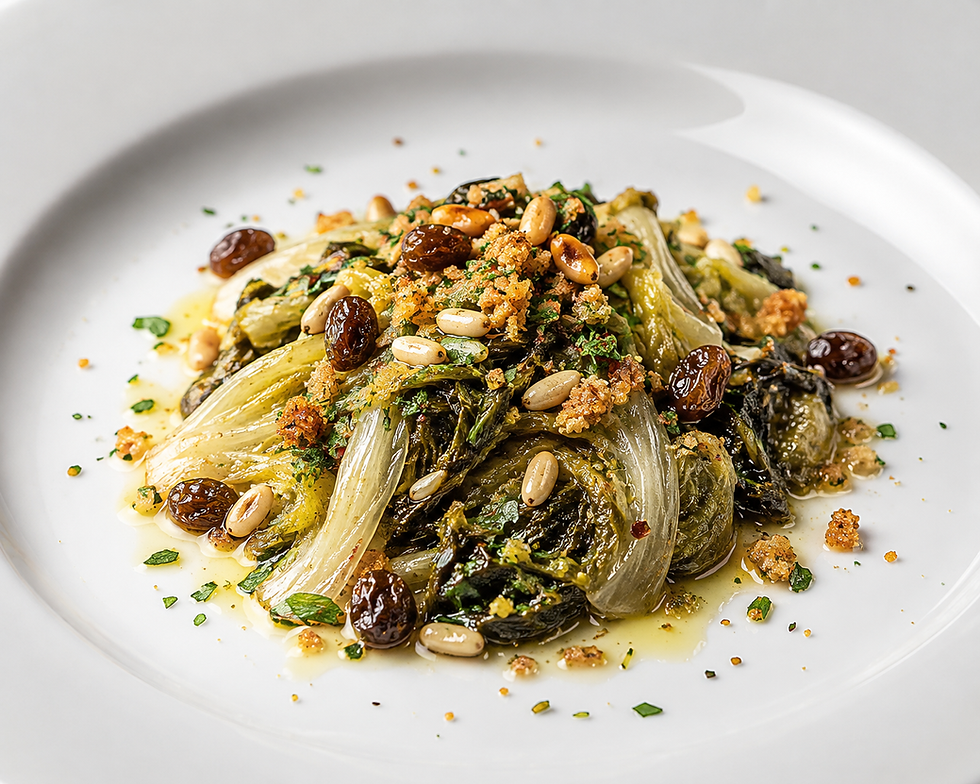
Scarola brasata is the green Naples cooks more than any other, and the version with raisins, pine nuts, anchovies and fried breadcrumbs explains why. Raw escarole is bitter, wet and enormous. A single covered pan answers all three problems at once: the leaves collapse to a fraction of their volume, the bitterness turns round and savoury, and the water they release becomes the sauce.
Everything else in the pan pushes against that bitterness from a different direction. Raisins bring sugar, vinegar brings acid, anchovies bring salt and depth, olives and capers a briny edge, pine nuts fat and a soft bite. Remove any one and the dish tilts, which is why the combination has survived unchanged for generations.
The pangrattato is the layer most cooks outside Naples leave off. Coarse crumbs of stale bread fried in oil with garlic and one anchovy go over the greens at the table, never in the pan, and they are the only crisp texture in an otherwise soft dish. In a kitchen with no cheese, this was the cheese.
Yield: 6 side servings. Prep: 25 minutes. Cook: 30 minutes. Total: about 55 minutes. Difficulty: easy to moderate. Course: contorno. Region: Campania, Naples and the vegetable plain behind it.
The Story
Escarole is a broad leaved winter chicory, grown on the flat rich ground of the Agro Nocerino Sarnese and around Acerra, the same plain that supplies Naples with tomatoes in summer. The heads sold in the city markets are tightly furled, pale gold at the heart and dark at the outer leaves, and that gradient matters: the outer leaves carry the bitterness, the heart is sweet and almost buttery, and a good pan of scarola carries both.
The dish that fixed this combination in Neapolitan memory is not a side dish but a pie. Pizza di scarola is the vigil food of Christmas Eve in Naples, a lidded pie of bread dough filled with escarole cooked exactly as it is here, with raisins, pine nuts, anchovies, Gaeta olives and capers. Families argue about whether the filling should carry more olives or more raisins, never about whether it should carry both.
Dried fruit with salted fish runs the length of the south, and it arrived through centuries of Mediterranean trade in raisins, nuts and spices rather than through any single conquest. Naples applied it to vegetables. The anchovies come salted in barrels from Cetara on the Amalfi coast, home of colatura, and the small purple Gaeta olive is cured in brine rather than lye, which is why it stays soft and faintly bitter. The fried crumb, mollica atturrata, belongs to the poorest end of the same kitchen, where stale bread was never thrown out.
Ingredients
For the escarole
Escarole heads, 3 large, about 3 lb (1.35 kg) untrimmed
Extra virgin olive oil, 1/4 cup (60 ml)
Garlic cloves, thinly sliced, 3
Salt packed anchovies, rinsed and filleted, 6 fillets
Crushed red pepper flakes, 1/2 tsp (1 g)
Dry white wine, 1/3 cup (80 ml)
Fine sea salt, 1/2 tsp (3 g), plus more for the blanching water
For the sweet and sour elements
Golden raisins, uva passa, 1/3 cup (50 g)
Warm water or dry white wine for soaking, 1/2 cup (120 ml)
Pine nuts, 1/4 cup (35 g)
Gaeta olives, pitted and torn in half, 1/3 cup (55 g)
Salt packed capers, rinsed and drained, 1 tbsp (10 g)
White wine vinegar, 2 tsp (10 ml)
For the crisp breadcrumbs
Day old country bread, crusts removed, 3 oz (85 g), torn into coarse crumbs
Extra virgin olive oil, 3 tbsp (45 ml)
Garlic clove, lightly crushed and left whole, 1
Salt packed anchovy, rinsed and filleted, 1 fillet
Fine sea salt, 1 small pinch
For finishing
Extra virgin olive oil, 1 tbsp (15 ml)
Flat leaf parsley, roughly chopped, 1 tbsp
Freshly ground black pepper, to taste
Preparation
Trimming and washing the escarole
Slice the root end off each head and discard any bruised leaves. Cut the large leaves crosswise into ribbons about 2 inches (5 cm) wide and leave the pale heart leaves whole. Escarole traps grit at the base of every leaf, so submerge it in cold water, swish hard and lift the leaves out rather than pouring the water off. Repeat until the sink stays clean, usually three changes.
Blanching for 90 seconds
Bring a large pot of well salted water to a fast boil, drop the escarole in for 90 seconds and push it under. Lift it into a colander and press gently with a ladle. The blanch takes the aggressive edge off the bitterness, fixes the colour and removes much of the water that would dilute the pan. Do not shock it in ice water, which leaves the leaves waterlogged.
Plumping the raisins and toasting the pine nuts
Cover the raisins with warm water or warm white wine for 15 minutes, until plump but not collapsing, then drain and keep a tablespoon of the liquid. Toast the pine nuts in a dry pan over medium low heat, shaking constantly, for 2 to 3 minutes until blond and fragrant, then tip them onto a cold plate at once.
Frying the pangrattato
Tear the bread into coarse uneven crumbs, stopping while they are still irregular. Warm the 3 tablespoons of oil in a small skillet with the crushed garlic and one anchovy fillet, pressing the anchovy until it dissolves. Remove the garlic once golden, add the crumbs and fry, stirring almost continuously, for 4 to 5 minutes until deep gold and audibly crisp. Salt lightly and drain on paper.
Melting the anchovies into the oil
Set a wide braising pan over medium low heat with the 1/4 cup of olive oil and the sliced garlic. Cook for about 2 minutes until the garlic is pale gold and nowhere near brown, then add the six anchovy fillets and the pepper flakes. Press them with a wooden spoon and keep the heat low: within two minutes they break down and the oil turns cloudy and savoury.
Braising the escarole
Add the blanched escarole in two or three additions, turning each through the anchovy oil before adding the next. Raise the heat, pour in the white wine and let it bubble for a minute. Season with the 1/2 teaspoon of salt, cover and braise for 12 to 15 minutes, lifting the lid twice to turn the leaves from the bottom up. They are ready when the thick white ribs give to a knife.
Adding the sweet and sour elements
Uncover and scatter in the drained raisins, toasted pine nuts, torn olives and rinsed capers, then add the vinegar and the reserved spoon of raisin liquid. Turn everything through gently without breaking the leaves. Cook uncovered for 4 to 6 minutes, which softens the raw edge of the vinegar. Taste only now, since the anchovies, olives and capers have already done the salting.
Reducing the pan and resting
There should be a small amount of dark concentrated juice in the pan, enough to gloss the leaves and pool slightly. If it is swimming, reduce uncovered for two minutes; if it has gone dry, add a tablespoon of water. Off the heat stir in the finishing oil and the parsley and let it stand 5 minutes.
Plating
Scarola brasata is served warm rather than hot, at around 140°F (60°C), and it is genuinely better that way. The bitterness reads heavier when the dish is scorching, and the raisin sweetness only comes forward once it has cooled a little. Warm the plates but do not heat them hard, since a very hot plate keeps driving moisture out of the greens.
For a family table bring it in the cooking pan or turn it into a shallow earthenware dish, lifting the leaves with tongs so they sit loose and high rather than compressed, and spoon the dark juice back over the top. Plated individually, use a shallow bowl so the juices stay gathered and build a loose mound of about 4 oz (115 g) per person, making sure each serving carries visible raisins, olives and pine nuts. Scatter the crumbs only once the dish is on the table.
Professional Technique
The central technique is the management of bitterness, and it happens in three places rather than one. Escarole carries bitter compounds concentrated in the outer leaves and in the white ribs. The 90 second blanch leaches part of them into water that is thrown away, the covered braise breaks more of them down under prolonged gentle heat, and the sugar in the raisins then works on perception rather than chemistry, since sweetness suppresses the perception of bitterness on the palate.
The second is the handling of the anchovy. A salt packed fillet is roughly a third salt by weight and carries a very high concentration of free glutamates built up over months in the barrel. Warmed slowly in oil below about 200°F (95°C), it disintegrates and those glutamates disperse through the fat, seasoning every leaf that later passes through it. Dropped into hot oil, the same fillet seizes, browns and throws off the sharp volatile compounds that people who say they dislike anchovies are actually describing.
Texture and Moisture Control
Escarole is roughly 94 percent water and almost all of it has to go somewhere. Three pounds of raw leaves reduce to about a pound cooked. The blanch removes the first portion, the covered braise releases the bulk, and the final uncovered minutes concentrate what remains into the small amount of dark glossy juice that coats the leaves. Judge it by tilting the pan: the liquid should run slowly and cling, not slosh.
Two structures have to survive, and they fail in opposite directions. The white ribs need enough time under the lid to go completely tender, because a rib that still snaps ruins a mouthful that is otherwise silky. That is what the lid is for: trapped steam cooks the ribs through without giving the leaves enough time to turn to paste. The crumbs need the reverse, total dryness, which is why they never meet steam.
Fat has a mechanical job here as well as a flavour one. The second spoonful of raw oil stirred in off the heat emulsifies lightly with the pan juices and gives them enough body to cling to the leaves instead of draining to the bottom of the dish.
Professional Mise en Place
This is an easy dish to cook and a slow one to prepare, because the washing takes real time. The braise is better the next day, so treat it as the prepared element and keep only the crumbs to the last minute.
Equipment and tools
Large sink or basin for washing, and a large colander
Large pot for the blanch, with a spider or slotted spoon
Wide braising pan with a lid, at least 12 inches (30 cm)
Small skillet kept for the crumbs alone
Long tongs, wooden spoon and a ladle for pressing the leaves
Prepared ahead
Escarole washed, cut and blanched, 1 day ahead, pressed and covered
Raisins plumped and pine nuts toasted, 1 day ahead, kept separate
Olives pitted and capers rinsed, up to 2 days ahead
Anchovies filleted and kept under a film of oil, up to 3 days ahead
The whole braise cooked and refrigerated up to 2 days ahead
Service setup
Braise held covered over the lowest heat or in a low oven
Pangrattato fried last and left uncovered away from the stove
Finishing oil, parsley and a pepper mill within reach
Serving dish warm, not hot, and tongs rather than a spoon
Crumbs carried to the table separately and scattered there
Chef Tips
Buy salt packed anchovies in the tin rather than oil packed fillets in a jar. They need 10 minutes under running water and a thumb run along the backbone, and they taste of anchovy rather than of the cheap oil they sat in. Cover the opened tin with coarse salt and it keeps for months.
Taste one raw outer leaf from each head before you start. Escarole varies enormously in bitterness with the season and the grower, and a head cut after a hard frost is sweeter than one grown in mild weather. If the raw leaf is aggressive, blanch for 2 minutes and add an extra tablespoon of raisins. If it is mild, blanch for 60 seconds and change nothing.
Make double the pangrattato. It keeps for a week in an airtight jar at room temperature once completely cold, and it improves roast vegetables, braised beans and any grilled fish. Never refrigerate it, since the humidity softens it within hours.
Cook this the day before you want to eat it. Braised escarole genuinely improves overnight: the raisins keep releasing sugar, the anchovy salt distributes evenly, and the sharp edge of the vinegar rounds out. Rewarm gently and fry the crumbs fresh.
Common Mistakes
Washing the escarole badly. Grit sits at the base of every leaf and one gritty mouthful destroys the dish more surely than any seasoning error. Lift the leaves out of the water rather than pouring the water through them, and keep changing it until the sink stays clean.
Frying the anchovies instead of melting them. Dropped into hot oil they seize, brown and turn sharply fishy. Keep the oil at a gentle warmth, press the fillets with a wooden spoon and let them dissolve slowly into a cloudy savoury base.
Skipping the blanch to save a pot. Raw escarole taken straight into the braise releases so much water that the pan boils rather than braises, and the bitterness stays at full strength.
Adding the vinegar at the start. Acid added early slows the softening of the thick white ribs and leaves them stubbornly firm, and the harsh edge cooks in rather than off. It belongs in the last uncovered minutes, with the raisins.
Stirring the breadcrumbs into the pan. They absorb the juices immediately and turn to paste, losing the only crisp element the dish has. They go on at the table, never in the kitchen.
Wine Pairing
Falanghina del Sannio DOC: The Campanian everyday white and the most natural match on the table. Its brisk green apple and citrus acidity cuts through the olive oil and the fried crumbs, while the faintly bitter almond note it finishes on meets the chicory bitterness head on and reads as agreement rather than conflict.
Greco di Tufo DOCG: Grown on volcanic soils inland from Naples and the most structured white in Campania. Its smoky mineral grip and thick almost oily texture handle the combined salt of anchovies, capers and olives, which would leave a thinner wine tasting sour. Its ripe stone fruit answers the raisins without adding sweetness.
Fiano di Avellino DOCG: The choice when the balance is tipped towards the raisins. Fiano carries an unmistakable toasted hazelnut and dried pear character that runs alongside the pine nuts, and its moderate acidity and waxy body cushion the vinegar instead of amplifying it.
Lacryma Christi del Vesuvio DOC: The bottle from the slopes of the volcano and the one with the most local logic. In its dry white form it is saline and faintly ashy, and that salinity makes the anchovy read as savoury depth rather than as salt. Serve it cool but not cold, around 50°F (10°C).
Etna Bianco DOC: A Sicilian alternative with a sharper mineral line than anything in Campania. Carricante gives high fixed acidity, a citric attack and a dry stony finish, exactly what a dish of olive oil, fried bread and dissolved anchovy needs to reset the palate. The driest option here, and the best if you have pushed the vinegar.
Storage & Reheating
The braise keeps in an airtight container in the refrigerator for 4 days and improves for the first two. Press it down gently so the pan juices cover the surface, which stops the top layer drying and oxidising. Do not leave it in an uncovered aluminium bowl, since the vinegar and salt pick up a metallic edge within a day. The crumbs go in a separate airtight jar at room temperature.
Rewarm in a covered pan over low heat with a tablespoon of water, turning the leaves once or twice, for about 5 minutes. A microwave works at half power in 30 second bursts but overheats the olives. Do not rewarm twice. If the juices have been absorbed, add a teaspoon of oil and a teaspoon of water and swirl the pan off the heat to bring the gloss back.
Escarole freezes better than most greens because it is already fully collapsed and carries plenty of oil. Freeze it without the pine nuts, which go soft, in a flat sealed bag for up to 3 months and thaw overnight in the refrigerator. Add freshly toasted pine nuts and fresh crumbs at the end, and never freeze the pangrattato.
Nutrition
Per serving, based on 6 side servings, including a portion of the breadcrumbs:
Calories: 245 kcal
Total Fat: 18 g
Saturated Fat: 2.5 g
Trans Fat: 0 g
Unsaturated Fat: 15 g
Cholesterol: 5 mg
Sodium: 560 mg
Total Carbohydrates: 17 g
Fiber: 5 g
Total Sugars: 8 g
Added Sugars: 0 g
Protein: 5 g
Lactose: 0 g
Principal micronutrients: vitamin K, vitamin A, folate, vitamin C, potassium, manganese, iron, magnesium
These figures are estimates. Sodium moves most, since it depends entirely on how thoroughly the salt packed anchovies and capers were rinsed.


Comments