
Italian Bronte Pistachio Semifreddo | Semifreddo al Pistacchio di Bronte
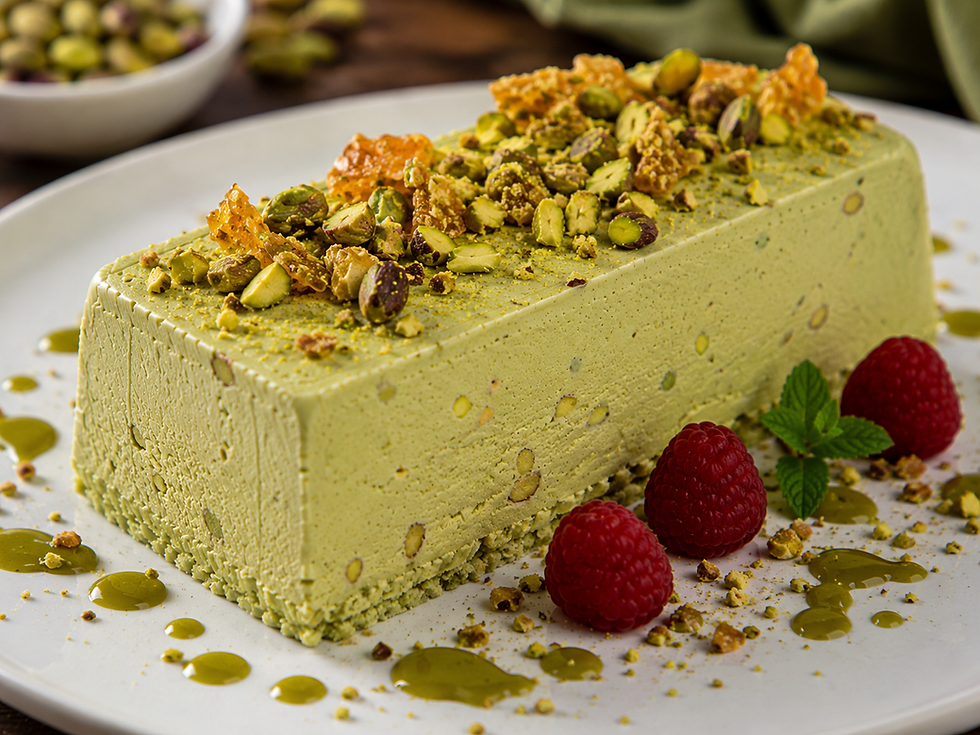
A semifreddo made with pistachio di Bronte is judged first with the eyes. That deep living green is the reason the nut costs what it costs, and it is also the most fragile thing in the recipe, because the pigment that produces it does not survive heat. Everything below is built around protecting the colour, from how the nuts are peeled to the moment the paste meets the base.
Yield: 8 to 10 slices from a 9 by 5 inch loaf tin. Prep: 50 minutes. Cook: 15 minutes. Freeze: 6 hours minimum. Total: about 7 hours 15 minutes. Difficulty: intermediate. Course: dolce. Region: Sicily, Bronte on the western slope of Etna.
The Story
Bronte sits on the western flank of Etna, and the pistachio groves there grow out of sciara, the broken black lava left by old flows. It is terrible ground for almost everything else. The trees are grafted onto wild terebinth that pushes its roots into the fissures of the rock, and because there is no soil to plough and no slope a machine can climb, the grove is worked the way it was two centuries ago. Yield per tree is a fraction of what an irrigated orchard on flat land gives. The lava holds the day's heat and releases it slowly at night, and that long warm cycle is what concentrates sugar and oil in the kernel. The Arabs brought the tree here, and the dialect name, frastuca, still carries the Arabic word inside it.
The harvest happens every other year. Growers strip the flower buds in the off year so the tree puts everything into the following crop, which means a Bronte grove yields once every twenty four months and the whole town works through September when it does. The nuts are picked by hand into baskets, spread on terraces to dry, then hulled and shelled, and the shelling is done largely by women working in rooms off the main street for a few intense weeks. The green kernel inside is long and slim rather than round, with a thin violet skin over it, and the flavour is resinous and faintly sweet rather than simply nutty. The DOP was granted in 2009 to protect all of it, and the town holds a sagra every second autumn when the crop comes in.
Semifreddo is where a Sicilian household uses that pistachio when there is no ice cream machine on the counter, and it is not a compromise. Sicilian pastry has always leaned on whipped egg and cream frozen in a mould, from the old spumoni of the Palermo pastry shops to the loaves cut at family tables on a hot August evening. Pistachio belongs in that tradition more naturally than in any other, because the nut brings its own fat and its own perfume and needs almost nothing added to it. In Bronte itself the pistachio goes into everything, from the pesto sold in jars to the filling of cannoli and the crust of a roast, but the frozen loaf shows the raw nut most honestly, since nothing in it is cooked.
Ingredients
For the pistachio paste
Raw shelled pistachio di Bronte, 9 oz (255 g)
Granulated sugar, 2 tbsp (25 g)
Fine sea salt, 1/4 tsp (1.5 g)
For the semifreddo base
Egg yolks, large, 5
Granulated sugar, 1/2 cup plus 2 tbsp (125 g)
Water, 3 tbsp (45 ml)
Heavy cream, cold, 1 3/4 cups (420 ml)
Vanilla bean, split, 1/2
For the pistachio croccante
Raw shelled pistachio di Bronte, chopped, 2 oz (55 g)
Granulated sugar, 1/3 cup (65 g)
Water, 1 tbsp (15 ml)
Flaky sea salt, 1 pinch
For finishing
Raw shelled pistachio di Bronte, 1 1/2 oz (40 g)
Whole milk, 5 tbsp (75 ml)
Confectioners sugar, 2 tbsp (15 g)
Extra virgin olive oil, mild, 1 tsp (5 ml)
Candied orange peel, finely diced, 1 tbsp, optional
Preparation
Step 1
Blanch and peel the pistachios, and stop there. Boil a small pan of water, drop in the 9 oz (255 g) of kernels and count 45 seconds, no longer. Drain them, tip them into iced water, then rub the violet skins away between two clean cloths. Dry them on a tray for 20 minutes. Do not put them in the oven and do not toast them: the point of this recipe is the raw kernel.
Step 2
Grind the paste cold. Put the peeled dry kernels in the freezer for 20 minutes along with the bowl and blade of the food processor. Grind them with the 2 tbsp (25 g) sugar and the salt in five second pulses, scraping down between each, until you have a dense oily paste. Touch the bowl every minute, and if it is warm return everything to the freezer for ten minutes.
Step 3
Make the croccante. Put the 1/3 cup (65 g) sugar and the water in a small heavy pan over medium heat and let it caramelize to a pale amber without stirring, around 340°F (170°C). Off the heat, stir in the chopped nuts and the salt, pour it onto baking paper and press it thin with an oiled spoon. Leave it to set hard, break it into shards and seal it in a tin.
Step 4
Boil the syrup. Combine the 125 g sugar and the 3 tbsp (45 ml) water in a small pan, brush the inside wall down with wet fingers and boil it without stirring to 240°F (115°C) on a clipped thermometer. While it climbs, start the yolks and the scraped vanilla seeds in a stand mixer on medium speed so they are pale by the time the syrup is ready.
Step 5
Whip the base and cool it right down. With the mixer running, pour the syrup in a thin steady stream down the inside wall of the bowl, never onto the whisk, which throws hardened sugar threads around the sides. Raise the speed and whip 8 to 10 minutes. The base is ready when it holds a ribbon and the bowl feels no warmer than your hand, near 90°F (32°C).
Step 6
Fold in the pistachio paste. Add the cold paste to the cooled base in two additions, folding with a large spatula from the bottom of the bowl up through the middle. The paste is stiff and the base is light, so give each addition a full minute rather than beating it smooth. Taste it now: pistachio and cream with the sugar behind both, and a clear soft green.
Step 7
Whip the cream and fold in three. Whip the cold cream only to soft peaks, the stage where the whisk leaves a trail that slumps back within two seconds. Fold a third in firmly to loosen the mixture, then the second third gently, then the last with as few strokes as you can manage. Stop while faint pale streaks remain.
Step 8
Fill the tin and freeze. Line the loaf tin with plastic film with a generous overhang on all sides. Pour the mixture in, rap the tin on the counter three times to release large air pockets, smooth the top and fold the film over. Freeze at least 6 hours and preferably overnight, on a level shelf away from the door. Make the sauce on the day: blitz the 40 g of nuts with the milk, sugar and oil until smooth.
Plating
Take the loaf from the freezer 8 to 10 minutes before cutting and leave it wrapped on the counter. Chill the plates instead of warming them. Unfold the film, invert the tin onto a board, lift it away and peel the film off in one movement so the surface stays matte.
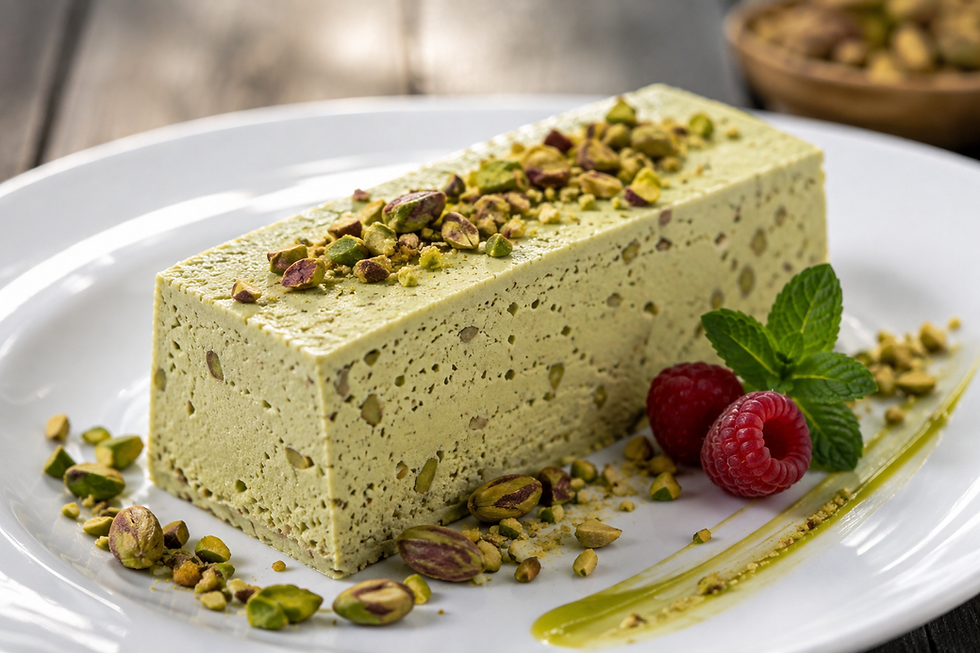
Cut with a long thin blade dipped in hot water and wiped dry between every slice, in one continuous downward stroke rather than a sawing action. Aim for slices about 1 inch (2.5 cm) thick. Lay each one flat on a cold plate, spoon a line of pistachio sauce along one side rather than over the top, and stand two shards of croccante against the slice so they stay crisp. A few diced pieces of candied orange peel and nothing else. The green is the decoration.
Professional Technique
The green of a Bronte pistachio is chlorophyll, the same pigment that colours a leaf, and it is fragile in exactly the ways a pastry kitchen is dangerous. At the centre of each chlorophyll molecule sits an atom of magnesium. Heat and oxygen displace it and put a hydrogen atom in its place, and the molecule that results is brown. That single substitution is why a pistachio paste roasted for fifteen minutes, or held warm through service, drifts from bright green to dull olive brown. Nothing reverses it.
So the method protects the pigment at every stage instead of trying to repair it. The nuts are blanched for 45 seconds, long enough to slip the violet skin and far too short to cook anything, then dropped into iced water to kill the carry over heat. They are ground frozen, with the bowl and blade frozen too, because a processor working on oily nuts generates real heat inside a sealed chamber. And the paste never touches a flame or a hot pan: it goes into the whipped base only once that base is down to roughly 90°F (32°C).
Learn to read the colour, because plenty of commercial pistachio paste is corrected. A natural Bronte green is muted and slightly grey in the shadows, it varies visibly from spoonful to spoonful, and it dulls a little as the semifreddo sits. A coloured paste is uniform, saturated, faintly blue in the green, and holds its shade for a week. Smear a thin film on a white plate: the natural one shows flecks of skin and a fat sheen, the corrected one a flat wash. Read the label, since almond is the usual filler under that colour.
Texture and Moisture Control
The pistachio itself does most of the textural work here, and it does it through fat. A Bronte kernel runs close to 55 percent oil, so 9 oz (255 g) of paste brings a great deal of soft fat into the mixture, and that fat stays plastic at freezer temperature instead of setting hard. It is why this semifreddo cuts cleanly straight from the freezer while a fruit version needs twenty minutes of standing. The trade off is that the same fat weighs the mixture down if the air is knocked out.
Air is the other half. The whipped yolk base and the soft peak cream are both foams, and every stroke of the spatula after the mixture looks uniform costs volume that cannot be whipped back in. Cream taken past soft peaks is as damaging, breaking into grains under folding.
The croccante fails fastest of all. Caramel is hygroscopic and pulls moisture from the air, so shards left uncovered on a humid afternoon turn tacky within the hour. Keep them sealed and set them on the plate at the last second. Serve the slices at around 5°F (minus 15°C), cold enough to hold their edges and warm enough for the perfume to come through.
Professional Mise en Place
The loaf has to be made the day before, so the work splits cleanly between a long session of preparation and a very short one at service.
Equipment and tools
Stand mixer with whisk, plus a food processor with the bowl and blade frozen
Digital sugar thermometer and a small heavy bottomed pan
Loaf tin, 9 by 5 inch (23 by 13 cm), and plastic film
Large flexible spatula, long thin slicing knife, jug of hot water
Prepared ahead
Semifreddo moulded and frozen, 1 day ahead and up to 3 weeks
Croccante made up to 1 week ahead, sealed in a tin with a dry paper towel
Pistachio sauce blitzed on the day of service, kept covered and cold
Candied orange peel diced and kept in a small sealed container
Service setup
Plates chilled in the refrigerator, never warmed
Loaf out of the freezer 8 to 10 minutes before the first slice, still wrapped
Knife standing in hot water with a clean cloth beside it
Sauce in a spoon or small jug, croccante sealed until the moment of plating
Chef Tips
Buy whole raw kernels and peel them yourself. Pistachios sold already peeled have almost always been blanched hot and dried in warm air, and that is enough to dull them before you start. Nuts still in the shell keep best of all.
Weigh the paste after grinding rather than trusting the weight of the nuts. Some sticks to the bowl and the blade, and 30 g short means a semifreddo that tastes politely of pistachio instead of aggressively of it.
Check the cooled base with the back of your wrist before the paste goes in. Body temperature is the ceiling. If the bowl feels warm at all, sit it in iced water for five minutes with the whisk turning slowly.
Freeze the loaf on a level shelf at the back of the freezer, never in the door. Temperature swings from opening the door build coarse crystals at the surface, and the first slice is the one that shows it.
Common Mistakes
Toasting the pistachios. The commonest way this dessert is ruined, and irreversible: fifteen minutes in a hot oven turns the paste olive brown and nothing brings the green back. Blanch 45 seconds, peel, keep them raw.
Grinding the nuts warm. A processor running on oily kernels heats the bowl fast, dulling the colour and separating the oil into a greasy slick. Freeze the nuts, the bowl and the blade, and pulse in short bursts.
Taking the syrup past 240°F. Boiled beyond 240°F (115°C) the syrup sets the base too firm and the semifreddo turns chewy rather than yielding. Use a thermometer and pull the pan the moment it reads.
Whipping the cream to stiff peaks. Stiff cream cannot be folded without breaking into grains, leaving a buttery texture instead of a smooth one. Stop at soft peaks, where the whisk trail slumps back in two seconds.
Overfolding to a perfectly uniform mixture. Every stroke after the streaks disappear crushes air cells you cannot replace, and the loaf freezes dense. Stop while faint pale streaks remain.
Plating the croccante early. Caramel absorbs humidity within minutes and goes tacky, losing the crack it is there for. Keep it sealed and place it as the plate leaves the kitchen.
Wine Pairing
Moscato di Noto DOC: The closest match on the island. Its orange blossom and elderflower aromatics sit above the resinous perfume of the pistachio rather than competing with it, and the residual sugar stays moderate enough not to bury a dessert this restrained. Serve at 46°F (8°C) to keep the acidity forward against the cream.
Malvasia delle Lipari DOC: Dried on mats in the Aeolian sun, it brings candied apricot and dried fig sweetness with a saline thread underneath, and that salinity is why it works: it echoes the flaky salt in the croccante and stops the pairing turning cloying. Its glycerol weight matches the fat of the pistachio.
Marsala DOC: Choose a Superiore dolce and it becomes the technical pairing of the list. Oxidative ageing gives Marsala a walnut and toasted almond character that meets the pistachio on shared ground, while the fortified alcohol cuts the cream and resets the palate. Serve a small measure at 54°F (12°C).
Vin Santo del Chianti Classico DOC: The mainland alternative, for anyone who finds Sicilian sweet wines too floral. Long ageing in caratelli under the roof gives a dry finishing edge and a nutty depth that reads almost savoury against a nut dessert. Its acidity is high for the sugar level, which carries a cream base without heaviness.
Moscato d'Asti DOCG: The lightest option, and the right call after a long meal. Low alcohol, gentle pressure and grapey freshness scrub against the fat of the pistachio, and the fine bubble lifts a frozen dessert that would otherwise coat the palate. Serve very cold, opened at the table.
Storage & Reheating
The moulded loaf keeps in the freezer for up to 3 weeks, wrapped in its film and sealed inside a freezer bag or rigid container. The second layer matters: pistachio fat picks up freezer odours quickly.
Never let a semifreddo thaw and refreeze. A slice left out for half an hour and returned to the freezer sets with coarse grainy crystals and a collapsed texture. Cut only what you need and get the rest back into the cold, rewrapped tightly against the cut face.
The croccante keeps a week in a sealed tin with a dry paper towel and must never go in the refrigerator, where it turns sticky at once. The pistachio sauce keeps covered and cold for 2 days, thickening slightly, so loosen it with a teaspoon of cold milk just before serving.
Nutrition
Per serving, based on 9 slices from the loaf:
Calories: 480 kcal
Total Fat: 36 g
Saturated Fat: 14 g
Trans Fat: 0 g
Unsaturated Fat: 21 g
Cholesterol: 150 mg
Sodium: 95 mg
Total Carbohydrates: 33 g
Fiber: 3 g
Total Sugars: 28 g
Added Sugars: 24 g
Protein: 9 g
Lactose: 2.1 g
Principal micronutrients: vitamin B6, thiamine, copper, manganese, phosphorus, potassium, vitamin A, lutein
These figures are estimates and move with the size of the slice and the amount of sauce and croccante served alongside it.



Comments