
Italian Pistachio Semifreddo | Semifreddo al Pistacchio
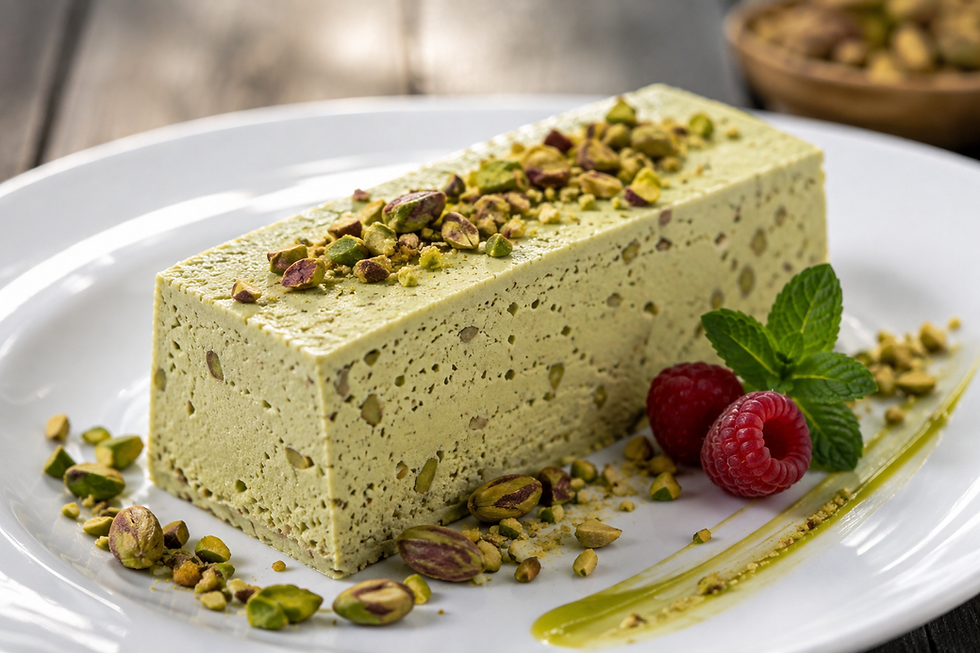
Semifreddo al pistacchio is what a Sicilian kitchen makes when it wants the flavour of pistachio gelato and does not own a gelato machine. A cooked egg base, whipped cream and a heavy spoonful of pure pistachio paste go into a loaf tin and into the freezer, and what comes out slices like a terrine and melts like ice cream.
The whole difficulty sits in one place: getting that dense, sticky paste evenly through a light foam, before the cold makes the mistake permanent.
Yield: 8 servings from a 9 by 5 inch (23 by 13 cm) loaf tin. Prep: 40 minutes. Cook: 12 minutes. Freeze: 6 hours minimum. Difficulty: intermediate. Course: dessert. Region: Sicily, around Etna.
The Story
Pistachio came to Sicily with the Arabs and settled on the black volcanic soil around Etna, where the trees root in fractured lava and crop properly only every second year. What turned the pistachio into a pastry ingredient rather than a nut eaten by the handful was not the harvest, though, but the mill. From the late nineteenth century the workshops of Bronte, Adrano and Biancavilla began grinding shelled kernels into a smooth paste, and that paste, sold in tins, is what carried pistachio into the pastry kitchens of Catania, Messina and Palermo. A confectioner no longer had to blanch, peel and grind his own nuts. He bought a tin.
Semifreddo arrived from the opposite direction, out of the home kitchen and the trattoria rather than the laboratory. Gelato needs a churn that keeps the mass moving through the whole of its freezing; semifreddo needs a bowl, a whisk and a freezer compartment. That made it the dessert of every restaurant that wanted something frozen on the card without buying a machine, and of every household that acquired a freezer through the middle of the twentieth century. By the nineteen sixties it was the standard Italian answer to dessert for eight people on a Sunday.
The two met naturally, and for a reason that has more to do with chemistry than with geography. Pistachio paste is roughly half fat, and fat is what carries flavour through cold. A frozen dessert mutes almost every aroma put into it, and the ones that survive best are the fat soluble ones: vanilla thins out, citrus disappears, pistachio holds. The paste also brings its own colour, a dull grey green nothing like the bright green of industrial products, and a faint tannic bitterness, the only thing standing between a sweet frozen cream and mere sweetness.
In Sicily the dessert is served without ceremony: made in a loaf tin lined with film, frozen overnight, turned out and cut at the table with a warmed blade, sent out with nothing on the plate but chopped pistachio. That restraint is the correct reading of the dish. The paste costs what it costs, and the point of making it is to taste it.
Ingredients
The paste is the only ingredient here worth real money, and the only one with no substitute.
For the pâte à bombe
Egg yolks, large, 6
Granulated sugar, 3/4 cup (150 g)
Water, 3 tbsp (45 ml)
Fine sea salt, 1 small pinch
For the pistachio cream
Pure unsweetened pistachio paste, 5 oz (140 g)
Heavy cream, 36 percent fat, 2 cups (480 ml), very cold
Whole milk, 2 tbsp (30 ml)
For the pistachio croccante
Shelled unsalted pistachios, 3 oz (85 g)
Granulated sugar, 1/3 cup (65 g)
Water, 1 tbsp (15 ml)
Fine sea salt, 1 small pinch
Neutral oil, for the tray
For finishing
Shelled pistachios, coarsely chopped, 2 tbsp (16 g)
Flaky sea salt, a few grains per plate
Buy paste whose label lists pistachios and nothing else. Products sold as pistachio cream are sweetened spreads built on milk powder and vegetable fat, with perhaps a tenth of their weight in nut, and they give a pale sweet loaf with no pistachio flavour in it at all. True paste is stiff, dark and separated under a layer of its own oil in the tin, and has to be stirred back together before you weigh it.
Preparation
Cooking the pistachio croccante
Oil a small tray and set it beside the stove: there are only seconds to work once the caramel is ready. Put the sugar and water in a small heavy pan, swirl once and cook over medium heat without stirring until the syrup is the colour of dark honey, around 340F (170C). Add the pistachios and the salt, stir hard for five seconds to coat them and tip the mass onto the tray. Spread it thin with an oiled spoon, let it set about 15 minutes, then chop it to the size of rice grains.
Whipping the pâte à bombe
Put the yolks and the salt in a stand mixer and start the whisk on medium. Cook the sugar and water to 250F (121C) on a probe thermometer. With the mixer running, pour the syrup down the inside of the bowl in a thin steady stream, clear of the whisk, then raise the speed and whip 6 to 8 minutes, until the mass triples, pales and holds a ribbon off the whisk. Stop while the bowl is still warm to the hand, around 100F (38C). You need that warmth next.
Loosening the pistachio paste
Stir the paste in its tin until the separated oil is worked back in, then weigh it into a bowl. Add the milk and two generous spoonfuls of the warm pâte à bombe and work the three together with a small whisk, pressing rather than stirring, until the mixture is glossy and uniform with no dark specks left in it. Add two more spoonfuls and whisk again. Only when it pours off the whisk in a smooth ribbon do you scrape it back into the rest of the pâte à bombe and fold it through. Cool the base to room temperature, about 20 minutes.
Whipping the cream to soft peak
Whip the very cold cream in a chilled bowl to soft peaks only, the stage where the peak folds over as the whisk lifts instead of standing upright. It should still look wet. Cream taken to stiff peaks has begun breaking its fat into butter grains, and in a frozen dessert those grains read as a greasiness no folding removes.
Folding base and cream together
Whisk one third of the cream briskly into the pistachio base until the two are the same density. Then fold that lightened base into the rest of the cream in two additions, cutting down through the centre with a large spatula, sweeping along the bottom and turning the mass over, a quarter turn of the bowl between strokes. Twenty strokes is enough. Stop the moment the colour is even.
Layering and freezing the loaf
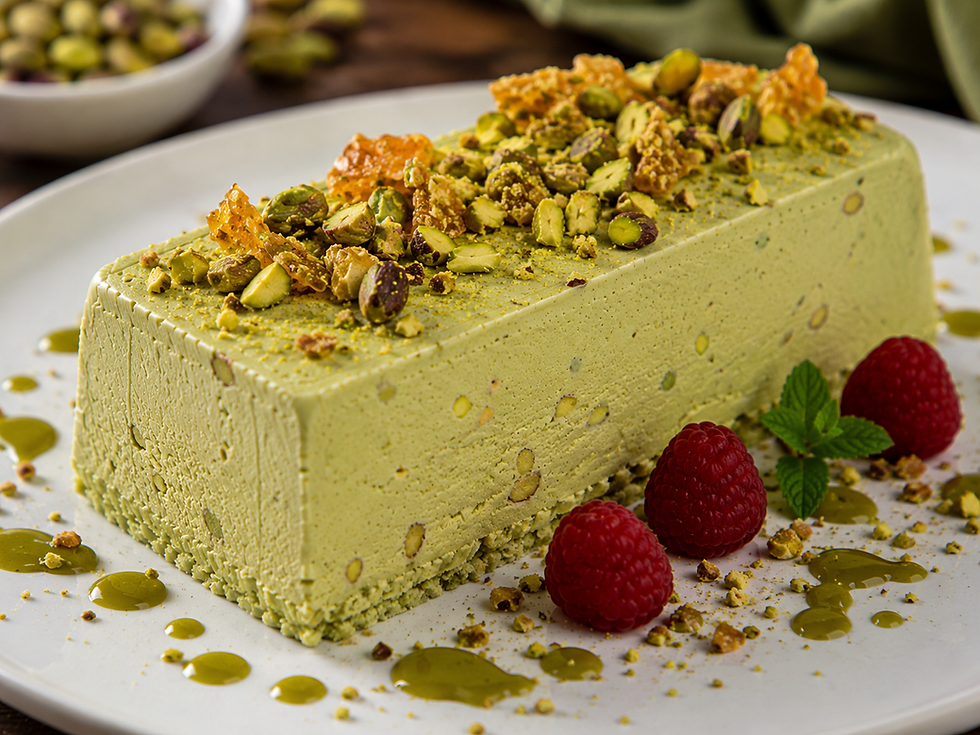
Line the loaf tin with cling film, overhanging on all four sides. Spoon in half the mixture and level it. Scatter two thirds of the croccante over the surface in an even seam, half an inch (1 cm) clear of the walls so the slices show a clean band and not a crumbling edge. Add the rest, level the top, tap the tin twice on the bench and fold the film over. Freeze at least 6 hours, preferably overnight.
Turning out and slicing
Move the tin to the refrigerator 15 minutes before service. Unfold the film, invert the loaf onto a cold board, peel the film off and cut with a long thin blade dipped in hot water and wiped dry between slices. Press straight down rather than sawing, which drags the praline and tears the cut face.
Plating
Plates go into the freezer for ten minutes before service, not the refrigerator. A slice loses its edges in about four minutes on a room temperature plate, and the first thing to go is the clean line of the praline seam.
Lay the slice flat rather than propping it up, slightly off centre, with the seam running across the plate so the diner sees the band of caramel and nut before tasting it. Scatter the remaining croccante and the chopped pistachios along one side only. Two or three grains of flaky salt on the surface sharpen the nut and cut the sugar. Nothing else belongs here: no sauce, no mint, no cocoa. Serve at once, and send any second helping out as a second round rather than two slices on one plate.
Professional Technique
The technique that decides this dessert is the slackening of the pistachio paste, and it is the principle of tempering: a dense mass is never added straight to a light one, it is brought most of the way towards it first. Pure paste at room temperature is stiff, tacky and roughly half fat. Drop it whole into a whipped base and it does not disperse. It knots. Each knot pulls foam around itself and sets as a small rubbery nugget, while the base around it stays pale and carries no flavour at all.
Taking two spoonfuls of the warm pâte à bombe into the paste first changes what you are handling. The syrup and the water in the yolks thin it; the residual heat, only around 100F (38C), softens its fat enough to flow. You are building a dilute emulsion, and once the paste is fluid it disperses into a far larger volume with almost no work. The reverse order fails: cold paste into cold cream only makes smaller lumps.
The timing is absolute because a lump in a semifreddo is permanent. In a sauce you can go on whisking over heat until it dissolves. Here, once the base has cooled, the paste is below the melting range of its own fat and is a solid. Once cream is folded in, whisking is no longer available: thirty more strokes deflate the foam long before they break a knot. Once the loaf is frozen no step is left at all. Every lump you can see in a slice was set in place in the thirty seconds when the paste was added.
Texture and Moisture Control
Semifreddo stays soft at freezer temperature because sugar, fat and air all interfere with the growth of ice crystals, and the ratio here is tuned to slice cleanly at 0F (minus 18C) while still melting on the tongue. Cut the sugar to make it less sweet and the loaf freezes into a brick that shatters under the knife. Drop the cream below 36 percent fat and the water in it has nothing holding it, and the texture turns grainy within two days.
Air is the variable you control by hand, and the window is narrow at both ends. Cream whipped too little leaves a dense, heavy slice; cream whipped too far and folded too long collapses in the tin and weeps a thin layer of liquid at the bottom as it freezes. Aim for a mixture that mounds softly in the spoon and settles level within a few seconds, then freeze it at once: the foam drains the moment it stops being worked.
After freezing, moisture control is mostly about the croccante. Caramel is hygroscopic and pulls water from whatever it touches, so the seam softens slowly inside the loaf and the garnish softens fast on the plate. Keep the finishing croccante sealed and dry and scatter it at the last second.
Professional Mise en Place
Nothing in this dessert happens at service except slicing, which means the whole of the work is mise en place and the whole of the risk is in the two minutes around the paste.
Equipment and tools
Stand mixer with whisk, plus a second chilled bowl for the cream
Probe thermometer that reads to 350F (175C)
Small heavy saucepan for the syrup and a second for the caramel
Loaf tin, 9 by 5 inch (23 by 13 cm), and cling film
Large flexible spatula and a long thin slicing knife
Prepared ahead
Croccante, up to 2 weeks ahead, sealed and dry at room temperature
Paste stirred smooth in its tin and weighed out, on the day
Loaf assembled and frozen, 1 day to 3 weeks ahead
Pistachios for finishing chopped on the day of service
Service setup
Plates in the freezer, 10 minutes minimum
Jug of hot water and a clean cloth beside the board for the knife
Loaf moved to the refrigerator 15 minutes before the first slice
Croccante and chopped pistachios in sealed containers within reach
Chef Tips
Weigh the paste, never spoon it. It is sticky enough that a heaped tablespoon carries half again what you intend, and 20 percent too much gives a loaf that freezes hard and tastes oily.
Work the separated oil back into the tin before weighing. The oil that rises to the top is pistachio fat, and if you leave it behind you are weighing out solids and the paste you use will behave like sand.
Cut the loaf cold and let the slices sit, rather than softening the loaf and then cutting it. Fifteen minutes in the refrigerator makes it sliceable; three minutes on a cold plate brings a slice to eating temperature. Softening the whole loaf on the bench gives one good slice and seven ragged ones.
If the paste still shows specks after slackening, push the mixture through a fine sieve before it meets the cream. It costs a minute at the only point in the recipe where a correction is still possible.
Common Mistakes
Adding the paste straight into the finished base. It knots instantly and no amount of folding recovers it. Slacken it with the milk and a little warm pâte à bombe until it flows off the whisk.
Letting the pâte à bombe cool completely before using it. Cold base and cold paste never combine smoothly. Take the spoonfuls while the bowl is still warm, then cool the rest.
Whipping the cream to stiff peaks. The fat breaks into butter grains and the slice reads greasy. Stop at the soft peak that folds over as the whisk lifts.
Using sweetened pistachio cream instead of paste. The result is a pale sweet loaf with no pistachio flavour that freezes too soft. Read the label.
Scattering the croccante right up to the walls of the tin. The praline sits against the film, the seam breaks as the loaf turns out and every slice loses its band. Keep it half an inch (1 cm) clear.
Sawing through the frozen loaf. The blade drags praline through the cream and tears the cut face. Dip the knife in hot water, wipe and press straight down.
Wine Pairing
Malvasia delle Lipari DOC: The Sicilian answer and the closest match on the list. Made from grapes dried on the Aeolian islands, it carries apricot, dried fig and a resinous herbal edge, with acidity high enough to keep a sweet wine from doubling the sugar of a sweet dessert. Its own faint bitterness on the finish meets the tannic edge of the pistachio directly.
Marsala Superiore Dolce DOC: Oxidative ageing gives Marsala exactly the flavours a pistachio praline already has: caramel, toasted nut, brown butter. That is a pairing by similarity rather than contrast, and it works because the wine brings alcoholic warmth the frozen dessert lacks. Serve a Superiore rather than a cooking Marsala, lightly chilled, in a small glass.
Vin Santo del Chianti Classico DOC: Dried Malvasia and Trebbiano aged in small barrels under a headspace of air, which builds almond, walnut and dried orange peel. The almond note runs alongside the pistachio instead of competing with it, and the cutting acidity clears the fat of the cream between mouthfuls. Less sweet than it smells, which is the reason it suits a frozen cream.
Moscato di Noto DOC: The lightest option and the one for anyone who finds fortified wine heavy after a meal. Moscato bianco from the south east corner of Sicily gives orange blossom, peach and elderflower over modest alcohol, and its aromatic lift makes the pistachio taste greener and fresher. Serve it cold, around 46F (8C), so the aromatics stay defined against the cold of the dessert.
Storage & Reheating
The finished loaf keeps 3 weeks in the freezer, wrapped in its film and then sealed inside a rigid container or a freezer bag with the air pressed out. Film alone is not enough past the first week: the surface picks up freezer smells and grows a rime of frost that melts into a wet layer on the plate. Label it, because a wrapped semifreddo looks like every other wrapped thing in a freezer.
Cut slices do not keep. Return an uncut portion of the loaf to the freezer immediately, pressing film against the open face, and never refreeze a slice that has softened on the bench: the water in it has already recrystallised and the texture comes back grainy. The croccante keeps 2 weeks sealed and dry at room temperature and is the one component that should never go into the refrigerator.
Nutrition
Per serving, based on 8 portions:
Calories: 465 kcal
Total Fat: 34 g
Saturated Fat: 16 g
Trans Fat: 0 g
Unsaturated Fat: 17 g
Cholesterol: 195 mg
Sodium: 65 mg
Total Carbohydrates: 33 g
Fiber: 2 g
Total Sugars: 29 g
Added Sugars: 26 g
Protein: 8 g
Lactose: 2.5 g
Principal micronutrients: vitamin A, vitamin E, vitamin B6, thiamine, potassium, phosphorus, copper, manganese
These figures are estimates and move with the paste you buy, since pistachio pastes vary in fat content and some carry added sugar.



Comments