
63°C Egg with 36 Month Parmigiano Reggiano Foam and Oscietra Caviar | Uovo a 63°C, Spuma di Parmigiano Reggiano 36 Mesi e Caviale Oscietra
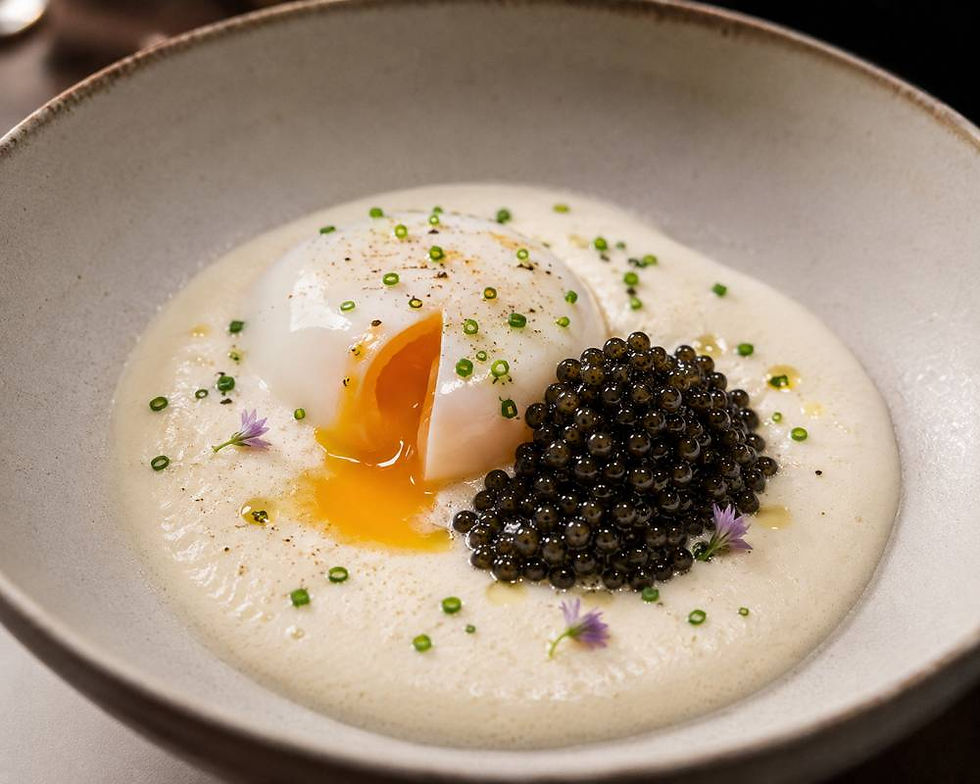
Three ingredients reach the plate and none is cooked the way a grandmother would recognise. An egg is held whole at 145°F (63°C) for an hour, until the yolk thickens toward warm cream and the white sets only barely. Parmigiano Reggiano aged 36 months is melted into cream, strained, charged with gas and dispensed as a warm foam. The Oscietra goes on last, straight from ice.
All three sit on the same axis of flavour: the yolk is fat and sulphur, the old cheese is glutamate and salt, the roe is iodine and butter. The cooking is mostly a matter of holding each at the temperature where it is best and assembling in the last ten seconds. The margins are narrow both ways: a bath two degrees too warm gives a set yolk, and a bowl from a hot cabinet cooks the caviar on contact.
Yield: 4 servings. Prep: 25 minutes. Cook: 60 minutes. Rest: 4 hours for the charged siphon. Total: about 5 hours 30 minutes, of which 20 minutes is active work at service. Difficulty: advanced. Course: antipasto or light secondo. Style: contemporary Italian.
The Story
Parmigiano Reggiano DOP comes from a strip of Emilia and Lombardy that has not moved in eight centuries, from raw milk, calf rennet and nothing else, and its character is decided after the wheel is made. At 12 months it tastes young: elastic, milky, around 32 percent water. At 24 months the paste breaks instead of bending and the flavour moves toward broth and dried fruit. At 36 months more water is gone, the paste fractures in flakes, and the free amino acids are concentrated enough that the cheese reads savoury rather than salty. The white specks in an old wheel are the proof: crystals of tyrosine, released as casein breaks down and precipitating once concentrated enough. They crunch under the tooth, they are the most reliable sign of real age, and that same loss of water and protein is why an old cheese behaves so differently in warm cream.
The caviar has a stranger Italian history than most people expect. Sturgeon were a Po river fish, abundant enough through the middle ages that Ferrara and Cremona had guild rules about selling them, and the Adriatic stock ran upriver to spawn until dams and pollution finished it in the twentieth century. Farming replaced it, earlier here than anywhere in western Europe: the spring water of the Lombard and Venetian plain proved close to ideal, and Italy today is among the largest caviar producers in the world.
Low temperature cooking reached Italian kitchens from French charcuterie research by way of the restaurants of the 1990s, and the 63 degree egg became one of its signatures because no traditional method reaches that texture. Be straightforward about what this plate is: not traditional, no region, no festival. It is contemporary Italian cooking built on two products of real historical depth and one piece of modern equipment.
Ingredients
For the eggs
Very fresh large eggs, 4, at refrigerator temperature
For the Parmigiano Reggiano foam
Parmigiano Reggiano DOP aged 36 months, finely grated, 3 1/2 oz (100 g)
Heavy cream, 3/4 cup (180 ml)
Whole milk, 1/2 cup (120 ml)
Agar agar powder, 1/4 tsp (0.6 g)
Unsalted butter, 1 tbsp (14 g)
Ground white pepper, 1/8 tsp (0.3 g)
Freshly grated nutmeg, 1 very small pinch
Fine sea salt, only if needed after tasting
Nitrous oxide charger for a 1 pint siphon, 1
For finishing
Oscietra caviar, 2 oz (56 g), kept on ice
Fresh chives, finely cut, 1 tbsp (4 g)
Extra virgin olive oil, 1 tsp (5 ml), optional
Preparation
Step 1
Cook the eggs at 63 degrees

Set a thermostatted bath to 145°F (63°C) and let it stabilise. Lower the four whole eggs in their shells into freely circulating water and hold them for 45 to 60 minutes. Confirm the reading with an independent probe thermometer rather than the display: this step has no margin and no visual cue.
Step 2
Infuse the Parmigiano below 70 degrees

Whisk the agar into the cold cream and milk, bring it just to a boil to hydrate it, then take the pan off the heat and let it fall to 160°F (70°C). Add the grated cheese in four or five handfuls, whisking each in before the next, thermometer in the liquid. Above that point the proteins tighten, squeeze out their fat and the base splits. Whisk in butter, white pepper and nutmeg, then taste: old Parmigiano brings salt and the caviar brings more, so the base should read slightly under seasoned.
Step 3
Strain, charge and rest the siphon

Blend the warm base smooth and pass it through a fine mesh conical sieve into a clean 1 pint siphon. One undissolved crumb blocks the valve and the batch comes out in spurts or not at all. Fill the siphon two thirds at most, seal it, charge with one nitrous oxide cartridge, shake firmly ten times and refrigerate upright for at least 4 hours.
Step 4
Hold the caviar cold and cut the chives

Leave the tin unopened in the refrigerator until every warm component is finished, then set it into crushed ice and open it only at the moment of plating. Have a mother of pearl, horn or bone spoon ready and keep metal away from the roe.
Step 5
Warm the siphon and the bowls, shell the eggs
Stand the siphon in water at 140°F (60°C) for about 20 minutes, shaking hard every few minutes. Warm four shallow bowls to no more than 105°F (40°C), clearly warm to the back of the hand and never hot. Crack each egg at its widest point and let it slide into a small perforated ladle under its own weight, since at this cooking the white is barely coagulated and tears if handled. The thin outer white runs through and goes with it.
Step 6
Dispense, place the caviar, serve

Shake the siphon again and dispense a shallow base of warm foam into each bowl. Set an egg on it rather than pressed into it, then a smaller cloud to one side so the egg stays visible. Place a deliberate 1/2 oz (14 g) of Oscietra against the yolk with the nonreactive spoon, never stirred in. Above about 105°F (40°C) the membranes fail and the pearls slump into grey paste, so the roe goes on last and the bowl goes out at once.
Plating
Use a shallow wide bowl rather than a flat plate. The foam needs a well or it spreads to the rim and thins out, and the curve keeps the egg from sliding. White or very pale glaze is right: the colours in play are pale gold, ivory and dark bronze, and any pattern underneath turns the composition into noise.
The bowl is warm, not hot: aim for 105°F (40°C) and check it against the inside of your wrist. Keep the three elements legible. The egg sits in the centre and stays visible, the foam is a base and a single accent rather than a blanket, and the caviar is one defined portion. Resist microgreens, flowers, truffle oil and lemon on a plate whose whole argument is restraint.
Professional Technique
The technical subject here is a stable cheese foam, harder to build than a cream foam because the structure has to come from the cheese itself. Two components do the work. The milk fat, most of it from the cream but a real share from the Parmigiano, is what the gas dissolves into and what gives the bubbles their walls. The casein, cut into short peptides by three years of enzyme activity, is surface active: it migrates to the gas and liquid interface and stabilises it. Too little fat and the foam is a stiff froth that dries on the plate; too much cheese and the base will not pass the valve.
Temperature during the infusion decides everything that follows. Parmigiano emulsifies into warm dairy only inside a window whose ceiling is around 160°F (70°C). Below it the fat stays dispersed; above it the protein network contracts, expels water and fat, and the mixture separates into oil and a tough curd a blender cannot rescue. That is why the agar, used in the smallest dose that stabilises anything at all, is hydrated first at a boil with no cheese in the pan, and why the cheese goes in afterwards off the heat and in stages. Then the fine mesh cone, which catches undissolved paste and tyrosine crystals, because one crystal in the valve seat jams it and the jam shows up on the first plate of service.
The siphon is filled two thirds so the gas has headspace, then charged once with nitrous oxide, chosen over carbon dioxide because it dissolves readily in fat and adds no acidity. The rest of at least 4 hours in the refrigerator is where the foam is actually made: the agar sets into a fragile gel that shearing turns fluid, and the gas goes fully into solution. Dispensed straight after charging, the same base comes out coarse and falls within a minute. Gelatin stabilises a cold foam just as well, but it melts below the temperature wanted here, which is why agar suits a warm one.
A 36 month wheel behaves differently from a young one, and this recipe is written for the old cheese. It carries less water, so at the same weight it gives more solids and a thicker base. Its protein is already short chained, so it dissolves faster and stabilises the interface better. Its glutamate and salt are more concentrated, so the base tastes seasoned before any salt is added. And it carries crystals, which must be strained out. A 12 month cheese gives a wetter, blander, stringier base.
Texture and Moisture Control
Three textures have to arrive intact and each fails at a different temperature. The yolk at 63 degrees is a thickened liquid held just below the point where its proteins set in earnest: at 149°F (65°C) the same egg comes out grainy. The foam depends on a set agar gel and survives 140°F (60°C) but slackens as the fat warms further. The caviar membranes begin to rupture around 105°F (40°C). Those three numbers set the service.
Moisture management is mostly about the white. A 63 degree egg carries a large volume of thin outer white that never sets, and in the bowl it thins the foam and leaves a watery halo, so straining the shelled egg is not optional. The same applies to the roe, lifted from the tin rather than scooped through its liquid, and to the bowls, warmed dry.
Professional Mise en Place
The foam is made at least 4 hours ahead and the eggs close to service, so the two ends of this recipe sit far apart.
Equipment and tools
Thermostatted bath or circulator, and an independent probe thermometer
One pint culinary siphon and one nitrous oxide charger
Blender and a fine mesh conical sieve
Small perforated ladle for straining the shelled eggs
Mother of pearl, horn or bone spoon, and a bowl of crushed ice
Four shallow wide bowls, held barely warm
Prepared ahead
Base strained, charged and refrigerated in the siphon, 4 hours to 1 day ahead
Cheese grated finely on the day, kept covered and cold
Chives cut and covered, up to 2 hours ahead
Bath up to temperature and verified
Caviar tin unopened and refrigerated until the last minute
Service setup
Siphon standing at 140°F (60°C), shaken often, one test portion dispensed
Eggs holding at 145°F (63°C), shelled one at a time to order
Bowls warm at 105°F (40°C), dry and wiped
Caviar on crushed ice, opened only once the first bowl has foam and egg
Chives, oil and a clean cloth within reach
Chef Tips
Buy the freshest eggs you can find and use them cold. At 63 degrees the white never firms, and the older the egg the more of it has gone thin, leaving a lot of watery white to strain away.
Dispense a test portion away from the plate before the first bowl, every service. It tells you whether the valve is clear, whether the shaking sheared the gel enough, and whether the seasoning still reads.
Buy the Parmigiano as a wedge and grate it on the day. Pre grated cheese is rarely the age it claims and often carries an anticaking starch that turns a warm infusion cloudy and gluey.
If a siphon is genuinely unavailable, do not whisk the base into a froth and call it a foam: it will be gone before the bowl reaches the table. Serve the strained base warm as a sauce under the egg instead, a good dish and simply a different one.
Common Mistakes
Cooking without a verified thermometer. A pan on a low flame drifts five or six degrees within minutes and nothing about the shell shows it. At 149°F (65°C) the yolk sets, at 140°F (60°C) it is raw. Without temperature control this recipe does not exist.
Adding the cheese to dairy that is too hot. Above roughly 160°F (70°C) the aged proteins contract and expel their fat, and the base splits. Hydrate the agar at a boil, take the pan off the heat, let it fall, then add the cheese in stages.
Skipping the sieve. Undissolved paste and tyrosine crystals block the valve, and the blockage shows up on the first plate. Two minutes with a fine mesh cone prevents it.
Dispensing immediately after charging. Without the rest of at least 4 hours the agar has not set and the gas has not dissolved into the fat, so the foam comes out coarse and collapses.
Warming the bowls in a hot cabinet. A bowl above 105°F (40°C) ruptures the caviar membranes from below. Warm to body temperature, no further.
Using metal for the roe, or stirring it in. Metal leaves a taste on caviar and stirring it through warm foam destroys the pop. Use mother of pearl, horn or bone, in one movement.
Wine Pairing
Franciacorta DOCG: The first choice. Italian traditional method from Lombardy, with years on the lees, gives a fine persistent bead and a bready depth that continues the aged cheese rather than contrasting with it. The acidity is the working part: yolk and Parmigiano fat coat the palate and blunt acidity, so a wine that seems taut alone arrives merely fresh here. Choose a Brut over an Extra Brut, since a little sugar sits better against the salt of the roe.
Trento DOC: The alpine answer, and the more mineral of the two great Italian traditional method zones. It brings sharper green apple and a stony finish where Franciacorta brings pastry, useful if the foam tastes powerfully savoury. Its saline close meets the Oscietra directly.
Alta Langa DOCG: Piedmont's traditional method, and the bottle to pour if you want the wine to hold its own rather than accompany quietly. A high proportion of Pinot Nero gives more body and a faintly red fruited core, and thirty months on the lees build a texture that stands up to the foam rather than cutting through it.
Verdicchio dei Castelli di Jesi Classico Riserva DOCG: The still white with the most to offer here. Riserva Verdicchio gains a waxy, almost oily texture that echoes the yolk while keeping high acidity and the bitter almond finish of the grape. That bitterness lands after the fat and the salt have gone and resets the palate. Serve at 50°F (10°C).
Collio Friulano DOC: For anyone who would rather drink a savoury white than bubbles. Friulano from the Collio marl is dry, broad across the middle and finishes with a herbal, almond and faintly saline bite that suits the sulphurous side of a soft yolk, with the extract to sit under the foam and the salinity not to be flattened by the roe.
Storage & Reheating
The assembled bowl does not keep for a minute. Once egg, warm foam and cold roe are together the only direction is downward, and nothing here reheats. It is a plate that is built and sent.
The components keep separately and unequally. The charged siphon holds in the refrigerator for up to 24 hours and is better after 4 hours than after 30 minutes, so making it the day before is an improvement: stand it at 140°F (60°C) for 20 minutes, shake hard and test a portion. Do not freeze the base, since agar gels survive freezing badly.
Cooked eggs are best straight from the bath, but they can be chilled in ice water, refrigerated up to 24 hours and brought back at 145°F (63°C) for 15 minutes before shelling. Unopened caviar keeps to the date on the tin at around 28°F to 32°F (minus 2°C to 0°C); once opened, finish it within 2 days, on ice and covered. Discard roe that has gone fishy or lost its shine.
Nutrition
Per serving, based on 4 servings:
Calories: 480 kcal
Total Fat: 41 g
Saturated Fat: 22 g
Trans Fat: 0.8 g
Unsaturated Fat: 16 g
Cholesterol: 400 mg
Sodium: 890 mg
Total Carbohydrates: 4 g
Fiber: 0 g
Total Sugars: 3 g
Added Sugars: 0 g
Protein: 22 g
Lactose: 3 g
Principal micronutrients: calcium, phosphorus, vitamin A, vitamin B12, vitamin D, selenium, choline, zinc, omega 3 fatty acids
These figures are estimates. Sodium moves most, since it depends on the age of the Parmigiano and on how generously the caviar is portioned.


Comments