
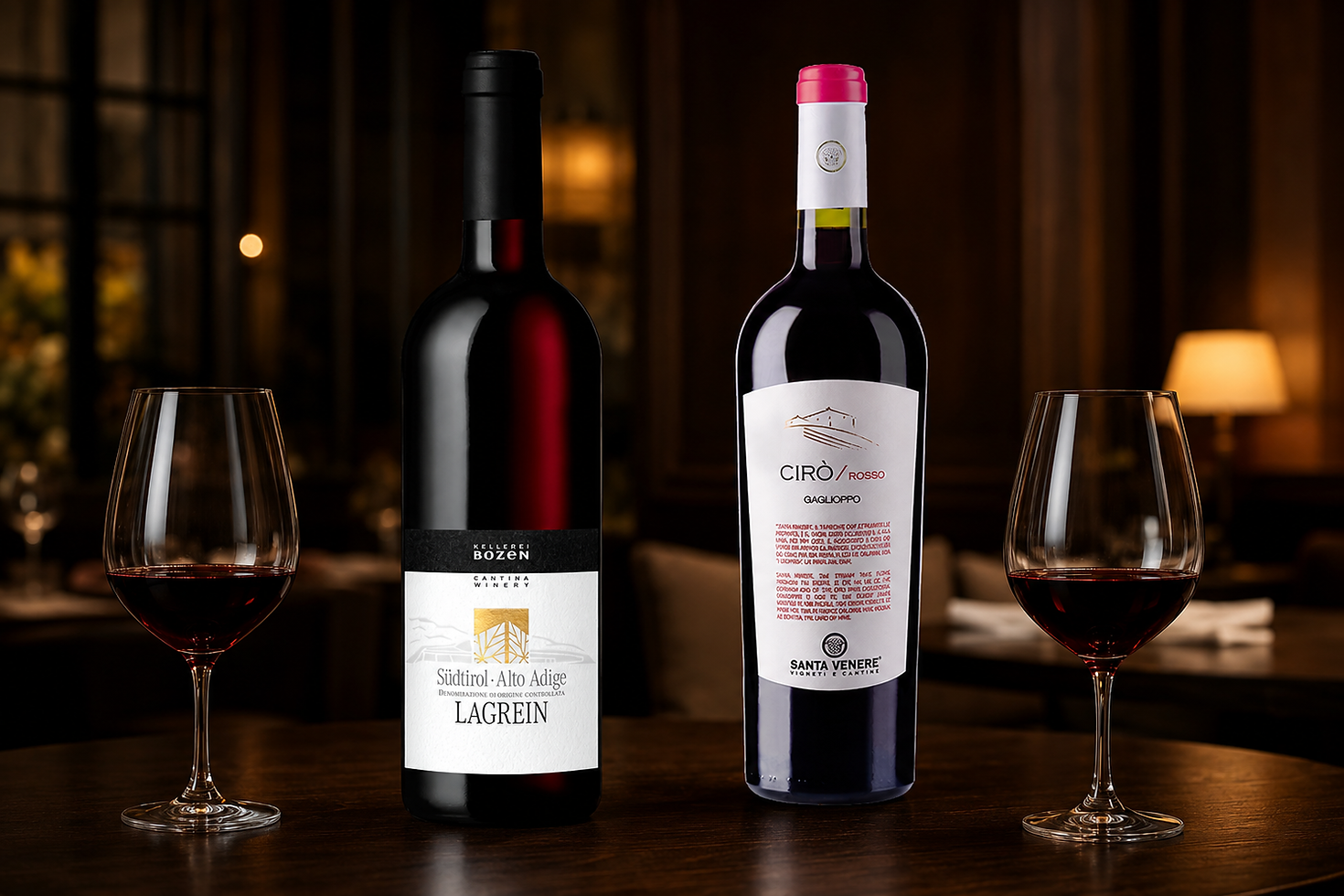
Alto Adige Lagrein DOC vs Cirò Rosso DOC: Scores, Key Differences, Food Pairings and Which Italian Red Wine to Buy
- 54 minutes ago
- 14 min read
Alto Adige Lagrein DOC vs Cirò Rosso DOC: Scores, Key Differences, Food Pairings and Which Italian Red Wine to Buy
Alto Adige Lagrein DOC and Cirò Rosso DOC are two indigenous Italian red wines that make the north-versus-south comparison genuinely useful. Lagrein is rooted in the Alpine basin around Bolzano, where warm valley-floor sites meet cool nights and mountain air. Cirò Rosso comes from Calabria’s Ionian side, where Gaglioppo ripens under Mediterranean sun, dry breezes, and a long growing season.
Both wines can be savory, deeply regional, and excellent with food, but they solve the dinner-table problem differently. Lagrein usually delivers darker fruit, violet, cocoa, color, and a velvety structure. Cirò Rosso is normally more transparent in color and more driven by red fruit, dried flowers, herbs, earth, acidity, and firm tannin.
This comparison evaluates representative denomination styles, not individual producers. It measures aroma, structure, terroir identity, food performance, finish, aging potential, and value so the choice becomes practical rather than theoretical.
Quick Answer
Choose Alto Adige Lagrein DOC when you want blackberry, dark cherry, violet, cocoa, spice, saturated color, and a smoother, fuller mid-palate for beef, venison, smoked pork, mushrooms, speck, and Alpine comfort food.
Choose Cirò Rosso DOC when you want sour cherry, dried rose, orange peel, Mediterranean herbs, earth, lively acidity, and more assertive tannins for lamb, sausages, ragù, baked pasta, grilled pork, eggplant, and boldly seasoned southern Italian dishes.
In simple terms:
Lagrein is darker, rounder, more violet-scented, and more immediately plush.
Cirò Rosso is redder in fruit, more tannic, more herbal, and more Mediterranean.
Lagrein is the easier choice for guests who enjoy modern texture and dark fruit.
Cirò Rosso is the stronger choice for rustic food, acidity-driven pairings, and regional identity.
Our overall winner is Cirò Rosso DOC, 95 points to 93.
Our value winner is also Cirò Rosso DOC.
Zafferano & Co. Comparative Score
These are denomination-level editorial scores. They evaluate the representative quality, identity, versatility, consistency, and value of each style rather than claiming that every bottle carrying the denomination performs identically.
Scoring Category | Maximum | Alto Adige Lagrein DOC | Cirò Rosso DOC | Category Winner |
|---|---|---|---|---|
Aromatic Complexity | 15 | 14 | 14 | Tie |
Structure and Balance | 15 | 14 | 14 | Tie |
Terroir Identity | 15 | 14 | 15 | Cirò Rosso |
Food Versatility | 15 | 14 | 15 | Cirò Rosso |
Finish and Persistence | 15 | 14 | 14 | Tie |
Ageability | 15 | 14 | 13 | Alto Adige Lagrein |
Value for Money | 10 | 9 | 10 | Cirò Rosso |
Total | 100 | 93 | 95 | Cirò Rosso |
Cirò Rosso wins by two points through a particularly strong combination of terroir identity, food versatility, and value. Lagrein equals it for aromatic complexity, balance, and finish, then takes the ageability category by one point because serious examples can evolve with impressive stability. The result is close: these are two distinctive wines for different palates, not a strong wine against a weak one.
At a Glance
Characteristic | Alto Adige Lagrein DOC | Cirò Rosso DOC |
|---|---|---|
Origin | Alto Adige, northern Italy | Calabria, southern Italy |
Principal grape | Lagrein | Minimum 80% Gaglioppo |
Typical color | Deep ruby to purple | Ruby to garnet, often more transparent |
Typical body | Medium to medium-full | Medium |
Acidity | Medium-high and energetic | Medium-high to high |
Tannin | Medium to high, often polished | Medium-high to high, more angular when young |
Primary fruit | Blackberry, black cherry, plum | Sour cherry, red plum, cranberry |
Floral and herbal notes | Violet, lilac, subtle alpine herbs | Dried rose, oregano, scrub herbs |
Savory notes | Cocoa, earth, smoke, dark spice | Leather, earth, orange peel, tobacco |
Finish | Dark-fruited, cocoa-toned, smooth | Dry, herbal, tannic, savory |
Best role | Polished dark-fruited food wine | Traditional Mediterranean table wine |
Ageability | Good to very good | Good in balanced examples |
Best value strength | Consistency and texture | Identity and food performance per dollar |
What Is Alto Adige Lagrein DOC?
Lagrein is one of Alto Adige’s defining indigenous red grapes. Its historic center is Bolzano, especially the warmer sites around Gries and the valley floor. Those locations may appear surprising in a mountain region, but they give Lagrein the heat it needs to ripen while the surrounding Alps preserve nighttime cooling and freshness.
The denomination name may appear as Alto Adige Lagrein or Südtirol Lagrein. The best-known dry red style is deeply colored and generally combines ripe dark fruit with floral lift, acidity, and substantial tannin. Producers may mature it in stainless steel, large oak casks, smaller barrels, or a combination, depending on whether the goal is fruit purity or a more ambitious reserve expression.
Typical Lagrein characteristics include:
Blackberry, black cherry, plum, and blueberry
Violet, lilac, and occasional dried flowers
Cocoa, dark spice, earth, and subtle smoke
Deep ruby-purple color
Fresh acidity beneath a broad mid-palate
Firm tannin that can become velvety with careful ripening and maturation
Lagrein’s appeal is contrast. The wine can look powerful and taste dark, yet good examples avoid heaviness because acidity and floral aromas keep the palate moving. That balance makes it useful with both rustic mountain dishes and polished meat preparations.
What Is Cirò Rosso DOC?
Cirò Rosso DOC is Calabria’s historic red-wine identity, based primarily on Gaglioppo. Current rules require at least 80% Gaglioppo, allowing a limited contribution from other authorized non-aromatic red grapes. Many producers emphasize Gaglioppo much more strongly because its tannin, acidity, red fruit, and savory character define the style.
Gaglioppo does not behave like a dark international grape. It can produce a relatively transparent ruby color while still delivering significant tannin, alcohol, and flavor. This difference between appearance and structure is central to understanding Cirò: pale color does not mean weak wine.
Typical Cirò Rosso characteristics include:
Sour cherry, red plum, cranberry, and dried red fruit
Dried rose, orange peel, Mediterranean herbs, and anise
Earth, leather, tobacco, and warm spice
Lively acidity and firm, drying tannin
A savory finish that works naturally with olive oil, grilled meat, tomato, and herbs
A distinctly southern Italian personality without relying on excessive sweetness or oak
Cirò Rosso is most convincing when ripeness, tannin, and freshness stay in proportion. Too little ripeness can make Gaglioppo severe; too much extraction or oak can hide its transparent red fruit and regional character. Balanced examples are both traditional and highly relevant at the modern table.
Important Label Difference: Cirò Rosso DOC and Cirò Classico DOCG
Buyers should now distinguish the broader Cirò Rosso DOC from the separate Cirò Classico DOCG. The Classico category identifies the historic production area under its own current designation, while Cirò Rosso DOC continues as the broader denomination. Older vintages and retail listings may still show earlier Classico DOC terminology, so the exact label and vintage matter.
This article evaluates Cirò Rosso DOC as the denomination named in the title. It does not treat every Classico, Superiore, or Riserva bottling as interchangeable with the standard style. Those categories can differ in origin, minimum requirements, concentration, maturation, and price.
The Fundamental Difference: Alpine Depth vs Mediterranean Tension
Lagrein expresses a warm pocket inside an Alpine environment. Its identity comes from dark fruit, floral perfume, color, cool-night freshness, and a texture that can feel generous without becoming jammy. The wine often moves from blackberry and violet toward cocoa and polished tannin.
Cirò Rosso expresses a sunlit Mediterranean landscape through Gaglioppo’s acidity and tannin. Its fruit remains redder, its herbs more pronounced, and its finish more openly savory. Instead of plush darkness, it offers grip, dried flowers, citrus peel, earth, and a feeling of heat moderated by freshness.
The practical distinction is straightforward: Lagrein gives more color and mid-palate softness; Cirò Rosso gives more tannic tension and southern Italian savor.
Aroma and Flavor Comparison
Lagrein normally opens with blackberry, black cherry, plum, violet, and lilac. Depending on maturation, cocoa, coffee, clove, smoke, or vanilla may appear, although excessive wood can obscure the grape. Even full examples often retain a cool floral line that prevents the nose from feeling heavy.
Cirò Rosso usually emphasizes sour cherry, red plum, cranberry, dried rose, orange peel, oregano, anise, earth, leather, and tobacco. The profile is less about polished black fruit and more about the interaction of red fruit, herbs, acidity, and savory development.
For dark fruit and violet, choose Lagrein. For red cherry, dried flowers, citrus peel, and Mediterranean herbs, choose Cirò Rosso.
Acidity, Body, Alcohol, and Texture
Both wines can reach substantial alcohol, but they carry it differently. Lagrein’s body and dark fruit tend to cushion alcohol and tannin, creating a broader, smoother sensation. Its acidity is important but often feels integrated into the wine’s volume.
Cirò Rosso can feel leaner even at a similar alcohol level because Gaglioppo’s acidity and tannin create a drier outline. The palate is often more linear, with less sweet-fruited cushioning and a more assertive finish.
Neither wine should automatically be described as heavy. Lagrein can be medium-bodied and juicy when made for early drinking. Cirò Rosso can be warm and substantial even when its color is transparent. Producer choices, yield, harvest date, extraction, and maturation matter as much as the grape name.
Tannin and Color
Color creates one of the comparison’s most useful lessons. Lagrein typically produces deeply pigmented wine with purple or near-black reflections. Its tannin can be considerable, but ripe fruit and careful cellar work often make the structure feel velvety.
Gaglioppo commonly gives Cirò Rosso a lighter ruby or garnet appearance. The tannin, however, can be firmer than the color suggests. Young bottles may feel angular and need food, air, or bottle age. That pale-color, firm-tannin combination makes Cirò very different from soft commercial reds.
If visual depth and a smoother first impression matter, Lagrein has the advantage. If you appreciate transparent color with serious grip, Cirò Rosso is more compelling.
Minerality, Salinity, and Savory Character
Lagrein’s mineral expression is usually secondary to fruit, flowers, earth, and cocoa. Gravelly and alluvial sites can contribute firmness and definition, but the wine’s signature is not normally overt saltiness.
Cirò Rosso often feels more openly savory. Clay and limestone, Mediterranean herbs, coastal influence, warm soils, and Gaglioppo’s naturally dry structure can create impressions of iron, dust, salt, earth, and dried vegetation. These are tasting associations, not literal minerals transferred directly from soil into wine.
For polished dark-fruit depth, Lagrein wins. For a drier, earthier, more saline Mediterranean impression, Cirò Rosso wins.
Fruit, Floral, and Herbal Character
Lagrein’s fruit sits mainly in the black and blue spectrum. Blackberry, black cherry, plum, and blueberry are joined by violet and lilac. Herbal notes exist but usually remain subtle, while cocoa and dark spice often become more prominent with maturation.
Cirò Rosso is built around red fruit and dried aromatics. Sour cherry, red plum, and cranberry can be joined by dried rose, oregano, fennel seed, anise, orange peel, and scrub herbs. With age, leather, tobacco, dried fruit, and earthy tones may expand.
Lagrein feels darker and more floral. Cirò feels redder, drier, and more herbal.
Finish and Complexity
Good Lagrein finishes with dark cherry, violet, cocoa, spice, and rounded tannin. The persistence can be excellent, particularly in lower-yield or reserve examples, and the best wines develop layers without losing freshness.
Good Cirò Rosso finishes with sour cherry, dried herbs, earth, orange peel, and firm tannin. Its complexity comes less from density than from the way fruit, acidity, tannin, and savory notes continue after swallowing.
The two denominations receive equal finish and complexity points. Lagrein has more immediate depth and polish; Cirò has more rustic tension and aromatic contrast.
Terroir Comparison: Northern Italy vs Southern Italy
Alto Adige Lagrein DOC
Lagrein’s classic environment lies around Bolzano, where the valley floor and lower slopes can become hot during the day. Alluvial, sandy, and gravelly soils support drainage, while the surrounding mountains create strong differences between daytime and nighttime temperatures.
This combination helps explain why Lagrein can ripen dark fruit and tannin without losing all freshness. It is not simply a cool-climate red. It is a warm-site grape protected by an Alpine framework.
Cirò Rosso DOC
Cirò’s landscape is shaped by Calabria’s Ionian side, with intense sunlight, dry conditions, coastal air, and clay-limestone soils in many sites. Gaglioppo has adapted to this environment over centuries and retains acidity and tannin through a long, warm season.
The resulting wine does not need black-fruit sweetness to communicate southern ripeness. Its identity appears through red fruit, warm herbs, dried flowers, earth, alcohol, acidity, and a firm structural line.
Vinification and Style
Fresh, entry-level Lagrein may be fermented and matured primarily in stainless steel or large neutral vessels to preserve fruit and violet. More structured versions can use large oak casks, barriques, or a combination. Oak should support texture and development rather than turn the wine into a generic vanilla-scented red.
Cirò Rosso may also be raised in stainless steel, concrete, large casks, or smaller barrels. Traditional examples often prioritize grape character and tannic evolution over obvious oak sweetness. Gentle extraction is particularly important because Gaglioppo can give substantial tannin without requiring aggressive cellar treatment.
In both categories, the best winemaking makes the grape more legible. Lagrein should retain flowers and acidity beneath its dark color. Cirò should retain red fruit and herbal detail beneath its tannin.
Food Pairing Comparison
Best Pairings for Alto Adige Lagrein DOC
Lagrein’s dark fruit, acidity, and polished tannin work best with browned meat, smoke, mushrooms, cured pork, and rich Alpine dishes.
Speck and cured pork
Canederli with butter or meat broth
Beef goulash
Venison with juniper
Grilled ribeye or strip steak
Roast pork with herbs
Polenta with mushrooms
Braised beef
Smoked sausages
Aged mountain cheese
Best Pairings for Cirò Rosso DOC
Cirò Rosso’s acidity, tannin, red fruit, and herbs perform particularly well with grilled meat, tomato, chile, aged cheese, and the olive-oil-driven flavors of southern Italy.
Grilled lamb chops
Pasta with pork or beef ragù
Calabrian sausage
Baked pasta with tomato and cheese
Eggplant Parmigiana
Roast goat or lamb
Grilled pork shoulder
Meatballs in tomato sauce
Cured meats with chile
Aged pecorino
Direct Food Pairing Decision
Dish or Occasion | Better Choice | Why |
|---|---|---|
Speck and cured pork | Alto Adige Lagrein | Dark fruit and violet soften smoke and salt |
Grilled lamb | Cirò Rosso | Tannin, herbs, and acidity match char and fat |
Beef steak | Alto Adige Lagrein | Broad fruit and polished structure suit beef |
Tomato-based ragù | Cirò Rosso | Acidity and red fruit align with tomato |
Venison | Alto Adige Lagrein | Dark berries and spice complement game |
Calabrian sausage | Cirò Rosso | Grip and savory herbs handle chile and pork |
Mushroom polenta | Alto Adige Lagrein | Earth, cocoa, and texture support mushrooms |
Eggplant Parmigiana | Cirò Rosso | Acidity refreshes fried eggplant and cheese |
Mixed grilled meats | Cirò Rosso | High-energy structure performs across the platter |
Wine-focused tasting | Tie | The choice depends on dark-fruit polish or Mediterranean tension |
Which Wine Is Better with Grilled Meat?
Cirò Rosso has the overall advantage with mixed grilled meats, lamb, sausages, and pork. Its acidity and tannin cut fat, while its herbs and red fruit echo smoke, oregano, fennel seed, and chile.
Lagrein is often better with a single rich cut of beef, especially when the preparation includes mushrooms, black pepper, a dark reduction, or smoked pork. Its broader fruit and smoother texture can feel more luxurious with steak.
Choose Cirò for a southern Italian grill. Choose Lagrein for beef, venison, and a more polished meat course.
Which Wine Is Better with Pasta?
Cirò Rosso is the more versatile pasta wine when tomato, sausage, eggplant, chile, or aged pecorino drives the dish. Its acidity prevents the pairing from becoming heavy, and its tannin finds enough protein and fat to soften.
Lagrein works better with meat-filled pasta, mushroom sauces, beef ragù without excessive tomato, and dishes built around butter, speck, or mountain cheese. Dark fruit and cocoa provide depth without fighting the earthy ingredients.
Price and Value
Lagrein benefits from Alto Adige’s reputation for precise vineyard work and reliable cellar standards. That consistency is valuable, but land, labor, mountain viticulture, and the regional premium can raise the entry point. Serious reserve bottlings can become substantially more expensive.
Cirò Rosso remains one of the clearest opportunities for drinkers seeking indigenous Italian character without paying primarily for prestige. The best value comes from producers who respect Gaglioppo’s acidity and tannin rather than masking them with excessive ripeness or oak.
At the same shelf price, Lagrein may feel smoother and more immediately polished. Cirò Rosso often delivers more regional identity and table performance for the money. That is why Cirò receives the Value Winner designation.
Ageability
Youthful versions of both wines can be enjoyed early, but structure gives each category meaningful aging potential. Lagrein’s color, acidity, fruit concentration, and tannin can support several years of development, while reserve and site-specific bottlings can mature longer.
With age, Lagrein can move from blackberry and violet toward dried plum, cocoa, tobacco, leather, and forest floor. The best examples retain enough acidity to prevent mature flavors from becoming flat.
Balanced Cirò Rosso can also develop attractively as firm tannin softens and red fruit evolves toward dried cherry, rose, orange peel, leather, tobacco, and earth. However, bottle selection is especially important: heat, oxidation, or unbalanced extraction can shorten the curve.
Lagrein wins the ageability category by one point because the denomination offers a slightly more dependable path from youthful fruit to mature complexity. Top Cirò remains fully capable of long development.
Serving Temperature, Glassware, and Decanting
Serve youthful Alto Adige Lagrein at approximately 57–61°F (14–16°C) and more structured bottles around 61–64°F (16–18°C). A medium-to-large red-wine glass allows violet and dark fruit to open while keeping alcohol controlled. Brief decanting can help a concentrated young bottle.
Serve Cirò Rosso at approximately 61–64°F (16–18°C). Use a medium red-wine glass with enough bowl space for dried flowers and herbs. Young, tannic examples may benefit from thirty to sixty minutes of air, although fragile mature bottles should be handled more carefully.
Do not serve either wine at a warm room temperature. Excess warmth emphasizes alcohol and makes tannin feel less precise.
When to Choose Alto Adige Lagrein DOC
You prefer blackberry, black cherry, violet, cocoa, and dark spice.
You want a deeply colored red with a smoother mid-palate.
The menu includes beef, venison, speck, mushrooms, or polenta.
You want a northern Italian indigenous grape with strong regional identity.
You are serving guests who enjoy polished modern texture.
You want dependable aging potential in a structured bottling.
You prefer dark-fruited depth over pronounced herbal austerity.
When to Choose Cirò Rosso DOC
You prefer sour cherry, dried rose, orange peel, herbs, and earth.
You enjoy firm tannin and lively acidity.
The menu includes lamb, sausage, tomato ragù, eggplant, or aged pecorino.
You want a southern Italian red that tastes unmistakably regional.
You value food performance more than plush texture.
You are looking for one of Italy’s strongest indigenous-wine values.
You want a red that rewards air and a substantial meal.
Buyer’s Decision Map
Choose Alto Adige Lagrein DOC for:
Darker fruit and deeper color
Violet, lilac, cocoa, and dark spice
A broader and more polished texture
Beef, venison, speck, mushrooms, and mountain dishes
A slightly stronger category-wide aging profile
Guests who prefer smoother modern reds
Choose Cirò Rosso DOC for:
Red cherry, dried rose, orange peel, and herbs
Firm tannin and lively acidity
Lamb, sausage, tomato, chile, eggplant, and pecorino
A more overt Mediterranean identity
Exceptional regional character for the price
A savory red built for the dinner table
Frequently Asked Questions
Is Lagrein Heavier Than Cirò Rosso?
Lagrein usually looks darker and feels broader, but Cirò Rosso can have equally serious alcohol and firmer tannin. Lagrein is more plush; Cirò is more linear and gripping.
Which Wine Has More Tannin?
Both can be tannic. Cirò Rosso often makes tannin more obvious because Gaglioppo combines firm structure with relatively transparent color and less dark-fruit cushioning. Lagrein’s tannin is frequently softened by a broader mid-palate.
Which Wine Has Higher Acidity?
Cirò Rosso generally presents acidity more forcefully. Lagrein can also be fresh, but its acidity is usually integrated into darker fruit and a rounder texture.
Is Cirò Rosso a Light Red Wine?
Not necessarily. Its color may be lighter than Lagrein, but Gaglioppo can produce substantial tannin, alcohol, and persistence. Visual transparency should not be confused with low structure.
Which Wine Is Better for Steak?
Lagrein is usually the better choice for a rich beef steak because dark fruit, violet, cocoa, and polished tannin complement browned meat. Cirò is preferable when the grill includes lamb, sausage, herbs, or chile.
Which Wine Is Better with Tomato Sauce?
Cirò Rosso is generally better because its red fruit and acidity align naturally with tomato. Lagrein can work with a meat-heavy ragù, but a sharp tomato sauce may make its dark fruit feel less integrated.
Can Lagrein and Cirò Rosso Age?
Yes. Quality Lagrein and balanced Cirò Rosso can both develop for several years, while ambitious bottlings can mature longer. Producer, vintage, storage, extraction, and maturation matter more than the denomination name alone.
What Is the Difference Between Cirò Rosso DOC and Cirò Classico DOCG?
Cirò Rosso DOC is the broader denomination evaluated here. Cirò Classico DOCG is the separate current designation for the historic Classico area. Older labels and listings may use previous terminology, so always read the exact bottle label and vintage.
Which Wine Offers Better Value?
Cirò Rosso receives our Value Winner designation because it combines indigenous identity, food versatility, and serious structure at a generally accessible category position. Lagrein remains a strong value when polish and consistency are the priorities.
Which Wine Is Better Overall?
Cirò Rosso wins this comparison 95 to 93 for terroir identity, food versatility, and value. Lagrein remains the stronger choice for dark-fruit polish, deeper color, beef pairings, and slightly more dependable aging performance.
Final Verdict
Alto Adige Lagrein DOC and Cirò Rosso DOC are compelling precisely because neither tastes like a generic international red. Lagrein expresses northern Italy through an indigenous grape that thrives in Bolzano’s warm basin while retaining Alpine freshness. Cirò expresses southern Italy through Gaglioppo’s red fruit, herbs, acidity, and tannin on Calabria’s Ionian side.
Lagrein is the more polished and immediately generous wine. Its blackberry, black cherry, violet, cocoa, deep color, and broad texture make it excellent with beef, venison, speck, mushrooms, and rich mountain cooking.
Cirò Rosso is the more angular and openly gastronomic wine. Sour cherry, dried rose, orange peel, Mediterranean herbs, earth, acidity, and firm tannin make it exceptionally effective with lamb, sausage, ragù, eggplant, chile, and aged pecorino.
For dark fruit, velvety texture, and Alpine depth, choose Alto Adige Lagrein DOC. For Mediterranean tension, food versatility, regional identity, and value, choose Cirò Rosso DOC.
Zafferano & Co. Final Score
Alto Adige Lagrein DOC: 93/100 ★★★★
Cirò Rosso DOC: 95/100 ★★★★★
Overall Winner: Cirò Rosso DOC
Value Winner: Cirò Rosso DOC


Comments