
Italian Marche Ricotta Pastries | Calcioni di Ricotta Marchigiani

Calcioni are the Easter pastry of the Marche: a disc of sweet egg pastry folded over fresh ricotta, crimped shut, cut across the top and baked until deep gold. This is the sweet household version, scented with lemon zest, cinnamon and a spoonful of mistra, the anise liqueur of the region.
Yield: 16 pastries. Draining: 12 hours. Prep: 45 minutes. Chill: 1 hour. Bake: 20 minutes. Difficulty: intermediate.
The Story
Calcioni belong to Easter in the Marche, and to the days of baking that come before it. In the hill towns between the Sibillini mountains and the Adriatic, they were made when the household was finally allowed eggs, sugar and fresh cheese again after the long weeks of Lent. The same pastry goes by calcioni, cacioni or piconi depending on the valley, and every family holds a firm opinion about which name and which filling is the true one. They were baked by the dozen in the wood oven, cooled on boards and racks, and carried in baskets on Easter Monday, when families walked out to the countryside for the traditional picnic.
The filling is where the argument lives. In the province of Macerata and up towards the mountains, the classic filling is young pecorino, eggs and sugar, a sweet and salty mixture that surprises anyone expecting a dessert. Ricotta gave the gentler version. It was the by product of the sheep milk cheesemaking that defined the Apennine pastures, where shepherds moved their flocks between the Sibillini uplands in summer and the coastal hills in winter and used everything the milk could become: cheese first, then ricotta from the whey. A festive pastry built on that second curd is exactly what the frugal kitchens of the Marche did best.
Sugar and lemon zest were the luxuries. Cinnamon and mistra, the anise liqueur distilled around Ascoli Piceno, mark the version made for the holiday itself, and a spoonful still goes into the filling. The dough is a plain sweet frolla, sturdy enough to travel and sealed well enough to survive a day in a basket. What makes calcioni hard is not the ingredient list but the water in the ricotta, a lesson the women who made them by the dozen learned long before anyone wrote it down. Every trick in this recipe, from the overnight drain to the tight crimp, is a piece of that inherited kitchen knowledge, kept because it works and repeated because nobody found a better way.
Today calcioni are still baked in the days before Easter in Ascoli Piceno, Macerata and the small towns of the hills, and bakeries sell them through the holiday. The best ones share two things: a filling that is set rather than runny, and a crust thin enough to shatter. Both come from the same discipline, which is why this recipe treats the ricotta as seriously as the pastry.
Ingredients
Temperature matters as much as quantity here. Keep the butter cold from the refrigerator, let the eggs come to room temperature so they blend smoothly, and use ricotta that has been drained and chilled. Weigh everything on a scale, because cup measures for flour and ricotta vary widely and the ratio of filling to pastry decides whether the seal holds.
For the pastry
All purpose flour, 3 1/4 cups (400 g)
Granulated sugar, 2/3 cup (130 g)
Unsalted butter, cold, cubed, 10 tbsp (140 g)
Large eggs, 2
Large egg yolk, 1, the white reserved for the glaze
Lemon zest, finely grated, from 1 lemon
Baking powder, 1/2 tsp (2 g)
Fine sea salt, 1/4 tsp (1.5 g)
For the ricotta filling
Whole milk ricotta, sheep milk if possible, 1 lb 2 oz (500 g) before draining
Granulated sugar, 1/2 cup (100 g)
Large eggs, 2
Lemon zest, finely grated, from 1 lemon
Ground cinnamon, 1/4 tsp (0.5 g)
Mistra or dark rum, 1 tbsp (15 ml)
Fine sea salt, 1 pinch
For finishing
Large egg white, 1, reserved from the pastry
Granulated sugar, 2 tbsp (25 g), for sprinkling
Confectioners sugar, 1 tbsp (8 g), for dusting
Candied orange peel, a few thin strips, optional, for serving
Parchment paper, 1 sheet, to line the tray
Preparation
Drain the ricotta overnight
Line a fine mesh sieve with a double layer of cheesecloth, set it over a deep bowl and spread in the ricotta without pressing. Cover and refrigerate at 38°F (3°C) for 12 hours. Good sheep milk ricotta gives up 2 to 3 oz (60 to 85 g) of whey and feels firmer. Discard the whey and weigh what remains, about 15 oz (425 g), because the filling is balanced against that weight, not the weight in the tub.
Sand the butter into the flour
Combine the flour, sugar, baking powder, salt and lemon zest in a wide bowl. Rub in the cold butter with your fingertips until it looks like coarse breadcrumbs with a few flat flakes still visible. Work fast and stop while the mixture is cool. If the butter softens, chill the bowl for 10 minutes. This is a sweet frolla, not a laminated dough.
Bring the dough together and rest it
Beat the two whole eggs with the yolk, keep back 1 tablespoon and pour the rest into a well in the flour. Draw the dough together with a fork, then the flat of your hand, pressing rather than kneading. Add the reserved egg only if dry patches remain. Flatten into a disc 1 inch (2.5 cm) thick, wrap and refrigerate for 1 hour.
Beat and chill the filling
Push the drained ricotta through the sieve with a spatula to remove the grain. Beat in the sugar, then the two eggs one at a time, then the zest, cinnamon, mistra and salt, stirring only until smooth. Air beaten in now expands in the oven. Cover and chill for at least 30 minutes, so the filling portions cleanly and stays off the sealing edge.
Roll and cut the discs
Heat the oven to 375°F (190°C) with a heavy tray on the middle rack. Roll the dough to 1/8 inch (3 mm) and cut 4 inch (10 cm) discs. Brush the loose flour off the outer half inch of each disc, because flour on the rim is the commonest cause of a failed seal. Chill the scraps for 10 minutes, reroll once, then discard the rest.
Fill, fold and crimp
Place a heaped tablespoon of filling, about 1 oz (30 g), slightly off centre on each disc, leaving a border of 3/4 inch (2 cm). Fold into a half moon, pressing the air out from the middle towards the edges, then seal the rim firmly with a fork. Do not stretch the edge thin. A thick sealed rim survives the oven.
Glaze and cut the cross
Set the pastries on a parchment lined tray and chill for 15 minutes. Brush with loosely whisked egg white and sprinkle with granulated sugar. Then, with the tip of a sharp paring knife, cut a small cross on each one, two short cuts about 1 inch (2.5 cm) long, through the upper pastry only and not into the filling. Cut after glazing, never before, or the egg white seals the cross shut.
Bake on the preheated tray
Slide the parchment onto the hot tray and bake at 375°F (190°C) for 18 to 22 minutes. The heat from below sets the base before the filling can soak in. They are done when the tops are deep gold, the sugar has formed a fine crust, the cross has opened onto pale set filling and the undersides lift away dry. Turn the tray once at 12 minutes if your oven is uneven.
Plating
Let the calcioni cool on a wire rack for at least 20 minutes. Served hot, the filling has not finished setting and the pastry has not finished crisping. They are at their best warm or at room temperature, which is how they are eaten across the Marche.
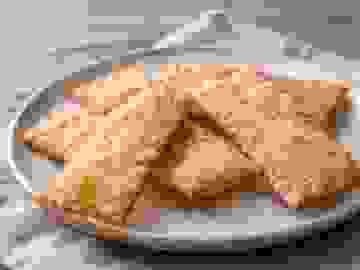
Arrange three on a plain white plate or a wooden board, cross side up so the pale filling shows through each opening. Dust very lightly with confectioners sugar just before serving, because sugar dusted earlier dissolves into the crust and disappears. Add a small cup of strong espresso or a glass of the wine below, and a few thin strips of candied orange peel if you want colour. Keep the plate plain: the pastry is the whole dish, and its golden colour and open cross need no garnish to look generous.
Professional Technique
The technical centre of calcioni is a ricotta filling that must set in the oven like a soft custard instead of running out of the crust. Fresh ricotta is roughly three quarters water held in a loose curd, and a filling made straight from the tub releases that water as soon as heat tightens the proteins. The answer starts hours before baking. Draining the cheese by weight in a sieve for 12 hours removes the free whey, and weighing it afterwards turns a variable ingredient into a known one, so the sugar and eggs are measured against real solids.
The egg is the only binder in the filling, with no flour or starch to help, and it does two jobs. As the temperature inside the pastry passes about 160°F (71°C) the egg proteins coagulate into a net that traps the remaining moisture and holds the filling as a soft, sliceable set. That net also stops whey from pooling and soaking the base. This is why the eggs are beaten in only until combined: extra air lifts the filling and then collapses it, leaving a hollow and a wet crust.
The cross cut on top is a designed vent, not decoration. Steam builds inside a sealed pastry as the filling heats, and without an exit it forces its way through the weakest point, which is usually the crimp. Two short cuts through the upper pastry, made before baking and after glazing, widen as the crust bakes and set, releasing the vapour in a controlled way. The rim stays sealed and whole, and the pale filling showing in the opening tells you when it is done.
Texture and Moisture Control
Two textures meet in a calcione: a thin, short, crumbly crust and a filling that is creamy but firm. The crust is protected by keeping the dough cold until it enters the oven. Cold butter melts late and leaves fine pockets, and the low water content of a frolla means little gluten develops, so the bite stays tender instead of chewy. Rolling to 1/8 inch (3 mm) is the compromise: thinner tears at the fold, thicker bakes dense and pale.
The preheated tray does the rest of the crust's work. Bottom heat sets the base within the first minutes, so any moisture that does leave the filling meets a crust that is already firm. The egg white and sugar glaze dries into a thin crackling shell, and that shell carries the deep gold colour.
Cooling completes the texture. Straight from the oven the filling is still loose and will run when cut. Twenty minutes on a wire rack lets it finish setting and lets steam leave the crust without condensing underneath, which is why a pastry cooled on a plate turns soft on the bottom. They are best on the first day.
Professional Mise en Place
Calcioni reward planning: the ricotta needs a night, the dough needs an hour and the filling needs a chill, so the active work is short if the order is right.
Equipment and tools
Fine mesh sieve, cheesecloth and a deep bowl for draining
4 inch (10 cm) round cutter and a rolling pin
Heavy baking tray and parchment
Sharp paring knife for the cross and a fork for sealing
Wire rack, dry pastry brush and a digital scale
Small bowl for the egg white and a clean pastry brush for glazing
Prepared ahead
Ricotta drained the night before and weighed
Dough made a day ahead and kept wrapped in the refrigerator
Filling beaten and chilled up to 4 hours ahead
Pastries filled and cut into discs the same morning, kept cold
Service setup
Oven and tray fully preheated before the first pastry goes in
Egg white beaten and sugar ready beside the tray
Cooling rack cleared and ready before the tray comes out
Confectioners sugar dusted only at the moment of serving
Chef Tips
Buy sheep milk ricotta from a cheesemaker if you can, not a tub with stabilisers. Stabilisers change how the filling sets, and a firm, slightly grainy curd is a sign it will drain well.
Weigh the drained ricotta before adding the sugar. If it weighs less than expected, reduce the sugar a little, because a drier cheese tastes sweeter.
Bake one test pastry first and keep it as a reference. If it leaks, chill the filling longer or drain the cheese for a few more hours before baking the whole batch.
Mistra can be replaced by a few drops of anise liqueur or dark rum, but keep the quantity small. It is meant to scent the filling, not to be tasted on its own.
Make a double batch and freeze half of the pastries unbaked on a tray. They bake straight from frozen with only a few extra minutes, and having them ready makes unexpected guests an easy event instead of a stressful one.
Common Mistakes
Skipping the drain. Undrained ricotta releases whey as it heats and the filling swells, weeps and soaks the base. Twelve hours in the sieve is not optional, and the whey that comes out is the proof that it was needed.
Beating the filling too long. Air makes it puff in the oven and then collapse, leaving a hollow pastry. Mix only until smooth.
Leaving flour on the rim. A floury edge will not seal, and the filling escapes at the crimp. Brush the border clean before folding.
Skipping the cross or cutting too deep. Without a vent, steam splits the crimp. A cut that reaches the filling lets it bubble out. Cut through the upper pastry only.
Overfilling the pastry. More than a heaped tablespoon pushes filling onto the sealing edge and stretches the dough thin at the fold. The pastry then splits in the oven. Weigh about 1 oz (30 g) for each disc.
Baking on a cold tray. A base that starts slowly absorbs moisture and turns pale and soft. Preheat the tray for the full oven time.
Wine Pairing
Verdicchio di Matelica DOC: The local answer, from the inland Marche. A dry white works here because the filling carries little sugar, and its high acidity cuts the butter in the crust cleanly. The bitter almond note on the finish runs alongside the lemon zest instead of competing with it. A young bottle is best, cold and unoaked.
Moscato d'Asti DOCG: The easy bottle, low in alcohol with a soft frothy pressure that scrubs the butter from the palate between bites. Its orange blossom and ripe peach sit directly on the lemon and cinnamon. Serve it very cold, at about 43°F (6°C).
Vin Santo del Chianti Classico DOC: For a batch baked dark, where the sugar crust has gone toffee. Years in small sealed barrels give dried fig, walnut and candied orange, and that nutty note suits browned butter pastry. The acidity keeps the rich ricotta from settling heavily.
Recioto di Soave DOCG: The most delicate sweet white here, with white peach, acacia honey and almond skin. Its restrained sweetness flatters a filling built on fresh cheese instead of shouting over it. Pour it in small glasses at 50°F (10°C).
Romagna Albana DOCG: A neighbour from just over the northern border. In its passito form it gives apricot, quince and honeyed thickness, but what makes it work here is the grip: Albana has unusually firm phenolics for a white, and that faint tannic pull stops the pairing from turning into sugar on sugar. Choose the passito if the pastries are heavily dusted.
Storage & Reheating
Refrigerate the cooled calcioni in an airtight container, layered with parchment, for up to 3 days. Because the filling is fresh cheese, do not leave them at room temperature for more than 4 hours after baking. Bring them out 30 minutes before eating.
To freeze, wrap the cooled pastries individually and freeze for up to 2 months. Reheat straight from frozen, uncovered, on a tray at 325°F (165°C) for 12 to 15 minutes, or 8 to 10 minutes from the refrigerator. Never microwave them: the crust turns leathery and the filling loosens.
If the crust has softened in storage, a few minutes in the oven restores most of its crispness. Bring the pastries to room temperature first, place them on a rack over a tray so hot air reaches the base, and let them cool for 5 minutes after reheating.
Nutrition
Per pastry, based on a yield of 16:
Calories: 290 kcal
Total Fat: 13 g
Saturated Fat: 7 g
Trans Fat: 0.3 g
Unsaturated Fat: 5 g
Cholesterol: 90 mg
Sodium: 105 mg
Total Carbohydrates: 36 g
Fiber: 1 g
Total Sugars: 17 g
Added Sugars: 16 g
Protein: 7 g
Lactose: 0.5 g
Principal micronutrients: calcium, phosphorus, selenium, riboflavin, vitamin A, vitamin B12
These figures are estimates. The lactose figure is low because much of it leaves with the whey during the overnight drain.




Comments