
Italian Master Method for Risotto | Risotto Classico

Risotto is not a recipe, it is a method, and once the method is in your hands every variation takes care of itself. What follows is the base version, with nothing added to distract from the technique: rice, light stock, onion, white wine, butter and Parmigiano, cooked so the grains stay separate and al dente while the liquid around them thickens into a starch emulsion. There is no cream in it, and there never was.
Four things decide whether it works. The rice must be a variety with a soft starchy exterior and a hard core. The toasting must be dry, brief and audible. The stock must be hot and added in controlled amounts rather than poured in all at once. And the finish, the mantecatura, must happen off the heat with cold butter and cheese beaten in hard enough to emulsify. Everything else is detail.
Learn this and risotto alla milanese becomes a pinch of saffron, risotto ai funghi a pan of mushrooms, and a risotto with any vegetable you like a question of when to add it. The method below is written to be repeated until your hands know it without measuring.
Yield: 4 servings. Prep: 20 minutes. Cook: 25 minutes. Rest: 2 minutes. Total: about 50 minutes. Difficulty: intermediate. Course: primo. Region: northern Italy, the rice plains of Piedmont, Lombardy and Veneto.
The Story
Rice reached Italy long before risotto did, through Arab Sicily and through Spanish and Venetian trade, treated at first as a costly spice sold by apothecaries rather than as food. Cultivation on a serious scale began in the Po valley in the late fifteenth century, when the Sforza dukes of Milan encouraged the draining and irrigation of the wet flat land around Novara, Vercelli and Pavia. Those paddies are still there, and Italy is still the largest rice producer in Europe.
The dish is much younger than the crop. For centuries rice in Lombardy was boiled into soups and porridges, and cooking it slowly in a pan with its own thickened liquid appears in print only in the early nineteenth century. Luraschi, cooking in Milan, published risotto recipes including a yellow one with saffron in 1829, and from there the method spread through the region. What was codified then is what is described below: toast, moisten gradually, stir, finish with fat.
The named varieties are more recent still, and were bred for exactly this job. Vialone Nano was selected in 1937 and remains the Veneto favourite, shorter and quicker to cook. Arborio takes its name from a town in the province of Vercelli. Carnaroli, created in 1945 from a cross of Vialone and Lencino, has the highest amylose content of the three, which is why it holds its bite longest and why professional kitchens keep it on the shelf.
Ingredients
For the stock
Light vegetable stock, unsalted or barely salted, 7 cups (1.7 liters)
Fine sea salt, to taste, added to the stock not the rice
For the soffritto
Yellow onion, very finely chopped, 2 oz (60 g)
Unsalted butter, 1 tbsp (14 g)
Extra virgin olive oil, 1 tbsp (15 ml)
For the rice
Carnaroli rice, 1 3/4 cups (320 g)
Dry white wine, at room temperature, 1/3 cup (80 ml)
For the mantecatura
Unsalted butter, very cold, cut into cubes, 3 tbsp (45 g)
Parmigiano Reggiano, aged 24 months, finely grated, 2 oz (60 g)
Freshly ground black pepper, to taste
Preparation
Step 1
Season the stock and keep it hot. Bring it to a bare simmer in a saucepan beside your risotto pan and hold it there for the whole cooking time, with a ladle in it. Season the stock rather than the rice, so every addition carries the same seasoning and nothing needs correcting at the end. It should taste pleasant to drink and slightly under seasoned, since the Parmigiano is salty and arrives later.
Step 2
Chop the onion until it disappears. The pieces should be no larger than a grain of rice. Anything bigger stays visible and crunchy in the finished dish, and the point of the soffritto is sweetness and body without texture left behind. If chopping that finely is beyond your knife, grate the onion on the coarse holes of a box grater.
Step 3
Build the soffritto slowly. Melt the butter with the olive oil in a wide heavy pan over low heat, add the onion and a pinch of salt, and cook for 6 to 8 minutes until completely soft and translucent. It must not colour. The oil raises the smoking point of the butter and keeps the milk solids from browning, and any golden edge reads as a caramel note that does not belong in a white risotto.
Step 4
Toast the rice. Raise the heat to medium, tip in the dry rice and stir constantly for 2 to 3 minutes, adding no liquid. The grains should turn from chalky white to translucent at the edges with an opaque dot at the centre, and the pan should sound dry and sandy under the spoon. A grain should be too hot to hold. This is the tostatura, and skipping it is the difference between risotto and rice pudding.
Step 5
Deglaze with the wine. Pour it in all at once and keep stirring until the pan is almost dry and the sharp alcohol smell has gone, about 1 to 2 minutes. Use wine at room temperature, never straight from the refrigerator, because cold liquid on hot toasted grains halts the cooking. To leave wine out, use a ladle of stock and a teaspoon of lemon juice at the end.
Step 6
Begin adding stock. Add one ladle of hot stock, enough to just cover the rice, and stir. You want a steady simmer, not a boil and not a sulk. Wait until the liquid has almost gone and the spoon leaves a clear trail across the base before the next ladle goes in. Adding stock too early simply boils the rice.
Step 7
Stir with purpose, not constantly. The instruction never to stop stirring is wrong, and constant agitation breaks the grains. Stir firmly every twenty seconds or so, scraping the base and the corners so nothing catches, and let the pan work in between. The aim is friction between grains, which strips starch off their surfaces, and that comes from decisive movements rather than fussing.
Step 8
Track the cooking and taste from minute twelve. Carnaroli takes 16 to 18 minutes from the first ladle. Bite a grain at minute 12 and every two minutes after. You want a grain that yields under the tooth with a firm centre still present, not chalky and not soft. Stop adding stock about one ladle short, because the rice keeps absorbing during the rest and the finish.
Step 9
Rest, then mantecare. Take the pan off the heat and let it stand 2 minutes, uncovered. This riposo lets the temperature drop and the grains relax. Add the cold cubed butter and the grated Parmigiano and beat them in hard with a wooden spoon, or shake the pan sharply towards you, until the risotto turns glossy and loosens noticeably. Check the wave, adjust with a splash of hot stock, and serve within a minute.
Plating
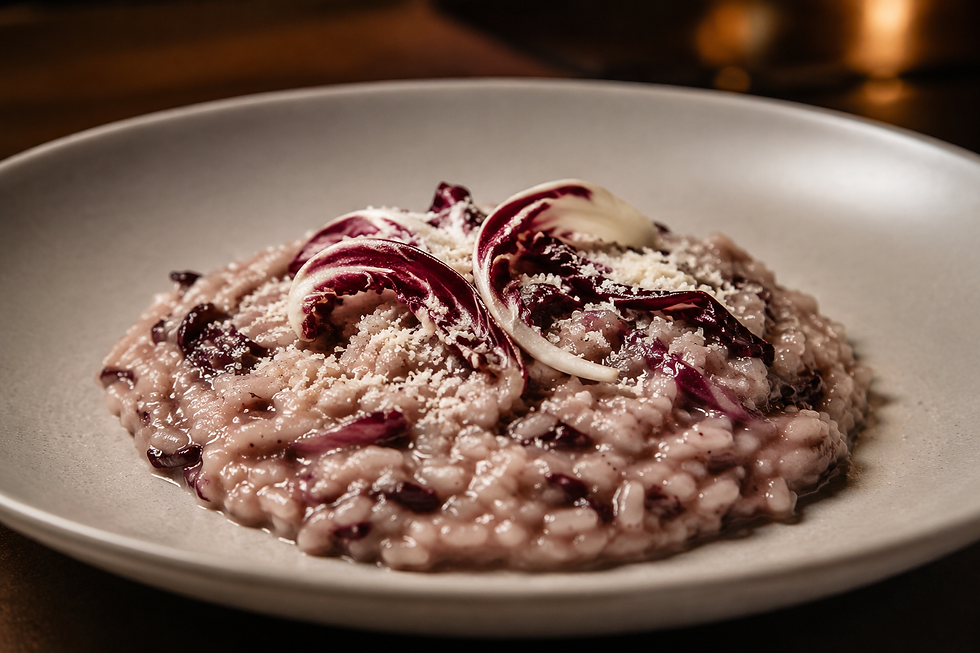
Risotto is served on a warm flat plate, never in a deep bowl. The classic wide rimmed plate exists precisely for this: it spreads the rice into a thin even layer where heat escapes fast and the texture holds from the first mouthful to the last. A bowl keeps the centre hot, the rice carries on cooking in it, and by the time the diner reaches the bottom it has turned stodgy. Warm the plates to about 140°F (60°C).
Spoon a generous ladle into the centre, then do what Italians call battere il piatto: hold the plate flat and tap the underside sharply with the heel of your hand two or three times. The risotto spreads into a smooth circle with a slightly raised edge, which is what all'onda looks like when it is right. Finish with a light dusting of Parmigiano and a grind of pepper and carry it to the table at once, because the window between perfect and heavy is about ninety seconds.
Professional Technique
The whole method is an argument about starch. Risotto rice carries two kinds: amylopectin, which sits in the softer outer layers, dissolves readily and thickens the liquid into a creamy suspension, and amylose, concentrated in the dense core, which resists gelatinisation and keeps the centre al dente. A good risotto variety has plenty of both in the right places. Long grain rice has too little amylopectin outside to make a sauce, and pudding rice too little amylose at the core to keep any bite.
Tostatura is what protects that structure. Two or three minutes of dry heat partially dextrinises the surface starch and firms the outer layer of each grain, so that when liquid arrives the grain releases starch gradually across eighteen minutes instead of dumping it in the first five. Untoasted rice goes slack, the sauce turns gluey and the centres overcook before the liquid has thickened. Adding stock in stages does the complementary job: it keeps the grains rubbing against each other in a relatively small volume of liquid, and that mechanical abrasion is what strips the amylopectin off and builds the emulsion.
Texture and Moisture Control
The target is all'onda, the wave. Tilt the pan and the risotto should move as a slow single mass and settle back level within about two seconds, leaving a thin film behind. If it runs like soup there is too much liquid, and the fix is thirty seconds back over gentle heat while stirring. If it sits in a mound, add hot stock a ladle at a time. Judge it in the pan, never on the plate, because it stiffens as it cools.
Temperature control does the rest. Stock added cold drops the pan temperature, stops the simmer and leaves the grains soaking rather than cooking, which gives a wet risotto with chalky centres. That is why the stock stays at a bare simmer throughout. At the other end the mantecatura fails if the pan is still hot: butter added over heat melts and runs out as a greasy layer, while cold butter beaten into a pan rested for two minutes emulsifies with the starch and the cheese into a stable glossy sauce. That rest is not a convenience, it is what makes the emulsion possible.
Professional Mise en Place
Risotto demands unbroken attention for twenty minutes, so nothing can be prepared once it has started. Everything below is in place before the rice touches the pan.
Equipment and tools
Wide heavy pan with a thick base, about 11 inches (28 cm) across
Second saucepan for the stock, kept beside it with a ladle
Wooden spoon or flat wooden spatula, never a whisk
Microplane or the finest holes of a box grater for the Parmigiano
Warm flat plates with a wide rim, held at about 140°F (60°C)
Prepared ahead
Stock made and tasted for seasoning, up to 3 days ahead or frozen
Onion finely chopped, up to 4 hours ahead and kept covered
Parmigiano grated, up to 2 hours ahead, left at room temperature
Butter cut into cubes and returned to the refrigerator until the finish
Wine measured out and standing at room temperature
Service setup
Stock at a bare simmer, never boiling and never allowed to reduce hard
Rice weighed and dry, with nothing rinsed and nothing soaked
Cold butter and grated cheese within reach of the pan
Plates warming and the table ready before the first ladle goes in
A small jug of extra hot stock for the final adjustment
Chef Tips
Never rinse risotto rice. Washing strips exactly the surface starch the method depends on, and rinsed rice will never produce a sauce however long you stir. This is the instruction that most often crosses over wrongly from other rice traditions, where rinsing is correct. Here it is fatal.
Use a wide pan rather than a tall one. A layer of rice about 1 inch (2.5 cm) deep gives the evaporation and the grain contact this method needs. In a narrow deep pan the bottom layer steams under the weight above it, the liquid reduces too slowly and you stir for twenty five minutes to get what a wider pan gives in eighteen.
Make the stock light. A heavily reduced or strongly flavoured stock overwhelms the rice, and one that reduces hard while the risotto cooks will over salt it at the end. Onion, carrot, celery and parsley stems simmered for forty minutes is exactly right. For a meat version, a light chicken stock works on identical timings.
Learn to hear the pan. A correctly simmering risotto makes a steady soft sound, neither violent bubbling nor silence. If it goes quiet the heat is too low and the grains are soaking. If it spits and roars the heat is too high and the liquid evaporates before the rice can absorb it. The sound tells you more than looking, and sooner.
Common Mistakes
Adding cold stock. Cold liquid stops the simmer dead and the rice swells instead of cooking, giving a wet risotto with hard chalky centres that extra time will not repair. Keep the stock at a bare simmer beside you throughout.
Skipping or rushing the tostatura. Without two or three minutes of dry toasting the grains dump their surface starch at once, the sauce turns to paste and the centres overcook. The rice should sound sandy and be too hot to hold before any liquid goes near it.
Adding all the stock at once. That is boiling rice, not making risotto. The grains never rub against each other, no starch is released by friction and the liquid stays thin. Add one ladle at a time.
Finishing the butter over the heat. Butter added to a hot pan melts and separates, giving a greasy film instead of an emulsion. Take the pan off, rest two minutes, then beat in cold cubed butter and cheese hard.
Using the wrong rice. Long grain, basmati and parboiled rice cannot make risotto, because they lack the soft outer starch that becomes the sauce. Use Carnaroli, Arborio or Vialone Nano, adjusting the timing since Vialone Nano cooks faster.
Cooking it all the way in the pan. The rice keeps absorbing during the rest and the mantecatura, so a risotto taken to perfection over the flame is soft by the time it reaches the plate. Stop one ladle short.
Wine Pairing
Gavi DOCG: Cortese grown in southern Piedmont, and the classic answer to a white risotto. Bone dry, high in acidity and almost austere, with green apple and a mineral finish, which is what a dish built on butter and aged cheese needs beside it. It is also the obvious cooking wine here, since pan and glass should agree.
Roero Arneis DOCG: From the sandy left bank of the Tanaro, with more flesh than Gavi and a softer profile of pear, white flowers and almond. That roundness suits a risotto finished generously with butter, where a very lean white can seem thin. Its low acidity means drinking it young and serving it properly cold, at about 48°F (9°C).
Lugana DOC: Turbiana from the southern shore of Lake Garda, grown on heavy clay that gives it unusual weight and a long saline finish. It has the structure to sit under the Parmigiano without being erased, and a citrus lift that keeps the palate moving through a rich starchy dish.
Soave Superiore DOCG: Garganega from the volcanic hills east of Verona, and the natural choice with Vialone Nano, since rice and wine come from neighbouring parts of the Veneto. The Superiore bottlings carry more concentration and a bitter almond close that plays against the sweetness of the onion and the fat of the finish.
Franciacorta DOCG: The Lombard traditional method sparkler, and a real match rather than a celebratory afterthought. Its fine bead and firm acidity scour the butter from the palate between forkfuls, and its bread and yeast character picks up the toasted note the rice gains during the tostatura. Choose a Brut or Pas Dose.
Storage & Reheating
Risotto keeps badly, because the grains carry on absorbing liquid in the refrigerator and the emulsion sets solid. Leftovers keep covered and refrigerated for 2 days at most. Reheat in a wide pan over low heat with a ladle of hot stock, stirring gently until the mass loosens and moves again, then take it straight off. A microwave heats unevenly and drives the butter out.
The better answer is to treat cold risotto as a different dish. Riso al salto is the Milanese solution: press it into a thin cake in a buttered pan and fry over medium heat until a deep crust forms, about 4 minutes a side. Cold risotto is also the base for arancini and suppli, rolled around a cube of cheese, crumbed and fried. Do not freeze risotto as risotto, since the grains collapse on thawing, but crumbed arancini freeze well for up to 2 months.
Nutrition
Per serving, based on 4 portions of the base recipe:
Calories: 520 kcal
Total Fat: 18 g
Saturated Fat: 11 g
Trans Fat: 0 g
Unsaturated Fat: 6 g
Cholesterol: 48 mg
Sodium: 620 mg
Total Carbohydrates: 70 g
Fiber: 2 g
Total Sugars: 2 g
Added Sugars: 0 g
Protein: 13 g
Principal micronutrients: calcium, phosphorus, selenium, niacin, vitamin A
These figures are estimates for the plain version. Sodium depends almost entirely on how the stock was seasoned and on the age of the Parmigiano, and any addition will change the numbers.




Comments