
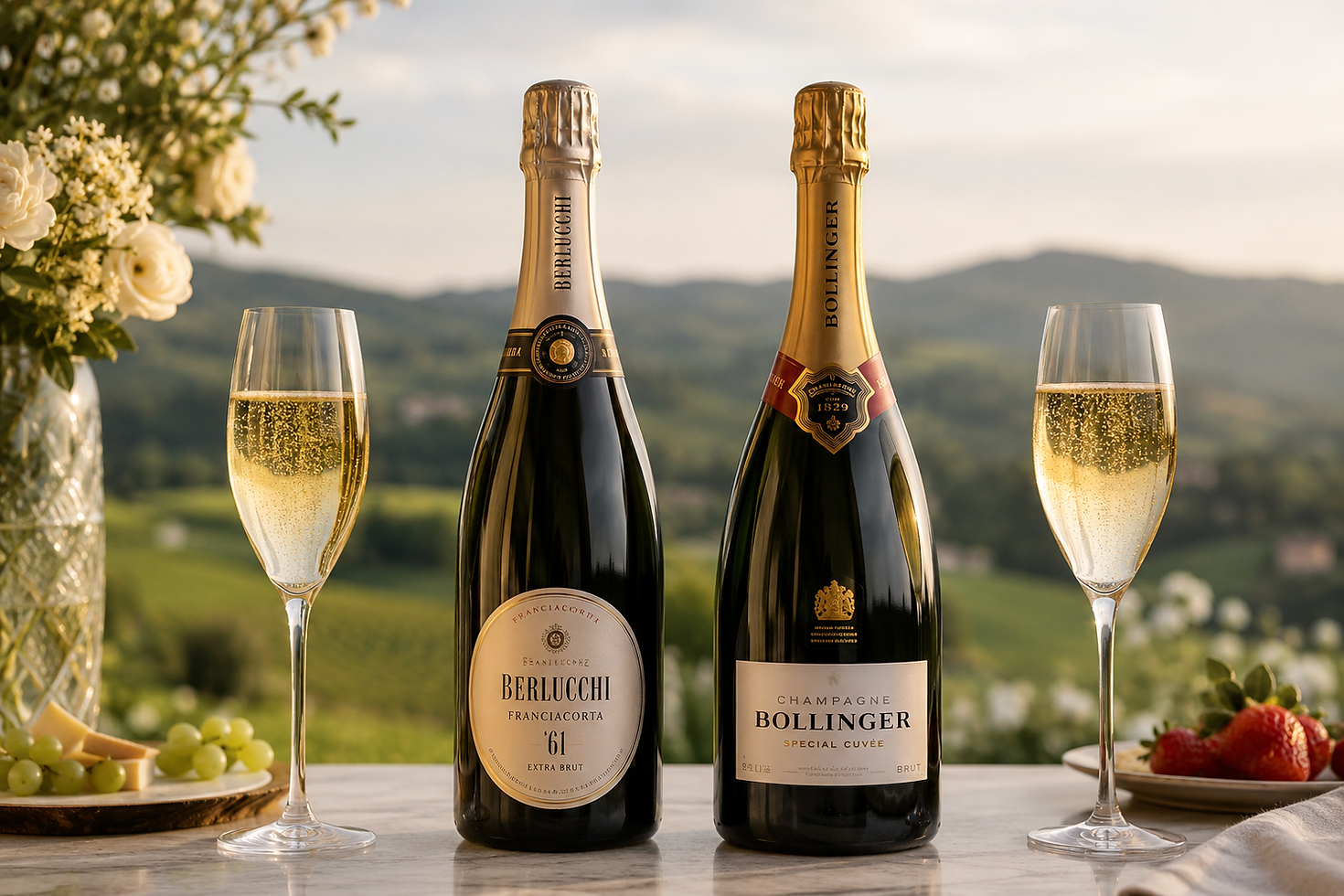
Franciacorta vs Champagne: What's the Difference?
- 23 hours ago
- 9 min read
Updated: 22 hours ago

Franciacorta and Champagne belong in the same serious conversation. Both are protected sparkling wines made through a second fermentation in the individual bottle, followed by lees aging, riddling, disgorgement, and dosage. Both rely heavily on Chardonnay and Pinot Noir, and both can produce fine bubbles, layered aromas, gastronomic versatility, and genuine cellar potential. Their differences come from place, blending traditions, grape options, climate, aging rules, scale, and cultural identity.
Franciacorta comes from a compact zone in Lombardy near Lake Iseo, where glacial soils, lake influence, and a relatively warm growing season give the wines ripe citrus and orchard fruit, savory depth, and a polished texture. Champagne comes from a much larger and cooler French region shaped by chalk, limestone, marl, and an elaborate culture of blending across grapes, villages, parcels, and vintages. It often emphasizes higher acidity, chalky tension, and a broader spectrum of mature autolytic aromas.
Quick Answer: Franciacorta or Champagne?
Choose Franciacorta when you want a premium traditional-method sparkling wine with Italian identity, generous fruit, refined mousse, savory freshness, and excellent performance at the table. It is especially compelling with risotto, lake fish, seafood, salumi, aged cheese, roast poultry, and creamy first courses. Satèn offers a distinctive softer-pressure style that Champagne does not reproduce as a formal category.
Choose Champagne when you want sharper acidity, chalk-driven precision, a wider range of house and grower styles, deep reserve-wine complexity, and the strongest global reputation for long-aged sparkling wine. Champagne is usually more expensive, but it also offers extraordinary diversity, from linear Blanc de Blancs to structured Blanc de Noirs, rosé, vintage, and prestige cuvées.
Franciacorta vs Champagne at a Glance
Category | Franciacorta | Champagne |
Origin | Lombardy, near Lake Iseo | Champagne region, northeastern France |
Main grapes | Chardonnay and Pinot Noir; Pinot Blanc and Erbamat permitted | Chardonnay, Pinot Noir, and Meunier dominate |
Method | Second fermentation in the bottle | Second fermentation in the bottle |
Minimum maturation | 18 months on lees for standard Franciacorta | 15 months in cellar for non-vintage Champagne |
Typical profile | Ripe citrus, apple, white flowers, nuts, bread, savory finish | Citrus, apple, chalk, brioche, toast, nuts, high acidity |
Signature styles | Satèn, Rosé, Millesimato, Riserva | Blanc de Blancs, Blanc de Noirs, Rosé, Vintage, prestige cuvée |
Market position | Premium, limited, often strong relative value | Global luxury benchmark with a very wide price range |
The Essential Difference: Similar Method, Different Terroir
The production method creates the family resemblance. In both regions, a still base wine is bottled with yeast and sugar so a second fermentation can create carbon dioxide inside the bottle. The wine then rests on spent yeast cells, developing texture and aromas associated with bread, pastry, cream, biscuit, and nuts. Sediment is moved toward the neck, removed at disgorgement, and the final dosage helps establish balance and sweetness.
Terroir and blending create the divergence. Franciacorta’s base wines often begin with slightly riper fruit and broader mid-palate weight. Champagne’s cooler conditions generally preserve more piercing acidity, while chalk-rich sectors can produce a recognizable sense of linearity and tension. Producer decisions still matter enormously: harvest date, pressing, malolactic fermentation, oak, reserve wines, lees time, dosage, and bottle age can make two wines from the same appellation taste dramatically different.
Origin, Landscape, and Climate
Franciacorta: Glacial Hills and Lake Iseo
Franciacorta lies in the Alpine foothills of Lombardy, south of Lake Iseo and west of Brescia. A glacier descending from Val Camonica shaped a morainic amphitheater of rolling hills. The resulting soils commonly contain sand, silt, stones, and glacial deposits, with good drainage and varying water reserves. The zone is compact, but differences in elevation, exposure, soil depth, and subsoil create meaningful variation among vineyards.
The climate is continental, moderated by Lake Iseo. The lake stores warmth, tempers winter cold, and helps move cooler air through the vineyards during the growing season. Compared with Champagne, Franciacorta generally ripens grapes under warmer conditions. That does not mean the wines lack acidity; careful site choice, Chardonnay, Pinot Noir, and the late-ripening local grape Erbamat can all support freshness.
Champagne: Chalk, Latitude, and Regional Diversity
Champagne is farther north and spans several major sectors, including the Montagne de Reims, Vallée de la Marne, Côte des Blancs, Côte de Sézanne, and the Aube. Its subsoils include chalk, marl, and hard limestone. Porous chalk can hold water and release it gradually, helping vines balance ripeness with acidity. Different soils and exposures also influence where Chardonnay, Pinot Noir, and Meunier perform best.
Grapes and Blending
Standard Franciacorta is made from Chardonnay and/or Pinot Noir, with Pinot Blanc permitted up to 50% and Erbamat up to 10%. Chardonnay occupies most of the vineyard area and contributes citrus, flowers, apple, structure, and finesse. Pinot Noir adds body, red-fruit nuance, and longevity. Pinot Blanc can bring softness and perfume, while Erbamat contributes high acidity and a discreet aromatic profile. Erbamat is not permitted in Satèn.
Champagne is dominated by Chardonnay, Pinot Noir, and Meunier. Chardonnay favors freshness, floral and citrus aromas, chalky precision, and longevity. Pinot Noir provides structure, depth, and red-fruit character. Meunier offers roundness, approachability, apple, pear, and yellow-fruit notes. A small group of other authorized varieties survives in tiny proportions, but most bottles are explained by the three principal grapes.
Production Method and Aging Rules
Franciacorta: Longer Baseline Lees Aging
Franciacorta grapes must be harvested by hand and pressed gently for the base wines. After blending, the second fermentation occurs in the bottle. Standard Franciacorta spends at least 18 months on its lees. Millesimato, made with at least 85% wine from the stated vintage, requires at least 30 months. Riserva is a vintage category selected for extended development and requires at least 60 months on the lees.
Satèn and Rosé require at least 24 months on the lees. Satèn is based principally on Chardonnay, with Pinot Blanc allowed, and has lower bottle pressure, capped at five atmospheres. That creates a silkier, softer mousse. Rosé requires a significant Pinot Noir component and emphasizes red berries, rose, toast, and structure. These regulated styles give Franciacorta a clear internal map.
Champagne: Cellar Time and the Power of Reserve Wines
All genuine Champagne must spend at least 15 months in the producer’s cellars before release, while vintage Champagne requires at least three years. In practice, many houses and growers age their wines longer. Lees maturation adds autolytic complexity, but reserve wines are equally important. They allow a producer to carry mature flavors and a consistent signature across changing harvests.
Bubbles, Texture, Aroma, and Flavor
Classic Franciacorta combines a fine, persistent perlage with ripe lemon, apple, pear, white peach, flowers, fresh bread, almond, hazelnut, and a savory finish. The fruit often feels rounder than in Champagne, and the palate can carry more immediate generosity. Satèn is deliberately creamy and delicate because of its lower pressure. Rosé adds strawberry, raspberry, rose, and Pinot Noir structure.
Champagne often feels more incisive. Citrus, green or yellow apple, white flowers, chalk, and saline impressions can sit above brioche, biscuit, toast, cream, and roasted nuts. Pinot-led wines may show broader shoulders and red fruit; Chardonnay-led wines may feel more linear. Mature bottles can develop honey, dried fruit, mushroom, coffee, and spice. The mousse is usually fine and persistent, though producer and aging choices matter more than nationality.
Acidity, Body, Alcohol, Minerality, and Finish
Champagne generally wins on perceived acidity and chalky tension. Its finish can feel long, cool, and linear, especially in Chardonnay-driven wines from chalk-rich areas. Franciacorta generally wins on breadth, fruit ripeness, and a softer transition through the mid-palate. It can still be dry, energetic, and mineral in character, but the shape is often rounder and more immediately gastronomic.
Styles to Know
Franciacorta Satèn: Chardonnay-led, lower pressure, silky mousse, and a rounded Brut style.
Franciacorta Rosé: at least 35% Pinot Noir, with red-fruit intensity and additional structure.
Franciacorta Millesimato and Riserva: vintage-focused wines with 30 and 60 months of minimum lees aging.
Champagne Blanc de Blancs: made from white grapes, most commonly Chardonnay, with citrus, chalk, and finesse.
Champagne Blanc de Noirs: made from Pinot Noir and/or Meunier, generally broader and more structured.
Vintage and prestige Champagne: selected wines designed for greater depth, extended aging, and cellar development.
Food Pairing: Italian Breadth Versus French Precision
Franciacorta is exceptional with Italian food because its acidity cuts richness while its fruit and savory lees character complement the dish. Try Brut with antipasti, salumi, fried seafood, risotto, lake fish, shellfish, roast chicken, veal, Grana Padano, or Parmigiano Reggiano. Satèn is particularly effective with creamy risotto, delicate pasta, scallops, butter sauces, and soft cheeses. Rosé handles tuna, duck, charcuterie, and tomato-accented dishes.
Champagne is equally versatile but often shines where sharper acidity and chalky tension are useful: oysters, caviar, smoked salmon, tempura, fried chicken, French fries, roast poultry, mushrooms, aged cheese, and butter-rich seafood. For a concrete example, our Champagne risotto with seared scallops and Oscietra caviar shows how acidity, creaminess, sweetness, and salinity can meet in one dish.
Serving and Glassware
Serve both wines chilled but not frozen, generally around 46–50°F or 8–10°C. Complex Riserva, vintage, and prestige cuvées may reveal more detail a little warmer. Use a tulip-shaped glass rather than an extremely narrow flute. The wider bowl gives aromas space to develop, while the tapered rim preserves freshness and directs the bubbles. A standard white-wine glass can also work well for mature bottles.
Aging Potential
Franciacorta’s aging ladder makes selection relatively clear. Standard bottlings are ready on release, while Millesimato and Riserva offer more structure and longer development. Well-balanced examples can gain toast, nuts, dried citrus, honey, and savory complexity for years, especially when acidity and fruit concentration are strong. Satèn can age, but many drinkers prefer its youthful silkiness and floral detail.
Champagne has the broader record for long-term cellaring. Vintage and prestige cuvées can evolve for decades under excellent storage, while strong non-vintage wines may also gain complexity. Aging softens fruit and bubbles while increasing tertiary aromas. It is not automatically an upgrade: drink young for brightness and tension; cellar when you actively prefer toast, honey, nuts, mushroom, and a more vinous texture.
Price, Availability, and Value
Franciacorta is a premium wine, not an inexpensive substitute for Champagne. Its hand harvest, bottle fermentation, extended lees aging, limited zone, and DOCG rules carry real costs. In the United States, however, a well-chosen Franciacorta often offers traditional-method complexity at a lower price than a Champagne of comparable ambition. The challenge is availability: selection can be narrower, and producer knowledge matters.
Champagne has a much larger global market and an enormous price range. Entry-level non-vintage bottles, grower wines, vintage releases, and prestige cuvées serve different buyers. Part of the price reflects production and aging; part reflects scarce vineyard land, distribution, brand equity, and demand. Value is strongest when the producer’s style matches your preference rather than when the label is simply famous.
Which One Should You Choose?
Choose Franciacorta for Italian identity, ripe citrus and orchard fruit, savory breadth, and strong value within premium traditional-method wine.
Choose Franciacorta Satèn for a softer, silkier mousse and elegant pairings with creamy or delicate dishes.
Choose Champagne for higher perceived acidity, chalky precision, reserve-wine depth, and the widest range of mature styles.
Choose vintage or reserve-level bottles from either region when complexity and cellaring matter more than immediate freshness.
Choose both for a blind tasting that isolates terroir and blending because the basic production method is shared.
For the neighboring Italian comparison, read Franciacorta vs Prosecco. To place Champagne against the world’s most familiar Italian sparkling style, use our Prosecco vs Champagne guide. Together, the three comparisons clarify the difference between tank-fermented freshness and bottle-fermented complexity.
Frequently Asked Questions
Is Franciacorta Italian Champagne?
No. Franciacorta and Champagne are separate protected origins. They share second fermentation in the bottle and extended lees aging, but they have different territories, grapes, regulations, styles, and cultural identities. Calling Franciacorta Italian Champagne obscures what makes it distinctive.
Which has longer minimum aging?
Standard Franciacorta requires at least 18 months on the lees. Non-vintage Champagne requires at least 15 months of cellar maturation. For vintage wines, Franciacorta Millesimato requires at least 30 months on the lees, while vintage Champagne requires at least three years. Franciacorta Riserva requires at least 60 months on the lees.
Which wine is drier?
Neither is automatically drier. Both regions use dosage categories. Pas Dosé or Brut Nature and Extra Brut are driest, Brut is dry, and Extra Dry is sweeter than Brut. Read the label and consider acidity, because higher acidity can make the same sugar level taste less sweet.
Does Franciacorta have finer bubbles than Champagne?
Both can produce exceptionally fine, persistent bubbles because both ferment in the bottle and age on lees. Champagne often feels more tense and energetic; Franciacorta often feels rounder. Satèn deliberately uses lower pressure for a silkier mousse. Producer quality and serving temperature are decisive.
Which is better with food?
Both are full-meal wines. Franciacorta has a natural affinity with risotto, salumi, lake fish, seafood, roast poultry, and Italian cheeses. Champagne is outstanding with oysters, caviar, fried foods, mushrooms, poultry, and butter-rich seafood. Choose the dosage and body to match the dish.
Which is better for a celebration?
Champagne delivers the stronger international luxury signal. Franciacorta offers equal seriousness with a more distinctive Italian identity and often better relative value. For a formal toast, either works; for an Italian menu or a guest list interested in discovery, Franciacorta can be the more memorable choice.
Final Verdict
Franciacorta is not a copy of Champagne. It is Lombardy’s own traditional-method sparkling wine, shaped by morainic soils, Lake Iseo, ripe fruit, Italian gastronomy, and strict aging rules. Choose it for savory breadth, polished texture, Satèn’s unique softness, and premium quality that frequently remains underappreciated outside Italy.
Champagne remains the global benchmark for breadth of style, chalk-driven precision, reserve-wine blending, and proven longevity. Choose it for tension, complexity, prestige, and access to an unmatched range of producers and cuvées. The fair conclusion is not France over Italy or Italy over France: it is Franciacorta for generous Italian refinement and Champagne for layered northern precision.


Comments