
Millefoglie Croccante con Ricotta, Pere Caramellate e Mandorle (Italian Crispy Millefoglie with Ricotta, Caramelized Pears and Almonds)
- 3 days ago
- 6 min read
Updated: 23 hours ago
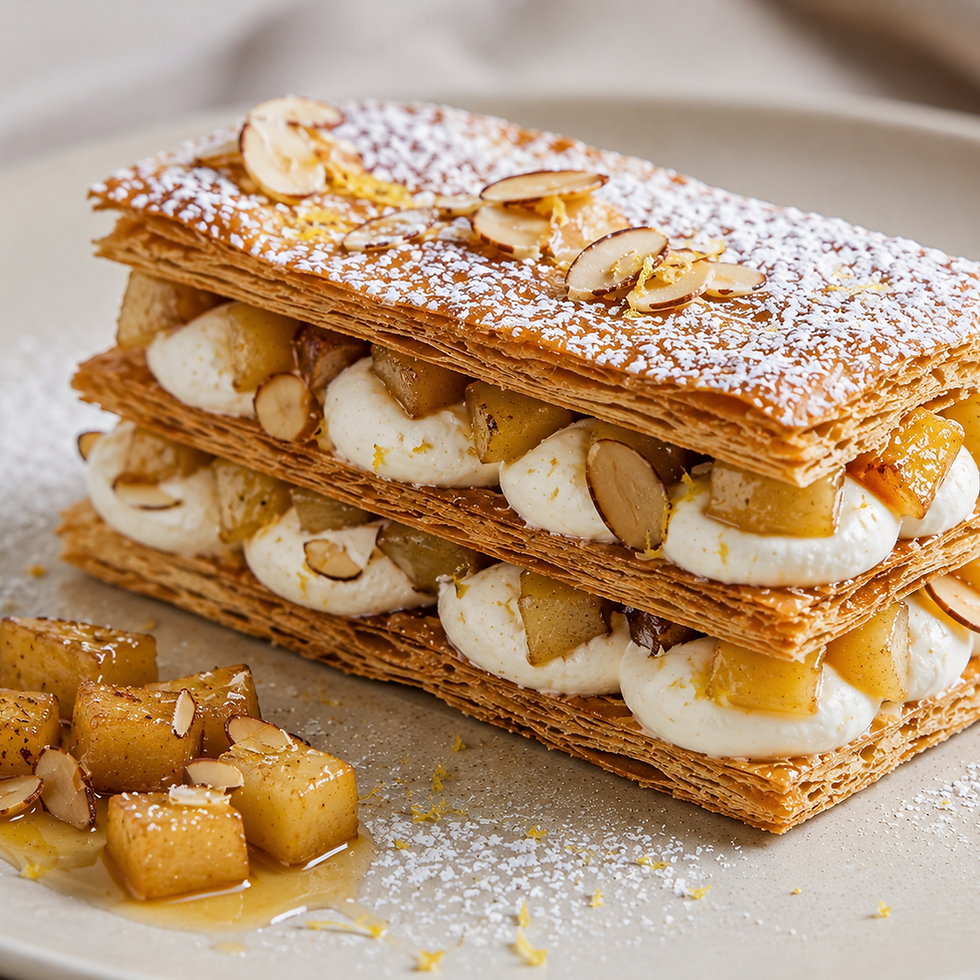
Millefoglie Croccante con Ricotta, Pere Caramellate e Mandorle (Italian Crispy Millefoglie with Ricotta, Caramelized Pears and Almonds)
Story of the Dish
Millefoglie is a dessert of contrast. A proper version is not simply puff pastry filled with cream: it is a study in crispness, temperature, and controlled moisture. In this interpretation, ricotta gives the filling an Italian identity, caramelized pears provide fruit and warmth, and almonds bring a toasted finish that keeps the dessert from becoming one dimensional.
The challenge is timing. Puff pastry must be baked deeply enough to remain crisp, the ricotta cream must be dense rather than loose, and the pears must be caramelized until their surface moisture has evaporated. Assemble shortly before service so the pastry remains audible and brittle when cut.
Recipe Information
Difficulty: Intermediate. Region/Origin: Italian contemporary pastry. Servings: 8. Preparation Time: 40 minutes. Baking Time: 30 minutes. Cooling Time: 45 minutes. Assembly Time: 15 minutes. Total Time: about 2 hours 10 minutes.
Ingredients
1 lb all butter puff pastry, thawed but cold; 2 cups whole milk ricotta, drained; 1/2 cup heavy cream; 1/3 cup confectioners' sugar; 1 tsp vanilla extract; 1 tsp lemon zest; 3 firm ripe pears; 3 tbsp unsalted butter; 1/4 cup granulated sugar; 1 tbsp lemon juice; 1/2 tsp cinnamon; 1/2 cup sliced almonds; pinch of fine sea salt; confectioners' sugar for finishing.
Preparation
Heat the oven to 400°F. Roll the cold puff pastry to an even 1/8 inch thickness. Place between two sheets of parchment and two baking sheets so it rises evenly. Bake 20 minutes, remove the top sheet and parchment, dust very lightly with confectioners' sugar, and bake another 6 to 10 minutes until deeply golden and crisp. Cool completely before trimming into equal rectangles.
For the filling, drain ricotta well, then whip it with confectioners' sugar, vanilla, lemon zest, and salt until smooth. Whip the cream separately to medium peaks and fold it into the ricotta in two additions. Refrigerate until firm.
Peel and dice the pears into 1/2 inch cubes. Melt butter in a wide skillet, add sugar, and cook until it begins to caramelize. Add pears, lemon juice, cinnamon, and a pinch of salt. Cook over medium high heat until glazed and tender but not collapsing, and until no watery syrup remains. Cool completely.
Toast almonds at 325°F for 6 to 8 minutes. Assemble each millefoglie with a pastry layer, piped ricotta cream, a restrained spoonful of pears, a second pastry layer, more cream and pears, then the final pastry. Finish with almonds and a light dusting of confectioners' sugar. Serve immediately.
Professional Technique
Professional millefoglie depends on moisture management. Bake puff pastry until the center layers are dry, not merely golden on the exterior. Cooling on a rack prevents steam from softening the underside. The pears must be cool and nearly dry before assembly.
Pipe rather than spoon the ricotta filling for clean structure. If preparing for service, keep all components separate and assemble to order. A serrated knife cuts the pastry more cleanly than a chef's knife and reduces compression.
Chef Tips
Use all butter puff pastry. Drain ricotta overnight if necessary. Choose pears that are ripe but still firm. Caramelize in a wide pan so steam escapes quickly. Toast almonds just before service for maximum aroma. Chill the cream but keep the pastry at room temperature.
Common Mistakes
Do not assemble hours in advance. Do not underbake the pastry. Do not use hot pears on ricotta cream. Do not leave excess syrup in the fruit. Do not oversweeten the filling, because the caramelized pears and pastry already contribute sweetness.
Wine Pairing
Wine Pairing: Vin Santo complements caramelized pears and almonds with dried fruit and nut notes. Moscato d'Asti keeps the pairing light and aromatic. Recioto di Soave adds apricot and honey character with balancing acidity. Malvasia delle Lipari contributes floral and dried fruit intensity. Brachetto d'Acqui is a lighter option whose red berry notes create a pleasant contrast with pear and ricotta.
Storage and Reheating
Store pastry, cream, and pears separately. Baked pastry keeps airtight at room temperature for 24 hours and can be re crisped at 325°F for 4 to 5 minutes. Ricotta cream keeps refrigerated for 2 days. Pears keep refrigerated for 3 days. Once assembled, eat within 30 minutes for best texture.
Nutrition per Serving
Nutrition per Serving: Calories 480; Protein 9 g; Carbohydrates 46 g; Fat 30 g; Saturated Fat 14 g; Fiber 3 g; Sugars 22 g; Sodium 250 mg; Cholesterol 55 mg.
Advanced Chef Notes
The pastry layer deserves more attention than it usually receives. Puff pastry is laminated dough, and the layers stay crisp only when enough water is driven off during baking. A pale sheet may look delicate but turns leathery once it meets cream. Bake until the internal layers are fully colored. Pressing the pastry between baking sheets limits excessive rise and produces the flat, elegant sheets needed for clean restaurant style portions.
Ricotta filling should be dense enough to pipe and soft enough to eat without resistance. If it is loose after draining, place it in a fine sieve over a bowl for several more hours rather than compensating with extra sugar. Too much sugar draws water out of ricotta and eventually makes the filling wetter. Folding whipped cream into a smooth ricotta base creates volume, but the mixture should still hold a defined ridge from the piping bag.
Pear caramelization is best done in batches if the skillet is crowded. Crowding traps steam and turns the process into stewing. The fruit should develop glossy edges while keeping a recognizable cube shape. A small amount of lemon juice protects freshness and prevents the caramel from tasting flat. If the pears release a great deal of liquid, continue cooking until the pan is almost dry before cooling them on a tray rather than in a deep bowl.
Assembly is a service decision, not just a recipe step. For a dinner party, all components can be prepared early, but the final stack should be built close to dessert time. In a professional kitchen, pastry sheets can be cut and stored airtight, filling held in piping bags, and pears portioned separately. Building each plate to order takes little time and protects the crisp texture that defines millefoglie.
A precise presentation uses restraint. Align the pastry layers rather than letting them slide, pipe small even points of ricotta cream instead of one thick mass, and distribute pears so they are visible from the side. A few toasted almond slices provide height and texture. Powdered sugar should be a veil, not a blanket. The cut should reveal crisp pastry, clean cream, and fruit in distinct layers.
When cutting and plating millefoglie, treat the pastry as a fragile architectural element. Use a long serrated knife and a gentle sawing motion instead of pressing downward. If the top sheet is extremely crisp, pre score it before final assembly so portioning does not crush the cream. Keep finished plates away from heat lamps and humid holding areas. If the pastry has softened before service, never try to rebake an assembled millefoglie; separate components cannot be recovered once the cream has penetrated the layers. The correct solution is prevention through late assembly. For an event, prepare extra pastry rectangles because breakage is normal. A professional result is measured by the first bite: the fork should crack through crisp layers, the ricotta cream should remain cool and clean, and the pear should give moisture without turning the pastry soggy.
If preparing individual portions, cut all pastry pieces from the same baked sheet so their thickness and color match. Uneven pieces make the stack unstable and create inconsistent bites. Keep the lower layer flat and use the ricotta cream as structural support by piping near the corners as well as the center. Pear pieces should sit inside the cream rather than directly on the pastry whenever possible, because the cream forms a partial moisture barrier. At the last moment, check the top pastry for crispness and replace any softened piece. This small discipline is what separates a composed millefoglie from a dessert that looks impressive but collapses as soon as the guest touches it with a fork.
One final detail is temperature contrast. The pastry should be room temperature, while the ricotta cream and pears should be cool. If every component is refrigerator cold, the butter in the pastry becomes firm and the aroma is muted; if everything is warm, the cream loses definition. Build the dessert with cool filling and room temperature pastry, then serve immediately. This gives the fork a crisp crack, lets the ricotta remain fresh, and keeps the caramelized pear aromatic. The almonds should be toasted the same day whenever possible because their volatile oils fade quickly after grinding or slicing. A successful millefoglie should feel light despite its richness, with no single layer dominating the others.


Comments