
Italian Roman Pasta with Guanciale and Pecorino | Pasta alla Gricia
Updated: Sep 13

Pasta alla Gricia is one of Rome’s essential pasta dishes and the clearest expression of the relationship between guanciale, Pecorino Romano, black pepper and starchy pasta water. It contains no tomato, cream, egg or garlic. Its apparent simplicity leaves nowhere for poor heat control or an unstable emulsion to hide.
Often described as the ancestor of amatriciana, gricia developed from the food traditions of shepherds and cured-pork producers in Lazio. The correct texture is glossy and fluid, with crisp-edged guanciale and Pecorino coating the pasta rather than collecting in clumps.
Recipe Information
Servings: 4
Prep Time: 15 minutes
Cook Time: 20 minutes
Total Time: 35 minutes
Region: Lazio, Italy
Difficulty: Intermediate
Ingredients
14 oz (400 g) rigatoni, mezze maniche or spaghetti
5.3 oz (150 g) guanciale, rind removed and cut into 1/4-inch (6 mm) strips
3.5 oz (100 g) Pecorino Romano, finely grated, plus a little for serving
1 1/2 teaspoons (3 g) freshly ground black pepper, divided
Kosher salt for the pasta water, used sparingly
1 1/2 cups (360 ml) hot pasta cooking water, reserved as needed
Preparation
Step 1
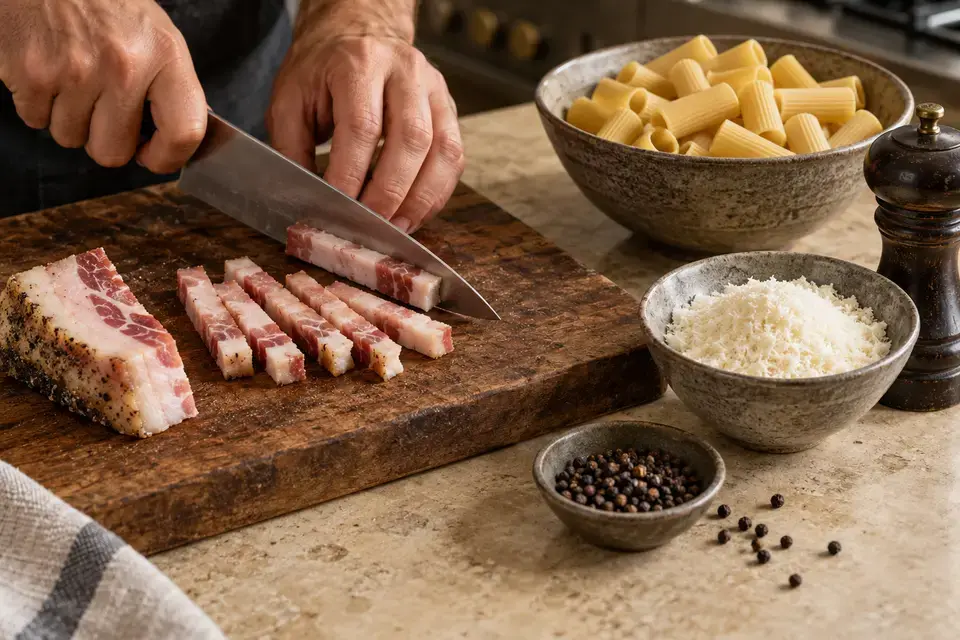
Prepare the Ingredients. Remove the rind from the guanciale and cut it into even 1/4-inch (6 mm) strips. Finely grate the Pecorino Romano, grind the black pepper, and measure the rigatoni before beginning.
Step 2

Render the Guanciale Slowly. Place the guanciale in a cold skillet, then set it over medium-low heat. Cook for 8–10 minutes, turning the pieces as the fat renders, until the edges are golden while the centers remain tender.
Step 3

Reserve the Crisp Guanciale and Toast the Pepper. Transfer about one-third of the crispest guanciale to a plate for finishing. Leave the remaining guanciale and rendered fat in the skillet, add half of the black pepper, and toast it for 20–30 seconds.
Step 4

Cook the Rigatoni. Boil the rigatoni in lightly salted water and cook it for 2–3 minutes less than the package’s al dente time. Before transferring the pasta, reserve at least 1 1/2 cups (360 ml) of the starchy cooking water.
Step 5

Transfer the Pasta and Add Cooking Water. Transfer the very firm rigatoni directly into the skillet with the guanciale. Add a controlled amount of pasta water to begin finishing the pasta in the pan.
Step 6

Risottare and Toss the Pasta. Continue cooking the dry pasta in the skillet by risottatura, adding pasta water only as needed. Toss repeatedly so the rigatoni releases starch, absorbs the seasoned liquid, and develops a shallow glossy base.
Step 7

Prepare the Pecorino Romano Emulsion. In a bowl, combine the finely grated Pecorino Romano with small additions of hot starchy pasta water and a little warm rendered guanciale fat. Whisk until the mixture becomes a dense, smooth, glossy cream without lumps.
Step 8

Add the Pecorino Cream Gradually. Pour only a small amount of the dense Pecorino cream directly from the bowl into the moving pasta. Add it gradually while keeping the skillet in motion so the emulsion disperses immediately without forming a visible pool.
Step 9

Return to the Heat and Toss. Return the skillet to low heat and toss the rigatoni vigorously. The Pecorino cream, starchy water, and guanciale fat should form only a thin glossy coating around the pasta, never a heavy or visible sauce.
Step 10

Plate and Serve Immediately. Divide the Pasta alla Gricia among warm shallow bowls. Finish with the reserved crisp guanciale, the remaining black pepper, and a light dusting of Pecorino Romano, then serve immediately.
Professional Technique
Begin rendering guanciale in a cold skillet. Slow heating liquefies the fat before the exterior browns, giving enough flavorful fat to build the emulsion. If the pan is heated first, the outside can burn while the center remains rubbery and too little fat is released.
The pasta finishes cooking in the skillet by risottatura. This is not simple reheating: the pasta absorbs seasoned liquid while agitation releases starch. Add the cooking water progressively so the pasta remains surrounded by a small amount of glossy liquid rather than floating in broth.
Pecorino must be emulsified away from aggressive heat. Cheese proteins tighten and clump when they meet a boiling surface. Remove the pan, let the violent bubbling stop, and add finely grated cheese gradually while tossing. Pasta water joins the rendered fat and cheese into a stable coating.
Judge the sauce before plating. It should flow slowly when the skillet is tilted and look slightly loose because it continues to thicken as it leaves the heat. A dry gricia cannot be repaired on the plate.
Regional Context
Gricia belongs to the family of Roman pastas built around cured pork, hard sheep’s-milk cheese and black pepper. Add tomato and it moves toward amatriciana; add egg and it becomes carbonara. The identity of gricia depends precisely on what is absent as much as what is present.
The dish is associated with Lazio and with the pastoral routes connecting Rome to the Apennines. Shelf-stable pasta, guanciale and Pecorino Romano were practical ingredients, yet the modern dish requires refined control of fat, starch and temperature.
Ingredient Notes
Guanciale is cured pork jowl, not bacon. Its fat is aromatic and silky, and the meat has a distinctive cured flavor. Pancetta can make a pleasant pasta, but it does not reproduce the character of gricia.
Use genuine Pecorino Romano and grate it finely just before cooking. A microplane-style texture melts more evenly than coarse shreds. Taste the cheese and guanciale before salting the water.
Short tubular pasta holds rendered fat and cheese inside its ridges and cavities; spaghetti gives a more fluid, continuous coating. Both are traditional choices when cooked very al dente.
Chef Tips
Use less water than for a conventional pasta boil. The higher starch concentration makes the final emulsion easier to stabilize.
Keep extra hot pasta water beside the skillet until every portion is plated. A spoonful can restore flow if the sauce tightens.
Warm the serving bowls. Cold ceramic rapidly firms Pecorino and fat, shortening the ideal serving window.
Reserve some crisp guanciale before adding water to the skillet. It preserves textural contrast at service.
Common Mistakes
Do not add cream, butter or olive oil. Properly rendered guanciale supplies the necessary fat, and starch supplies the emulsion.
Do not use heavily salted pasta water. Reduction concentrates salt, while guanciale and Pecorino already season the dish.
Do not cook Pecorino over high heat. Boiling separates the sauce and produces rubbery clumps.
Do not drain the pasta fully and leave it waiting. Transfer it directly into the skillet while it is very al dente and surrounded by surface starch.
Do not serve a dry sauce. Gricia should remain glossy and mobile enough to coat every piece of pasta.
Serving & Presentation
Twirl spaghetti into warm shallow bowls or spoon rigatoni into a compact mound. Keep the sauce visible as a sheen rather than hiding the pasta beneath grated cheese.
Finish with guanciale and black pepper at the last moment. Excess Pecorino on top can absorb moisture and make the first bites chalky.
Serve gricia as soon as it is emulsified. The ideal balance lasts minutes, not an extended holding period.
Wine Pairing
Frascati Superiore DOCG — citrus freshness, moderate alcohol and a savory mineral finish cut through guanciale fat while respecting Pecorino.
Cesanese del Piglio DOCG — a Lazio red with bright acidity, red-fruit character and gentle spice can match the cured pork without overwhelming the pasta.
Trebbiano d’Abruzzo DOC — a structured, dry expression offers enough acidity for the cheese and a restrained profile that keeps the Roman flavors central.
Storage & Reheating
Pasta alla Gricia is best eaten immediately. Refrigerate leftovers in an airtight container for up to 2 days, although the emulsion will not fully return to its original texture.
Reheat only the required portion in a skillet over low heat with 2–3 tablespoons (30–45 ml) water. Toss gently until warm. Do not boil and do not add more cheese until the pan is off the heat.
Freezing is not recommended because the pasta softens and the Pecorino emulsion separates after thawing.
Nutrition
Approximate nutrition per serving: 690 calories, 28 g protein, 76 g carbohydrates, 30 g fat, 12 g saturated fat, 4 g fiber, 3 g sugars and 1,050 mg sodium. Values vary with the guanciale, Pecorino and amount of rendered fat retained.
Summary
Pasta alla Gricia is a Roman pasta made with guanciale, Pecorino Romano, black pepper and pasta water. It contains no cream, tomato or egg. The finished sauce should be glossy and fluid, with the cheese emulsified into the rendered pork fat and starch.
Render the guanciale slowly from a cold skillet, finish the very al dente pasta in the pan with concentrated cooking water, then remove the skillet from direct heat before adding finely grated Pecorino. Serve immediately in warm bowls.
The principal risks are excess salt, dry pasta and cheese exposed to boiling heat. Control those three points and the few ingredients form a complete, precise sauce.


Comments