
Italian Neapolitan Pastiera | Pastiera Napoletana
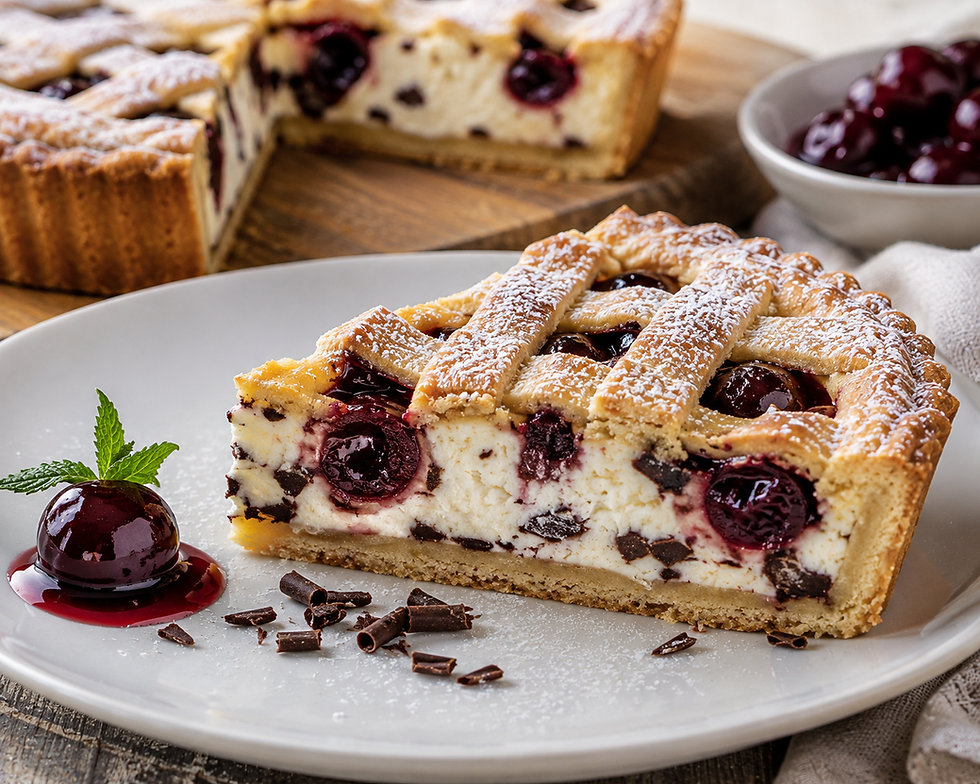
Pastiera is the Neapolitan Easter tart, a crisp lemon scented shell around a dense, perfumed filling of ricotta, cooked wheat, eggs and orange blossom. It smells of spring the moment it leaves the oven.
This version follows the classic proportions and adds the small controls that make it sliceable, creamy and never grainy.
Yield: one 10 inch (25 cm) tart, 10 servings. Prep: 1 hour, plus overnight soaking. Cook: 2 hours for the wheat, 1 hour 10 minutes to bake. Rest: 24 hours. Difficulty: intermediate.
The Story
Every Neapolitan family has a pastiera, and every family swears theirs is the correct one. The legend begins with the siren Parthenope, who rose from the gulf each spring to sing at the foot of Posillipo. The people sent her seven gifts in thanks: flour, ricotta, eggs, wheat cooked in milk, orange blossom water, spices and sugar. The gods mixed them together, and the result was so sweet that the siren sang more beautifully than ever. The story is charming, and Neapolitans tell it with a straight face. Whatever you make of the myth, it lists the real ingredients of the tart with surprising accuracy, and it explains why Neapolitans treat the cake as something older than any single kitchen.
History is more modest but just as convincing. Wheat was the grain of rebirth long before Christianity, carried in the spring rites of Ceres, and the Easter cakes of Campania inherited it. The nuns of the convent of San Gregorio Armeno, on the street that still sells nativity figures, are credited with perfecting the recipe, perfuming it with orange blossoms picked in the cloister garden. Another story says that Maria Theresa of Austria, the solemn queen of Ferdinand II of Bourbon, smiled for the first time when she tasted it. The king reportedly wished that Easter could last all year. Court cooks refined it further, and by the nineteenth century pastiera had left the convents and become the fixed sweet of every Neapolitan Easter table, sent by neighbours from house to house as a gesture of goodwill. In many homes the first pastiera of the season is still made by the oldest woman of the family, with the whole household soaking wheat and zesting oranges alongside her.
The custom that matters most is the timing. Pastiera is baked on Holy Thursday or Good Friday and left alone until Sunday, because the wheat, citrus and spice need those two days to knit into a single flavour. The lattice of pastry strips across the top, traditionally seven, is not decoration alone: it lets steam escape and shows the golden filling beneath. Bakeries across the city still line up the golden tarts in their windows during Holy Week, and the perfume of orange blossom drifts through the alleys of the historic centre. Eaten fresh from the oven, pastiera is merely good. Eaten on Easter Sunday, it is Naples.
Ingredients
For the pasta frolla
All purpose flour, 2 1/2 cups (300 g)
Granulated sugar, 1/2 cup (100 g)
Cold unsalted butter, cubed, 10 tbsp (140 g)
Whole egg, 1
Egg yolks, 2
Lemon zest, 1 tsp
Fine sea salt, 1/4 tsp (1.5 g)
For the cooked wheat
Hulled soft wheat berries, grano per pastiera, 1 cup (200 g), or jarred grano cotto, 1 1/2 cups (300 g)
Cold water, for soaking and cooking, about 8 cups (2 L)
Whole milk, 1 cup (240 ml)
Unsalted butter, 1 tbsp (14 g)
Lemon peel, 1 wide strip, removed after cooking
Fine sea salt, 1 pinch
For the ricotta filling
Sheep's milk ricotta, well drained, 1 lb 2 oz (500 g)
Granulated sugar, 1 1/4 cups (250 g)
Whole eggs, 3
Egg yolks, 2
Orange blossom water, 2 tbsp (30 ml)
Candied citron and orange peel, diced, 1/2 cup (90 g)
Ground cinnamon, 1/2 tsp (1 g)
Vanilla extract, 1 tsp (5 ml)
Orange zest, finely grated, 1 tsp
Fine sea salt, 1 pinch
For finishing
Egg white, 1, for brushing the shell
Powdered sugar, for dusting, about 2 tbsp (15 g)
Softened butter and flour, for the tart pan, 1 tbsp (14 g) butter and 1 tbsp (8 g) flour
Candied orange peel strips, for garnish, 1/4 cup (45 g)
Preparation
Step 1: Soak the wheat
Rinse the wheat berries, cover them with plenty of cold water and soak for 24 hours, changing the water once. Jarred grano cotto skips this step and the next. Start on the Tuesday or Wednesday before Easter so the wheat, tart and rest all fit before Sunday.
Step 2: Cook the wheat
Drain the berries and put them in a heavy pot with fresh water to cover by 2 inches (5 cm). Simmer very gently for about 2 hours, topping up with hot water, until the grains are tender and a few split open. Add the milk, butter and lemon peel, cook 15 minutes more until creamy, then take the pot off the heat and let everything cool completely without draining. Remove the lemon peel. The mixture should look like a loose, creamy porridge of whole grains. If it looks dry after cooling, stir in a few tablespoons of warm milk.
Step 3: Make the pasta frolla
Rub the cold butter into the flour, sugar, salt and zest until sandy. Add the egg and yolks and press together, without kneading. The dough should hold together when pinched but stay slightly crumbly. Divide it into two thirds and one third, flatten into discs, wrap and chill for at least 1 hour. Cold dough is easier to roll and keeps its shape in the oven. Work quickly, because butter warms fast in a Neapolitan spring kitchen.
Step 4: Line the tart pan
Roll the larger piece to 1/8 inch (3 mm) and fit it into a buttered 10 inch (25 cm) tart pan at least 1 1/2 inches (4 cm) deep, letting it come up the sides. Trim the overhang, prick the base lightly with a fork, and chill 20 minutes. Then brush the base with lightly beaten egg white to seal it, and keep the rest of the white for later.
Step 5: Mix the cream
Beat the well drained ricotta with the sugar until completely smooth. Beat in the eggs and yolks one at a time, then the orange blossom water, vanilla, cinnamon, zest and salt. The cream should be glossy, pourable and completely free of lumps. Taste it and adjust the perfume before anything else goes in.
Step 6: Fold in the wheat and citrus
Drain excess liquid from the cooled wheat, keeping the creamy part clinging to the grains. Fold it into the ricotta cream with the candied peel, gently, using a spatula and slow strokes so the grains stay whole. The mixture will look thick and studded with grain, which is exactly right.
Step 7: Fill and lattice
Heat the oven to 350°F (175°C). Pour the filling into the shell to 1/4 inch (6 mm) below the rim. Roll the remaining dough, cut 7 strips and lay them in a diamond lattice, pressing the ends into the edge and trimming the excess. Brush the strips lightly with the remaining egg white for shine.
Step 8: Bake and rest
Bake on the lower rack for 1 hour to 1 hour 10 minutes, until the center reads 170°F (77°C) and the top is deep golden. Cool completely in the pan, then rest at room temperature, loosely covered, for 24 hours. Do not refrigerate during the rest, since the perfume develops better in the open air of a cool kitchen.
Plating
Unmold onto a flat board, dust generously with powdered sugar just before serving, and cut with a thin knife dipped in hot water and wiped between slices. Serve wedges at room temperature on small white plates, never chilled, since cold dulls the orange blossom. A tiny glass of the wine below and a strong espresso are all the accompaniment it needs. In Naples it is often the breakfast of Easter Monday. For a restaurant plate, cut a narrow wedge, stand it slightly on its side to show the layers of grain and cream, and add three slivers of candied orange peel and a small spoonful of lightly sweetened whipped ricotta beside it. Keep the plate plain, because the tart carries everything. Warm plates would soften the crust, so use room temperature ones. Serve modest slices, since the tart is rich.
Professional Technique
The grano cotto is the whole recipe. Hulled wheat berries are dense, with a tough bran layer and a starch core that stays chalky until it has absorbed water and heat for a very long time. Two hours of gentle simmering after a full soak is not excess. Grains cooked for one hour still feel like gravel, and the 70 minute bake will not finish them, because a ricotta filling holds too little free water to soften wheat in the oven. Cook until the grains are tender to the tooth and only a few hairline split, never bursting into mush. Taste one grain every ten minutes near the end. The right grain yields easily between the teeth yet still offers a small, pleasant resistance at its heart.
Cooling the wheat in its own liquid does two jobs. While the pot cools, the grains keep drinking and plump to their final size, and the starch that leaked out during cooking thickens into a soft gel with the milk. That gel is the binder. It coats each grain, holds the ricotta cream together and gives the slice its clean, creamy structure with no flour at all. Drain it away and you throw the binder out; the filling then weeps and crumbles instead of setting.
The bite is protected the same way. Because every grain is fully tender before it meets the filling and is cushioned by that starch gel, it stays distinct after 70 minutes in a humid custard, pleasantly springy rather than hard or pasty. Fold the wheat in by hand, never with a mixer or blender, which would crack the grains and turn the gel into porridge.
Texture and Moisture Control
Ricotta is mostly water, and water is the enemy of a sliceable pastiera. Drain it in a sieve for at least 12 hours in the refrigerator, and sieve it if it is coarse. A watery ricotta yields a soft, sweating center and a soggy base however long you bake. Sugar also pulls moisture out of the dairy, so beat it in until fully dissolved before adding the eggs.
The egg white brush creates a thin waterproof film between filling and dough, so the shell stays crisp and short rather than damp. Bake at a moderate 350°F (175°C): higher heat puffs the custard, then collapses it and cracks the surface, while gentle heat sets the eggs slowly into a creamy, dense crumb.
Pull the tart when the center still trembles slightly. Carryover heat finishes it as it cools in the pan. The 24 hour rest is also a texture step: the filling firms, the moisture redistributes and the crust, though it softens a little at the edge of the filling, keeps its snap on the outside. A tart cut too early shows a glossy wet slice; a tart rested properly shows a matte, creamy and clean edge.
Professional Mise en Place
Pastiera is a project spread across three days, so organization decides success. The work is mostly waiting, and every step has its own place in the calendar, from soaking the wheat to slicing on Easter morning.
Equipment and tools
10 inch (25 cm) tart pan, 1 1/2 inches (4 cm) deep, with removable base
Fine mesh sieve for draining ricotta
Heavy pot for the wheat, rolling pin, thin knife and a pastry wheel
Instant read thermometer to check the center of the tart, and a wire rack for cooling
Baking sheet to preheat under the tart pan
Prepared ahead
Wheat soaked two days before baking and cooked the day before
Pasta frolla made up to 2 days ahead and kept chilled
Ricotta draining overnight, candied peel diced
Filling mixed the morning of baking
Egg white reserved and covered for brushing
Service setup
Tart rested a full 24 hours, unmolded on Easter morning
Powdered sugar sifted only at the table
Knife, hot water and clean cloth ready for slicing
Small plates at room temperature and espresso cups ready
Chef Tips
Use sheep's milk ricotta if you can find it. It is drier, sweeter and more aromatic than cow's milk ricotta, and it needs less draining. Ask the dairy to sell it the same morning, and drain it as soon as you get home.
Add the orange blossom water gradually and taste the raw cream. Brands vary in strength, and too much makes the tart taste like soap. Start with 1 tablespoon (15 ml) in the raw cream and add more only if the aroma is faint.
Cut the candied peel small. Large pieces sink and leave sticky pockets of sugar. Candied citron is traditional; good quality orange peel is a worthy alternative.
Bake with the tart on a preheated baking sheet to get a firm bottom crust, and keep the lattice strips cold until they go on. Warm strips stretch and sag into the filling. Finally, write down the day you baked it: a pastiera improves until day three and it is easy to lose track of the days.
Common Mistakes
Undercooking the wheat. Grains left firm stay hard and gritty after baking. Cook until tender, then let them cool in the pot. Taste before you mix.
Using undrained ricotta. Excess whey turns the center wet and spoils the crust. Drain overnight in the refrigerator over a bowl.
Overbaking. A fully set, puffed center means the eggs have curdled and the filling will be dry and cracked. Stop while it still wobbles slightly in the center and check with a thermometer.
Cutting it warm. The filling has not set and the slice collapses. Wait a full day, and the slice will stand clean.
Opening the oven early. A cold draft in the first 40 minutes shocks the custard, so the top cracks and sinks. Keep the door shut until the lattice has taken colour.
Rolling the dough too thin. The shell tears under the heavy filling. Keep it at 1/8 inch (3 mm) and patch any cracks with a scrap of dough. Thin dough also browns too fast at the edge.
Wine Pairing
Moscato d'Asti DOCG: Light, gently sparkling and low in alcohol, with peach and orange blossom aromas that echo the perfume of the tart. Its fine bubbles cleanse the ricotta richness without adding weight. Serve it well chilled, in a small flute, and pour it alongside a thin slice rather than a large one. At only 5 percent alcohol it also keeps a long Easter lunch light.
Malvasia delle Lipari DOC: A golden volcanic wine with apricot, honey and Mediterranean citrus. Its sweetness matches the candied peel, and a lively acidity keeps the finish from turning heavy. Serve slightly cool, around 55°F (13°C), in a small glass. The salty volcanic edge of the wine also sharpens the sweetness of the ricotta, which stops each mouthful from feeling cloying.
Vin Santo del Chianti Classico DOC: Amber, nutty and lightly oxidative, with dried fig and caramel notes that meet the cinnamon and the toasted butter of the shell. A classic partner for crumbly pastry. Its moderate acidity and long, toasty finish stand up to the density of the filling. Serve at cellar temperature in a small glass and take small sips between bites, letting the wine warm slowly in the hand.
Ramandolo DOCG: From Friuli, with apricot, acacia honey and a fresh mineral edge. Its balance of sweetness and acidity lifts the wheat and lemon zest and leaves the mouth clean. A cooler climate wine, it brings a floral note that reads as a second orange blossom, and its silkiness suits the smooth ricotta cream.
Storage & Reheating
Keep the pastiera covered at cool room temperature for the first two days, then refrigerate for up to 5 days total in an airtight container. Bring slices to room temperature for 30 minutes before serving, since cold mutes its perfume. Do not reheat in an oven or microwave. The filling is a delicate custard and turns rubbery.
It freezes well: wrap whole or sliced pieces tightly and freeze for up to 2 months, then thaw overnight in the refrigerator. Dust with powdered sugar only after thawing. A thawed pastiera keeps its flavour, though the crust softens slightly. Leave it uncovered on the counter for an hour before serving so the surface dries and the perfume returns. Store any leftover lattice trimmings, baked, as biscuits for the next day, in a tin, away from moisture.
Nutrition
Per serving, based on 10 generous servings:
Calories: 430 kcal
Total Fat: 17 g
Saturated Fat: 9 g
Trans Fat: 0 g
Unsaturated Fat: 8 g
Cholesterol: 135 mg
Sodium: 170 mg
Total Carbohydrates: 58 g
Fiber: 2 g
Total Sugars: 32 g
Added Sugars: 28 g
Protein: 12 g
Lactose: 3 g
Principal micronutrients: calcium, phosphorus, vitamin A, selenium
These figures are estimates and vary with the ricotta, the candied peel and the size of the slice. A portion is one tenth of the tart.


Comments