
Italian Gorgonzola Chicken Breast | Petto di Pollo con Gorgonzola e Noci

Gorgonzola and walnuts are one of the oldest flavour agreements on the Po valley plain, usually met in a bowl of pasta or on a cheese board. Turned into a pan sauce they take on something harder: carrying a lean white meat with almost no fat of its own and no connective tissue at all.
The whole dish rests on how the cheese is handled. Gorgonzola has been taken apart from the inside by a mould, and a cheese that is already half demolished behaves nothing like a young one in a hot pan. Get that wrong and the sauce turns to grease and grit in seconds.
Yield: 4 servings. Prep: 25 minutes. Cook: 25 minutes. Rest: 10 minutes. Total: about 1 hour. Difficulty: intermediate. Course: secondo. Region: Lombardy and Piedmont, the Gorgonzola DOP zone.
The Story
Gorgonzola takes its name from a small town east of Milan, and for most of its life it was called stracchino di Gorgonzola. Stracco is Lombard dialect for tired, and it described the milk of cows that had just walked down from the alpine summer pastures in autumn, worn out by the descent. The Italian word for a blue cheese, erborinato, comes from erborin, Milanese for parsley, for the green veining that runs through the paste. Production drifted west over the last century and most DOP wheels are now made in the provinces of Novara and Pavia rather than in the town that named it.
Two styles exist and they are not variations on each other. Dolce is aged around fifty to sixty days, stays soft enough to spread and tastes of cream first and blue second. Piccante runs to eighty days and often well beyond, comes out firm and drier, and is sharp in a way that takes over anything it is put near. The cheese was protected under Italian law in 1955 and at European level in 1996, by which point the old two curd method, one curd from the evening milk and one from the morning, had almost entirely given way to a single curd.
The walnut is the everyday nut of the north, grown across the hills of Piedmont and Lombardy, and blue cheese with walnuts is farmhouse eating rather than restaurant invention. The chicken version, though, is recent. White meat became the default weekday protein in northern Italian kitchens in the second half of the twentieth century, and cooks simply took the sauce they already knew from gnocchi and short pasta and put it over a flattened breast. It is honest home cooking, and it works for a plain reason: the cheese supplies the fat and the salt that a chicken breast does not have.
Ingredients
For the chicken
Boneless skinless chicken breasts, 4, 6 oz each (170 g each)
Fine sea salt, 1 tsp (6 g)
All purpose flour, 2 tbsp (16 g)
Unsalted butter, 2 tbsp (28 g)
Extra virgin olive oil, 1 tbsp (15 ml)
Fresh sage leaves, 4
Freshly ground black pepper, to taste
For the sauce
Gorgonzola dolce DOP, rind removed, 4 oz (115 g)
Gorgonzola piccante DOP, rind removed, 1/2 oz (15 g)
Shallot, finely chopped, 1 small
Dry white wine, 1/2 cup (120 ml)
Unsalted chicken stock, 3/4 cup (180 ml)
Heavy cream, 1/4 cup (60 ml)
Freshly grated nutmeg, 1 small pinch
For finishing
Shelled walnut halves, 2 1/2 oz (70 g)
Flat leaf parsley, finely chopped, 1 tbsp
Extra virgin olive oil, a few drops per plate
Freshly ground black pepper, to taste
Preparation
Step 1
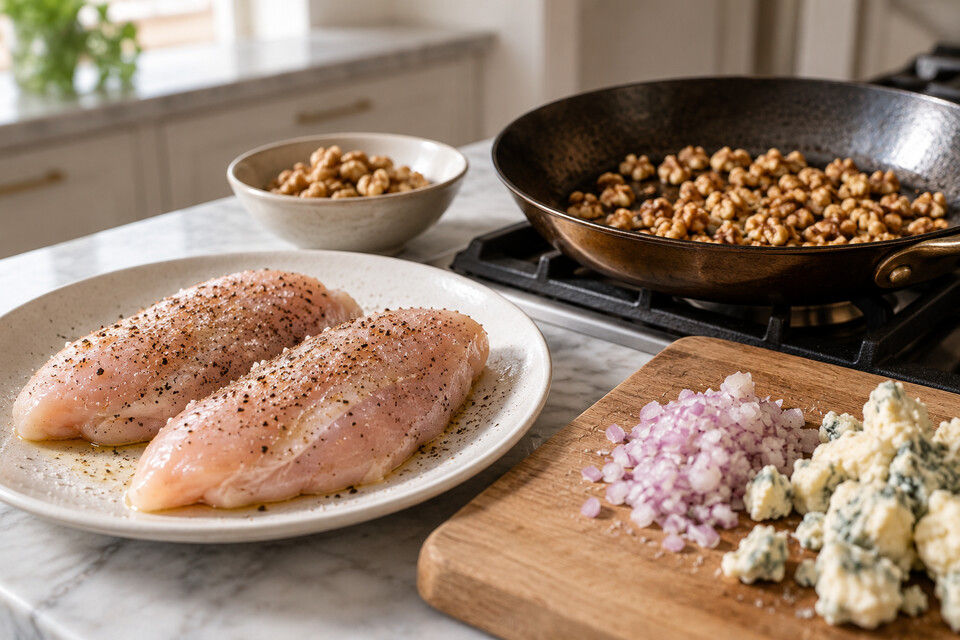
Even out and salt the breasts. Trim the ragged edge and the loose tenderloin flap from each breast. Lay one at a time between two sheets of parchment and press the thick end with a meat mallet until the piece is an even 3/4 inch (2 cm) through. Salt all four on both sides and leave them uncovered on a rack in the refrigerator for 30 minutes, then pat the surface completely dry.
Step 2
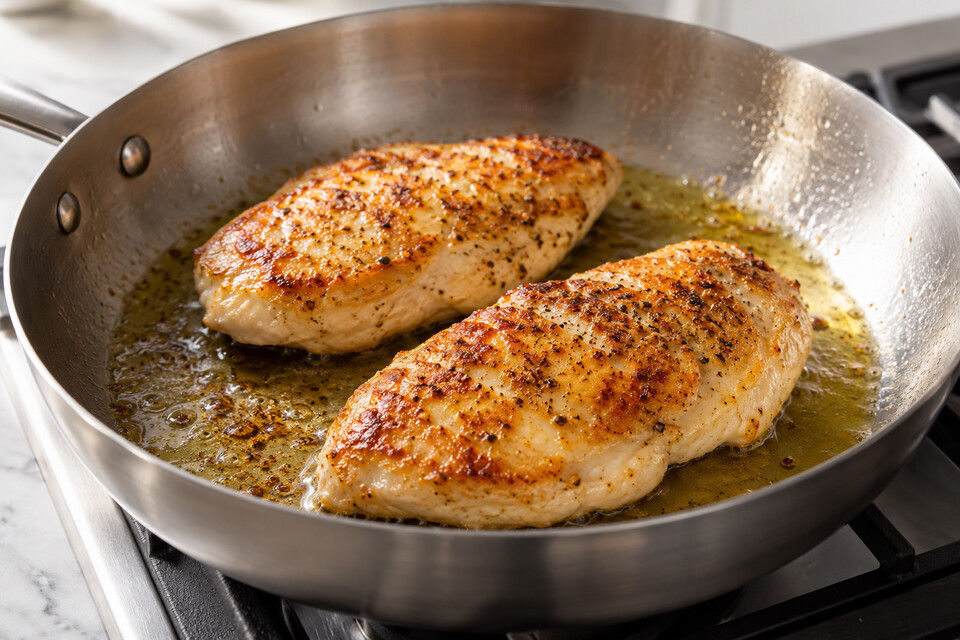
Toast the walnuts, lightly. Heat the oven to 325F (165C) and spread the walnut halves on a small tray. Give them 6 to 8 minutes and not a minute more, taking them out while they still smell sweet rather than dark. Tip them straight onto a cold plate, because a hot tray keeps cooking them. Rub off any loose skin with a cloth, break most of them roughly and keep eight halves whole for the plates.
Step 3
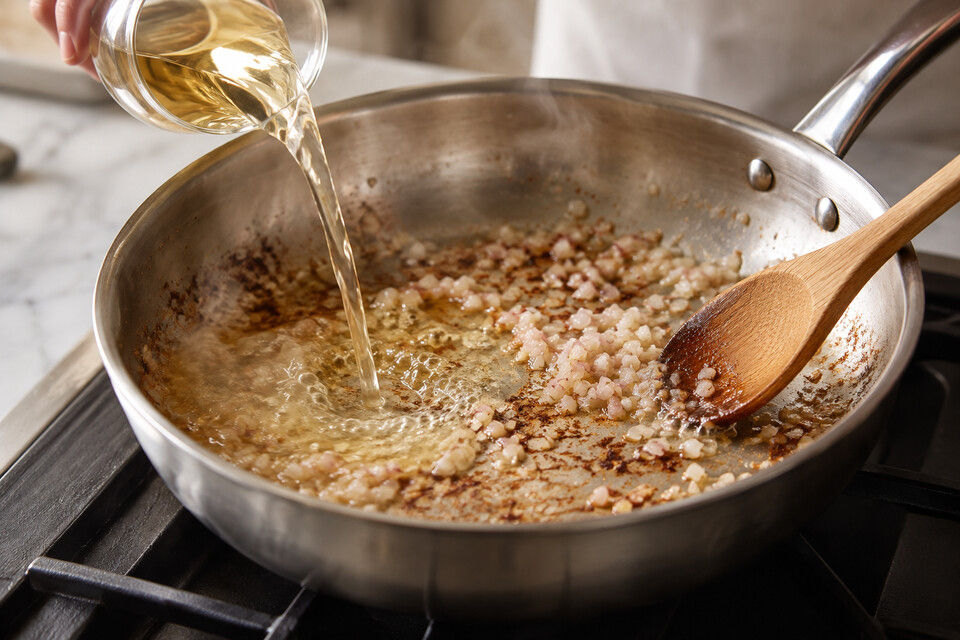
Get the cheese ready before anything is hot. Cut the rind off both Gorgonzolas and cut the paste into cubes of about 1/2 inch (1 cm). Leave them on the counter while you cook, since cheese taken straight from the refrigerator needs more heat to melt and more heat is precisely what you are trying to avoid. Keep the dolce and the piccante in two separate piles: they go into the pan at different moments.
Step 4
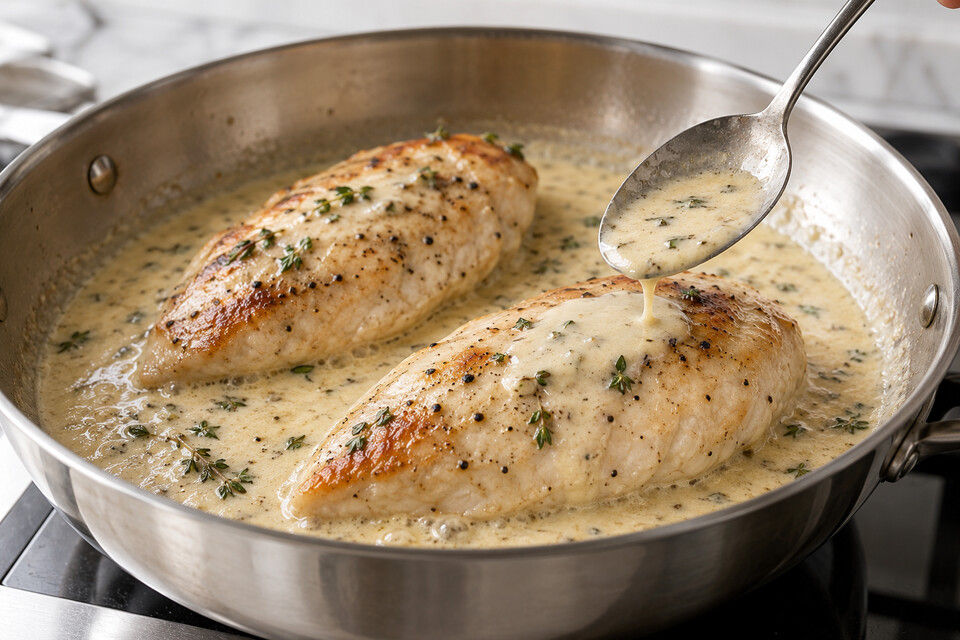
Sear the breasts. Dust them very lightly with flour and knock off everything loose. Heat the butter and oil in a wide heavy pan over medium high heat until the foam subsides, drop in the sage leaves and lay the breasts down without crowding them, which would steam them. Leave them alone for 4 minutes, until the underside is properly gold, then turn them once.
Step 5
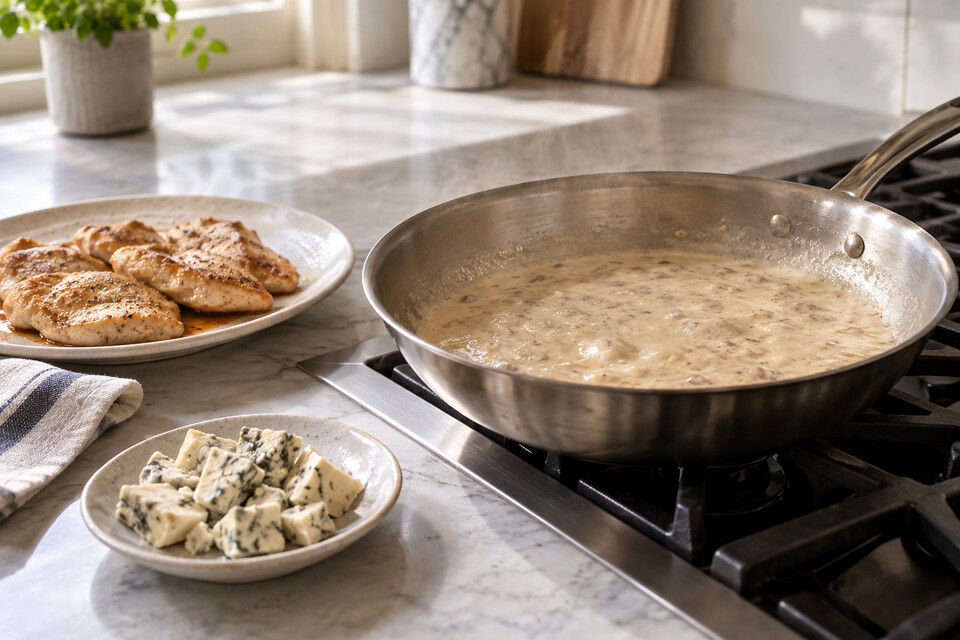
Finish the chicken and rest it. Lower the heat to medium and cook the second side for 4 to 5 minutes, until the thickest point reads 155F (68C) on an instant read thermometer. Lift them onto a warm plate, cover loosely and leave for 8 to 10 minutes. They climb to roughly 160F (71C) as they sit, which is where a breast is cooked through and still holding its juice.
Step 6
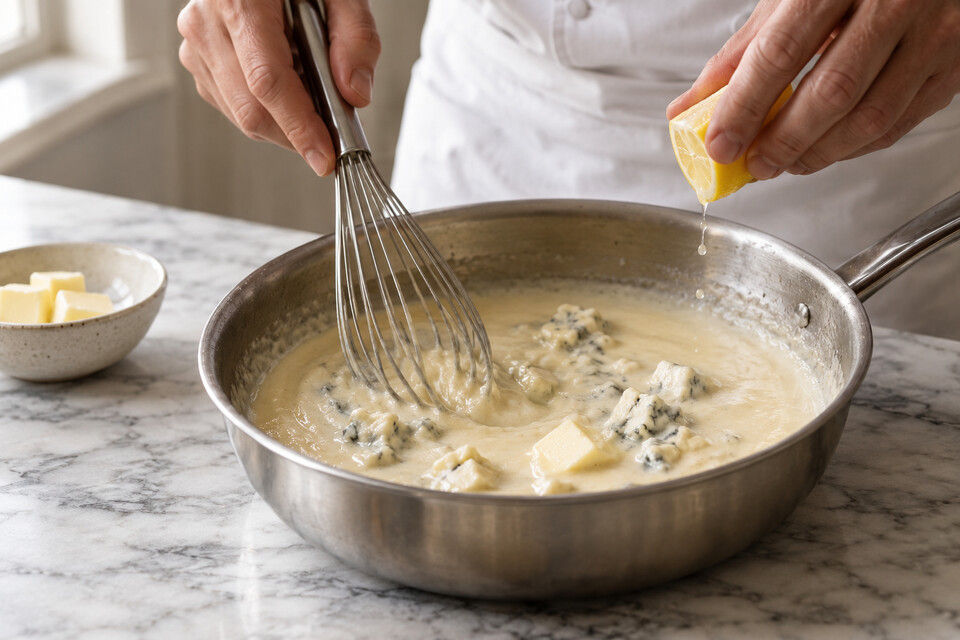
Build the reduction. Pour off all but a thin film of fat, set the pan back over medium heat and soften the shallot for 1 minute. Add the wine, scrape the base clean and reduce until the pan is nearly dry, about 3 minutes, which takes out the raw alcohol. Add the stock and reduce it by half, then the cream, and simmer 2 minutes until it coats a spoon.
Step 7
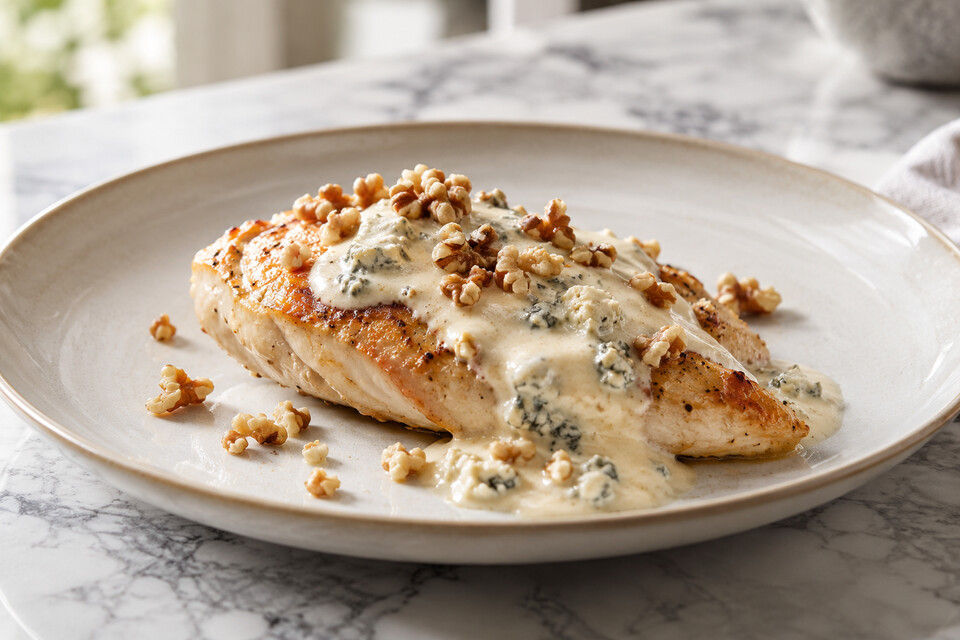
Melt the Gorgonzola off the heat. Take the pan off the stove and wait a full 30 seconds. Add the dolce a few cubes at a time, swirling rather than whisking, and let each addition vanish before the next. Add the piccante last, taste, grate in the nutmeg and pour in any juice the resting meat has released. If it needs loosening use warm stock, never more cream.
Plating
Warm the plates, which matters more here than on most dishes, because this sauce sets and dulls the moment it meets cold porcelain. Slice each breast across the grain into four or five thick pieces at a slight angle, and fan them just enough that the cut faces show. Cutting across the grain is what keeps a pounded breast tender rather than rubbery.
Spoon the sauce over the sliced meat instead of flooding the plate, so that part of the seared surface still reads as seared. Scatter the broken walnuts over the top and stand two whole halves against the meat. Finish with the parsley, a few drops of good olive oil and a grind of pepper. Polenta, mashed potato or plain braised savoy cabbage take the extra sauce well. Skip anything acidic beside it, because vinegar and blue cheese turn on each other.
Professional Technique
A wheel of Gorgonzola is colonised by Penicillium roqueforti, and almost everything the cheese tastes of is the work of that mould rather than of the milk it came from. The lipases the mould secretes cut the triglycerides of the milk fat into free fatty acids, and some of those are then oxidised into methyl ketones, above all 2 heptanone and 2 nonanone. Those ketones, not salt and not age by themselves, are the pungent, faintly metallic smell people mean when they say a cheese tastes blue.
The consequence in the kitchen is mechanical rather than a matter of taste. The same mould also secretes proteases, and those have spent weeks demolishing the casein network that holds an ordinary cheese together. A young cheese melts smoothly because that network softens while still trapping the fat inside it. Gorgonzola has very little network left, so once it is pushed much above 150F (65C) there is nothing to hold the fat and the fat simply leaves: the pan fills with a grainy white mass sitting in a pool of yellow oil, and whisking will not bring it back. Added off the heat into a liquid that already carries cream, it disperses instead of breaking.
Two things follow from that. Dolce and piccante are not interchangeable and cannot be swapped by weight, because piccante has been aged three months or more, has lost water and has been through far more lipolysis, so it carries several times the free fatty acid load per ounce: treat it as a seasoning in the small quantity given, never as the body of the sauce. The walnut asks for the same restraint. It is roughly two thirds fat, mostly polyunsaturated and quick to turn, and the thin skin around the kernel carries tannins that are bitter before you do anything to them. A minute too long in the oven and it turns properly acrid, stacking bitter on top of the bitterness the cheese already brings.
Texture and Moisture Control
Two things here can dry out and one can split. The breast has no fat and no collagen to fall back on, so its only protection is the pounding, which shortens the time it spends over heat, and the pull at 155F (68C), which hands the last five degrees to carryover instead of the pan. Taken past 165F (74C) the muscle fibres contract hard, squeeze their water out and go stringy, and no amount of sauce puts that back.
The sauce is an emulsion held partly by the cream and partly by whatever cheese protein survives, and it is stable across a narrow band only. Below about 140F (60C) it tightens and turns pasty on the spoon; above about 155F (68C) it breaks. Hold it in the pan off the heat, or over the lowest possible flame, and if it stiffens add warm stock a spoonful at a time rather than cream, which only adds more fat to an emulsion that is already struggling to hold the fat it has. The walnuts go on at the last second: sitting in the sauce they soften inside a minute and the dish loses its only crunch.
Professional Mise en Place
Everything except the sauce can be done in advance, and the sauce itself takes four minutes, so the service depends almost entirely on having the cheese cut and sitting at room temperature before the chicken ever goes into the pan.
Equipment and tools
Wide heavy skillet, stainless or cast iron, never nonstick, so there is a fond to deglaze
Meat mallet and two sheets of parchment
Instant read thermometer
Small tray for the walnuts and a cold plate to stop them on
Rack set over a tray for the salted breasts
Prepared ahead
Breasts trimmed, pounded and salted, up to 6 hours ahead, uncovered on a rack in the refrigerator
Walnuts toasted and broken, on the day, kept dry and uncovered
Gorgonzola derinded and cubed, up to 4 hours ahead, loosely covered at cool room temperature
Shallot chopped, stock measured out and warmed
Plates in a low oven
Service setup
Dolce and piccante in two separate bowls within reach of the stove
Warm stock beside the pan for loosening the sauce
Walnuts and parsley in small bowls, added only at the plate
Sauce held off the heat, never left sitting over a flame while the meat rests
Chef Tips
Buy the Gorgonzola cut from a whole wheel when you can, and smell it before you leave the counter. A dolce that smells of ammonia is past its moment, and that ammonia will be the loudest thing on the plate however little you use.
Do not salt the sauce until the cheese is in and melted. Between the Gorgonzola and the reduced stock there is a great deal of salt in the pan already, and the only sensible moment to judge it is at the end.
Use stainless steel or cast iron, not a nonstick pan. The browned film the chicken leaves behind is where most of the savoury depth of this sauce comes from, and nonstick will not hand you one worth deglazing.
If it splits anyway, pull the pan off the heat, add two tablespoons of cold stock and swirl without stirring. It often comes back. If not, strain it, serve it as a thin jus and put small cubes of cheese over the hot meat.
Common Mistakes
Melting the Gorgonzola over the flame. This is the one failure that ends the dish. The cheese has almost no protein network left to hold its own fat, so direct heat separates it into curds and oil within seconds. Off the heat, every time.
Swapping piccante for dolce one for one. The aged cheese carries far more free fatty acid per ounce and will bury the chicken completely. Keep the proportions given: dolce for the body, a very small amount of piccante for the edge.
Cooking the breast to 165F (74C) in the pan. Pull it at 155F (68C) and let carryover finish while it rests. A breast brought to its final temperature over heat is dry by the time it reaches the plate.
Over toasting the walnuts. Their oils are fragile and the skin is tannic, so a dark walnut is a bitter walnut, and bitter walnut against blue cheese means bitterness twice over, not contrast.
Fixing a tight sauce with more cream. Cream adds fat to an emulsion already struggling with fat. Warm stock, a spoonful at a time, loosens it without pushing it over.
Wine Pairing
Lugana DOC: The closest thing to a local white, grown on the heavy clay of the southern shore of Lake Garda. Turbiana gives it a broad, almost waxy texture that stands up to a cream sauce instead of vanishing under it, with enough acidity underneath to reset the palate between mouthfuls. Its faint bitter almond finish runs alongside the toasted walnut.
Oltrepò Pavese Metodo Classico DOCG: Lombardy's serious sparkling wine, built largely on Pinot Nero in the hills south of Pavia, which is Gorgonzola country itself. The bottle fermentation gives a fine persistent bead that lifts the fat off the tongue, and the bread and hazelnut notes of the lees sit naturally beside the walnuts.
Roero Arneis DOCG: From the sandy left bank of the Tanaro in Piedmont. Arneis carries more body and less acid than most northern whites, with pear, camomile and a dry almond bitterness on the close, and that combination handles the salt of the cheese without the wine turning thin or sour against it.
Gavi DOCG: The sharper choice, and the right one if your sauce has come out rich. Cortese grown on the white marls of south eastern Piedmont gives high acidity, green apple and a saline cut that goes straight through the cream and the butter. Serve it properly cool, around 50F (10C).
Pinot Nero dell'Oltrepò Pavese DOC: For anyone who wants a red with white meat, and the only sort that works here: light bodied, low in tannin, red cherry and undergrowth. Tannin and blue cheese turn metallic together, so structure is the last thing to look for. Serve it at 57F (14C).
Storage & Reheating
Keep the meat and the sauce in separate airtight containers in the refrigerator for up to 3 days. Stored together the chicken goes on drinking the sauce and both of them suffer, the meat turning salty and the sauce turning thin. The toasted walnuts belong in a third container at room temperature, never in the refrigerator, where they take up moisture and lose their snap within a day.
Rewarm the sliced chicken covered, with a spoonful of stock under it, in a 275F (135C) oven for about 8 minutes. Warm the sauce separately in a small pan over the lowest heat, stirring, and stop the moment it is warm to the finger. Do not put it in the microwave: it will split there for exactly the reason it splits over a flame. Neither part freezes well and the sauce least of all.
Nutrition
Per serving, based on 4 servings:
Calories: 610 kcal
Total Fat: 42 g
Saturated Fat: 17 g
Trans Fat: 0.5 g
Unsaturated Fat: 23 g
Cholesterol: 175 mg
Sodium: 990 mg
Total Carbohydrates: 8 g
Fiber: 1.5 g
Total Sugars: 2 g
Added Sugars: 0 g
Protein: 48 g
Lactose: 1 g
Principal micronutrients: calcium, phosphorus, vitamin B12, niacin, selenium, copper, magnesium, manganese
These figures are estimates, and sodium is the one to watch, since nearly all of it arrives with the Gorgonzola and the salting of the meat. Unsalted stock, as the ingredient list specifies, keeps it roughly where it is written; a salted commercial stock pushes a single serving comfortably past a gram.



Comments