
Vegan Almond Brittle Semifreddo with Espresso Sauce, Reinterpreted | Semifreddo Vegano al Croccante di Mandorle Rivisitato

Semifreddo is the Italian frozen dessert that is never churned: a light mousse set in a loaf mold, frozen and sliced, soft enough to cut with a spoon straight from the freezer. The classic is made with eggs, sugar and heavy cream; this vegan version is a reinterpretation that keeps that texture without any animal ingredient. An Italian meringue made with aquafaba, the cooking liquid of chickpeas, gives the air and the structure; chilled coconut cream, whipped until firm, gives the richness; and a crisp almond brittle, the croccante of Italian feasts, is crushed and folded through so every slice crunches. A warm espresso sauce poured at the table brings bitterness and heat against the cold, sweet almond cream.
Yield: 8 servings. Prep: 50 minutes. Cook: 25 minutes. Rest: 8 hours freezing, plus 10 minutes tempering. Course: dessert. Region: a vegan interpretation of the Italian semifreddo tradition.
The Story
The name says everything: semifreddo means half cold. It describes a family of Italian desserts that are frozen but never feel icy, because they are made of air rather than of churned ice crystals. The classic method belongs to pastry, not to the gelato maker. In the classic, a whipped base of egg yolks cooked with sugar syrup is folded with an Italian meringue of egg whites and with whipped heavy cream, poured into a mold and frozen. The fat and the air bubbles keep the ice crystals small and separated, so the dessert slices cleanly and melts on the tongue like a cold mousse.
Almond croccante has an even longer history in Italy. It is the simplest confection there is, almonds bound in caramelized sugar, and it is sold at village feasts and fairs across the south, often under local names such as cupeta or copeta. Sicily is the heart of Italian almond growing, and around Noto, in the province of Syracuse, the traditional varieties Romana, Pizzuta d'Avola and Fascionello are protected as a Slow Food Presidium.
A classic semifreddo is not vegan. The classic depends on three animal ingredients: egg yolks for the custard base, egg whites for the meringue and heavy cream for richness. This recipe is a reinterpretation that replaces each of them honestly. Aquafaba contains proteins and soluble starches from the chickpeas that trap air when whipped, exactly as whites do, and it holds its foam when cooked by a hot sugar syrup. Coconut cream, chilled until its fat is solid, whips into a firm cream with a fat content close to that of whipping cream.
The result is not an imitation but a semifreddo built on the same physics: a stable foam, fat to coat the ice crystals, sugar to keep the freezing point low. This recipe follows the classic pastry structure step by step, measures the sugar syrup with a thermometer, chills the coconut cream to the right temperature and adds the croccante at the last moment, so the slices are light, creamy and crisp at once, and keep that texture for days in the freezer.
Ingredients
Use whole blanched almonds with a strong aroma, Sicilian when you can find them, and toast them yourself: pre-roasted almonds are often stale. Choose a full-fat coconut cream with at least 22 percent fat and no added gums, sold in cans, and refrigerate it for at least 24 hours so the solid cream separates cleanly from the water. Aquafaba should come from a can of chickpeas cooked only in water and salt, or from chickpeas you cook yourself and reduce until the liquid has the consistency of a light syrup. For the sauce, use a freshly brewed espresso or a strong moka coffee made from a medium roast.
For the almond croccante
Whole blanched almonds, 3/4 cup (110 g)
Granulated sugar, 1/2 cup (100 g)
Water, 2 tbsp (30 ml)
Fresh lemon juice, 1/2 tsp (3 ml)
Fine sea salt, 1 pinch
Neutral oil, for the sheet pan, 1 tsp (5 ml)
For the aquafaba meringue
Aquafaba, chilled, 1/2 cup (120 ml)
Cream of tartar, 1/4 tsp (1 g)
Granulated sugar, 2/3 cup (130 g)
Water, 3 tbsp (45 ml)
For the almond cream
Full-fat coconut cream, solid part only, chilled, 1 2/3 cups (400 g)
Smooth white almond butter, 3 tbsp (48 g)
Powdered sugar, 1/4 cup (30 g)
Pure vanilla extract, 1 tsp (5 ml)
Natural bitter almond extract, 2 drops (optional)
Fine sea salt, 1 pinch
For the espresso sauce
Freshly brewed espresso, 3/4 cup (180 ml)
Granulated sugar, 1/3 cup (65 g)
Unsweetened cocoa powder, 1 tbsp (6 g)
Cornstarch, 2 tsp (6 g)
Fine sea salt, 1 pinch
For the garnish
Toasted sliced almonds, 2 tbsp (12 g)
Cocoa powder, for dusting
Flaky sea salt, a few flakes
Preparation
Step 1
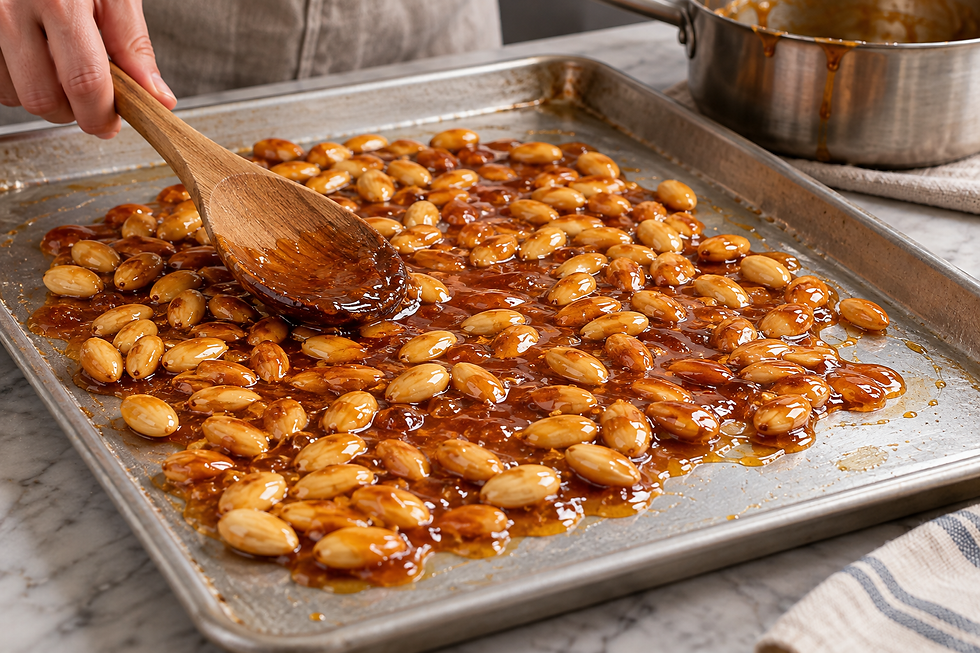
Toast the almonds and make the croccante. Spread the almonds on a sheet pan and toast them at 325°F (165°C) for 12 to 14 minutes, until they are golden to the center when one is snapped in half. Keep them warm. Oil a second sheet pan or a silicone mat. In a small heavy saucepan, combine the sugar, the water and the lemon juice and cook over medium heat without stirring until the syrup turns a deep amber, about 340°F (171°C). Tip in the warm almonds and the salt, stir with a wooden spoon for 20 seconds so every almond is coated, and pour onto the oiled pan. Spread it thin with the back of the spoon. Warm almonds keep the caramel fluid long enough to coat them; cold ones make it seize into sandy lumps.
Step 2

Crush the croccante. Let the brittle cool completely, about 20 minutes, until it snaps cleanly. Break it into pieces, put them in a heavy zip bag and crush them with a rolling pin into irregular fragments from the size of a lentil to that of a pea. Sift out about 2 tbsp of the finest dust and keep it apart for the garnish. Store the fragments in an airtight jar until the moment you fold them in.
Step 3

Whip the aquafaba. Line a 9 by 5 inch (23 by 13 cm) loaf pan with plastic wrap, leaving it to overhang on all sides. Put the chilled aquafaba and the cream of tartar in the bowl of a stand mixer and whip at medium speed for 2 minutes, then at high speed for 4 to 6 minutes, until it forms soft, glossy peaks that bend at the tip. The bowl and the whisk must be completely free of grease, because even a trace of fat collapses the foam.
Step 4

Make the Italian meringue. While the aquafaba whips, combine the sugar and the water in a small saucepan and cook over medium-high heat to 248°F (120°C), measured with an instant-read thermometer. With the mixer running at medium-high speed, pour the hot syrup in a thin stream down the side of the bowl, never on the whisk. Then whip at high speed for 8 to 10 minutes, until the meringue is stiff, shiny and has cooled to about 85°F (29°C) on the outside of the bowl. The hot syrup partially cooks and sets the aquafaba proteins, turning a fragile foam into a meringue that survives folding and freezing.
Step 5
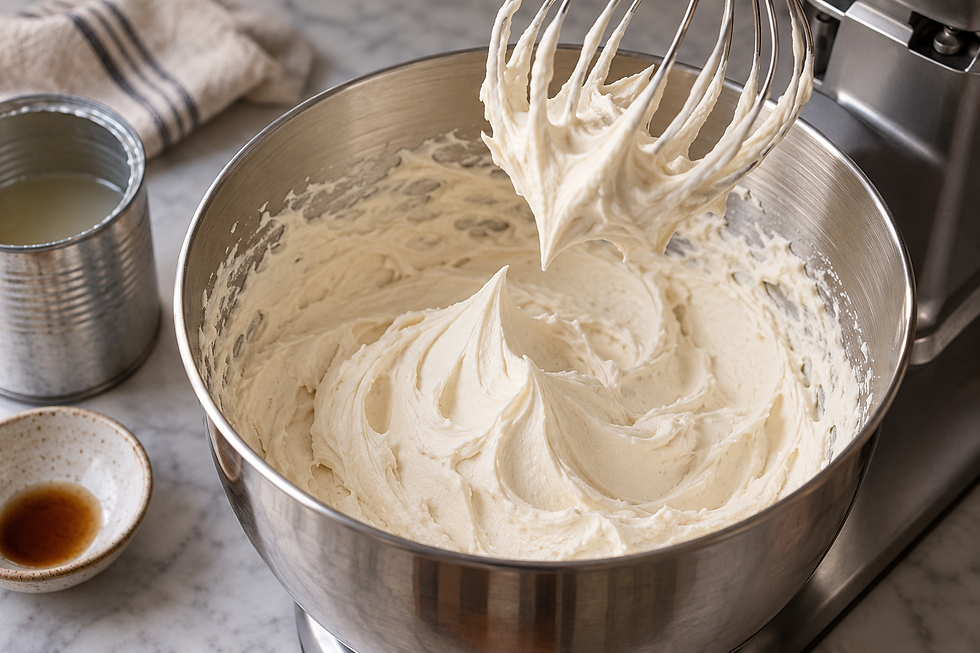
Whip the almond cream. Open the chilled cans of coconut cream without shaking them and scoop out only the solid white cream, leaving the clear water behind. In a cold bowl, whip the coconut cream with the almond butter, the powdered sugar, the vanilla, the bitter almond extract and the salt at medium speed for 2 to 3 minutes, until it holds firm, smooth peaks. Do not overwhip: coconut fat turns grainy when worked too long or when it warms above 70°F (21°C).
Step 6

Fold and assemble. Stir one third of the meringue into the almond cream to lighten it, then fold in the rest in two additions with a large flexible spatula, cutting down through the center and turning the bowl, until no white streaks remain. Fold in the crushed croccante last, with no more than six or seven strokes. Pour the mixture into the lined pan, tap it once on the counter to release large air pockets, smooth the top, cover with the overhanging wrap and freeze for at least 8 hours, ideally overnight. Every extra stroke of the spatula breaks air bubbles, and the air is what keeps the semifreddo soft at freezer temperature.
Step 7

Make the espresso sauce. In a small saucepan, whisk the sugar, the cocoa, the cornstarch and the salt, then whisk in the hot espresso little by little until smooth. Bring to a simmer over medium heat, whisking, and cook for 1 to 2 minutes, until the sauce turns glossy and coats the back of a spoon. Keep it warm at about 120°F (50°C), or cool it and rewarm it gently before service.
Step 8

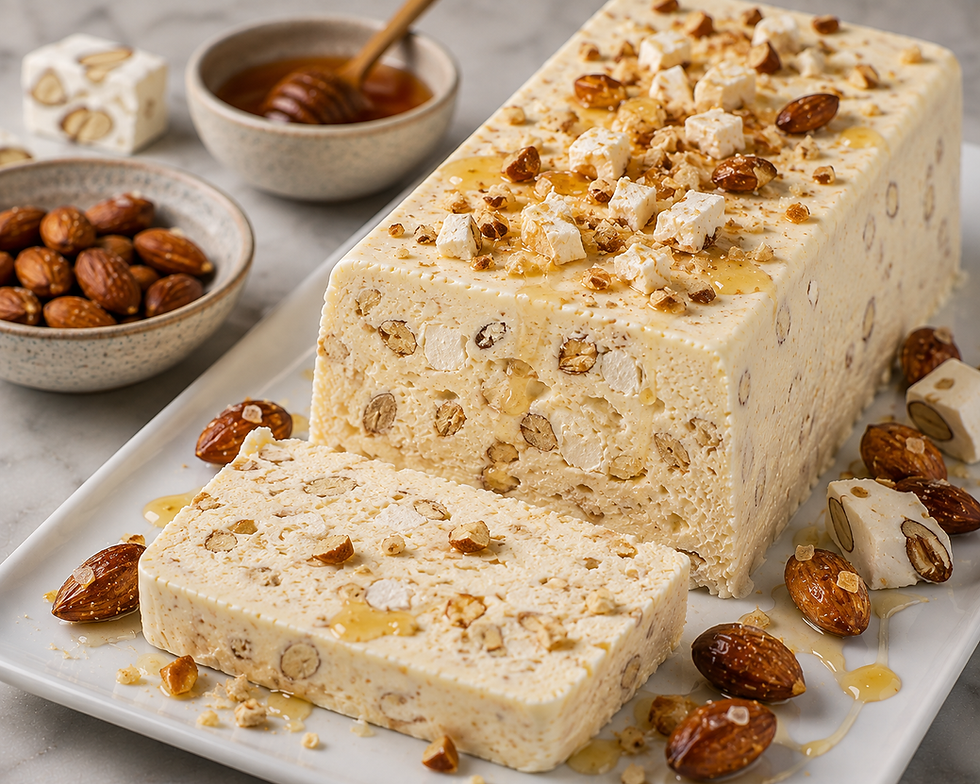
Temper and slice. Ten minutes before serving, lift the semifreddo out of the pan with the plastic wrap, unwrap it onto a chilled cutting board and leave it at room temperature. Dip a long thin knife in hot water, wipe it dry and cut slices 1 inch (2.5 cm) thick, cleaning and warming the blade after every cut. At the right moment the center gives slightly under a fingertip and the knife passes through the croccante without dragging it.
Plating
Use flat dessert plates chilled in the freezer for 10 minutes, so the slice does not begin to melt from below while you plate. Lay each slice flat, slightly off center, with the cut side up to show the almond fragments in the white cream. Pour the espresso sauce into a small warm jug and bring it to the table separately, or spoon a pool of about 2 tbsp (30 ml) beside the slice, never over it, so the contrast of hot and cold stays sharp.
Scatter a few toasted sliced almonds over the top, dust a thin line of cocoa along one edge with a small sieve, add a pinch of the reserved croccante dust and two or three flakes of sea salt. The guest eats it with a dessert spoon, cutting through cream and almonds and dragging each bite through the warm sauce, so the bitterness of the coffee meets the sweetness of the caramel in the same mouthful.
Professional Technique
The key number is the syrup temperature. At 248°F (120°C) the syrup holds just enough water to blend into the foam without breaking it and enough heat to set the aquafaba proteins. Below 240°F (115°C) the meringue stays soft and weeps in the freezer; above 255°F (124°C) the syrup hardens on contact and leaves sugary threads. The second number is the proportion: about equal volumes of meringue and almond cream give a semifreddo that is light and still creamy.
The hidden variable is the temperature of the coconut cream. Coconut fat melts between 75 and 79°F (24 and 26°C), much closer to room temperature than dairy fat. It must go into the bowl at refrigerator temperature, around 40°F (4°C), and the meringue must have cooled below 90°F (32°C) before the two meet. A warm meringue melts the coconut fat, the cream loses its structure and the mixture turns liquid, then freezes into a dense, icy layer at the bottom of the mold.
The doneness test for the mixture is the ribbon and the peak. Before it goes into the pan, a spoonful lifted from the bowl should hold a soft peak that slowly bends over, and the surface should look matte and smooth, never shiny and runny. After freezing, the semifreddo is ready when the center is firm to the touch but a thin knife still enters it with no effort after 10 minutes of tempering.
Air and Freezing Control
Semifreddo replaces the churning of gelato with trapped air. In a gelato machine, constant movement breaks the ice crystals as they form; in a semifreddo, nothing moves while it freezes, so the air bubbles and the fat must keep the crystals apart instead. That is why every stage of this recipe protects the foam: a grease-free bowl, a cooked meringue, a gentle fold, and freezing in a single uninterrupted session.
Sugar controls the softness at freezer temperature. Dissolved sugar lowers the freezing point of the water in the mixture, so part of it stays unfrozen even at 0°F (-18°C), and that unfrozen part is what makes the slice scoopable. This recipe uses about 25 percent sugar on the weight of the mixture, which gives a clean slice after a short rest.
The croccante is the opposite problem: it must not dissolve. Sugar in the brittle draws water from the cream around it, and in a few days the fragments can turn soft. Fold them in cold and dry, freeze the semifreddo at once and serve it within five days, when the almond pieces are still crisp and the caramel still cracks between the teeth.
Professional Mise en Place
A semifreddo is made the day before, which makes it an ideal dessert for service: on the day only the sauce, the slicing and the garnish remain. Organize the work so the meringue and the coconut cream are ready at the same moment and no component waits at the wrong temperature.
Equipment and tools
Stand mixer with whisk attachment, two clean bowls, one chilled
Small heavy saucepans for the caramel, the syrup and the sauce
Instant-read or candy thermometer, large flexible spatula
9 by 5 inch (23 by 13 cm) loaf pan, plastic wrap, sheet pan, silicone mat
Long thin knife, jug of hot water, clean towel
Prepared ahead
Coconut cream cans refrigerated for at least 24 hours
Aquafaba measured and chilled
Almond croccante made and crushed, kept in an airtight jar, up to 3 days ahead
Semifreddo frozen in its mold, 1 to 5 days ahead
Espresso sauce cooked and cooled, up to 2 days ahead, refrigerated
Service setup
Dessert plates chilling in the freezer
Espresso sauce warm in a small pan or jug at about 120°F (50°C)
Knife in hot water with a towel beside the cutting board
Toasted sliced almonds, croccante dust, cocoa in a small sieve and flaky salt on the pass
Chef Tips
Reduce homemade aquafaba before you use it. If you cook your own chickpeas, simmer the strained cooking liquid until it is slightly syrupy and pale gold, about half its original volume, then chill it. Thin aquafaba never reaches stiff peaks, however long it whips, because it contains too few proteins per spoonful.
Toast the almonds deeply. Pale almonds taste of little once they are frozen, because cold dulls aromas. Toast them until golden to the center and smell them: they should be clearly nutty, almost like roasted coffee, before they go into the caramel.
For a cleaner presentation, freeze the semifreddo in individual rings or silicone molds of about 1/2 cup (120 ml) each. They freeze in 4 to 5 hours, unmold in a second with the warmth of your hands and need only 5 minutes of tempering before service.
For an affogato-style service, skip the sauce and bring a short espresso in a small cup. The guest pours it over the slice: the outer layer melts into a cream while the center stays cold.
Common Mistakes
Using coconut cream at room temperature. Warm coconut cream never whips and the dessert freezes into a dense block. Refrigerate the cans for at least 24 hours and use only the solid part.
Adding the syrup too early or too cold. Syrup poured before it reaches 248°F (120°C) leaves a soft meringue that weeps in the freezer. Measure the temperature and pour only when it is right.
Folding a warm meringue into the cream. A meringue still above 90°F (32°C) melts the coconut fat and the mixture collapses. Keep whipping until the outside of the bowl feels just warm.
Overmixing during the fold. Each extra stroke breaks air bubbles and makes the semifreddo harder. Fold in two additions and stop as soon as the streaks disappear.
Adding the croccante too early. Brittle left in the mixture before it freezes, or left in the open air, softens and bleeds sugar. Fold it in last, dry and cold.
Cutting it straight from the freezer. A frozen semifreddo cracks and the knife drags the almonds. Temper it for 10 minutes and cut with a warm, dry blade.
Reducing the sugar. Less sugar means more frozen water and a slice as hard as ice. Keep the sugar as written and balance the sweetness with the bitter espresso sauce.
Wine Pairing
Moscato di Noto DOC: From the same corner of southeastern Sicily as the finest Italian almonds, a sweet white of Moscato Bianco with apricot, orange blossom and candied citrus notes. Its sweetness matches the caramel of the croccante, and its acidity keeps the coconut cream from feeling heavy. Serve it at about 50°F (10°C).
Passito di Pantelleria DOC: Made from Zibibbo grapes dried in the sun of the island of Pantelleria, with aromas of dried apricot, fig and toasted almond. Its concentration stands up to the espresso sauce, and its nutty finish echoes the brittle. Serve it at about 54°F (12°C).
Vin Santo del Chianti Classico DOC: The Tuscan wine of grapes dried for months and aged in small barrels, amber, with notes of walnut, dried fruit and caramel. The traditional companion of almond biscuits, it brings the same harmony to an almond semifreddo. Serve it at about 57°F (14°C).
Marsala DOC: The fortified wine of western Sicily, best in its sweet Superiore versions, with notes of dates, dried figs, licorice and coffee. Its warmth and its roasted tones make it the natural bridge between the coffee sauce and the toasted almonds. Serve it at about 57°F (14°C).
Storage & Reheating
Freezer: keep the semifreddo in its mold, tightly wrapped in plastic and then in foil, for up to 5 days; after that the croccante softens and the surface begins to take on freezer odors. Do not let it thaw and refreeze, because each cycle costs air and makes it icier. Refrigerator: not suitable, because the semifreddo melts into a cream within a few hours. The espresso sauce keeps for 4 days in a closed jar in the refrigerator.
Nothing is reheated except the sauce. Rewarm it in a small pan over low heat, whisking, until it reaches about 120°F (50°C), adding a teaspoon of hot water if it has thickened. In the microwave, heat it at 50 percent power for 30 seconds, stir and repeat until warm. Always temper the semifreddo for 10 minutes at room temperature before slicing.
Nutrition
Per serving, based on 8 servings:
Calories: 430 kcal
Total Fat: 25 g
Saturated Fat: 16 g
Trans Fat: 0 g
Unsaturated Fat: 9 g
Cholesterol: 0 mg
Sodium: 110 mg
Total Carbohydrates: 48 g
Fiber: 3 g
Total Sugars: 43 g
Added Sugars: 42 g
Protein: 5 g
Principal micronutrients: vitamin E, manganese, magnesium, copper, iron, riboflavin
These figures are estimates, calculated on the quantities listed and rounded to the nearest whole number, including the espresso sauce and the garnish. They vary with the fat content of the coconut cream and the size of the slices.


Comments