
Italian Orange Sorbet | Sorbetto all'Arancia
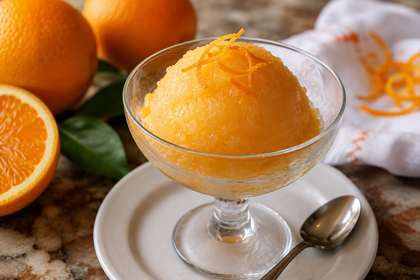
Orange sorbet looks like the simplest frozen dessert in the Italian repertoire and is one of the least forgiving. Four ingredients, no fat, no eggs, nothing to hide behind: every decision you make about sugar shows up in the texture on the spoon. Balanced correctly it is dense, smooth and violently orange. Balanced badly, by a margin smaller than you would think, it is either a slush that never sets or a block of ice you have to chip at.
Yield: 6 servings, about 1 quart (950 ml). Prep: 25 minutes. Chill: 4 hours. Churn: 25 minutes. Harden: 4 hours. Total: about 9 hours, mostly unattended. Difficulty: intermediate. Course: dolce. Region: Sicily and Calabria.
The Story
Frozen dessert in Italy begins with snow rather than with machines. On Etna, in the Madonie and the Nebrodi, and across the Calabrian Sila, communities dug stone lined pits called neviere, packed them with compacted winter snow, insulated the load with ash, straw and chestnut leaves, and sold it through the summer. The men who carried it down to the coastal towns by night, the nivaroli, ran a real industry with contracts, tariffs and lawsuits that appear in Sicilian archives from the sixteenth century onward. The trade was regulated and leased: a winter with no snowfall meant a summer without sorbet and a measurable hole in a city's revenue. Sorbet exists here because refrigeration existed here, in that crude seasonal form, centuries before anyone built a compressor.
The other half of the inheritance is Arab. Sugar cane and bitter orange arrived in Sicily with the ninth century conquest, along with sharbat, the chilled sweetened drink whose name became sorbetto. What Sicily did was turn the drink into something you eat. By the seventeenth century the craft was formal enough to export: Francesco Procopio dei Coltelli, born near Aci Trezza, opened in Paris in 1686 and made Sicilian sorbet fashionable in a city that had no snow pits. In 1775 a Neapolitan doctor, Filippo Baldini, published an entire treatise called De' sorbetti, classifying them by base and arguing at length that they were medicine.
The orange came later than the lemon and settled in specific places. The Washington Navel of the Ribera coast in the province of Agrigento carries a DOP, grown on alluvial soil between the Verdura and Magazzolo rivers. The Biondo Tardivo di Trebisacce ripens late on the Calabrian plain of Sibari. Around Palermo the Conca d'Oro was solid citrus long before it was solid buildings. All of it is winter fruit, picked from December to April, which is why sorbetto all'arancia in Italy is a cold weather dessert and not a beach one. The Italian rule for choosing juicing fruit is simple: thin skin, heavy for its size, sold loose from a crate rather than in a net. The sorbet you can make in August, from oranges shipped across the equator, is a different and lesser thing.
Ingredients
Buy the oranges by weight and taste one before you commit. You want juicing fruit that is sweet and still sharp, heavy for its size, thin skinned, and unwaxed if any of it is going to be zested. Blood oranges make a different sorbet with a different colour and belong in a different recipe. Weigh the sugar rather than scooping it, because a packed cup and a loose one differ by enough to move the finished base by two degrees Baume. The glucose syrup is not optional filler: it controls crystal growth, and it is what separates a dense sorbet from a granita.
For the sorbet base
Freshly squeezed orange juice, strained, 3 cups (720 ml), from 8 to 10 oranges
Finely grated orange zest, from 3 unwaxed oranges, about 1 tbsp (6 g)
Granulated sugar, 1 cup (200 g)
Water, 3/4 cup (180 ml)
Glucose syrup or light corn syrup, 1 1/2 tbsp (30 g)
Freshly squeezed lemon juice, 2 tbsp (30 ml)
Fine sea salt, 1/8 tsp (0.7 g)
For serving
Candied orange peel, cut into thin strips, 1 oz (28 g)
Unwaxed orange, for grating fresh zest at the table, 1
Coupe glasses or small bowls, chilled in the freezer, 6
Preparation
Get the freezer and the tools cold first
Set the freezer to its lowest setting the night before and put the ice cream maker canister in it for at least 12 hours. Chill the storage container, the sieve, the mixing bowl and a metal spoon at the same time. None of this is fussiness. Every degree the base gains between the refrigerator and the machine is a degree the machine has to remove before freezing begins, and a slow start is what grows large crystals.
Infuse the syrup with the zest
Grate the zest from three oranges before you cut any of them, taking only the coloured layer and none of the white pith beneath it. Combine the sugar, water, glucose syrup and salt in a small saucepan, add the zest, and warm over medium heat, stirring, only until the sugar has fully dissolved and the liquid runs clear. Do not boil it. Pull the pan off the heat, cover it, and leave the zest to infuse while the syrup cools to room temperature, about 40 minutes.
Juice the oranges and strain twice
Juice the fruit by hand or with a reamer rather than a high speed press, which tears the pith and drags bitterness into the liquid. Strain through a medium sieve to remove seeds and coarse membrane, then through a fine mesh one, leaving a little fine pulp in suspension. Do not clarify it completely: that pulp carries pectin and fibre and does real work blocking ice crystals later. Measure out exactly 3 cups (720 ml).
Blend the base and read the density
Strain the cooled syrup to remove the zest, pressing it to get everything out, then stir it into the juice with the lemon juice. Mix thoroughly rather than vigorously: air whipped in now will simply be lost. Take a reading with a saccharometer or a refractometer and aim for 28 to 30 Brix, which is roughly 17 degrees Baume. Taste it cold and expect it to be slightly sweeter and slightly more acidic than you want the finished sorbet to be, because freezing mutes both.
Mature the base in the refrigerator
Cover the base and refrigerate it for at least 4 hours and preferably overnight. Maturation is doing two things: it brings the mixture down to 39°F (4°C) so the machine can start freezing almost immediately, and it lets the pectin and the glucose fully hydrate so they can hold water once the ice starts forming. A base churned warm will never reach the same density no matter how long you run the machine.
Churn to a soft mound
Pour the cold base into the running machine and churn for 20 to 30 minutes. Watch the paddle rather than the clock. The sorbet is ready when it has thickened enough to hold a soft mound on the paddle and the surface has gone from glossy to matte, at about 21°F (minus 6°C). Stop there. Churning further beats in excess air and the sorbet turns pale and foamy, losing both the colour and the clean bite that the fruit paid for.
Harden, then temper for service
Scrape the sorbet into the chilled container, press it flat with the cold spoon to drive out air pockets, lay parchment directly on the surface, close the lid and freeze at least 4 hours at 0°F (minus 18°C). Before serving, move it to the refrigerator for 10 to 15 minutes. You want 12 to 14°F (minus 11 to minus 10°C): soft enough to scoop cleanly, cold enough to hold shape.
Plating
Serve it in glass and serve it cold. Coupe glasses or small footed bowls straight from the freezer are the classic Sicilian service, and the frosted glass buys you a further two or three minutes before the edges start to weep. Use a warm dry scoop, dipped in hot water and wiped between each portion, and give two neat quenelles or one round scoop per glass rather than a pile.
Garnish is one thing, not three. Two thin strips of candied orange peel laid across the top, or a few rasps of fresh zest grated over the sorbet in front of the guest, which releases oil and perfume at the moment it matters. Skip the mint leaf: it smells of nothing at this temperature. Send the glasses out the second they are filled.
Professional Technique
Everything in a sorbet comes down to the ratio between sugar and water, because that ratio decides whether the mixture freezes at all. Dissolved sugar lowers the freezing point of water: pure water sets at 32°F (0°C), while a sorbet base at roughly 29 percent total sugar sets at around 21°F (minus 6°C). Your freezer runs at about 0°F (minus 18°C). Push the sugar too high and the freezing point falls toward that, so the mixture never hardens and slumps in the glass as slush. Take it too low and nearly all the water crystallises into one continuous mass: a block of flavoured ice you scrape rather than scoop.
You measure it rather than guess. Float a saccharometer, graduated in degrees Baume, in the cold finished base: 16 to 18 degrees is the working window for fruit sorbet, 17 the target. A refractometer reads the same balance as Brix, where you want 28 to 30. With neither, the old Neapolitan test works: a clean egg dropped into a correctly balanced base floats with a patch of shell the size of a coin showing. Sinking means too lean, riding high too sweet.
The trap specific to orange is that the fruit brings its own sugar and most recipes ignore it. Fresh orange juice runs 9 to 11 percent sugar by weight, so 3 cups (720 ml) contributes roughly 2 1/2 oz (70 g) before you add a grain. Count it into the total, not on top of it. Add a standard 1 1/4 cups (250 g) to this much juice and you land near 34 Brix, still pourable after a night in the freezer.
Texture and Moisture Control
Smoothness in a sorbet is nothing more than crystal size. Crystals under about 30 microns read as creamy on the tongue; above 50 they read as gritty. Three things keep them small: a base already at 39°F (4°C) so freezing begins at once, constant agitation that breaks each crystal as it forms, and molecules in the liquid that get in the way. Glucose syrup and fine orange pulp do that last job.
Air is the other variable and it needs restraint. A sorbet wants 15 to 25 percent overrun, enough to lighten it and carry aroma, no more. Overchurn past 40 percent and the colour fades from deep orange to pale apricot, the sorbet feels foamy and melts faster because the structure is mostly bubbles. Stop the machine when the mixture mounds.
After that, temperature is the whole battle. Hardening flat under parchment stops freezer air from drawing moisture out and building a crust of frost. Every partial thaw and refreeze melts the smallest crystals and refreezes that water onto the larger ones, so the sorbet coarsens every day it sits. Serve between 12 and 14°F (minus 11 and minus 10°C) and never refreeze a portion that has gone soft.
Professional Mise en Place
The work is almost entirely front loaded. Nothing happens at the last minute except scooping, and the only thing that can fail at service is temperature.
Equipment and tools
Ice cream maker, canister frozen 12 hours or compressor prechilled
Saccharometer graduated in degrees Baume, or a digital refractometer
Microplane, hand reamer or citrus press, medium and fine mesh sieves
Small saucepan, digital thermometer, shallow metal container with a lid
Scoop, jug of hot water and a cloth for wiping it
Prepared ahead
Machine canister and storage container in the freezer, the night before
Zest infused syrup, strained, up to 3 days ahead, refrigerated
Candied orange peel in strips, up to 1 week ahead, sealed jar
Juice squeezed, strained and measured on the day, kept covered and cold
Base mixed, read for density, matured at least 4 hours or overnight
Service setup
Coupe glasses in the freezer at least 30 minutes before service
Sorbet moved to the refrigerator 10 to 15 minutes before the first order
Scoop standing in hot water, container kept closed between portions
Whole unwaxed orange and microplane at the pass for zesting to order
Chef Tips
Zest every orange before you cut it, even the ones you do not need zest from. It freezes perfectly in a sealed bag, whereas grating a halved squeezed orange wastes the peel and your knuckles.
The lemon juice is a correction, not a fixed quantity. Sicilian winter oranges at their peak are sweet and low in acid, and 2 tbsp (30 ml) brings the base into focus. If your fruit is sharp already, cut it to 1 tbsp (15 ml).
No machine is not a reason to abandon the recipe. Freeze the base in a shallow metal tray and rake it with a fork every 30 minutes for about 3 hours. What you get is a granita, coarser and more crystalline, and delicious on its own terms.
Save the spent peels. Simmered in syrup or dried in a low oven, they come back as garnish for the next batch. The point of a four ingredient dessert is that the fruit works twice.
Common Mistakes
Guessing the sugar instead of measuring it. A base 4 Brix off will not set properly and nothing afterwards will fix it. A hydrometer costs very little and removes the problem permanently.
Boiling the syrup with the zest in it. Heat drives off the volatile oils carrying the orange aroma and leaves a stewed marmalade note. Warm only until the sugar dissolves, then infuse off the heat, covered.
Grating into the white pith. The pith holds bitter limonin and naringin, far more obvious once the mixture is frozen and cold has muted the sugar. Take the coloured layer only, rotating the fruit as you go.
Churning a base that is not properly cold. A warm base spends its first ten minutes in the machine simply cooling down, and slow freezing grows large crystals. Four hours refrigerated is the minimum, overnight better.
Refreezing sorbet that has softened on the table. Every thaw and refreeze cycle enlarges the crystals, so a glass that went out and came back is now noticeably grainy. Scoop only what will be eaten and keep the rest hard.
Wine Pairing
Moscato di Noto DOC: The most exact match, made from Moscato Bianco on the limestone plateau behind Noto in southeastern Sicily. Its sweetness sits just above that of the sorbet, the only position from which sweetness survives this much acidity, and its orange blossom and candied peel aromatics repeat the zest instead of arguing with it. Pour it at 46°F (8°C).
Moscato di Siracusa DOC: Grown a short way north of Noto and yet a rounder wine: lower in acidity, with a honeyed apricot weight that arrives before the citrus does. That extra body is what you want when the sorbet is served very cold, because the wine fills the palate the ice has just scoured clean. Production is tiny, so treat a good bottle as the occasion.
Malvasia delle Lipari DOC: From the Aeolian islands, made from grapes dried on cane racks in the sun, and the most interesting pour here. Dried apricot, candied orange peel and a faint saline mineral note from volcanic soil give it a savoury edge a straight Moscato lacks, and that edge stops the pairing collapsing into sugar against sugar. Serve small measures.
Marsala DOC: Choose a Superiore Dolce or a genuinely sweet Vergine, never the bottle kept for cooking. Fortification takes the alcohol to around 18 percent, which registers as real warmth against a sorbet at 12°F (minus 11°C), and the oxidative character of walnut, caramel and dried orange is the closest thing in Italian wine to marmalade. That contrast of cold and warm is the whole point.
Storage & Reheating
Sorbet is not reheated, it is managed. Kept flat, pressed down, covered with parchment on the surface and sealed, it holds good texture for 5 days at 0°F (minus 18°C) and stays safe for a month, but coarsens steadily after the first week as small crystals give up water to large ones. Use a shallow metal container rather than a deep plastic one: it freezes faster going in and chills back down faster after every scoop.
If it has set too hard, temper it in the refrigerator for 15 minutes rather than on the counter, which softens the outside while the centre stays solid. If it has gone grainy, let it melt completely, strain it, take a fresh density reading and churn it again. The unfrozen base keeps 2 days refrigerated, and the zest infused syrup keeps 3.
Nutrition
Per serving, based on 6 servings of about 2/3 cup (160 ml):
Calories: 165 kcal
Total Fat: 0 g
Saturated Fat: 0 g
Trans Fat: 0 g
Unsaturated Fat: 0 g
Cholesterol: 0 mg
Sodium: 30 mg
Total Carbohydrates: 42 g
Fiber: 0.4 g
Total Sugars: 40 g
Added Sugars: 33 g
Protein: 0.8 g
Lactose: 0 g
Principal micronutrients: vitamin C, folate, potassium, thiamine
These figures are estimates and move with the fruit: very sweet late season oranges carry more natural sugar than December fruit.


Comments