
Italian Sicilian Blood Orange Sorbet | Sorbetto all'Arancia Rossa
Updated: Sep 14

A blood orange sorbet is one of the shortest recipes in the Sicilian repertoire and one of the least forgiving. There is no cream, no egg, no fat to hide behind. What reaches the spoon is juice, sugar, water and the size of the ice crystals, and all four are decided before the machine is switched on.
The fruit does most of the work. Arance Rosse di Sicilia IGP, grown on the volcanic plain running from Catania towards Paterno and Francofonte, develop a pigment no other European orange produces reliably. The three protected varieties are Tarocco, Moro and Sanguinello, and they are not interchangeable: one is sweet and lightly berried, one dark and almost brambly, one sits between them. Choosing among them is the first act of seasoning here.
What follows is a method rather than a formula to copy blindly. The syrup is built separately and cooled before it touches the juice, the base rests cold overnight so it freezes fast, and the sorbet is churned to a soft ribbon and hardened flat. This is a sorbetto, not the semifreddo of the same fruit: nothing is whipped into it and nothing about it is rich.
Yield: 8 servings, about 1 quart (950 ml). Prep: 30 minutes. Maturation: 8 hours or overnight. Churning: 20 to 30 minutes. Hardening: 3 to 4 hours. Difficulty: intermediate. Course: dessert or palate cleanser. Region: Sicily, the citrus plain east of Catania.
The Story
Frozen fruit ices are older in Sicily than almost anywhere in Europe, and the island owes them to the same Arab administration that brought citrus. Sorbetto descends from sharbat, the sweetened iced drink of the medieval Arab world, and the raw material that made it possible was snow. Ice was cut from the upper slopes of Etna and the Madonie in winter, packed with ash and straw into stone pits called neviere, and carried down to Catania and Palermo through the summer under a licensed trade that lasted into the nineteenth century. Sicilian ices predate cream gelato by centuries, and the oldest are exactly this: fruit, sugar, water, cold.
The blood orange arrived later and took its own territory. The red pigment is anthocyanin, and the trees produce it only where warm days are followed by genuinely cold nights, which on this plain is the work of Etna and its air draining downhill after dark. Tarocco, selected around Francofonte, stays the sweetest and least acidic, Moro is the darkest and most aggressive, Sanguinello the latest and most balanced. The IGP granted in 1996 covers Catania, Siracusa and Enna. In a preparation with nothing else in it the cultivar is effectively the recipe, which is why producers still name it on the tub.
Ingredients
For the fruit base
Blood orange juice, freshly squeezed and strained, Tarocco or Sanguinello, 2 cups (480 ml)
Finely grated blood orange zest, from 2 oranges, 1 tbsp (6 g)
Freshly squeezed lemon juice, 2 tbsp (30 ml)
For the syrup
Water, 3/4 cup (180 ml)
Granulated sugar, 3/4 cup (150 g)
Dextrose powder, or glucose powder, 3 tbsp (35 g)
Fine sea salt, 1 small pinch
For finishing
Blood orange segments, cut free of all membrane, 8
Candied blood orange peel, in fine strips, 2 tsp (8 g)
Extra virgin olive oil, mild and fruity, a few drops per plate, optional
Flaked sea salt, a very small pinch per plate, optional
Preparation
Choose and juice the oranges
Work with fruit that feels heavy for its size and smells of orange at the skin. Zest two of them first, taking only the coloured surface and none of the white pith, because zest cannot be taken once the fruit is cut. Squeeze by hand or on a reamer rather than in a high speed extractor, which tears the membrane and drags bitterness into the juice. Strain through a fine mesh sieve, leaving about a teaspoon of pulp for body. You need 8 to 10 medium oranges for 2 cups (480 ml). Refrigerate the juice at once: it loses aroma and colour within hours on the counter.
Cook the syrup
Combine water, sugar, dextrose and salt in a small saucepan and warm over medium heat, stirring, only until every crystal has dissolved and the liquid is clear. Give it fifteen seconds at a bare simmer and take it off. Boiling gains nothing, and evaporation concentrates the syrup and throws out the balance you are about to rely on. Cool it to refrigerator temperature, over an ice bath if you are in a hurry.
Combine the base and judge the balance
Stir the cold syrup into the cold juice, add lemon juice and zest, and taste. The base should read as slightly too sweet and slightly too intense now, because freezing mutes both by a noticeable margin. With a refractometer, aim for 26 to 29 percent sugar by weight: below that it freezes hard and grainy, above it never sets firm enough to scoop. Without one, judge by mouth, or use the old Sicilian test of floating a clean whole egg until a coin sized disc of shell shows.
Mature the base cold
Cover and refrigerate at least 8 hours, ideally overnight. This is not idle waiting: the zest infuses, the sugars distribute, and the base enters the machine near 39°F (4°C) rather than at room temperature, so it crosses the freezing zone fast and forms small crystals. Strain out the zest before churning for a perfectly smooth texture, or leave it for a more fragrant result.
Churn without fat
Pour the cold base into a running ice cream machine and churn 20 to 30 minutes. With no cream, no yolk and no stabiliser, nothing traps air the way a gelato base does, so it will not climb. Stop when it looks like thick wet snow and holds a soft ridge behind the paddle, near 21°F (minus 6°C). Going further warms the mixture through friction and coarsens the texture you have just built.
Harden flat, then serve
Transfer straight into a shallow metal container that has been in the freezer beforehand, spread it level to about 1 1/2 inches (4 cm), press parchment directly onto the surface and cover. A shallow layer freezes through evenly; a deep tub sets in a ring and leaves a soft middle inside an icy edge. Freeze 3 to 4 hours, and take it out 5 to 10 minutes before serving so the aroma opens and the scoop releases cleanly.
Or make it without a machine
Pour the matured base into a wide shallow metal tray, freeze 45 minutes, then drag the frozen edges into the centre with a fork. Repeat every 30 minutes for about three hours, doing by hand what the paddle does. For a result closer to churned sorbet, let the tray freeze solid, break it up, process briefly until smooth, and refreeze an hour.
Plating
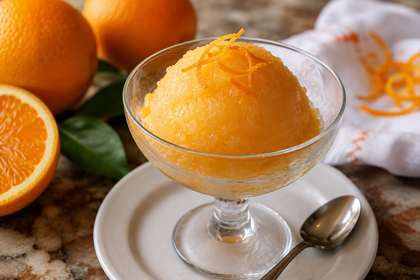
Serve it cold and serve it plain. One quenelle or one clean scoop in a chilled coupe, a small stemmed glass or a shallow ceramic bowl is the whole presentation, and the colour does the rest. Dip the spoon in hot water, dry it, and shape the quenelle in two passes rather than five, since every extra pass melts the surface and dulls the edge.
Garnish lightly if at all: two blood orange segments cut free of their membrane, a few strips of candied peel, nothing wet. Between courses, serve one small scoop with no garnish at all. As a dessert, the one addition worth making is a few drops of mild olive oil and the smallest pinch of flaked salt, a Sicilian pairing that reads as strange and makes complete sense in the mouth: the oil carries the citrus aromatics, the salt sharpens the fruit.
Professional Technique
Everything technical here reduces to one fact: sugar is not flavouring, it is structure. Dissolved sugar lowers the freezing point of water, so at a normal freezer temperature near 0°F (minus 18°C) part of the water stays liquid and holds the ice crystals apart. That unfrozen fraction is what makes a sorbet scoopable. Take sugar out to make it less sweet and you remove the antifreeze with it. Add too much and so little water freezes that it never firms at all.
This is why the dextrose matters and is not simply extra sugar. Freezing point depression depends on the number of dissolved molecules, not on sweetness, and dextrose has roughly half the sweetening power of sucrose at a similar molecular weight. Replacing part of the sugar with it depresses the freezing point further without making the sorbet sweeter, exactly what blood orange needs, since the fruit carries plenty of its own sugar. Glucose syrup does a comparable job and adds a little viscosity.
The last technique is temperature discipline, and it is where home sorbet usually fails. With no fat globules and no protein network, nothing protects this mixture from crystal growth: every time it warms and refreezes, small crystals melt and their water joins larger ones. Cold base in, fast churn, immediate transfer, shallow container, no round trips to the counter.
Texture and Moisture Control
Three temperatures define this dessert. The base enters the machine at about 39°F (4°C), leaves it near 21°F (minus 6°C) looking like thick snow, and hardens at 0°F (minus 18°C). It is served at roughly 10 to 14°F (minus 12 to minus 10°C), which is why the tempering rest of 5 to 10 minutes is part of the recipe. Straight from a cold freezer it is numbingly hard, the aroma locked shut and the fruit tasting of almost nothing.
Water moves in the other direction too. The surface loses moisture to the freezer air and gains it back as frost, and both spoil it, so parchment pressed directly onto the surface under the lid is worth more than any container claim. Keep a little pulp in the juice: the fine solids interrupt crystal growth and give a fuller feel without dairy. If the sorbet comes out grainy rather than dense, the cause is almost always a base that went in too warm, or sugar below the working range.
Professional Mise en Place
One long wait sits in the middle of this preparation, so everything except the churn happens the day before. Organise the work around the maturation.
Equipment and tools
Ice cream machine with the bowl frozen at least 24 hours, or a compressor model run for 10 minutes first
Fine mesh sieve, citrus reamer, microplane grater
Digital scale and, if you have one, a refractometer
Shallow metal container for hardening, chilled in the freezer in advance
Scoop or two dessert spoons for quenelles, plus a jug of hot water
Prepared ahead
Syrup cooked and fully chilled, up to 1 week ahead in a sealed jar
Juice squeezed, strained and refrigerated, on the day of churning only
Base assembled and maturing cold, 8 hours or overnight
Candied peel cut into fine strips, kept dry and sealed
Serving glasses and the storage container in the freezer
Service setup
Sorbet moved to a warmer part of the freezer, or the refrigerator, 10 minutes before service
Hot water and a clean cloth beside the scoop, wiped between every portion
Orange segments cut at the last moment and held cold on a chilled plate
One container out at a time, returned to the freezer straight after plating
No wet garnish held on the pass, since nothing wet should sit on the sorbet
Chef Tips
Taste the juice before you build anything. Blood oranges vary enormously across the season, sharp and pale in December, deep and almost jammy in March, and the same weight of sugar will not suit both. Early fruit usually needs less lemon, late fruit a little more.
If you can only find Moro, cut it with Tarocco or plain orange juice. Moro is the most striking of the three and also the most bitter, and a sorbet made entirely from it can taste medicinal by the third spoonful. One part Moro to two parts Tarocco gives the colour of the first and the balance of the second.
Chill the storage container and the serving glasses. Warm glass melts the outside of a scoop on contact and the sorbet reaches the table already weeping.
Do not make this with bottled or pasteurised juice. Heat treatment destroys the volatile aromatics and pushes the colour towards brown. Frozen unpasteurised juice from a Sicilian producer is a genuine substitute out of season; a supermarket carton is not.
Common Mistakes
Heating the juice. Blood orange aroma sits in volatile compounds that leave well below simmering point, and the pigment browns with heat. Cook the syrup alone, cool it fully, and keep the juice raw and cold from the squeezer to the machine.
Cutting the sugar to make it lighter. Sugar is the antifreeze that keeps part of the water liquid at freezer temperature. Reduce it by a third and you do not get a lighter dessert, you get a block of fruit ice that blunts a spoon.
Churning a base that is not cold. A base at room temperature spends far too long crossing the freezing zone, and slow freezing grows large crystals. The overnight rest is what gives a mixture with no fat in it any chance of a fine texture.
Zesting into the pith. The white layer under the coloured skin is intensely bitter and never softens in a cold preparation. Use a microplane with a light hand and stop the moment the surface under the blade turns pale.
Hardening in a deep tub. A tall container freezes from the outside inwards and leaves an icy rim around a centre that never sets. Spread the churned sorbet to about 1 1/2 inches (4 cm) in a shallow tray instead.
Wine Pairing
The wine must be at least as sweet as what is on the spoon and cold enough not to seem heavy beside it. Blood orange adds a second demand: real acidity in the glass, or the wine tastes dull against the fruit.
Moscato d'Asti DOCG: Low in alcohol, gently frizzante and full of orange blossom and white peach, it sits alongside the sorbet without competing for the same space. Its acidity keeps pace with the citrus and the light carbonation lifts the cold sweetness off the palate instead of letting it settle.
Brachetto d'Acqui DOCG: A sweet sparkling red whose raspberry and rose perfume runs straight into the berry note that separates a blood orange from an ordinary one. Light in body and very low in tannin, which matters here, since tannin against ice turns hard and drying. Serve it properly cold, near 46°F (8°C).
Recioto di Soave DOCG: Dried Garganega grapes give a still, honeyed wine of apricot and candied peel with a firm acid spine under the sugar. That acidity is what lets it stand against a sorbet this sharp, and its candied citrus character meets the zest and the peel on the plate.
Moscato di Scanzo DOCG: The richest option and the one for a small portion after dinner rather than a full serving. Air dried for a month before pressing, it offers dried rose, cinnamon and red fruit at a concentration that would swamp a delicate dessert but holds its own against the depth of Moro fruit.
Storage & Reheating
The unchurned base keeps refrigerated in a sealed container for up to 2 days, and the second day is often better because the zest has infused. Beyond that the juice oxidises and the colour dulls. The base freezes too: portion it flat in a sealed bag for up to 1 month and thaw it fully in the refrigerator before churning.
The finished sorbet holds good texture at 0°F (minus 18°C) for about 2 weeks and stays safe far longer, though each week coarsens the crystals slightly. Keep it in a shallow airtight container with parchment pressed onto the surface, at the back of the freezer where the temperature is stable, never in the door, and label it with the date.
There is no reheating step and there should never be one. The only correct regeneration is tempering: 5 to 10 minutes at room temperature, or 15 in the refrigerator, until a scoop moves through with mild resistance. If a batch has softened past that, do not refreeze it: blend it with a little prosecco and serve it at once as a sgroppino.
Nutrition
Per serving, based on 8 servings from about 1 quart (950 ml):
Calories: 132 kcal
Total Fat: 0.2 g
Saturated Fat: 0 g
Trans Fat: 0 g
Unsaturated Fat: 0.1 g
Cholesterol: 0 mg
Sodium: 12 mg
Total Carbohydrates: 33 g
Fiber: 0.4 g
Total Sugars: 31 g
Added Sugars: 23 g
Protein: 0.7 g
Lactose: 0 g, this sorbet contains no dairy
Principal micronutrients: vitamin C, folate, potassium, thiamine and the anthocyanins that colour the fruit
These figures are estimates. The sugar in the fruit varies by several grams per serving between early Tarocco and late Sanguinello, and the optional oil and salt are not counted.


Comments