
Italian Espresso Soufflé | Soufflé al Caffè Espresso
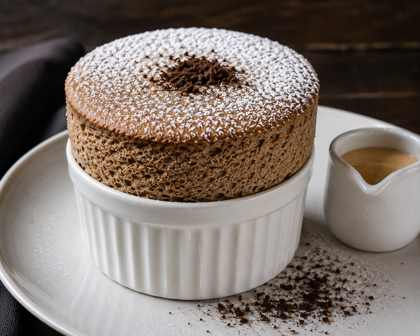
An espresso soufflé is one of the few desserts in Italian cooking that will not wait for anybody. It rises in the oven, reaches the table still climbing, and starts to settle within two minutes of leaving the heat. That is not a fault to be engineered away, it is the dish itself. The only real skill is arranging the kitchen and the table so that those two minutes belong to the people eating rather than to the cook.
Yield: 6 soufflés in 6 oz (180 ml) ramekins. Prep: 35 minutes. Cook: 13 minutes. Total: about 1 hour. Difficulty: advanced. Course: dolce. Region: Naples and Turin, the two Italian cities that made coffee a dessert flavour.
The Story
The soufflé is French by birth and Italian by adoption, and the route it took is well documented. Through the eighteenth and nineteenth centuries the aristocratic houses of Naples and Palermo employed French trained cooks, known in Neapolitan dialect as monzu, a local rendering of monsieur. They brought the whole vocabulary of the French kitchen south with them: the bechamel, the gateau, the timballo and the sformato, and the soufflé along with it. What the Neapolitan kitchen did with those techniques was to load them with its own ingredients, and coffee was the most obvious of them.
Naples had been drinking coffee since the middle of the eighteenth century, and by the nineteenth the caffè of the city was a social institution with its own rules, its own small cup and its own vocabulary. Turin, at the other end of the peninsula, built a parallel culture in its arcaded coffee houses, where coffee was drunk alongside pastry rather than at a counter. Both cities treated coffee as a flavour to be cooked with, not only a drink: granita di caffè in the south, bicerin and coffee creams in the north. The pairing of coffee with eggs and cream is older than the machine that made it famous. Nineteenth century Neapolitan cookery already turned coffee into creams and ices, and the pastry shops of the city were selling coffee flavoured sformati decades before anyone thought of building one on whipped whites and sending it straight to the table.
Espresso as we know it came later and came from the machine. Luigi Bezzera patented his steam pressure apparatus in Milan in 1901, Desiderio Pavoni bought the patent and began building machines in 1905, and within a generation the short, thick, intensely concentrated extraction had replaced the long brews in Italian bars. That concentration is what makes this dessert possible. A soufflé can absorb only a small volume of extra liquid before it stops rising, so the coffee has to arrive in a form that carries a great deal of flavour in very little water. Espresso, reduced further in a pan, is precisely that form, and the dessert is unthinkable without it.
Ingredients
For the ramekins
Unsalted butter, softened, 1 1/2 tbsp (21 g)
Granulated sugar, 3 tbsp (38 g)
For the espresso reduction
Freshly pulled espresso, 3/4 cup (180 ml), about 6 single shots
Granulated sugar, 1 tbsp (13 g)
For the coffee base
Whole milk, 1/2 cup (120 ml)
Unsalted butter, 2 tbsp (28 g)
All purpose flour, 3 tbsp (24 g)
Granulated sugar, 1/4 cup (50 g)
Egg yolks, large, 4
Finely ground espresso coffee, 1 tsp (2 g)
Fine sea salt, 1/8 tsp (0.7 g)
Vanilla extract, 1/2 tsp (2.5 ml)
For the meringue
Egg whites, large, 6, at room temperature
Granulated sugar, 3 tbsp (38 g)
For finishing
Confectioners sugar, for dusting, 1 tbsp (8 g)
Cold heavy cream, unwhipped, 1/2 cup (120 ml), to pour at the table
Espresso beans, 6, one per serving
Preparation
Butter the ramekins and coat them with sugar
Coat the inside of each ramekin completely with the softened butter, floor and walls, leaving no bare patch. Tip in a spoonful of granulated sugar, rotate the dish until the whole buttered surface is covered, then turn the excess into the next ramekin and repeat. The sugar shell gives the batter something to grip and it caramelizes lightly, which is where the thin crust comes from. Refrigerate the six ramekins on a small tray.
Reduce the espresso
Pull the espresso and pour it into a small saucepan with the tablespoon of sugar. Simmer over medium heat until it comes down to about 5 tbsp (75 ml), 6 to 8 minutes, leaving a glossy dark syrup on a spoon. Keep the heat moderate: espresso driven hard turns flatly bitter and there is no correcting it. Set it aside to cool to room temperature.
Cook the base
Warm the milk. In a second heavier pan melt the butter, stir in the flour and cook the paste for a minute over medium low heat, stirring constantly, until it smells faintly of biscuit. Pour in the hot milk in three goes, whisking hard after each, then add the sugar, the salt and the ground espresso. Cook 2 minutes more, whisking, until it thickens and pulls away from the sides.
Enrich the base with the yolks
Off the heat, let the pan cool for 3 minutes so the yolks will not scramble. Whisk them in one at a time, waiting until each disappears before adding the next, then whisk in the vanilla. The base should be glossy, thick and warm rather than hot. Cover it and leave it at room temperature.
Fold in the espresso syrup
Whisk the cooled espresso syrup into the base in two additions, beating well after each so it stays smooth. It will slacken noticeably. That is expected, and it is why the flour quantity here is higher than in a plain vanilla soufflé: the base has to carry extra liquid and still set. Taste now, the last moment you can correct sweetness or coffee strength.
Heat the oven and set the tray
Heat the oven to 400°F (200°C) conventional, rack in the lower third, with a heavy baking tray on it. The tray needs about 15 minutes to come to temperature and it matters: it drives heat straight into the base of each ramekin, where the first steam is generated. Only once the oven is fully up should you touch the whites.
Whip the whites and combine
Whip the whites on medium speed until opaque and foaming, then rain in the sugar and continue until they hold a peak that bends over at the tip. Stop there. Slacken the base with a third of the meringue, working it in without ceremony, then add the rest in two goes, cutting down through the middle and lifting up the side. Stop while a few pale streaks remain.
Fill, clean the rims and bake
Spoon the batter into the chilled ramekins right to the top and level each with a palette knife drawn across the rim. Wipe the rim clean with a thumb: a smear of batter there anchors the soufflé on one side and makes it climb crooked. Bake 12 to 14 minutes, until risen by about an inch and set at the edge with the centre still trembling. Serve at once.
Plating
A soufflé is plated in the ramekin it was baked in, and the service is decided before it comes out. Have the six saucers already on the table, each with a folded napkin to take the heat, and a jug of cold cream poured and waiting. Nothing should need fetching once the oven door opens.
Take the tray out, dust each soufflé with confectioners sugar through a fine sieve in one pass, and walk them to the table. Do not tap them and do not move them from dish to dish. Lay one espresso bean on each saucer. At the table, tell the guests to break the crust with a spoon and pour a little cold cream into the opening: the temperature contrast is the point, and the cream also slows the collapse of what they have not eaten yet.
Professional Technique
The defining technical fact about a soufflé is that it has a service window of roughly two minutes, and no technique closes it. What holds it up in the oven is steam expanding inside thousands of small air cells while the egg protein sets around them. The moment the dish leaves the heat that steam condenses back into water, the internal pressure drops, and the structure sits down. There is not enough flour in a soufflé to hold the shape alone, and adding enough to do so would make it a cake. The professional response is not a better technique but better organisation: the soufflé goes into the oven when the guests are already seated, never a minute before.
A coffee soufflé settles slightly faster than a vanilla one, and the reason is arithmetic. The espresso syrup adds liquid to a base whose flour and protein have to bind all of it. More free water means more steam at peak, a taller rise, and then a sharper fall once that steam has nowhere to go. You trade a few seconds of standing time for the flavour, a trade worth making, but it has to be planned for: seat the table first, then bake.
What can be done in advance is almost everything else. The ramekins can be buttered, sugared and refrigerated hours ahead, and are better for it, since cold walls give the batter a firmer initial grip. The espresso syrup can be reduced in the morning. The base, yolks and all, can be finished up to four hours ahead and held covered at cool room temperature, not refrigerated, so it stays loose enough to fold. Only the whites belong to the last moment: from the first turn of the whisk to the closing of the oven door is about six minutes, and that is the whole of the last minute work.
Texture and Moisture Control
A finished espresso soufflé should read as three different textures in one spoon: a thin crisp sugared crust at the top and sides, a light set foam through the body, and a small amount of loose warm cream at the very centre. That gradient comes from a temperature difference, not from underbaking. The outside of the ramekin is receiving direct oven heat and the middle is insulated by the foam around it, so pulling the dish while the centre still trembles gives you all three at once. Bake it until the centre is firm and you have a coffee sponge cake in a dish.
Moisture is the thing to watch, because the espresso brings extra. Reduce the coffee to the quantity given and no more generously than that: an extra 2 tbsp of unreduced espresso is enough to leave a wet band at the bottom of each soufflé that never sets. A base reduced too far or chilled in the refrigerator turns stiff, and a stiff base tears the meringue apart during folding. Hold it at cool room temperature and it folds in three movements. Serve within two minutes, before the steam condenses.
Professional Mise en Place
This dessert is unusual in that the mise en place is the recipe. Everything except the whites is done before the guests sit down, and the sequence below is what makes the last six minutes possible.
Equipment and tools
Six 6 oz (180 ml) straight sided porcelain ramekins
Heavy baking tray, preheated inside the oven
Stand mixer or hand mixer with a clean dry bowl and whisk
Large flexible spatula, palette knife, fine sieve for dusting
Prepared ahead
Ramekins buttered, sugared and refrigerated, up to 8 hours ahead
Espresso reduced to syrup and cooled, up to 1 day ahead
Coffee base finished with the yolks, covered, up to 4 hours ahead at cool room temperature
Whites separated, weighed and left to come to room temperature
Cream jug filled and refrigerated, saucers and napkins on the table
Service setup
Oven and tray at 400°F (200°C), confirmed with a thermometer
Guests seated and dessert plates cleared before the whites are whipped
Confectioners sugar in the sieve, ready in one hand
A clear path from the oven to the table, nothing to set down on the way
Chef Tips
Use coffee you would drink on its own. A soufflé has nothing to hide behind, so a stale over roasted espresso comes through as ash and every correction afterwards, more sugar included, makes it worse. Grind and pull it the same hour you cook.
Weigh the whites rather than counting them. Six large whites should come to about 7 oz (200 g), and eggs vary enough that counting alone can leave you 15 percent over, which is the commonest cause of a soufflé that rises magnificently and tastes of nothing but sweet foam.
Bake a single test soufflé first if the oven is new to you. Ovens run as much as 25°F (14°C) from their dial, and the difference between 12 and 14 minutes here is visible. One ramekin tells you exactly what the other five will do.
Never open the oven before minute 10. The rush of cool air drops the temperature at the moment the protein is still setting, and a soufflé caught then deflates in the oven and will not recover.
Common Mistakes
Baking before the guests are seated. The only mistake here that ruins a technically perfect soufflé. Put it in the oven while people are still finishing a previous course and it will be sitting down before it reaches them. Clear the table, seat everyone, then whip the whites.
Adding espresso without reducing it. Six shots unreduced is about 6 tbsp (90 ml) more water than the base can bind, and the result is a wet unset layer at the bottom of every ramekin. Reduce to 5 tbsp (75 ml), no shortcut.
Whipping the whites to a stiff peak. Whites taken that far have no room left to expand and they tear rather than stretch when folded. Stop at a peak that bends over at the tip.
Refrigerating the finished base. Cold base is stiff base, and it cannot be folded into a meringue without knocking the air out. Hold it covered at cool room temperature instead.
Leaving batter on the rim. A smear across the lip glues the soufflé down on one side and it climbs crooked, or splits. Level the top with a palette knife and wipe the rim with a thumb.
Wine Pairing
Marsala DOC: A Superiore Dolce, served cool in a small glass, is the closest thing on this list to a mirror of the dessert. Its oxidative ageing builds walnut, dried fig and burnt caramel notes that sit directly alongside the roasted character of the espresso rather than competing with it. The fortified strength also has the weight to follow a spoonful of cold cream, which lighter wines simply disappear underneath.
Vin Santo del Chianti Classico DOC: Dried Malvasia and Trebbiano grapes give a sweetness that is concentrated rather than syrupy, and the long cask ageing leaves a dry almond finish that keeps the pairing from turning cloying. Crucially the acidity survives the drying process, and it is that acidity which resets the palate between mouthfuls of an egg rich foam. Serve it at around 55°F (13°C).
Recioto di Soave DOCG: The lightest option here and the one to choose if the dessert follows a substantial meal. Garganega dried on the plant keeps a high natural acidity alongside notes of candied apricot, acacia honey and bitter almond, and the alcohol stays modest. It lifts the soufflé rather than weighing on it, and the almond note picks up the faint bitterness that coffee leaves at the back of the palate.
Malvasia delle Lipari DOC: From the Aeolian islands, with dried apricot, orange peel and a distinct salinity from the volcanic soil and the sea air. That saline edge is the interesting part: it works on a sweet dessert the way a pinch of salt works in the batter, sharpening the coffee and keeping the sugar in check. A small glass, well chilled, and nothing else after it.
Storage & Reheating
A baked soufflé cannot be stored and cannot be reheated. There is no method, professional or domestic, that puts the air back into a collapsed one: the steam that held it up has gone and the protein has already set around the empty cells. A soufflé that has fallen is an edible warm coffee pudding and should be eaten as such, with cream, without apology and without a second attempt at the oven.
The components keep well. The espresso syrup holds in a sealed jar in the refrigerator for up to 5 days. The finished base keeps covered at cool room temperature for 4 hours, or refrigerated for 24 hours, though a refrigerated base needs 40 minutes out of the cold and a good whisking before it will fold. Buttered and sugared ramekins keep refrigerated overnight. Egg whites keep 3 days refrigerated and freeze for 3 months, and thawed whites whip perfectly well. Nothing should be frozen once assembled.
Nutrition
Per serving, based on 6 soufflés, cream at the table included:
Calories: 285 kcal
Total Fat: 17 g
Saturated Fat: 9 g
Trans Fat: 0 g
Unsaturated Fat: 7 g
Cholesterol: 175 mg
Sodium: 115 mg
Total Carbohydrates: 25 g
Fiber: 0 g
Total Sugars: 21 g
Added Sugars: 19 g
Protein: 7 g
Lactose: 2.1 g
Principal micronutrients: vitamin A, vitamin B2, vitamin B12, choline, selenium, phosphorus, calcium
These figures are estimates and vary with how much cream each guest pours.


Comments