Italian Gaeta Octopus Pie | Tiella di Polpo di Gaeta
Updated: Oct 24
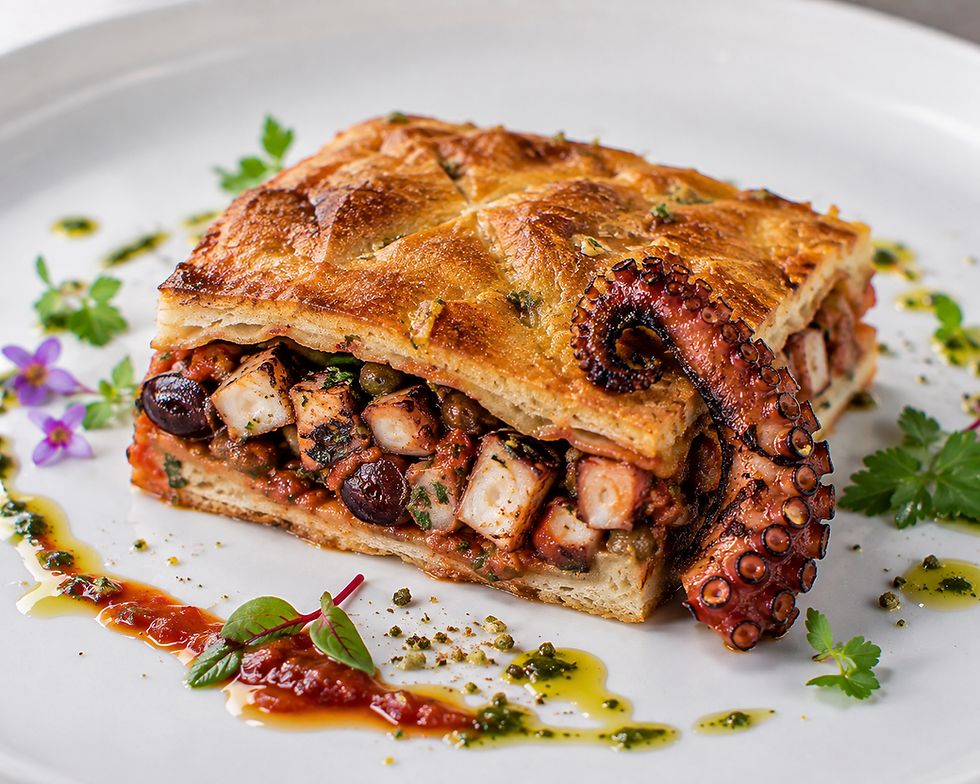
In Gaeta the tiella is not a home dish first and a bakery dish second. It is currency in the bread shops, sold by the slice from mid morning onward, stacked in shallow black pans behind the glass and cut with a long blade into wedges that people eat standing up on the pavement. It is a closed pie: two thin discs of oiled bread dough, a filling laid between them, an edge rolled over and pressed shut. The octopus version is the one the town is known for, and it is the one that separates a serious forno from a lazy one.
What makes it difficult is neither the octopus nor the dough. It is the water. A filling of octopus, tomato, olives and capers carries a great deal of liquid, and once the pie is sealed that liquid turns to steam with nowhere to go. Get it wrong and you cut into a pale, damp base under a perfectly browned lid. Everything that follows is organised around that single problem.
Serves 6. Prep: 40 minutes. Rise: 1 hour 30 minutes. Cook: 1 hour 30 minutes. Total: about 3 hours 40 minutes.
The Story
Gaeta sits on the Tyrrhenian coast at the southern edge of Lazio, on the gulf that carries its name, a fishing town with a fortified old quarter climbing the headland above the harbour. The pie takes its name from the pan: the tiella, a shallow round dish of metal or terracotta that went into the communal wood oven or straight onto the embers of the hearth. It belongs to the same family as the Apulian tiella and the Neapolitan pizza di scarole, closed pies born in poor kitchens where a skin of bread dough was used to stretch a small quantity of filling far enough to feed a table.
The fishermen's version travelled. Sealed between two layers of bread, the filling kept for a day, did not spill and could be eaten with one hand, which made the tiella the food a boat carried out at dawn. Ashore, the bakers turned it into a town speciality and then into an identity. Every forno in Gaeta bakes it, the best known families have been baking it for a century, and the town defends the name as its own property.
Fillings follow the calendar and the catch. Escarole with olives and anchovy is the winter one, alici e cipolle the cheapest and the most common, and sardines or squid appear when the market offers them. The octopus tiella is the one kept for Sundays, for feast days and for guests, and locally it is considered the noble version of the family.
Ingredients
For the dough
Bread flour, 4 cups (500 g)
Warm water, 1 1/2 cups (360 ml)
Instant yeast, 2 tsp (7 g)
Extra virgin olive oil, 3 tbsp (45 ml)
Fine sea salt, 2 tsp (12 g)
For the filling
Whole octopus, cleaned, 2 lb (900 g)
Crushed tomatoes, 2 cups (475 ml)
Gaeta olives, pitted, 3/4 cup (120 g)
Salted capers, rinsed, 2 tbsp (30 g)
Garlic cloves, thinly sliced, 2
Extra virgin olive oil, 3 tbsp (45 ml)
Dry white wine, 1/2 cup (120 ml)
Crushed red pepper flakes, 1/2 tsp (1 g)
Flat leaf parsley, chopped, 1/3 cup (15 g)
Fine sea salt, 1 tsp (6 g)
For finishing
Extra virgin olive oil, for the pan and the lid, 2 tbsp (30 ml)
Coarse sea salt, a generous pinch
Lemon wedges, to serve, 6
Preparation
Mixing and proofing the oiled bread dough
Combine the flour and the instant yeast in a bowl, pour in the warm water and mix to a shaggy mass, then leave it alone for 10 minutes. Add the salt and the olive oil and knead for 8 to 10 minutes, until the dough is smooth, slack and distinctly elastic. The oil goes in after the water on purpose, so that it does not coat the flour and slow the gluten down. Cover the bowl and leave it at room temperature for roughly 1 hour 30 minutes, until nearly doubled. The finished dough should stay soft and extensible, much closer to a focaccia dough than to a pastry.
Cooking the octopus and letting it cool in its liquid
Put the cleaned octopus into a heavy pot with no added water at all, cover it and set it over low heat. Within a few minutes it will release enough of its own liquid to cover itself. Simmer gently for 45 to 55 minutes, until the point of a knife slides into the thickest part of a tentacle without resistance. Turn off the heat and leave the octopus in that liquid for at least 30 minutes. Lift it out, drain it in a sieve, blot it and cut it into pieces of about 3/4 inch (2 cm). Keep the cooking liquid for a risotto or a soup; none of it goes into the pie.
Reducing the tomato and chilling the filling flat
Warm the olive oil with the sliced garlic and the pepper flakes in a wide pan until the garlic turns blond. Pour in the white wine and let it evaporate completely, then add the crushed tomatoes. Cook over medium heat for 20 to 25 minutes, stirring often, until the sauce is thick enough to hold an open channel when you draw a spoon across the base of the pan. Fold in the octopus, the olives and the rinsed capers, cook 5 minutes more, then check the salt and stir in the parsley. Spread the filling on a tray in a thin layer and refrigerate it until it is completely cold.
Lining the pan and sealing the two discs
Divide the dough into two pieces, one noticeably larger. Oil a shallow 12 inch (30 cm) metal pan. Roll the larger piece to about 1/8 inch (3 mm) and line the pan with it, letting the dough hang over the rim all the way round. Pour off any liquid that has gathered under the cold filling, then spread the filling in an even layer and leave a bare border of 1 inch (2.5 cm). Roll the second disc, lay it on top, then roll the two overhanging edges together toward the inside of the pan and press that roll down flat. Cut two or three slits in the lid.
Baking low first, then in the middle
Let the sealed pie rest for 25 minutes while the oven heats to 425°F (220°C), with the rack already sitting in the lowest position. Brush the lid with olive oil and scatter the coarse salt. Bake on that low rack for the first 20 minutes, so the base takes direct radiant heat and sets before the filling can wet it, then move the pan to the middle of the oven and bake a further 20 to 25 minutes, until the lid is deeply golden and the rolled edge is crisp and dry. Slide the pie straight out of the pan onto a wire rack.
Plating and Presentation
A tiella is cut in the pan or on a board and never plated in the way a restaurant would understand the word. The presentation is the cut itself. Let it stand on the rack for at least 20 minutes before the knife goes near it, and use the rack rather than the pan, because a pie left sitting in hot metal steams its own base back to softness. Cut with a long thin blade and a single drawing stroke instead of sawing, so the two crusts stay attached to the filling. Six generous wedges from a 12 inch (30 cm) pan is the working portion. Serve on a wooden board or a plain white plate with nothing under the wedge and nothing spooned over it: no garnish, no drizzle, no parsley at the table. A lemon wedge on the side is accepted in Gaeta, and nothing else is.
Professional Technique
The dough here is a bread dough enriched with oil rather than a pastry, and it is rolled far thinner than its softness suggests it will tolerate. The oil is what allows it to stretch to 1/8 inch (3 mm) without tearing and what keeps the baked crust short instead of tough, so cutting the oil back to make the dough easier to handle is exactly the wrong correction. The real technical problem, though, is everything that happens under the lid. Octopus and tomato both give up water in the oven, the two sealed discs trap it, and the steam has only one place left to go, which is downward into the base.
Three controls answer that. The filling is reduced and then cooled completely, because a warm filling starts evaporating into raw dough the instant the two touch. The top disc is slit in two or three places so the steam leaves upward and the pie does not inflate. And the rim is closed by rolling the two edges together and pressing the roll flat against the pan, never by pinching them, because a pinched seam is a single thin line of dough that splits as the pie expands and lets the juices run out and fry against the metal.
Texture and Moisture Control
A tiella is eaten warm and not hot. Straight from the oven the internal steam has not finished leaving the crumb, and the base reads as underbaked even when it is perfectly cooked. Twenty to thirty minutes on a rack changes the same pie completely: the base goes from soft to audibly crisp under the blade, and the filling firms enough to stay where it is put. The filling itself should be glossy and just bound, never soupy. If a spoonful of the cooled filling leaves a pool of liquid behind on the tray, it goes back into the pan to reduce further before it goes anywhere near the dough.
The pan matters as much as the oven. A dark metal tin or an old iron one conducts heat into the base quickly; glass and ceramic hold moisture against it and give a pale bottom no matter how long you bake. The following day the pie is regenerated in the oven at 350°F (175°C) for 12 minutes and never in the microwave, which drives the trapped moisture back through the crust and turns it to leather.
Professional Mise en Place
The tiella is a make ahead construction by nature, and no baker in Gaeta starts the dough and the filling on the same clock. Both elements must be finished and cold before assembly begins, which splits the work cleanly across two sessions.
Cook the octopus the day before and keep it whole in its own liquid, covered, in the refrigerator.
Reduce and season the tomato filling in advance, then spread it flat on a tray so it loses heat fast and chills through.
Time the dough so that its rise finishes roughly when the filling comes out of the refrigerator.
Oil the pan, cut the parchment if you use it, and set out the knife and the rack before your hands are covered in dough.
Heat the oven a full 30 minutes before the pie is sealed, with the rack already in the lowest position.
Chef Tips
Weigh the two pieces of dough: the base needs about 60 percent of the total, because it has to climb the sides of the pan as well as cover the bottom.
Rinse salted capers under several changes of running water rather than soaking them, since a long soak pulls out the flavour along with the salt.
Do not correct the salt until the tomato has finished reducing, because the olives and the capers keep releasing salt as they warm through.
If the lid colours before the base is set, cover it loosely with foil and keep the pan low. Colour on top is never worth a damp bottom.
Common Mistakes
Assembling with a warm filling: the heat gelatinises the starch on the inner face of the base before the oven ever reaches it, and that layer stays grey and pasty through the whole bake. The filling must be refrigerator cold, not simply cooled down to room temperature.
Sealing the pie with no vents: without slits in the lid the trapped steam inflates the pie like a balloon, then condenses as it cools and falls straight back onto the base. Two or three clean cuts, made after the edge is closed, are all it takes.
Pinching the rim instead of rolling it: a pinched edge is one thin seam and it splits as the dough expands, so the juices escape into the pan and fry there while the filling above them dries out. Roll the overhang inward and press the roll down flat.
Using an undrained octopus: the pieces carry liquid even after the cooking liquid has been poured away, and that water goes straight into the crust. Let them sit in a sieve for 10 minutes and blot them dry before they meet the tomato.
Wine Pairing
Frascati Superiore DOCG: The bottle of Lazio itself, and the one poured in this part of the region with anything that comes out of a bread oven. Its Malvasia driven texture is soft and slightly waxy, enough to sit comfortably beside the oil worked into the dough, while the acidity underneath lifts the salt of the olives and capers instead of adding to it. The faint bitter almond finish echoes the browned crust.
Falanghina del Sannio DOC: From just over the border in Campania, this is the saline answer to the filling. Citrus and green apple cut straight through the reduced tomato, and the firm mineral spine stands up to the octopus without covering its natural sweetness. Serve it at 50°F (10°C) so that the warmth of the pie does not flatten the aromatics.
Cesanese del Piglio DOCG: For anyone who wants a red against a tomato filling, the historic red of Lazio is the only sensible choice. The tannin is fine and low, the red cherry and black pepper aromatics meet the pepper flakes and the capers head on, and the moderate body never overwhelms a white fleshed seafood. Serve it lightly cool, around 59°F (15°C).
Storage and Reheating
The tiella keeps at room temperature under a cloth for a day, and it is genuinely better at hour six than at hour one. For longer, wrap the cooled wedges first in parchment and then in foil and refrigerate for up to 3 days. It freezes well as single wedges, wrapped the same way, for up to 2 months. Reheat from the refrigerator at 350°F (175°C) for about 12 minutes, or from frozen at 325°F (160°C) for about 25 minutes, in both cases placed directly on a preheated tray or a baking stone so the base recovers its crispness. Never use the microwave.
Nutrition Information
Approximate values per serving, based on six wedges cut from a 12 inch (30 cm) pan.
Calories, 585 kcal
Total Fat, 19 g
Saturated Fat, 3 g
Trans Fat, 0 g
Unsaturated Fat, 15 g
Cholesterol, 72 mg
Sodium, 980 mg
Total Carbohydrates, 68 g
Fiber, 4 g
Total Sugars, 5 g
Added Sugars, 0 g
Protein, 33 g
Lactose, 0 g
Iron, 6 mg; Potassium, 620 mg; Selenium, 62 mcg; Vitamin B12, 22 mcg
Allergens: wheat gluten and mollusc. Contains no dairy, no egg and no nuts.
These figures are estimates and will shift with the size of the octopus, the salt of the olives and capers, and the oil absorbed by the crust.


Comments