
Italian Calabrian Nougat | Torrone di Bagnara IGP
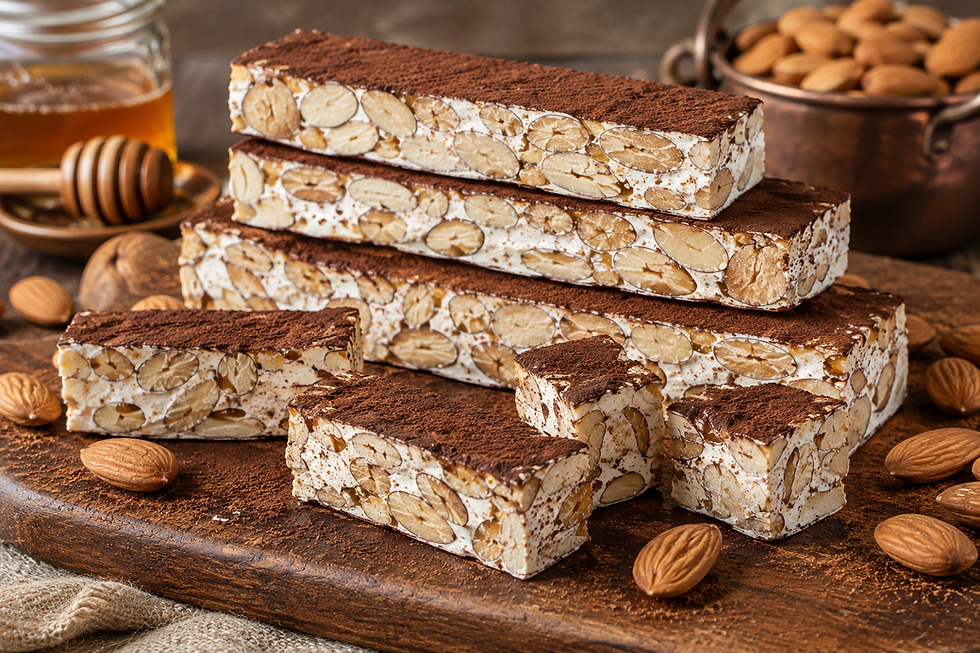
Torrone di Bagnara is the nougat of one small Calabrian town, and its name is protected at European level as a Geographical Indication. The base is short: honey, sugar, almonds and egg white, cast onto sheets of edible wafer. From that base the protected specification recognises two finished versions, and they taste nothing alike. What follows is the full process for both, and the reason the covering on a bar of torrone does far more work than it appears to.
Yield: about 24 bars, 3 lb 5 oz (1.5 kg) in total. Prep: 45 minutes. Cook: 1 hour 15 minutes. Setting: 12 hours. Total: about 14 hours. Difficulty: advanced. Course: dolce. Region: Calabria, Bagnara Calabra.
The Story
Bagnara Calabra sits on the Tyrrhenian side of the Calabrian coast, between Palmi and Scilla, on the stretch known as the Costa Viola, looking across the Strait of Messina towards Sicily. It is a town of fishermen and traders squeezed between the mountain and the water, and nougat making has been recorded there since the eighteenth century, when the port handled sugar and the feast days of the surrounding villages guaranteed a market. The protected specification now confines production to the territory of that one municipality in the province of Reggio Calabria.
The trade was carried largely by women. The bagnarote, the women of Bagnara, moved goods balanced on their heads along the coast road and up into the Aspromonte villages, selling fish, salt and sweets at markets and fairs far from home. Torrone suited that life better than almost anything else a household could make: it kept for weeks without refrigeration, it survived being carried, and it sold at festivals. The reputation of Bagnara nougat spread along the routes those women walked, not through any shop.
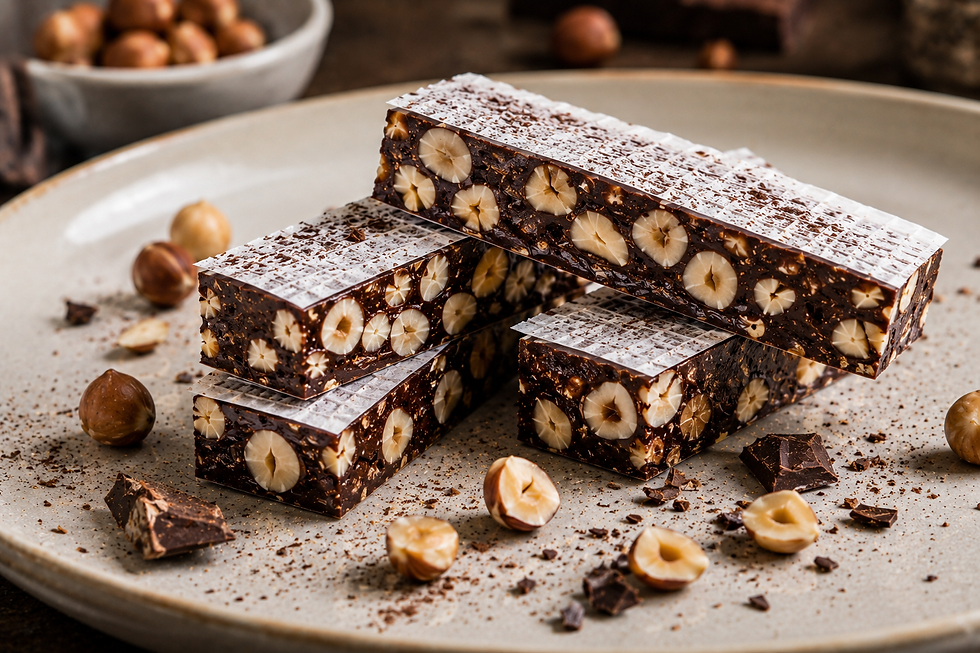
The specification protects two traditional versions of the same mass. The Martiniana is the older and plainer of the two, a pale nougat perfumed with cloves and white pepper, cut into bars and wrapped in wafer, so that the spice arrives a moment after the almond. The Torrefatto Glassato is the darker one: the bars are coated with a mixture of cocoa and sugar, then toasted until the coating sets into a hard bittersweet shell that cracks under the teeth before the almond does. Both start in the same copper pot and diverge only at the end.
Ingredients
For the nougat mass
Whole almonds, unpeeled, 1 lb 5 oz (600 g)
Acacia or wildflower honey, 10 1/2 oz (300 g)
Granulated sugar, 14 oz (400 g)
Water, 1/3 cup (80 ml)
Egg whites, at room temperature, 2 large (2 1/2 oz, 70 g)
Fine sea salt, 1 small pinch
Edible wafer sheets, ostie, 6 large
For the Martiniana
Ground cloves, 1/2 tsp (1 g)
Finely ground white pepper, 1/4 tsp (0.5 g)
For the Torrefatto Glassato
Unsweetened cocoa powder, 2 1/2 oz (70 g)
Granulated sugar, 3 1/2 oz (100 g)
Water, 2 tbsp (30 ml)
Ground cinnamon, 1/4 tsp (0.5 g), optional
Equipment you cannot improvise
Heavy copper or thick bottomed saucepan, 4 quart (4 l)
Stand mixer with the whisk attachment, or a strong handheld whisk and a second pair of hands
Digital probe thermometer reading to at least 320°F (160°C)
Wooden frame or a straight sided tray about 12 by 8 in (30 by 20 cm)
Preparation
Roasting the almonds
Spread the almonds on a tray and roast at 320°F (160°C) for 18 to 22 minutes, turning them twice, until the skins are dry and brittle and the kernel under them is the colour of pale straw. Rub them in a clean cloth to loosen most of the skins, then leave them in the switched off oven with the door ajar. They must go into the mass hot and bone dry.
Reducing the honey
Warm the honey in the copper pan over the lowest heat, stirring with a wooden spoon, until it thins, foams up and then settles again, roughly 25 minutes. You are driving off water, nothing more. Keep it moving and never let it colour or catch, because scorched honey turns the whole batch bitter and there is no correcting it.
Whipping in the egg white
Whisk the whites with the pinch of salt to firm peaks. With the honey still over very low heat, add the whites in three additions, whisking hard after each one. The mass will loosen alarmingly, then pull together and lighten. Hold it there over gentle heat for about 20 minutes, stirring, while it stiffens and turns opaque and ivory.
Adding the sugar syrup
Meanwhile bring the sugar and water to 305°F (152°C) in a separate pan without stirring, brushing the sides down with water. Pour it into the aerated honey in a thin steady stream, mixing constantly. Continue over low heat until a spoonful dropped into cold water sets firm and snaps cleanly, which is the point to stop.
Perfuming the Martiniana mass
If you are making the Martiniana, take the pan off the heat and beat in the cloves and white pepper now, while the mass is still fluid enough to accept them evenly. Ground spice added later sits in streaks. For a Torrefatto Glassato batch add nothing at this stage, since its character comes entirely from the coating.
Folding in the almonds
Tip in the hot almonds all at once and fold rather than stir, cutting through the mass with a wooden spatula so the nuts distribute without knocking the air out. Work quickly. Cold almonds would chill the nougat into an unworkable block within a minute, which is the whole reason they stayed in the warm oven.
Casting on the wafer
Line the frame with wafer sheets, trimming them to fit edge to edge with no gaps. Scrape the mass in, spread it level with an oiled spatula, and lay more wafer over the top while the surface is warm and still tacky to the touch. Press the sheets down firmly from the centre outwards to expel any trapped air.
Pressing and setting
Cover with a board, weight it evenly and leave it at cool room temperature for 12 hours, never in the refrigerator. When it is fully set, turn the slab out and cut it into bars with a heavy knife warmed under hot water and dried, in one decisive push per cut rather than a sawing motion.
Glazing the Torrefatto
For the second version, cook the sugar and water to a light caramel, stir in the cocoa and cinnamon off the heat, and roll each bar in the hot mixture until evenly coated. Set them on parchment and toast at 285°F (140°C) for 8 to 10 minutes, until the coating loses its gloss and hardens into a matt shell.
Plating
Torrone is served in pieces, not in slices. Cut the bars across into lengths of about 2 in (5 cm) and stand two or three pieces upright on a small plate so the cut face shows the almonds in section, which is the only way to judge the density of the nut and the fineness of the aeration.
Serve it at cool room temperature, around 64°F (18°C). Cold from the refrigerator the mass is glassy and hurts the teeth, and the clove and pepper of the Martiniana go mute. Too warm and the nougat bends instead of breaking. If you are putting both versions on the same plate, keep them apart, because the cocoa shell of the Torrefatto marks the pale one on contact.
Professional Technique
The covering on a bar of torrone is not decoration. It is a barrier, and it is the single component that decides whether the nougat you made today is still good in a week. Nougat is an intensely hygroscopic material: it is mostly sugar and honey held in a low moisture glass, and those sugars pull water vapour straight out of the surrounding air. Left bare in a coastal kitchen, a perfectly cooked slab turns tacky on the surface within a day, and by the second day it is wet to the touch and the almonds have gone soft. The wafer sheet is what stands between the mass and the atmosphere.
This is why the wafer goes on while the mass is warm but not boiling. Warm nougat still carries a thin film of syrup on its surface, tacky enough that the starch sheet bonds to it on contact and follows every irregularity, leaving no air pocket underneath. Applied to a boiling mass, the same sheet meets free steam: its starch absorbs that moisture immediately, wrinkles, softens and dissolves in patches, and a barrier with holes in it is no barrier at all. Applied to a slab that has already set, it simply will not stick, and it lifts away in one piece the first time the bar is handled.
On the Torrefatto Glassato the cocoa and sugar glaze does the same job, and does it better. It is applied hot and toasted, so it sets as a continuous shell of fat and crystallised sugar with no seams and no edges for air to get under, which is exactly why that version keeps longer than the Martiniana. What neither covering can protect is a cut face. The moment you cut a bar you expose raw nougat on both sides of the knife, and those faces begin taking up water at once. Wrap cut pieces immediately, and cut only what you are about to serve.
Texture and Moisture Control
Three things have to land together: a mass firm enough to snap yet fine enough not to be glassy, almonds that are crisp all the way through, and an aeration fine enough to lighten the bite without making the nougat crumble. The aeration comes from the egg white, and it is fragile. Once the whites are in, every minute of stirring over heat both thickens the mass and costs it a little volume, so the stirring has to be purposeful rather than constant.
Moisture is the enemy on both sides of the process. Almonds that carry any residual damp will soften inside the mass over the following days, which is why they are roasted until the skins are brittle and folded in hot. Work on a dry day if you can, and never on a day when something else is boiling in the same kitchen: humid air slows the setting, and the slab will still be soft after twelve hours under the weight.
The knife matters more than people expect. A cold blade compresses the mass and drags, tearing the wafer and shattering the edges of the bar. A blade warmed in hot water and wiped dry passes through cleanly and leaves a smooth cut face, which exposes less broken surface to the air.
Professional Mise en Place
This is a two day preparation with one very short critical window, the minute between the syrup going in and the almonds being folded. Everything else should be ready beforehand.
Equipment and tools
Copper or thick bottomed pan, second pan for the syrup, stand mixer, probe thermometer
Wooden frame or straight sided tray, board and even weights for pressing
Wooden spatula, oiled offset spatula, heavy knife and a jug of hot water
Prepared ahead
Almonds roasted, rubbed and held hot in the switched off oven
Wafer sheets trimmed to the exact frame dimensions, top and bottom
Spices weighed into a small bowl, cocoa and glazing sugar weighed separately
Egg whites at room temperature, weighed, and the mixer bowl scrupulously clean
Service setup
Bars cut only as needed, the rest of the slab left whole and wrapped
Cut pieces held in an airtight tin between layers of parchment
Knife and hot water ready, blade dried before every cut
Serving plates at room temperature, never chilled
Chef Tips
Choose the honey for what it will taste like, because it is the loudest ingredient in the finished bar. Acacia keeps the mass pale and lets the almond and the clove speak; a wildflower honey gives more depth but darkens the nougat. Chestnut honey will dominate everything and should be left out of this recipe.
Buy the wafer sheets before you start, and buy more than you need. Ostie are thin, they tear on handling, and a torn sheet leaves a gap in the barrier. They cost almost nothing and there is no substitute: parchment does not bond and rice paper behaves differently under a warm surface.
Test the mass in cold water rather than trusting the thermometer alone. Honey batches vary in water content, so two identical cooks can finish at different consistencies. Drop a small spoonful into iced water, wait five seconds and bite it: it should snap, not bend and not stick to your teeth.
Make a single batch. Doubling the quantity doubles the time the mass spends over heat while you fold in twice as many almonds, and the nougat sets in the pan before you have finished. If you want more, cook two batches one after the other.
Common Mistakes
Laying the wafer on a boiling mass. The steam coming off the surface softens the starch sheet, which then wrinkles and dissolves in patches and stops sealing anything. Let the mass come down until the surface is tacky rather than steaming, then press the sheet on from the centre outwards.
Folding in cold almonds. Almonds straight from a cool room drop the temperature of the mass so fast that it seizes while you are still mixing, and you end up with nuts in clumps and air knocked out. Keep them hot in the switched off oven until the second you need them.
Setting the slab in the refrigerator. It looks like a shortcut and it ruins the texture: the cold makes the mass brittle and glassy, and condensation forms on the surface when you bring it out, which is the one thing a hygroscopic sweet cannot tolerate. Cool room temperature, twelve hours, under weight.
Storing cut bars loose. Every cut face is unprotected nougat. Left in the open they are tacky by the next morning, whatever the covering on the other four sides is doing. Wrap them individually or hold them in a sealed tin with parchment between the layers.
Rushing the honey. Turning the heat up to save twenty minutes scorches it against the base of the pan, and burnt honey is bitter in a way no amount of sugar or spice will cover. Lowest heat, wooden spoon, keep it moving.
Wine Pairing
Greco di Bianco DOC: The local answer, from Bianco on the Ionian side of the same province as Bagnara. Sun dried grapes give it a dense apricot and orange peel sweetness carried on unusually firm acidity for a passito, and that acidity is what stops the pairing turning cloying against a sweet like this. Its own note of toasted almond runs straight into the nougat rather than sitting beside it.
Malvasia delle Lipari DOC: Made across the water from Bagnara, and lighter on its feet than most dessert wines. Moderate alcohol and a floral, candied citrus aromatic keep it from competing with the honey, while enough residual sugar to match the mass means the wine is never stripped thin. The best choice for the Martiniana, whose clove and white pepper read clearly against its perfume.
Marsala DOC: The bottle for the Torrefatto Glassato. A Superiore or Vergine has the oxidative walnut and dried fig depth to stand up to a toasted cocoa shell, and its faint bitterness meets the bitterness of the glaze instead of arguing with it. Serve it in a small glass at around 57°F (14°C), and choose a drier bottling if the coating is heavy.
Vin Santo del Chianti Classico DOC: The traditional Tuscan partner for hard almond sweets, and the logic transfers exactly. Long oxidative ageing in small barrels builds dried apricot, caramel and nut, so the wine echoes the roasted almond rather than contrasting with it, and its cutting acidity clears the sugar between bites. Pour it cool, never cold, in small quantities.
Storage & Reheating
Keep the slab whole for as long as you can. Wrapped in its wafer and sealed in a tin at cool room temperature, a Martiniana slab holds for 3 to 4 weeks and a Torrefatto Glassato, protected by its harder shell, for up to 2 months. Add a sheet of parchment between layers and keep the tin away from the stove and from any window that catches sun.
Never refrigerate torrone. The cold does nothing useful and the condensation that forms when the bars come back out is absorbed straight into the nougat. Freezing is worse still. If a bar has already gone tacky, spread the pieces on a tray and give them 5 minutes at 250°F (120°C), then cool them completely in a dry room and seal them at once. That recovers the snap, but not a soft almond.
Nutrition
Per bar, based on 24 bars from the full batch:
Calories: 265 kcal
Total Fat: 13 g
Saturated Fat: 1 g
Trans Fat: 0 g
Unsaturated Fat: 11.5 g
Cholesterol: 0 mg
Sodium: 15 mg
Total Carbohydrates: 33 g
Fiber: 2.5 g
Total Sugars: 29 g
Added Sugars: 17 g
Protein: 5 g
Lactose: 0 g
Principal micronutrients: vitamin E, magnesium, manganese, copper, riboflavin, phosphorus
These figures are estimates and cover the Martiniana. The cocoa and sugar glaze of the Torrefatto Glassato adds roughly 35 kcal and 5 g of sugar per bar.



Comments