
Wine Pairing: R. Pouillon Grande Vallée Extra-Brut
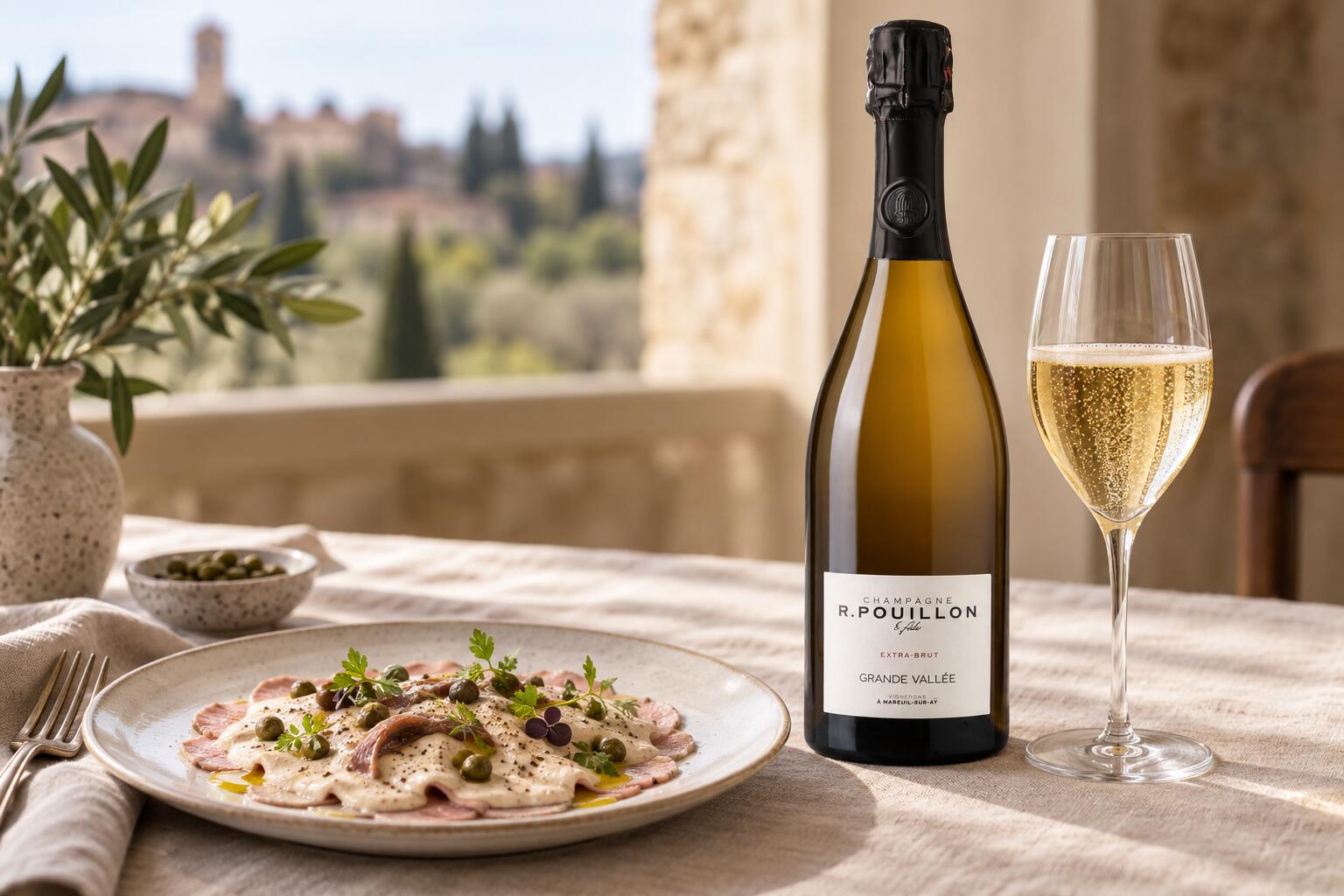
R. Pouillon Grande Vallée Extra-Brut is a Pinot Noir-led grower Champagne that combines the breadth of the Vallée de la Marne with the precision of low dosage. The exact release evaluated here is based on the 2021 harvest and blends fruit from five communes across the Grande Vallée, the Marne corridor and the Montagne de Reims.
The wine is built from approximately 65% Pinot Noir, 20% Meunier and 15% Chardonnay. Native-yeast fermentation, full malolactic conversion, mixed élevage in neutral wood, small vessels and enameled tanks, and the estate's distinctive use of grape must for the second fermentation and dosage create a Champagne with ripe orchard fruit, savory depth and a dry mineral finish.
This is not a delicate aperitif that must leave the table when food arrives. Pinot structure, reserve-wine complexity and subtle wood influence allow it to accompany seafood, fried dishes, creamy rice, veal and umami-rich sauces while the fine mousse and acidity keep each pairing fresh.
Because Grande Vallée is a non-vintage cuvée whose composition changes with each base year, every release-specific statement below refers to the verified 2021-base bottling currently offered by U.S. retailers. Older 2020-base or newer 2022-base lots should be treated as separate releases.
Cuvée Identity and Exact Release
The official cuvée is R. Pouillon Grande Vallée Extra-Brut. It was formerly known as Réserve Brut, but the current name better expresses its purpose: a broad portrait of the family's holdings across the Grande Vallée and neighboring sectors of Champagne.
The exact release examined here is based on the 2021 harvest. Its blend is approximately 65% Pinot Noir, 20% Meunier and 15% Chardonnay. The 750 ml bottle carries amber-brown glass, black foil, a black neck seal and a white label reading Champagne R. Pouillon & Fils, Extra-Brut and Grande Vallée.
Base year matters even when no vintage appears on the front label. Weather, reserve-wine proportions, disgorgement and time in market can change the expression from one release to another. Buyers comparing notes or prices should confirm that they are looking at the 2021-base release.
Origin Across Five Champagne Communes
Grande Vallée draws from Mareuil-sur-Aÿ, Mutigny, Avenay-Val-d'Or, Épernay and Festigny. These sites span the Vallée de la Marne and reach toward the Montagne de Reims, giving the cuvée a wider geographical frame than a single-village Champagne.
Clay-limestone soils are central to the style. Clay encourages body and ripe fruit, while limestone supports drainage, freshness and a mineral impression. Pinot Noir thrives in this context, developing structure without losing the acidity needed for sparkling wine.
The multi-commune blend is not designed to erase terroir. It presents the estate's holdings as a connected landscape. Mareuil and Avenay contribute Pinot authority, Meunier from Marne-influenced sites adds suppleness, and Chardonnay provides lift and definition.
Pinot Noir, Meunier and Chardonnay
Pinot Noir accounts for roughly 65% of the blend and provides the wine's spine. It brings plum, red apple, subtle red-fruit tones and enough structure for veal, poultry, mushrooms and browned flavors. This is why Grande Vallée performs more like a complete table wine than a narrow aperitif.
Meunier contributes approximately 20%. Its role is generosity: round fruit, early accessibility and a softening effect through the center of the palate. Meunier helps the wine meet creamy or fried textures without becoming severe.
Chardonnay represents about 15% and gives the blend its upward motion. Citrus, white flowers and mineral freshness keep the Pinot-led body agile. The three varieties are not equal in proportion, but each has a distinct culinary function.
Native Fermentation and Cellar Vessels
Fermentation begins with native yeasts. Allowing the microorganisms associated with the grapes and cellar to lead the process can produce a less standardized aromatic profile, though it also demands attentive cellar work and healthy fruit.
The base wines are fermented and raised through a combination of neutral barrels, small vats and traditional enameled tanks. Neutral wood supplies oxygen exchange and texture without the sweet flavor of new oak. Enameled vessels preserve fruit clarity and connect the modern cuvée to a traditional part of the Pouillon cellar.
The mixed-vessel approach explains the wine's balance of breadth and energy. It has a faint wood-shaped contour and savory depth, yet the fruit remains clear. The result is more vinous than a purely stainless-steel Champagne but less overtly oaky than a barrel-dominant style.
Full Malolactic Fermentation and Élevage
The wines complete full malolactic fermentation. This converts sharper malic acidity into softer lactic acidity and contributes a rounder, more integrated palate. In a Pinot-led Extra-Brut, that softness helps the low dosage feel balanced rather than austere.
The 2021-base wine is raised for approximately eight months before bottling. This period allows the components from different villages and vessels to settle into a coherent blend before the second fermentation begins in bottle.
Full malolactic conversion does not make the Champagne flat. The vineyard acidity, limestone influence and low dosage preserve tension. It simply changes the texture of that tension, moving it from a sharp edge toward a more polished, gastronomic line.
Méthode Fabrice Pouillon
Since the 2019 vintage, the estate has used what it calls Méthode Fabrice Pouillon across the range. Instead of relying on externally sourced refined sugar, naturally sweet grape must from the estate is used for the second fermentation and for dosage.
The method aims to keep the finished Champagne connected to its own fruit. The sugar required to create pressure and to balance the disgorged wine comes from grapes belonging to the same agricultural system, reinforcing the estate's emphasis on identity and continuity.
This technique does not remove the need for precision. The must must be stable, clean and carefully measured. In Grande Vallée, it supports a fine mousse and a dry finish while allowing ripe fruit to remain visible.
Lees Aging, Disgorgement and Dosage
The 2021-base Grande Vallée spends approximately two years on its lees after the second fermentation. This bottle aging refines the bubbles and adds quiet notes of bread, yeast, almond and cream around the primary fruit.
The dosage is approximately 2 grams per liter, placing the wine firmly in the Extra-Brut range. The estate uses grape must rather than a conventional sugar solution for this final adjustment, consistent with Méthode Fabrice Pouillon.
Different shipments of the same base year can carry different disgorgement dates, so the back label or importer documentation should be checked when exact bottle age matters. The verified U.S. technical information establishes the 2021 base, production method and dosage, but buyers should not substitute a disgorgement date from another lot.
The Pouillon Family and Estate History
The Pouillon family has cultivated vines in Champagne for more than a century. The estate label began in 1947, when Roger Pouillon chose to produce wine from the family's holdings with the support of his wife Bernadette and his uncle Louis Baulant.
Roger's son James joined in 1964 and modernized the cellar, introducing enameled tanks and gyropalettes while preserving the family's vineyard base. Fabrice Pouillon joined in 1998 after studies in business and oenology and gradually reshaped farming and cellar practice.
Conversion toward organic viticulture began in 2003, and the estate now incorporates biodynamic principles, cover crops, compost, herbal preparations and alternating-row cultivation. The objective is not a marketing label alone but stronger soil life and fruit capable of fermenting with native yeasts.
Appearance, Aroma and Palate
Grande Vallée shows a luminous gold color that can carry a faint bronze or copper cast, a visual consequence of the Pinot Noir emphasis and careful pressing. The mousse is fine and persistent rather than aggressively foamy.
The aroma combines ripe apple, yellow plum, pear skin and citrus with savory notes, bread crust, almond, gentle spice and a subtle earthy or oxidative nuance. The wood influence remains in the background as texture and seasoning.
On the palate, the wine is broad at entry but quickly becomes energetic. Orchard fruit and plum are held by bright acidity, firm Pinot structure and a mineral line. The finish is long, dry and slightly saline, with enough fruit to prevent the 2-gram dosage from feeling severe.
Technical Profile
Appellation: Champagne AOC, France. Producer: R. Pouillon & Fils. Cuvée: Grande Vallée Extra-Brut. Exact release: 2021 base. Style: non-vintage, Pinot Noir-led grower Champagne. Bottle evaluated: 750 ml.
Blend: approximately 65% Pinot Noir, 20% Meunier and 15% Chardonnay. Origins: Mareuil-sur-Aÿ, Mutigny, Avenay-Val-d'Or, Épernay and Festigny. Soils: clay-limestone. Farming: organic-oriented and biodynamic principles with manual harvesting.
Fermentation: native yeasts in neutral barrels, small vats and enameled tanks. Malolactic fermentation: complete. Élevage before bottling: approximately eight months. Lees aging: approximately 24 months. Dosage: about 2 grams per liter using estate grape must. Alcohol: approximately 12%.
Zafferano & Co. Wine Rating
★★★★☆ — Zafferano & Co. Editorial Evaluation
This four-star rating reflects the wine's expressive Pinot character, fine mousse, low-dosage balance, distinctive production method and unusually broad food-pairing range. No Wine Spectator score is used because a score for the precisely verified 2021-base release was not confirmed.
Grande Vallée offers genuine personality rather than neutral polish. Its earthy and savory notes may be more individual than a mass-market house Brut, but the fruit, acidity and structure remain composed. The wine rewards service at the table and gains complexity as it warms.
Serving Temperature and Glassware
Serve Grande Vallée at 48–52°F. A first pour near 48°F emphasizes freshness and mousse. As the glass approaches 52°F, Pinot fruit, spice, bread and gentle wood tones become more expressive.
Use a tulip-shaped Champagne glass or a medium white-wine glass. The bowl should provide enough air for a vinous grower Champagne while narrowing at the rim to preserve aroma and bubbles. A very narrow flute hides too much detail.
Decanting is generally unnecessary. Open the bottle fifteen minutes before the first serious pairing, pour modest quantities and let the wine expand naturally. Keep it cool, but do not bury it in ice throughout the meal.
Storage and Drinking Window
Store the bottle in darkness at a stable 50–55°F with minimal vibration. Avoid warm shelves, direct light and repeated temperature swings. Provenance is particularly important for Extra-Brut Champagne because heat can make low-dosage wines appear hard or prematurely oxidative.
The 2021-base release is enjoyable now for its fruit and energy. Correctly stored bottles should develop well through approximately 2030, gaining toast, dried fruit and nut complexity while the mousse becomes more integrated.
After opening, close the bottle with a proper sparkling-wine stopper and refrigerate. It is best the same day, although a well-sealed bottle can remain lively into the following day. A spoon in the neck is not an effective preservation method.
Current U.S. Price and Buying Advice
Current verified U.S. listings for the 2021-base 750 ml bottle range from approximately $66 to $85. The lower end reflects a current promotional price, while the upper end reflects standard specialist-retailer pricing. Taxes and shipping are additional.
The base year must be checked before purchase. Some U.S. listings now describe the 2022 base, while others still carry the 2021 base examined here. They are related releases but not technically identical wines.
Match the bottle to the exact reference: amber-brown glass, black foil, black embossed neck seal and white Grande Vallée Extra-Brut label. Confirm storage conditions, fill level and back-label information. A sound bottle from a reliable merchant is worth more than a small discount from uncertain provenance.
Food Pairing Logic
Pinot Noir structure allows Grande Vallée to handle more savory food than a delicate Blanc de Blancs. Veal, poultry, mushrooms, anchovy and browned flavors find support in the wine's body, while Meunier contributes fruit and softness.
Acidity and mousse refresh fried coatings, creamy rice and tuna sauce. Chardonnay and limestone-derived freshness follow citrus, fennel and shellfish. Lees aging adds bread and nut notes that connect with batter, toasted crumbs and pistachio.
Keep sweetness low and chile heat controlled. Very sweet desserts make Extra-Brut Champagne feel severe, while aggressive spice can overwhelm the fine mousse and expose alcohol. Savory, saline and textural dishes are the strongest partners.
Vitello Tonnato Piemontese
Vitello Tonnato Piemontese is the most complete pairing for this Pinot-led Champagne.
The wine has enough structure for veal and enough acidity for the creamy tuna sauce. Capers and anchovy extend its saline finish, while the faint savory and oxidative nuances make the combination feel integrated rather than merely contrasting.
Serve the dish cool rather than refrigerator-cold. Keep the sauce silky and the veal thinly sliced. Allow the Champagne to warm toward 52°F so its fruit and reserve-wine character can meet the dish fully.
Fritto Misto di Mare
Fritto Misto di Mare highlights the cleansing power of the mousse and the mineral finish.
Bubbles lift the fried coating, acidity controls the oil and the dry finish follows squid, shrimp and small fish. Pinot Noir and Meunier give enough body to prevent the wine from disappearing beside deeper fried flavors.
Use a light, crisp batter and serve immediately. Lemon should be offered with restraint: a small squeeze sharpens the pairing, while too much can make the Extra-Brut profile feel angular.
Champagne Risotto with Seared Scallops, Oscietra Caviar and Chives
Italian Champagne Risotto with Seared Scallops, Oscietra Caviar and Chives reveals the wine's broad texture and saline precision.
Full malolactic fermentation and lees aging meet the creaminess of the rice, while acidity keeps the dish fluid and energetic. Seared scallop reflects ripe orchard fruit, and caviar reinforces the mineral, savory close.
Maintain a loose all'onda texture and use cheese carefully. Excess butter or Parmigiano can cover the cuvée's more delicate plum, citrus and floral notes.
Scallop Carpaccio with Sicilian Citrus, Crisp Fennel and Bronte Pistachios
Scallop Carpaccio with Sicilian Citrus, Crisp Fennel and Bronte Pistachios draws attention to the freshest side of Grande Vallée.
Raw scallop follows the wine's fruit, citrus reflects Chardonnay lift and fennel emphasizes freshness. Pistachio connects with the almond and bread tones developed through wood, reserve wine and lees aging.
Use a precise citrus dressing and avoid excessive vinegar. The wine already has the acidity required to carry the dish, so the garnish should illuminate rather than sharpen it.
Italian Fried Zucchini Blossoms
Italian Fried Zucchini Blossoms offers a lighter fried pairing with a delicate vegetal center.
The mousse clears the batter, and the wine's dry fruit profile follows the blossom without masking it. A mild ricotta filling echoes the creamy texture created by full malolactic fermentation, while anchovy adds a direct saline link.
Keep the batter thin and the oil clean. Strongly seasoned fillings would dominate the floral and mineral details that make this pairing more than a simple contrast between bubbles and frying.
Relevant Grower Champagne Producers
R. Pouillon is a leading reference for vinous, site-conscious Champagne from the Grande Vallée. Philipponnat offers another powerful Pinot-led perspective from Mareuil-sur-Aÿ, while Billecart-Salmon shows a more polished house interpretation rooted in the same village.
Egly-Ouriet provides a concentrated, long-aged Pinot comparison from Ambonnay, and Vilmart & Cie demonstrates how oak can shape texture in the Montagne de Reims. Chartogne-Taillet explores distinct soils around Merfy with a more parcel-focused vocabulary.
These producers are not interchangeable. Grande Vallée is distinguished by its five-commune blend, the balance of all three principal grapes and the use of estate grape must for prise de mousse and dosage.
How to Read the Label
R. Pouillon & Fils identifies the producer. Grande Vallée is the cuvée name, and Extra-Brut signals a legally dry category with very low dosage. Champagne is the protected appellation.
The absence of a vintage year does not mean the wine lacks release identity. The bottle evaluated here is based on 2021. Retailer or importer documentation is therefore essential when comparing technical data, tasting notes and prices.
The white front label is intentionally restrained. Detailed information about base year, vessels, dosage method and disgorgement may appear on the back label, importer sheet or retailer listing rather than on the face of the bottle.
Why Champagne Can Only Come from Champagne
Champagne is a protected geographical appellation in northeastern France. Grapes must come from the delimited region, and the wine must follow rules governing pressing, fermentation, bottle aging, disgorgement and release.
The bubbles are created by a second fermentation in the same bottle that reaches the consumer. Grande Vallée is unusual because the fermentable material for that stage comes from naturally sweet estate grape must rather than conventional refined sugar.
Excellent traditional-method sparkling wines are produced in Franciacorta, Trentodoc, Alta Langa, Cava and other regions, but they cannot legally be called Champagne. Pouillon's wine belongs specifically to Champagne and expresses the Grande Vallée within it.
Professional Pairing Perspective
A complete savory sequence can begin with scallop carpaccio, continue with fried zucchini blossoms and fritto misto, move to Champagne risotto and finish with vitello tonnato. Each dish reveals a different role for fruit, mousse, acidity and Pinot structure.
Serve early pours close to 48°F and later pours closer to 52°F. The wine will move from citrus and mineral freshness toward plum, bread, spice and savory depth as the meal progresses.
One 750 ml bottle yields approximately five moderate restaurant pours. For a tasting menu, keep portions controlled and avoid refilling too quickly so the wine can develop in the glass.
Final Assessment
R. Pouillon Grande Vallée Extra-Brut is an expressive four-star grower Champagne built around the 2021 harvest. Its 65% Pinot Noir, 20% Meunier and 15% Chardonnay blend combines structure, generosity and lift across five communes.
Native fermentation, mixed vessels, complete malolactic conversion, approximately eight months of pre-bottling élevage and about two years on the lees create breadth without heaviness. A 2-gram dosage using estate grape must preserves a dry, energetic finish.
At roughly $66–$85 per 750 ml bottle in the United States, it delivers distinctive method, real gastronomic range and strong grower identity. It is equally persuasive with shellfish, fried food, risotto and veal, making it a serious table Champagne rather than a ceremonial afterthought.


Comments