
Around Italy: Marche | Sea, Hills and Art
Updated: Aug 30

Marche is one of Italy’s most complete regions, yet it remains surprisingly difficult to summarize. Its identity is divided between the Adriatic Sea and the Apennines, Renaissance courts and rural villages, fishing ports and mountain pastures. Within a relatively compact territory, the landscape moves from sandy beaches to white limestone cliffs, cultivated hills, medieval towns, underground caves and the high peaks of the Sibillini Mountains.
The region’s name is plural in Italian—Le Marche—and the geography explains why. For centuries, different borderlands, dioceses, communes, noble families and commercial centers developed their own customs. Even today, Pesaro, Urbino, Ancona, Macerata, Fermo and Ascoli Piceno feel distinct from one another. They share a regional character, but they do not speak with a single culinary or cultural voice.
Marche is often presented as a quieter alternative to Tuscany or Umbria. That comparison misses its most important quality. Marche is not an imitation of another central Italian region. Its Renaissance heritage, Adriatic cooking, handmade pasta, fortified hill towns, opera tradition, wines and agricultural culture form an identity that belongs entirely to this side of the Apennines.
To understand Marche, travelers must move between coast and interior. The sea alone cannot explain the region, and neither can the hills. Its true character exists in the continuous exchange between the two.
Five Provinces, Five Distinct Identities
Pesaro e Urbino The northern province brings together Adriatic resorts, the Montefeltro hills and one of Europe’s most important Renaissance cities. Pesaro looks toward the sea and maintains a strong musical identity connected to composer Gioachino Rossini. Urbino looks inward, protected by hills and Renaissance walls. Between them are Fano, Gradara, Fossombrone, Acqualagna, Cartoceto and the valleys of the Metauro and Foglia rivers.
The province’s cooking moves easily between fish, truffles, fresh and aged cheeses, cured meats and substantial pasta dishes. Casciotta d’Urbino, Prosciutto di Carpegna, white truffles from Acqualagna, crescia sfogliata and Bianchello del Metauro express a territory in which aristocratic court culture and practical rural cooking developed side by side.
Ancona Ancona is both the regional capital and a working Adriatic port. Its history has been shaped by maritime trade, Greek and Roman settlement, papal administration and contact with the eastern Mediterranean. The province also includes Senigallia, Jesi, Loreto, Fabriano, Corinaldo and the dramatic limestone landscape of Monte Conero.
This is a province of strong contrasts. Brodetto and stoccafisso belong to Ancona’s maritime identity, while Verdicchio dominates the vineyard-covered hills around Jesi. Senigallia has become one of Italy’s most significant fine-dining destinations, while smaller towns preserve bakeries, markets and osterie rooted in everyday Marchigiano cooking.
Macerata The province of Macerata extends from cultivated hills toward the Sibillini Mountains. Macerata itself is associated with music and the open-air Sferisterio, while Recanati is inseparable from Giacomo Leopardi and the operatic tenor Beniamino Gigli. Camerino, Tolentino, San Severino Marche, Cingoli and Treia preserve another side of the region’s artistic and civic history.
The cuisine becomes more agricultural and pastoral as the land rises. Ciauscolo, vincisgrassi, legumes, sheep’s milk cheeses, baked meats and rustic pastries belong naturally here. Around Matelica, Verdicchio develops a different personality from the version produced near Jesi, reflecting an inland valley with a cooler climate.
Fermo Fermo sits above the Adriatic in a commanding hilltop position, connected historically to the surrounding agricultural territory and the coastal communities of Porto San Giorgio and Porto Sant’Elpidio. Farther south, Torre di Palme rises above the sea, while Campofilone is known internationally for its exceptionally fine egg pasta.
The province is defined by an unusually close relationship between sea and farmland. Fish can appear beside local vegetables and olive oil, while the inland table favors poultry, rabbit, cured pork and handmade pasta. The landscape is orderly but never monotonous: vineyards, sunflower fields, olive groves and hill towns descend gradually toward the coast.
Ascoli Piceno Ascoli Piceno is built from pale travertine and possesses one of central Italy’s most harmonious historic centers. Piazza del Popolo, medieval towers, Roman remains, churches and narrow streets give the city a monumental dignity without separating it from daily life.
The surrounding province reaches from the Adriatic at San Benedetto del Tronto and Grottammare to Offida, Acquaviva Picena, the Monti della Laga and the Sibillini Mountains. Olive all’ascolana, fritto misto, pecorino wine, stuffed vegetables, lamb and brodetto alla sanbenedettese demonstrate the breadth of its cooking.
Between the Adriatic and the Apennines
Marche is organized by a series of river valleys running from the mountains toward the sea. This geography created natural east-west routes, but traveling north to south historically required crossing one valley after another. The result was the preservation of strong local identities within short distances.
The Adriatic coast changes character as it moves through the region. Around Pesaro, Fano and Senigallia, long sandy beaches meet established seaside towns. Monte Conero interrupts this continuity with high limestone cliffs, wooded slopes and smaller coves. Farther south, coastal life becomes closely associated with the fishing ports of Porto San Giorgio and San Benedetto del Tronto.
Behind the coast, the land rises quickly into an agricultural landscape of wheat, vines, olive trees, sunflowers, orchards and livestock. Farmhouses stand on ridges rather than valley floors, and villages occupy defensible hilltops. In the west, the Sibillini Mountains introduce an entirely different environment of high pastures, forests, gorges and snow-covered peaks.
This compressed geography explains why the Marchigiano table contains both refined seafood and deeply rustic mountain food. A traveler can begin the morning at a fish market, cross vineyard-covered hills after lunch and reach an Apennine village before dinner.
History Written Across the Landscape
The Piceni inhabited much of the territory before Roman expansion. Their archaeological remains, particularly in the southern part of the region, reveal a sophisticated culture connected to wider Adriatic trade networks.
Rome established roads, ports, theaters, arches and settlements throughout the territory. Fano’s relationship with the Via Flaminia, Ancona’s port, the theater at Urbisaglia and the surviving Roman structures in Ascoli Piceno and Fermo show that the region was fully integrated into the Roman world.
After the fragmentation of Roman authority, the territory became divided among Byzantine, Lombard, papal and local powers. The word “Marche” reflects its history as a collection of frontier lands. Medieval communes, monasteries, fortresses and noble families then shaped the urban centers that remain visible today.
During the Renaissance, Urbino became one of Europe’s most influential courts under Federico da Montefeltro. Artists, architects, mathematicians and scholars gathered around the Palazzo Ducale, producing an ideal of civilized court life that extended far beyond the region.
Other cities followed different paths. Ancona maintained its maritime importance; Loreto became a major pilgrimage destination; Jesi, Fermo, Ascoli Piceno and Camerino developed strong civic and cultural institutions. This is why Marche cannot be represented by a single capital or historical narrative.
Art, Music and Intellectual Life
Urbino is the region’s most internationally recognized artistic center. The Palazzo Ducale is not simply an imposing residence but one of the defining architectural achievements of the Italian Renaissance. Its relationship with Federico da Montefeltro, architect Luciano Laurana and the artists who worked around the court makes the city essential to understanding fifteenth-century European culture.
Raphael was born in Urbino, and the city’s disciplined architecture helps explain the intellectual environment from which his art emerged. Piero della Francesca, Paolo Uccello, Titian, Carlo Crivelli and Lorenzo Lotto are also central to the artistic history encountered across Marche.
Lorenzo Lotto’s presence is especially important. His works remain in places such as Loreto, Recanati, Jesi, Cingoli and Mogliano, allowing travelers to see paintings in the territories for which they were created rather than only inside major metropolitan museums.
Music is equally important. Pesaro celebrates Rossini through its theaters, cultural institutions and annual festival. Macerata’s Sferisterio transforms an early nineteenth-century arena into one of Italy’s most distinctive opera venues. Recanati contributes both Leopardi’s poetry and the memory of Beniamino Gigli.
Traditional crafts remain part of the cultural landscape. Fabriano has been associated with European papermaking for centuries, while ceramics, leatherwork, wood carving, embroidery and accordion production preserve regional knowledge that cannot be separated from local history.
How Marche Really Eats
Marchigiano cuisine is built around the exchange between coast, cultivated hills and mountains. The regional table includes seafood, egg pasta, pork, lamb, poultry, rabbit, wild herbs, truffles, mushrooms, legumes, cheeses and preserved foods.
Celebration dishes should not be confused with everyday cooking. Vincisgrassi, olive all’ascolana, large mixed fries and elaborate baked meats belong naturally to Sundays, weddings and feast days. Daily home cooking has traditionally been simpler: soups, vegetables, bread, legumes, modest pasta dishes, eggs and whatever the season or household economy made available.
Waste was historically avoided through careful technique. Leftover meats became fillings, bread thickened soups, offal entered mixed fries and mature ingredients were preserved rather than discarded. This economy created food of remarkable complexity without requiring luxury.
The coastline developed several brodetto traditions rather than one standardized recipe. Port by port, the selection of fish, acidity, tomatoes, peppers and cooking method changed. Inland cooking is equally local. Crescia in Urbino is not identical to crescia elsewhere, and the fine pasta of Campofilone cannot be treated as ordinary tagliatelle.
The correct question is therefore not simply, “What do people eat in Marche?” It is, “In which valley, town, season and household?”
Fifteen Essential Dishes of Marche
1. Olive all’Ascolana Olive all’Ascolana are one of the region’s most technically demanding preparations. Large green olives are carefully cut away from the pit in a continuous spiral, filled with a seasoned mixture of cooked meats, reconstructed, breaded and fried.
The final olive should remain recognizable. Its breading must be crisp and dry, while the filling should be savory without becoming heavy or greasy. In Ascoli Piceno, they belong to the broader tradition of fritto misto all’ascolana and are strongly associated with celebrations.
2. Vincisgrassi Vincisgrassi Marchigiani are often described as Marche-style lasagna, but that description is too limited. The dish has its own history, proportions and regional identity. Sheets of egg pasta are layered with a rich meat sauce, béchamel and grated cheese before baking.
Traditional versions may use several cuts of meat and, depending on the household, giblets. The dish should produce distinct layers rather than collapsing into a uniform mass. Vincisgrassi are Sunday food: substantial, carefully assembled and intended to serve a table rather than an individual diner.
3. Brodetto all’Anconetana Brodetto all’Anconetana reflects the practical cooking of Adriatic fishing communities. The selection historically depended on the catch, including fish that were difficult to sell individually but excellent when cooked together.
The fish must enter the pot according to texture and cooking time. Vinegar, tomato and aromatics support the seafood without turning the dish into an undifferentiated sauce. Bread is essential for absorbing the broth.
4. Brodetto alla San Benedettese Brodetto alla San Benedettese belongs to the southern coast and has its own recognizable identity. Green peppers and vinegar traditionally give the dish a sharper, more aromatic profile than many other Adriatic fish stews.
Its character comes from the fishing port of San Benedetto del Tronto. The recipe must preserve the distinction between the fish while allowing their juices, vegetables and acidity to create a coherent broth.
5. Stoccafisso all’Anconetana Stoccafisso all’Anconetana demonstrates the historic reach of Ancona’s maritime trade. Dried stockfish is slowly cooked with potatoes, tomatoes, wine, olive oil and aromatics.
The fish must first be properly rehydrated, a process that affects the texture of the entire dish. Long cooking allows the potatoes to absorb the sauce while the stockfish remains structured rather than disintegrating.
6. Maccheroncini di Campofilone Maccheroncini di Campofilone al Ragù are extraordinarily thin strands of egg pasta produced around the village of Campofilone. Their delicacy should not be confused with weakness: when correctly dried and cooked, they hold sauce while preserving an elegant texture.
Because the strands are so fine, cooking time is brief. Rich meat ragù is traditional, but the pasta should never disappear beneath an excessive quantity of sauce.
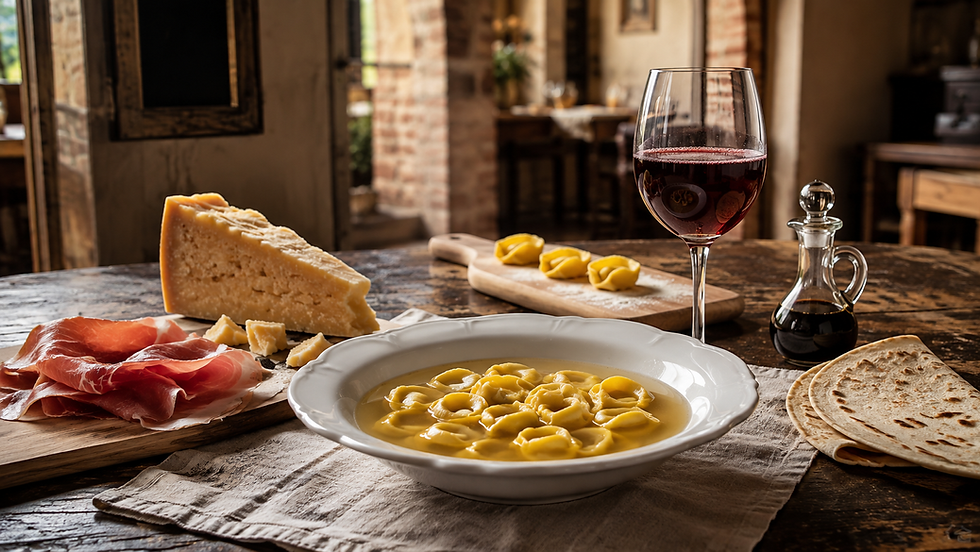
7. Crescia Sfogliata di Urbino Crescia Sfogliata di Urbino is a layered flatbread enriched with eggs and fat, then rolled, folded and cooked to produce a tender, flaky structure.
It may be filled with cured meats, cheese, grilled vegetables or cooked greens. The preparation has often been compared to piadina, but its richer dough and lamination create a different result.
8. Crescia con Ciauscolo Crescia con Ciauscolo brings together two central elements of inland Marche cooking. Ciauscolo is a soft, spreadable cured pork sausage traditionally seasoned with garlic, pepper and other aromatics.
The warmth of the crescia softens the salume, releasing its aroma and fat. This is not a decorative tasting bite but a direct expression of the region’s bread and pork traditions.
9. Pollo in Potacchio Pollo in Potacchio is braised with tomato, garlic, rosemary and white wine. The method is simple, but the balance is exacting. The chicken should brown before braising so that the sauce gains depth without becoming heavy.
“Potacchio” is associated with a regional style of cooking that can also be applied to rabbit or other meats. The finished sauce should be concentrated enough to cling to the meat and justify a generous piece of bread.
10. Coniglio in Porchetta Coniglio in Porchetta alla Marchigiana uses the aromatic logic of porchetta without requiring a whole pig. Rabbit is seasoned with wild fennel, garlic and herbs before roasting.
Careful cooking is necessary because rabbit is lean. The meat must remain moist while developing the fragrance that defines the porchetta tradition.
11. Agnello al Forno alla Marchigiana Agnello al Forno alla Marchigiana belongs naturally to Easter, family lunches and the pastoral territories near the Apennines. Garlic, rosemary, wine and potatoes create a recognizable regional preparation.
The goal is not to cover the lamb with seasonings but to use herbs and roasting juices to reinforce its character. The potatoes must absorb the rendered fat while maintaining crisp edges.
12. Calamari Ripieni alla Marchigiana Calamari Ripieni alla Marchigiana represent the region’s domestic coastal cooking. The squid is filled with a mixture that may include breadcrumbs, tentacles, garlic, parsley, egg and cheese, then cooked gently in a tomato or wine-based sauce.
Overfilling or overcooking makes the squid tough. The best versions remain tender and produce a sauce that carries the flavor of both the filling and the sea.
13. Crostini with Prosciutto di Carpegna and Casciotta d’Urbino Crostini con Prosciutto di Carpegna e Casciotta di Urbino unite two protected products from the northern part of the region. Prosciutto di Carpegna brings sweetness and controlled salinity, while Casciotta d’Urbino contributes a mild, slightly tangy richness.
The bread should support the products without becoming too thick or hard. Heat must be used carefully so the cheese softens without destroying the texture of the prosciutto.
14. Calcioni di Ricotta Calcioni di Ricotta Marchigiani are filled pastries that reveal the region’s preference for combining sweet and savory flavors. Ricotta or fresh cheese is enclosed in dough and balanced with sugar, citrus, egg and grated aged cheese.
Recipes vary between towns and families. Some calcioni lean decisively savory, while others are served as sweets. That variation is part of the tradition rather than evidence of one incorrect version.
15. Cremini Fritti Cremini Fritti all’Ascolana are cubes of firm pastry cream that are cut, breaded and fried. They commonly appear within fritto misto all’ascolana beside stuffed olives, vegetables and pieces of meat.
The contrast is the point: a crisp, savory exterior gives way to warm, lightly sweet custard. Proper chilling before breading allows the cremini to retain a clean shape in the fryer.
Other Foods That Define the Region
No account of Marche is complete without frustingo, a dense festive sweet containing dried fruit, nuts, cooked grape must and spices; lonza and lonzino; pecorino cheeses; formaggio di fossa in the northern borderlands; truffles from Acqualagna and the Apennines; and the local varieties of extra-virgin olive oil.
Moscioli selvatici from Portonovo are wild mussels collected along the Conero coast and treated as a territorial product rather than ordinary farmed shellfish. They are best served with minimal interference, often simply opened with olive oil, garlic, parsley and lemon.
Cicerchia, chickpeas, lentils, fava beans and field greens remain important to inland cooking. Their presence reveals the everyday agricultural table beneath the region’s better-known celebration dishes.
Eight Wines That Explain Marche
1. Verdicchio dei Castelli di Jesi Verdicchio dei Castelli di Jesi is the region’s most widely recognized white wine. It is produced in the hills surrounding the Esino Valley, mainly within the provinces of Ancona and Macerata.
The best examples combine citrus, orchard fruit, herbs, almond and a firm mineral structure. Verdicchio can accompany raw seafood, brodetto, grilled fish, white meats and aged cheeses, while riserva versions can develop significant complexity.
2. Verdicchio di Matelica Verdicchio di Matelica comes from an inland valley oriented differently from most of the region’s river systems. Its cooler conditions and greater distance from the sea help create a distinct expression of the grape.
It is frequently tighter and more vertical in youth, with marked acidity and excellent aging potential. It works especially well with stockfish, rabbit, poultry, mountain cheeses and pasta with mushrooms.
3. Castelli di Jesi Verdicchio Riserva DOCG The riserva denomination demonstrates that Verdicchio should not be understood only as a young seafood wine. Lower yields, careful selection and extended maturation can produce whites with structure, depth and longevity.
With time, the wine may develop notes of dried herbs, beeswax, almond, citrus peel and savory minerals. It can accompany richer fish preparations, vincisgrassi made with white meats, roast poultry and mature cheeses.
4. Rosso Conero Rosso Conero is based principally on Montepulciano grown around Monte Conero. The proximity of the Adriatic and the limestone landscape help define a red wine with dark fruit, herbs, structure and freshness.
It pairs naturally with coniglio in porchetta, grilled lamb, braised meats, aged pecorino and dishes flavored with wild fennel.
5. Rosso Piceno Rosso Piceno is produced across a broad area and typically combines Montepulciano with Sangiovese. Its identity changes according to site, proportions and winemaking, ranging from accessible everyday reds to more structured bottles.
Its versatility makes it suitable for maccheroncini with ragù, grilled pork, pollo in potacchio, cured meats and roasted vegetables.
6. Offida Pecorino DOCG Pecorino from Offida is a white wine with firm acidity, aromatic intensity and considerable structure. The grape should not be confused with the sheep’s milk cheese of the same name.
Pecorino can stand beside flavorful seafood, stuffed calamari, fried olives and white meats. Its strength requires dishes with enough texture and seasoning to maintain balance.
7. Bianchello del Metauro Bianchello del Metauro belongs to the Metauro Valley in the northern part of Marche. It is generally more delicate than the region’s most structured Verdicchio and Pecorino wines.
Its freshness and restrained fruit make it appropriate for Adriatic fish, young cheese, vegetable dishes and crescia served with lighter fillings.
8. Lacrima di Morro d’Alba Lacrima di Morro d’Alba is an intensely aromatic red produced in a small area north of Ancona. Floral notes—particularly rose and violet—combine with dark berries and spices.
Because of its perfume, the wine requires thoughtful pairing. Ciauscolo, salumi, grilled pork and moderately seasoned meat sauces allow its aromatic character to remain expressive without becoming detached from the food.
Two More Wines Worth Knowing
Vernaccia di Serrapetrona DOCG is a distinctive sparkling red associated with the Macerata hinterland. Its production tradition and aromatic profile make it unlike the region’s still reds. It can accompany cured meats, rustic baked foods and certain traditional sweets.
Conero Riserva DOCG represents the more structured expression of Montepulciano from the Conero area. It needs substantial food, controlled service temperature and enough time in the glass to reveal its full character.
Eight Restaurants Worth Planning Around
1. Uliassi — Senigallia Uliassi is one of Italy’s defining contemporary restaurants. Its position between Senigallia’s beach and the Adriatic is integral to the experience, but the cooking is not limited to luxury seafood.
Chef Mauro Uliassi combines marine ingredients, memory, technique and unexpected contrasts. This is a destination restaurant requiring advance planning. The tasting-menu format is the clearest way to understand the kitchen’s development and range.
2. Madonnina del Pescatore — Marzocca Moreno Cedroni’s Madonnina del Pescatore examines the Adriatic through an inventive and highly personal culinary language. Fish, shellfish, preservation, acidity and texture are treated with precision rather than displayed as simple luxury products.
The restaurant is near Senigallia but maintains a distinct identity. Diners should expect a structured gastronomic experience rather than a conventional coastal meal.
3. Dalla Gioconda — Gabicce Monte Dalla Gioconda occupies a panoramic position above the northern Marche coast. The restaurant’s cooking connects contemporary technique with local agriculture, the Adriatic and the Montefeltro landscape.
Its setting makes it particularly suitable for travelers exploring Gradara, Gabicce Monte and the province’s northern border. Reservations are essential, especially during the coastal season.
4. Nostrano — Pesaro Nostrano in Pesaro uses creative technique without losing contact with the region’s ingredients. The cooking moves between sea and countryside, reflecting the geography of northern Marche.
It is a strong choice for travelers who want a contemporary dinner after exploring Pesaro’s historic center, Rossini sites and waterfront.
5. Andreina — Loreto Andreina is known for its relationship with fire, embers and the flavors of the Marche countryside. Meat, vegetables, smoke and carefully controlled roasting techniques define much of the restaurant’s identity.
Its location near Loreto makes it possible to combine an important cultural visit with a destination meal. The cooking is modern, but its vocabulary remains connected to rural traditions.
6. Casa Bertini — Recanati Casa Bertini brings a contemporary gastronomic perspective to Recanati. The restaurant’s position in one of Marche’s most culturally significant towns creates a natural connection between landscape, memory and modern hospitality.
It is a logical evening destination after visiting the places associated with Leopardi, the town’s art collections and the surrounding Macerata hills.
7. Il Tiglio — Montemonaco Il Tiglio is located in the Sibillini Mountains, far from the region’s coastal dining circuit. This geographic isolation is central to its importance. Mountain herbs, vegetables, meats and other Apennine ingredients are approached through contemporary technique.
The journey should be treated as part of the meal. Travelers must allow time for mountain roads and should confirm seasonal conditions before departure.
8. Retroscena — Porto San Giorgio Retroscena offers an ambitious gastronomic experience close to the Adriatic in Porto San Giorgio. The restaurant provides a modern counterpoint to the province’s traditional seafood trattorie and country osterie.
It is well placed for travelers staying around Fermo, Torre di Palme or the southern Marche coastline.
Five Hotels for Understanding Marche
1. Excelsior Hotel, SPA & Lido — Pesaro This five-star boutique hotel stands on Pesaro’s seafront and provides direct access to the city’s coastal identity. Its private beach club, spa and proximity to the historic center make it suitable for travelers who want both urban culture and the Adriatic.
It is a practical northern base for excursions to Urbino, Fano, Gradara and the Montefeltro territory.
2. Castello di Granarola — Near Gradara Castello di Granarola occupies a restored historic property surrounded by countryside near Gradara. Its position offers access to the castle, the northern coast and the hills between Marche and Romagna.
The property is best suited to travelers seeking privacy, landscape and a slower pace rather than the services of a large city hotel.
3. SeeBay Hotel — Portonovo SeeBay Hotel is immersed in the vegetation of Portonovo within the Conero landscape. The location provides access to the bay, beaches, walking routes and restaurants associated with moscioli and Adriatic seafood.
It is an effective base for exploring Ancona, Sirolo, Numana, Loreto and the Verdicchio country around Jesi.
4. Borgo Lanciano Resort & Spa — Castelraimondo Borgo Lanciano is surrounded by inland scenery near Castelraimondo. Its spa, park and rural setting make it a useful base between the Macerata hills, Camerino, Matelica and the approaches to the Apennines.
This is the choice for travelers who want countryside and wellness while remaining within reach of important art towns and wine territories.
5. Palazzo dei Mercanti — Ascoli Piceno Palazzo dei Mercanti is a historic residence and spa in the center of Ascoli Piceno, within walking distance of Piazza del Popolo and the city’s principal monuments.
Staying inside the historic center allows travelers to experience Ascoli early in the morning and after evening visitors have left. It is also a useful base for Offida, the southern coast and the mountain territory.
Twenty-Five Places That Explain Marche
1. Urbino Urbino is the intellectual and architectural heart of Renaissance Marche. The Palazzo Ducale, National Gallery of Marche, Raphael’s birthplace, cathedral and steep streets require at least a full day.
The city should be explored on foot and without rushing. Its relationship between architecture, landscape and political ambition becomes clear only when seen from multiple viewpoints.
2. Pesaro Pesaro combines a historic center, Adriatic waterfront and major musical tradition. Rossini’s birthplace and the city’s opera culture are essential, but the city also rewards visitors through its markets, museums and everyday coastal life.
3. Gradara Gradara is dominated by its fortified castle and defensive walls. The town is linked in popular culture to the story of Paolo and Francesca, although its military and political history extends well beyond that literary association.
Visiting early or late in the day gives a clearer sense of the fortress and surrounding hills.
4. Fano Fano preserves important Roman connections, including the Arch of Augustus and the route of the Via Flaminia. Its historic center, fishing port and long Carnival tradition give it an identity different from nearby Pesaro.
The city is especially valuable for travelers interested in the continuous relationship between Roman urbanism and the modern Adriatic town.
5. Acqualagna and the Furlo Gorge Acqualagna is one of Italy’s best-known truffle centers. The surrounding territory leads toward the Furlo Gorge, where limestone cliffs, water and historic routes create one of northern Marche’s most dramatic landscapes.
Truffle season changes the rhythm of local menus, markets and festivals, but the area merits a visit throughout the year.
6. Ancona Ancona’s position on a curved promontory allows the sun to appear over and, at certain times of year, set toward the sea. The port, Cathedral of San Ciriaco, Arch of Trajan, Passetto and historic streets reveal a city shaped by maritime movement.
It is not a decorative resort town. Its working-port identity is precisely what makes it essential.
7. Riviera del Conero Monte Conero rises abruptly above the Adriatic, interrupting the region’s long sequence of sandy beaches. Forest trails, limestone cliffs and viewpoints create a coastal environment found nowhere else in Marche.
Access to individual beaches changes according to season and local conditions, so travelers should plan before arriving.
8. Portonovo Portonovo sits below Monte Conero among woodland, brackish lakes and the sea. The Romanesque church of Santa Maria di Portonovo, coastal landscape and tradition of wild moscioli make the bay more than a beach destination.
The area is particularly atmospheric outside the busiest summer weeks.
9. Sirolo and Numana Sirolo occupies a commanding position above the Conero coastline, while Numana descends toward the sea and port. Together they provide access to beaches, hiking and some of the region’s most recognizable Adriatic views.
The historic centers are compact, but the surrounding coastal landscape deserves additional time.
10. Loreto Loreto is one of Europe’s most important Catholic pilgrimage destinations. The Basilica della Santa Casa dominates the town and contains major artistic and architectural contributions.
Even travelers approaching the site from an art-historical rather than devotional perspective should allow enough time to understand its scale and international importance.
11. Jesi Jesi is surrounded by some of Marche’s most important Verdicchio territory. Its walls, theaters, palaces and connection to Emperor Frederick II make it a cultural destination rather than simply a base for wine travel.
The surrounding castles and vineyard towns can extend the visit into a full itinerary.
12. Senigallia Senigallia combines the broad Spiaggia di Velluto, the geometric Rocca Roveresca, historic arcades and one of Italy’s most important culinary scenes.
The city changes with the seasons. Summer emphasizes the beach, while spring and autumn make its urban structure and food culture easier to appreciate.
13. Corinaldo Corinaldo is enclosed by remarkably complete medieval and Renaissance walls. Stairways, towers and elevated views make it one of the region’s most visually coherent hill towns.
Its scale permits an unhurried visit, but the fortifications deserve more than a quick photographic stop.
14. Fabriano Fabriano’s identity is inseparable from papermaking. The city played a decisive role in the development of European paper production through technical innovations and skilled craftsmanship.
The paper and watermark museum provides essential context, while the historic center reveals the wealth and civic culture that grew around manufacturing.
15. Frasassi Caves The Frasassi cave system contains monumental underground chambers, stalactites and stalagmites formed over immense geological time. The scale is difficult to understand until entering the main caverns.
The surrounding Gola della Rossa e di Frasassi landscape adds hiking, religious architecture and natural scenery to the visit.
16. Recanati Recanati is associated above all with poet Giacomo Leopardi, whose writing transformed personal observation of the town and landscape into universal literature.
The city also preserves significant art, music history and panoramic views extending from the Adriatic toward the Apennines.
17. Macerata Macerata’s historic center rises above the surrounding countryside. The Sferisterio is its most famous monument, particularly during opera season, but the city’s palaces, university tradition and museums merit independent attention.
Evening performances can be combined with daytime exploration of the Macerata hills.
18. Cingoli Cingoli is sometimes called the “Balcony of Marche” because of the extensive views from its elevated position. On clear days, the landscape appears as a sequence of hills descending toward the Adriatic.
Its churches, streets and surrounding natural areas make it more than a viewpoint.
19. Treia Treia occupies a ridge overlooking cultivated countryside. Its balanced central square, historic buildings and strong relationship with traditional rural life make it one of the region’s most graceful smaller towns.
The town is also associated with pallone col bracciale, a historic Italian ball game.
20. Fermo Fermo’s Piazza del Popolo, cathedral, museums and Roman cisterns reveal multiple layers of regional history. The city’s elevated position provides wide views over hills and the Adriatic.
The underground cistern complex is particularly important for understanding the technical sophistication of the Roman settlement.
21. Torre di Palme Torre di Palme is a compact fortified village overlooking the sea. Stone streets, churches, walls and panoramic terraces create an unusually concentrated experience.
Nearby woodland paths and the coast make it possible to combine the village with a broader natural itinerary.
22. Offida Offida stands between the Tronto and Tesino valleys. It is known for wine, especially Pecorino and Passerina, as well as bobbin-lace craftsmanship and a historic Carnival tradition.
The church of Santa Maria della Rocca occupies a dramatic position at the edge of town and should not be missed.
23. Ascoli Piceno Ascoli Piceno is one of central Italy’s great stone cities. Piazza del Popolo, Piazza Arringo, the cathedral, baptistery, medieval towers, Roman bridge and travertine streets require a full day.
A proper visit must include the city’s food traditions, especially olive all’ascolana and the complete Ascolano mixed fry.
24. San Benedetto del Tronto San Benedetto del Tronto is a major fishing port and seaside destination. Its maritime museum, harbor, palm-lined waterfront and brodetto tradition reveal a city whose identity depends on both labor and tourism.
The old upper town provides a useful contrast to the modern coastal avenues.
25. Monti Sibillini National Park The Sibillini Mountains form the region’s wild western edge. Peaks, high plains, gorges, forests and historic villages create a landscape that demands preparation and respect.
Routes and access can change because of weather, restoration projects and environmental conditions. Travelers should confirm current information before hiking and should never underestimate distances or mountain weather.
When to Visit Marche
Spring is ideal for green hills, wildflowers, art towns and moderate temperatures. Easter also brings important religious traditions and seasonal foods, although major destinations become busier during holiday periods.
Summer belongs to the Adriatic, outdoor performances and village festivals. Coastal roads and beaches can become crowded, especially in August, so reservations are important.
Autumn is one of the region’s strongest seasons. Grape harvests, truffles, mushrooms, olive oil and cooler temperatures make the hills and Apennine territories particularly rewarding.
Winter reveals a quieter region of theaters, museums, mountain food and uncrowded historic centers. Some coastal properties and seasonal restaurants reduce operations, so travelers should verify opening schedules.
How to Travel Through Marche
A car is the most effective way to understand the region beyond the railway corridor. Trains serve the Adriatic coast reasonably well, but many inland towns, wineries, mountain restaurants and historic villages require road travel.
A serious first itinerary needs at least seven days. Ten to fourteen days allow travelers to divide their time among northern Marche, Ancona and Conero, the Macerata hills, Fermo and Ascoli Piceno.
Distances can appear short on a map, but hill roads, historic centers and mountain routes require time. One province per day is often more realistic than attempting to cross the region repeatedly.
The best journey is not a checklist. It should combine one major cultural destination, one landscape, one meaningful meal and enough unplanned time to enter a market, bakery, wine bar or village that was not included in the original itinerary.
The Meaning of Marche
Marche does not rely on a single monument, famous city or signature dish. Its strength lies in accumulation: one Renaissance palace, one fishing port, one handmade pasta, one hill town and one vineyard after another.
The region rewards travelers willing to recognize differences. Brodetto changes between Ancona and San Benedetto del Tronto. Verdicchio changes between Jesi and Matelica. Crescia changes according to territory and household. The northern province looks toward Montefeltro, while the south approaches the culture and landscapes of the Piceno.
This variety is not a weakness to be simplified. It is the central fact of Marche.
To travel here properly is to move continuously between worlds: from Raphael to Rossini, from truffles to wild mussels, from Adriatic light to Apennine forests, from grand theaters to silent monasteries, and from celebrated restaurants to family tables where regional knowledge has never required an audience.
Marche is not Italy in miniature. It is a complete Italy of its own.
During classes Chef shares tips on how to travel and enjoy Italy.


Comments