
Around Italy: Toscana | Renaissance Cities, Hill Towns and the Art of Living Well
Updated: Aug 30

Toscana shaped much of the world’s image of Italy. Florence, Siena, Pisa, Lucca, Arezzo, San Gimignano, Montepulciano, Pienza, Cortona, and countless smaller towns sit among vineyards, olive groves, cypress roads, wooded hills, and agricultural estates.
Firenze, the Cradle of the Renaissance
Florence became one of the great centers of Renaissance art, banking, politics, architecture, and humanist thought. The Medici family helped support artists and architects whose work transformed European culture.
The Duomo
Brunelleschi’s dome over Santa Maria del Fiore remains one of the great achievements of Renaissance engineering. Giotto’s Campanile and the Baptistery complete one of Italy’s most important architectural ensembles.
The Uffizi
The Uffizi contains masterpieces by Botticelli, Leonardo, Michelangelo, Raphael, Titian, Caravaggio, and many others.
Michelangelo’s David
David became a defining image of Renaissance humanism, civic pride, and technical mastery.
Ponte Vecchio and Oltrarno
Ponte Vecchio crosses the Arno while Oltrarno preserves artisan workshops, smaller piazzas, markets, churches, and a more residential rhythm.
Tuscan Cuisine
Traditional Tuscan food is rooted in simplicity: bread, beans, vegetables, olive oil, meat, herbs, game, and seasonal produce.
Bistecca alla Fiorentina
A thick bone-in steak is cooked over intense heat and served rare. Heavy sauces would only interfere with the quality of the meat.
Ribollita
Bread, beans, and vegetables become one of Tuscany’s great examples of cucina povera.
Pappa al Pomodoro and Panzanella
Both dishes transform stale bread into something essential. Tomatoes, olive oil, vegetables, and good technique turn leftovers into regional classics.
Siena
Siena preserves one of Europe’s great medieval urban environments. Narrow streets climb toward Piazza del Campo, the Palazzo Pubblico, and the extraordinary cathedral.
The Palio
The Palio is deeply connected with Siena’s contrade. It is not simply a horse race but a complex expression of neighborhood identity, ritual, rivalry, and civic pride.
Chianti
Between Florence and Siena lie vineyard-covered hills, olive groves, castles, stone farmhouses, and villages that form one of Italy’s classic wine landscapes.
Chianti Classico
Sangiovese gives the best wines red fruit, acidity, herbs, earth, spice, and aging potential.
San Gimignano
Medieval towers create a skyline unlike almost anywhere else in Italy. The town is also associated with Vernaccia di San Gimignano.
Val d’Orcia
Rolling fields, cypress-lined roads, isolated farmhouses, and medieval villages make the Val d’Orcia one of Tuscany’s most celebrated landscapes.
Pienza
Pienza was redesigned according to Renaissance humanist ideas and is famous for pecorino cheese.
Montepulciano
The hill town is associated with Vino Nobile di Montepulciano, based primarily on Sangiovese. It should not be confused with Montepulciano d’Abruzzo, which refers to a different grape and region.
Montalcino
Montalcino became internationally famous through Brunello di Montalcino.
Brunello
Produced from Sangiovese, Brunello can develop extraordinary complexity with age, combining fruit, earth, herbs, leather, tobacco, and spice.
Pici
Pici are thick hand-rolled pasta strands associated especially with southern Tuscany. Their irregularity is part of their character.
Wild Boar
Cinghiale appears in ragù, stews, roasts, and cured preparations and is central to inland Tuscan cuisine.
Lucca
Lucca’s Renaissance walls form a broad pedestrian circuit around a refined historic center. Piazza dell’Anfiteatro follows the footprint of an ancient Roman amphitheater.
Pisa
The Leaning Tower forms only one part of the extraordinary Piazza dei Miracoli. Medieval Pisa was also one of the great maritime republics.
Arezzo
Arezzo preserves Etruscan, Roman, medieval, and Renaissance layers and is especially associated with Piero della Francesca.
Cortona and the Etruscans
Cortona, Volterra, Chiusi, and other towns preserve important evidence of the Etruscan civilization that shaped central Italy before Roman domination.
Bolgheri
Bolgheri transformed modern Tuscan wine through the success of Cabernet Sauvignon, Cabernet Franc, Merlot, and wines such as Sassicaia.
Maremma
Southern coastal Tuscany is wilder and less manicured, with Mediterranean scrub, wetlands, vineyards, cattle country, and the traditional butteri horsemen.
Elba
The island of Elba combines Napoleon’s history with beaches, mountains, vineyards, harbors, and hiking.
Tuscan Olive Oil
Fresh Tuscan oil can be intensely grassy, bitter, peppery, and aromatic. Poured over toasted bread, it becomes fettunta.
Tuscan Bread
Traditional Tuscan bread is famously unsalted, making it an ideal partner for strongly flavored salumi, soups, and cheeses.
Lardo di Colonnata
Pork fat aged in marble basins near Carrara becomes an aromatic, delicate specialty.
Carrara Marble
The white marble quarries of Carrara have supplied stone since Roman times and were used by Michelangelo.
Truffles
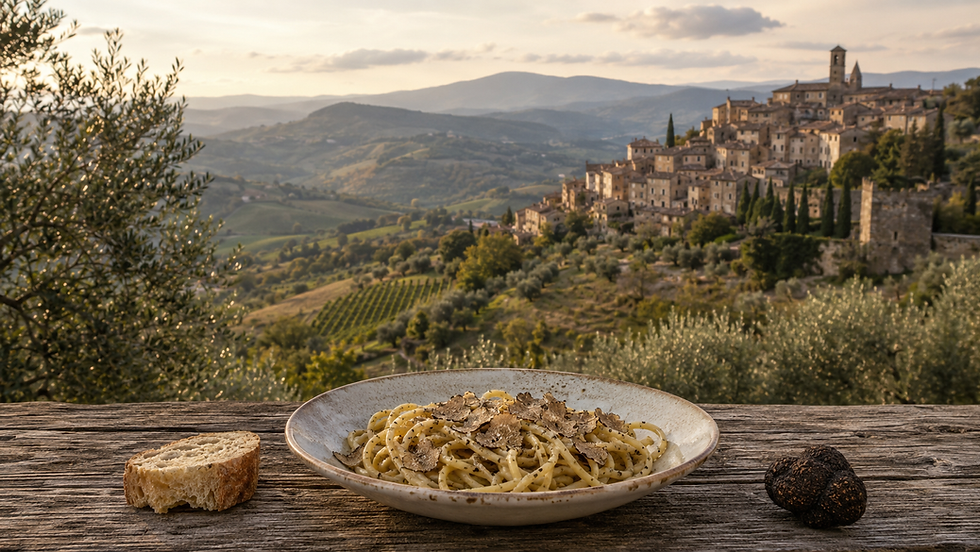
San Miniato is especially famous for white truffles, making autumn one of the region’s great gastronomic seasons.
When to Visit
Spring and autumn are ideal for cities and countryside. Summer brings heat and crowds but long days. Winter offers quieter cultural travel and hearty food.
What Makes Toscana Special
Tuscany’s international image is powerful, but the real region is broader: industrial towns, wild coast, mountains, Etruscan ruins, peasant soups, aristocratic wines, Renaissance masterpieces, and agricultural traditions. Its greatness lies in turning food, landscape, art, architecture, and daily life into culture.
Around Italy by ZAFFERANO & CO.
Tuscany Beyond the Postcard
Tuscany is one of the most photographed regions in the world, which makes it easy to mistake the image for the place. Cypress roads, vineyard hills and stone farmhouses are real, but so are industrial towns, working farms, coastal communities, mountain areas and cities shaped by centuries of political rivalry. Florence, Siena, Pisa, Lucca, Arezzo and the smaller hill towns all express different versions of Tuscan identity. A strong trip moves beyond the postcard and pays attention to how people actually use the landscape.
Renaissance Cities
Florence is central to the history of Renaissance art, architecture, finance and political power, but it should not erase the achievements of other Tuscan cities. Siena’s civic identity, Lucca’s walls, Pisa’s maritime history and Arezzo’s artistic heritage reveal a region built from competing city-states and local loyalties. Spending time in more than one city makes the historical complexity much clearer.
Hill Towns and Rural Tuscany
San Gimignano, Pienza, Montepulciano, Montalcino and many smaller towns are famous because their historic cores remain visually powerful. Yet they were not created as tourist scenery. Their position, walls, streets and public buildings reflect defense, agriculture, trade and political organization. The best way to visit them is slowly, ideally early or late in the day when the relationship between town and landscape becomes easier to appreciate.
Food Philosophy
Tuscan cooking is defined by restraint. Bread, beans, olive oil, vegetables, pasta, grilled meat, soups and cured products depend on ingredient quality and careful technique. Ribollita, pappa al pomodoro, panzanella and bistecca alla fiorentina come from very different parts of the food culture, but all demonstrate an unwillingness to hide the ingredient under excessive complication. Unsalted bread, often misunderstood by visitors, makes sense within a cuisine rich in cured meats, cheese and strongly seasoned accompaniments.
Wine Regions
Chianti Classico, Brunello di Montalcino, Vino Nobile di Montepulciano, Bolgheri and many smaller denominations make Tuscany one of Italy’s most important wine regions. Sangiovese remains central, but soils, altitude and local traditions create very different expressions. Winery visits are most useful when limited in number and connected to meals and landscape rather than treated as a tasting marathon.
The Coast and Islands
Tuscany also has a maritime side. The Maremma, the Etruscan Coast, coastal wetlands and the Tuscan Archipelago broaden the image of the region. Seafood, wild landscapes and different agricultural traditions appear as the hills descend toward the Tyrrhenian Sea. Travelers who include the coast often discover a Tuscany that feels less curated and more varied.
How to Travel Tuscany
Rail works well between major cities, but a car is valuable for rural areas and smaller towns. Avoid changing hotels every night; choose a base and explore outward. A week can combine Florence, another major city, a wine landscape and several smaller towns. Ten days allows space for the coast or southern Tuscany. Spring and autumn are especially strong for food, walking and comfortable temperatures.
What “Living Well” Actually Means
The popular idea of Tuscan lifestyle is often commercialized, but its roots are practical: seasonal food, local markets, public space, landscape, family meals and a slower relationship with time. Experiencing that rhythm requires doing less, not more. One long lunch and a walk through a town can teach more about Tuscany than five rushed attractions.
How to Read the Territory
Toscana becomes much easier to understand when geography is treated as the starting point rather than the background. The essential landscape is Renaissance cities, vineyard hills, medieval towns, the Maremma and Tyrrhenian coast. Those physical conditions shaped where people settled, what they grew, how they moved, which foods were practical and which towns became centers of trade or political power. A useful Around Italy approach is to look for those connections continuously. When a road climbs, ask what that altitude changes. When vineyards appear, notice exposure and slope. When a market sells a specific cheese, fish or vegetable, connect it to the landscape that produced it. This method turns sightseeing into regional understanding. It also prevents the common mistake of treating Italian destinations as collections of monuments detached from everyday life. In Toscana, the built environment, agriculture, food and local habits are part of one system. The more carefully those relationships are observed, the more coherent the destination becomes.
Food, Wine and Regional Logic
The most useful way to eat in Toscana is to follow local logic rather than search for a generic list of “best dishes.” Start with the ingredients that make sense here: ribollita, panzanella, pici, beans, bistecca, cured meats, pecorino and olive oil. These foods are not random specialties; they reflect climate, preservation, farming, fishing, trade and household technique. The same principle applies to wine. Important local references include Chianti Classico, Brunello di Montalcino, Vino Nobile and Bolgheri wines. A strong meal should allow regional products to support one another rather than competing for attention. Order fewer things, ask what is seasonal, and pay attention to texture and preparation. Avoid restaurants that offer the same long tourist menu regardless of place. In a serious regional kitchen, the menu should change when the territory changes. Markets, bakeries, wine shops and small food stores are equally important because they show what residents buy outside restaurant service. For travelers who want to understand Italian regional cuisine, those everyday places are often more educational than a formal tasting menu.
What to Do Without Rushing
A balanced itinerary in Toscana should combine major landmarks with ordinary local life. Core stops include Florence, Siena or Lucca, a hill town, one wine area and a rural landscape. Do not schedule them as a race. Build pauses into the day for walking, coffee, markets, viewpoints and meals. Italy’s regional identity is often visible in transitions between attractions: a residential street behind a famous square, a bakery opening in the morning, a farmer delivering produce, an evening passeggiata or a small church that is not on a top-ten list. These details are not filler. They are the evidence that a place is still lived in. A good rule is to choose one major cultural visit in the morning, one landscape or neighborhood experience in the afternoon and a long meal in the evening. That rhythm produces a clearer memory of the destination than five hours of continuous sightseeing.
A Three-Day Framework
For a three-day introduction, use the first day to understand the main urban or historic center and its immediate food culture. Walk before relying on transport, visit a market or specialist food shop, and have one traditional meal built around local ingredients. On the second day, move outward into the surrounding landscape: vineyard, coast, mountain, archaeological site or rural town depending on the geography of Toscana. This is where the relationship between city and territory becomes visible. On the third day, choose a contrasting experience rather than repeating the first two: a smaller village, a long walk, a second wine area, a museum focused on local history, or a coastal or alpine route. This three-part structure—center, territory, contrast—works because it prevents the trip from becoming one-dimensional. Travelers with more time should slow the same pattern down rather than simply adding more stops.
Travel Logistics That Actually Matter
The most practical way to move through this destination is rail for major cities and a car for countryside travel. The best general travel period is spring and autumn, although the right season depends on whether the priority is food, walking, beaches, snow, wine harvest or cultural sites. Early morning and late afternoon are consistently valuable because streets are quieter, light is better and local rhythms are easier to observe. Avoid changing accommodation every night unless geography makes it unavoidable. A stable base gives time for repeat visits to the same café, bakery or neighborhood and reduces the amount of the trip spent packing and driving. Reservations matter for famous restaurants and popular wineries, but leave part of the schedule open. Regional Italy rewards flexibility because weather, market days, festivals and local recommendations can change the best plan.
What to Buy and What to Skip
Useful regional purchases are things that carry the territory home without turning the trip into souvenir shopping. In Toscana, look for olive oil, pecorino, cured meats, wine and artisan pantry products. Buy from producers, specialist shops and markets when possible, and ask about origin rather than assuming that every product displayed in a tourist center is local. Skip generic packaging that could come from anywhere in Italy. The same discipline applies to wine: one bottle with a clear connection to a vineyard or meal is more meaningful than several labels chosen only for reputation. Food products should also be practical to transport and legal to bring to your destination country. The goal is not accumulation. It is to remember the place through something genuinely connected to its agriculture or craft tradition.
Common Travel Mistakes
The most common mistake in Toscana is trying to prove how much was seen. Rushed itineraries flatten regional differences and encourage visitors to eat at convenient places rather than good ones. Another mistake is assuming that famous equals representative. Major landmarks matter, but they rarely explain the full territory. Travelers also lose context when they separate food from history, or countryside from urban culture. Finally, do not judge local service, meal times or opening hours by American expectations. Italian regional travel works better when the visitor adapts to the place rather than demanding that the place adapt to the itinerary. Fewer transfers, fewer restaurant courses ordered at once, more walking and more attention to local timing usually produce a better trip.
Why This Belongs in Around Italy
Toscana deserves a place in Around Italy because it shows how strongly Italian identity is still organized by territory. Regional differences are not decorative folklore. They affect language, architecture, recipes, agriculture, wine, festivals and everyday habits. Understanding those differences is the entire point of traveling through Italy seriously. The destination becomes memorable when the reader can explain not only what was seen, but why the place looks, tastes and behaves the way it does. That is the standard for this guide: not a checklist, but a working understanding of the region.



Comments