
Around Italy: Umbria | The Green Heart of Italy
Updated: Aug 31
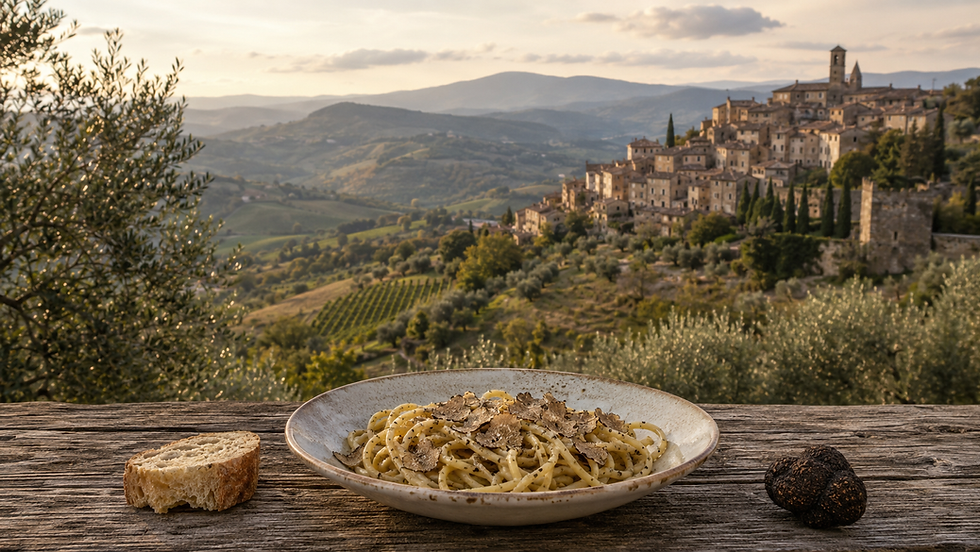
Umbria is commonly called the green heart of Italy, but the phrase becomes meaningful only when the region is read through its geography. It is the only landlocked region in central Italy and one of the few in the country without either a coastline or an international border. The Apennines rise along its eastern side, Lake Trasimeno opens across the west, the Tiber crosses the region from north to south and cultivated hills connect fortified towns, monasteries, vineyards, olive groves and farming valleys.
The absence of the sea did not isolate Umbria. Roman roads connected it to Rome and the Adriatic; medieval pilgrimage routes carried people through Assisi, Spoleto and Orvieto; merchants moved wool, grain, oil, ceramics and wine; religious orders established agricultural and intellectual centers; and powerful cities competed for land and political control. Umbria’s apparent stillness is therefore deceptive. Its landscapes are the result of movement, work and conflict.
Perugia and Terni, the region’s two provinces, contain several distinct Umbrian worlds. Perugia is an Etruscan and university city looking over the Tiber valley. Assisi joins Franciscan spirituality to some of the most important fresco painting in Europe. Gubbio preserves a severe medieval urban structure against Monte Ingino. Orvieto occupies a volcanic plateau above a hidden network of caves. Spoleto opens toward the Valnerina, while Norcia and Castelluccio belong to a mountain culture shaped by livestock, lentils, earthquakes and seasonal movement. Terni adds industry, Roman memory and the controlled power of the Cascata delle Marmore.
Umbrian food follows this geography. It is direct, savory and built around olive oil, bread, pork, legumes, grains, wild herbs, game, freshwater fish and black truffles. The cooking can appear rustic, but good results depend on exact technique: dough must be worked to the right resistance, meat must be browned without drying, truffle must be warmed without losing its aroma and lentils must remain intact. The region rewards diners who pay attention to detail rather than decoration.
Two Provinces, Many Umbrian Identities
Perugia
The province of Perugia covers most of Umbria and contains the regional capital, Assisi, Gubbio, Città di Castello, Lake Trasimeno, Spello, Foligno, Montefalco, Bevagna, Todi, Spoleto, Norcia and the Umbrian side of the Monti Sibillini. It is too large and varied to be treated as one tourism district. The northern valleys face Tuscany and Marche; the central zone follows the Tiber and Umbrian Valley; the west is shaped by Lake Trasimeno; the south and east move toward olive country, the Valnerina and high mountains.
Perugia itself is a layered city. Etruscan walls and gates remain beneath and beside medieval streets, Renaissance fortifications and modern university life. The Rocca Paolina physically reveals the relationship between papal power and the city it controlled. Piazza IV Novembre, Palazzo dei Priori and the Fontana Maggiore represent the civic culture of the medieval commune. The city’s chocolate reputation is real, but it should not obscure older traditions connected to bread, olive oil, pork, freshwater fish and the feast-day Torcolo di San Costanzo.
Assisi and the towns around Monte Subasio add another identity. Franciscan pilgrimage brought international movement into a landscape of stone, olive trees and small farms. Spello preserves major works by Pinturicchio and a strong relationship with olive growing. Foligno, positioned on the plain, became a commercial and transport center. Trevi rises above one of the region’s most important olive-producing territories. Together these places show that sacred art and agriculture were never separate systems.
Farther north, Gubbio, Montone, Umbertide and Città di Castello face the Upper Tiber and the Apennines. Gubbio’s stone architecture and civic traditions feel different from the softer hills around Montefalco. Città di Castello carries Renaissance art, printing and tobacco history. The Trasimeno area turns toward fishing, islands, wetlands and vineyards. Norcia and Castelluccio, meanwhile, belong to the high interior, where cured pork, sheep farming, lentils and mountain ecology define the table.
Terni
The province of Terni includes Terni, Orvieto, Narni, Amelia, San Gemini, Acquasparta, the southern Valnerina and the western valleys toward the border with Lazio. It is often reduced to Orvieto Cathedral and the Cascata delle Marmore, but its identity is more complex. Terni developed as an industrial city around water, steel and transport. Narni preserves Roman and medieval layers above the Nera valley. Amelia occupies an ancient hill site enclosed by imposing polygonal walls. Orvieto belongs to volcanic geology, papal history, ceramics and white wine.
Southern Umbrian cooking remains closely tied to hand-shaped flour-and-water pasta, roast and grilled meat, legumes, river fish, olive oil and simple sauces. Ciriole alla Ternana represent a pasta tradition different from strangozzi and umbricelli farther north. The Valnerina connects the province to trout, black truffle, sheep’s milk cheese and mountain herbs. Around Orvieto, the table moves toward pigeon, game, chicken, local white wine and foods influenced by the neighboring territories of Lazio and Tuscany.
The province also demonstrates how natural features can become engineered landscapes. The Cascata delle Marmore was created in antiquity through a Roman hydraulic intervention and later altered to manage water and energy. Today its flow is regulated, which means visitors must check release schedules rather than assume that the waterfall always appears at full power. This relationship between water, settlement and industry is central to understanding Terni.
A Region Organized by Water, Hills and Mountains
The Tiber enters Umbria from Tuscany, crosses the region and continues toward Rome. Its tributaries—the Nera, Chiascio, Topino, Nestore and Paglia among them—organized agriculture, roads and settlement. The broad Umbrian Valley between Assisi and Spoleto supported cultivation and movement, while narrower mountain valleys created more isolated economies. Lake Trasimeno, one of Italy’s largest lakes, formed its own fishing and agricultural culture without a natural surface outlet.
Umbrian hill towns were not positioned simply for beauty. Height offered defense, visibility, drainage and control over farmland. Perugia, Orvieto, Todi, Amelia, Montefalco and many smaller centers overlook the territory that sustained them. Their walls, gates, wells and underground cisterns reveal how urban life depended on careful management of water and food.
The eastern Apennines change the scale. The Valnerina narrows between wooded slopes and stone villages before opening toward Norcia and the high plateau of Castelluccio. Here climate, altitude and seismic risk shape daily life. Lentils, sheep, pork, forage, wild herbs and truffles belong to a mountain economy with limited growing seasons. The spectacular flowering of the Piano Grande is only one moment in a landscape that remains agricultural throughout the year.
Earthquakes are not an incidental detail. Central Italy’s seismic history has repeatedly altered towns, churches, roads and communities. Norcia, Castelluccio, Preci and other places continue to live with reconstruction after the 2016 sequence. A responsible journey acknowledges present conditions, checks access and supports local businesses without treating damaged towns as scenery.
From the Umbrians and Etruscans to Modern Umbria
Ancient Umbria was not a single political unit matching the modern regional boundary. Umbrian peoples occupied territories east of the Tiber, while Etruscan centers such as Perugia and Orvieto developed to the west. The river functioned at different times as a cultural and political divider. Roman expansion gradually absorbed both worlds, reorganizing roads, colonies, agriculture and administration.
The Via Flaminia became one of the decisive routes. It crossed the region through areas connected to Narni, Carsulae, Spoleto and the Apennine passes before continuing to the Adriatic. Roman remains at Carsulae, Spello, Assisi, Gubbio and elsewhere show a territory integrated into imperial networks. The ancient project that created the Marmore waterfall also demonstrates the scale of Roman intervention in Umbrian water systems.
After the decline of the Western Roman Empire, the region was divided among competing powers. Spoleto became the center of a Lombard duchy, while Byzantine, papal and local interests contested other areas. Monasteries and abbeys held land, preserved knowledge and organized agricultural production. Pilgrimage routes increased the importance of religious centers.
The medieval communes created the urban Umbria visible today. Perugia, Gubbio, Todi, Orvieto, Spoleto and other towns developed civic institutions, palaces, cathedrals and defensive systems while fighting both external rivals and internal factions. Their territories did not naturally cooperate as one region. Competition for castles, farmland, water and trade routes remained intense.
Assisi’s global importance emerged through Francis and Clare, but the movement they inspired cannot be separated from the social tensions of the thirteenth century. Franciscan ideals of poverty and fraternity developed within a commercializing urban society. The Basilica of Saint Francis later brought together architecture and major painting cycles associated with artists including Cimabue, Giotto and Pietro Lorenzetti.
Perugia became a significant artistic and intellectual center. Pietro Vannucci, known as Perugino, developed a language that shaped central Italian Renaissance painting and influenced the young Raphael. Pinturicchio worked across the region and beyond. Luca Signorelli’s frescoes in Orvieto Cathedral brought a powerful vision of the Last Judgment into one of Italy’s great sacred interiors.
Most of Umbria eventually came under papal control, although local autonomy and noble power persisted in different forms. The Rocca Paolina in Perugia remains one of the clearest physical expressions of papal domination: a fortress built over part of the city after the defeat of a local revolt. Umbria joined the Kingdom of Italy in 1860.
The modern period brought railway connections, agricultural transformation, emigration and industrial growth. Terni became a major center for steel and energy, while Perugia expanded as an administrative and educational capital. Smaller towns retained specialized traditions in ceramics, textiles, food production, furniture and agricultural processing. Contemporary Umbria therefore combines rural imagery with universities, industry, international tourism and advanced manufacturing.
Art, Faith and Craft
Sacred art is distributed across the region rather than concentrated in one museum city. Assisi contains the best-known ensemble, but Perugino can be followed through Perugia, Città della Pieve, Panicale and other towns. Pinturicchio’s Baglioni Chapel in Spello transforms a small church interior into a major Renaissance destination. Signorelli’s San Brizio Chapel in Orvieto is essential to understanding the development of monumental figure painting before Michelangelo’s Sistine Chapel ceiling.
Gubbio contributes the Eugubine Tables, seven bronze tablets recording an ancient Umbrian ritual language. They are among the most important surviving documents for the study of pre-Roman Italy. Spoleto adds the cathedral, Roman theater, Rocca Albornoziana and the Festival dei Due Mondi, which made the city an international performing-arts center.
Umbria’s craft traditions are equally important. Deruta is internationally known for maiolica, with workshops that continue a ceramic history visible in museums and architecture. Gubbio and Orvieto also maintain ceramic traditions with distinct forms and colors. Città di Castello is connected to printing and the work of Alberto Burri, whose materials and scale transformed twentieth-century Italian art.
Textiles remain central around Montefalco, Bevagna and the Upper Tiber. Traditional weaving, restoration and contemporary design coexist. These crafts should be approached through working studios and serious museums rather than shops selling generic souvenirs. The difference lies in clay preparation, firing, glazing, fiber, loom work and the knowledge carried by makers.
How Umbria Really Eats
Umbrian cooking is frequently described as simple. That is true only if simple means a limited number of ingredients handled with discipline. Bread is often unsalted and becomes a vehicle for olive oil, salumi, legumes, sauces and roasted meat. Flour-and-water pasta depends on texture because eggs and rich fillings cannot hide poor dough. Grilled meat requires control of fire, resting and seasoning. Truffle dishes fail when excessive garlic, cheese or heat covers the ingredient they claim to celebrate.
Pork culture is especially important around Norcia. The word norcino came to identify a specialist in pork butchery and curing far beyond the region. Prosciutto di Norcia IGP, capocollo, salami, sausages and other cured products reflect preservation, climate and technical knowledge. The serious tradition uses salt, time and appropriate cuts; it is not represented by an overloaded board of interchangeable meats.
Olive oil provides the region’s other great savory foundation. Umbria DOP includes several geographic mentions, and oils vary with cultivar, altitude, harvest and extraction. Moraiolo can bring pronounced bitterness and pungency, while blends may balance fruit, herbs and almond. New oil is traditionally tasted on toasted bread, where heat releases aroma without requiring decorative ingredients.
Legumes were everyday sustenance long before they became protected specialties. Lentils from Castelluccio, fagiolina del Trasimeno, cicerchia, chickpeas and beans enter soups, salads, stews and side dishes. They pair naturally with olive oil, rosemary, sage, garlic and cured pork, but good cooking preserves their identity instead of reducing them to puree.
Freshwater food belongs especially to Lake Trasimeno and river territories. Tench, carp, eel, perch and other fish appear grilled, stewed or in soups. Tegamaccio is associated with a mixed lake-fish stew cooked slowly in earthenware. These traditions are less internationally visible than truffle and pork, yet they are essential to western Umbria.
Feast-day sweets rely on dried fruit, nuts, honey, cocoa, spices, anise and olive oil. Rocciata, attorta, torcolo, pampepato and other preparations follow local calendars. Their dense structure records a pantry designed to preserve energy and flavor through winter rather than modern expectations of light pastry.
Thirteen Essential Umbrian Dishes
Strangozzi al Tartufo Nero
Strangozzi al Tartufo Nero represent one of Umbria’s clearest combinations of humble pasta and luxury ingredient. The dough is made principally from flour and water, rolled and cut into long, irregular strands. Black truffle should be cleaned carefully, sliced or grated close to service and warmed gently in olive oil. It must never be fried aggressively. Garlic may perfume the oil, but it should not dominate.
Umbricelli al Sugo d’Oca
Umbricelli al Sugo d’Oca join thick hand-shaped pasta to a slowly cooked goose ragù. The pasta requires enough resistance to carry the sauce without becoming heavy. Goose contributes depth and fat, so browning, deglazing and patient reduction are more important than adding excessive tomato or cheese.
Ciriole alla Ternana
Ciriole alla Ternana belong to southern Umbria. Thick flour-and-water strands are traditionally paired with direct sauces based on tomato, garlic, chile or other local ingredients. Their apparent simplicity exposes every technical error: uneven rolling produces mixed cooking, a watery sauce slides away and overcooking destroys the pasta’s purpose.
Torta al Testo
Torta al Testo con Prosciutto is a griddle bread cooked on a flat surface historically associated with the testo. The dough may be filled after cooking with prosciutto, sausage, cheese or cooked greens. A correct torta is browned and cooked through without becoming dry. The filling should support the bread rather than turn it into an oversized sandwich.
Crostini Umbri al Tartufo Nero
Crostini Umbri al Tartufo Nero place truffle over toasted bread, often with a savory base that may include anchovy according to local practice. The toast must remain crisp enough to support the topping. Salt must be controlled because preserved ingredients can easily overwhelm the truffle.
Faraona alla Leccarda
Faraona alla Leccarda is a guinea-fowl preparation associated with roasting and a deeply savory sauce. The bird is leaner than industrial chicken and requires careful protection from dryness. Browning, basting and resting matter. The finished sauce should concentrate roasting juices and aromatics rather than taste greasy.
Agnello a Scottadito Umbro
Agnello a Scottadito Umbro depends on thin chops, high heat and immediate service. Rosemary, garlic and olive oil can frame the meat, but long acidic marinades or excessive herbs flatten its flavor. The name implies eating the chops hot enough to challenge the fingers; the professional lesson is that they cannot wait under a heat lamp.
Involtini di Vitello alla Umbra
Involtini di Vitello alla Umbra demonstrate the region’s skill with filled meat. Thin veal must be evenly cut, the filling distributed without overpacking and the rolls secured so they cook uniformly. Deglazing and controlled braising create the sauce; prolonged cooking turns the veal dry before the filling improves.
Penne with Umbrian Sausage, Black Truffle and Pecorino di Norcia
Penne con Salsiccia Umbra, Tartufo Nero e Pecorino di Norcia brings together three powerful flavors. Balance is essential. Sausage supplies fat and spice, pecorino supplies salt and structure, and truffle supplies aroma. If every ingredient is used at maximum intensity, none remains distinct.
Lenticchie di Castelluccio
Insalata di Lenticchie di Castelluccio shows why these small lentils need little intervention. They cook relatively quickly and hold their shape when treated carefully. Olive oil, restrained acidity and herbs should clarify their earthy flavor. They also belong in soups and warm dishes with sausage, but the pulse must remain the central ingredient.
Insalata di Ceci Umbra
Insalata di Ceci Umbra represents the quieter side of the regional table. Properly cooked chickpeas, olive oil, herbs and measured acidity produce a complete dish without unrelated additions. Chickpeas should be creamy inside and intact outside; undercooked centers and broken skins indicate poor control.
Rocciata Umbra
Rocciata Umbra is a rolled pastry associated especially with Assisi, Foligno and Spello, with related forms known as attorta farther south. Thin olive-oil dough surrounds apples, walnuts, raisins, pine nuts, cocoa and spice. The filling must be moist enough to bind but dry enough to keep the lower pastry crisp.
Torcolo di San Costanzo
Torcolo di San Costanzo is Perugia’s ring-shaped feast bread, associated with the city’s patron celebration. Olive oil, dried fruit, candied citrus, pine nuts and anise produce a structured, aromatic crumb. It is not sponge cake and should not be softened into one. Fermentation, shaping and the traditional cuts across the top define its character.
The Umbrian Pantry
Prosciutto di Norcia IGP carries the mountain curing identity of the Valnerina. It should be sliced thinly enough to release aroma but not so thinly that texture disappears. Pecorino varies from fresh and mild to mature and assertive. Fresh sheep’s milk cheese belongs with bread, vegetables and delicate wines; aged pecorino can handle honey, truffle, cured pork and structured reds.
The black truffles of Norcia and Spoleto are among the region’s most recognized ingredients, but season and species matter. Summer truffle, winter black truffle and white truffle do not have the same aroma, price or culinary use. A menu that simply promises “Umbrian truffle” without identifying season or type gives incomplete information.
Lenticchia di Castelluccio di Norcia IGP reflects altitude, soil and traditional cultivation. Fagiolina del Trasimeno survives through dedicated production around the lake. Roveja, cicerchia and other pulses preserve a broader agricultural memory. These products should not become decorative garnishes in dishes whose main flavor comes from somewhere else.
Saffron is cultivated in areas including Cascia and Città della Pieve. Proper use requires infusing the threads and protecting their aroma. Powder of uncertain origin cannot represent the same ingredient. Honey, chestnuts, farro, mushrooms, wild greens and forest products complete a pantry that changes sharply between valley and mountain.
Eight Wines That Explain Umbria
Montefalco Sagrantino DOCG
Montefalco Sagrantino DOCG is produced entirely from Sagrantino and is one of Italy’s most tannic dry red wines. Its dark fruit, herbs, spice and formidable structure require protein, fat and time. Roast lamb, braised meat, game and mature pecorino can meet it. Serving it casually with a delicate truffle pasta wastes both wine and dish.
Montefalco Sagrantino Passito DOCG
The passito tradition predates the modern international reputation of dry Sagrantino. Grapes are dried to concentrate sugar, flavor and tannin. The wine remains structured rather than simply sweet. It belongs with aged cheese, nut pastries, dark chocolate used carefully and contemplative service in small pours.
Montefalco Rosso DOC
Montefalco Rosso is generally based on Sangiovese with Sagrantino and permitted supporting varieties. It offers a more flexible table wine than pure Sagrantino, combining red fruit, acidity, savory character and moderate-to-firm tannin. It works with umbricelli, sausage, roast poultry, pork and medium-aged pecorino.
Torgiano Rosso Riserva DOCG
Torgiano Rosso Riserva DOCG is one of Umbria’s historic fine-wine denominations. Sangiovese provides the core, while the precise blend follows the denomination rules and producer choices. The best examples combine red fruit, herbs, tobacco, earth and ageworthy structure. They suit roast meat, pigeon, game and long-cooked sauces.
Orvieto Classico DOC
Orvieto Classico DOC grows around the volcanic plateau and surrounding hills. The traditional blend centers on Grechetto and Procanico with other permitted grapes. Dry versions can show pear, citrus, flowers, almond and mineral tension. They work with freshwater fish, vegetable dishes, chicken, young cheese and crostini.
Grechetto di Todi DOC
Grechetto di Todi DOC is generally more textured than a neutral aperitivo white. Yellow fruit, herbs, almond and savory structure make it useful with roast poultry, pork, legumes, pecorino and truffle dishes that do not require tannic red wine.
Colli Martani Grechetto DOC
Grechetto from the Colli Martani can combine body, freshness, herbs and a characteristic almond finish. Producer and vineyard choices determine whether the wine is light and immediate or capable of short development in bottle. It is a natural partner for torta al testo, chickpeas, trout, roast chicken and fresh cheese.
Trasimeno and Amelia Wines
The Trasimeno denomination includes white, red, rosé and sparkling traditions shaped by several grapes, including the locally important Gamay del Trasimeno, genetically connected to Grenache. Around Amelia, Sangiovese, Ciliegiolo, Grechetto and other varieties contribute to wines that deserve more attention than a generic “Umbrian red” or “Umbrian white.” These areas prove that the region’s wine identity extends beyond Montefalco and Orvieto.
Eight Restaurants Worth Planning Around
Vespasia holds one Michelin star and operates within Palazzo Seneca. Its importance lies in translating Norcia, the Valnerina and mountain products into contemporary restaurant language without treating local tradition as decoration. This is the strongest gastronomic anchor for a stay focused on Norcia and the Sibillini. Current opening days and reconstruction-related travel conditions should be checked before the journey.
Elementi holds one Michelin star in Torgiano. The restaurant offers contemporary Italian cooking in one of Umbria’s historic wine territories. It is a logical choice for a day connecting Perugia, Torgiano, wine estates and the middle Tiber valley. The experience is more formal than a country trattoria and should be planned as the principal meal.
Ada holds one Michelin star and gives Perugia a creative fine-dining destination within the regional capital. Its value is not that it reproduces a fixed list of Umbrian classics, but that it offers a contemporary culinary point of view in a city often approached only through monuments and chocolate shops.
Une holds one Michelin star in Capodacqua near Foligno and presents creative cooking strongly connected to local sourcing. Its location makes it useful in an itinerary involving Assisi, Spello, Foligno and the Umbrian Valley. The meal deserves dedicated time rather than being inserted between several hurried town visits.
Granaro del Monte is recognized by Michelin with a Bib Gourmand and remains a valuable address for understanding robust Norcian cooking at a different register from Vespasia. Cured pork, pasta, legumes, truffle and grilled or roasted meat place the territory at the center. It is a strong choice for travelers who want regional flavor without a long tasting menu.
Tipico Osteria dei Sensi carries Michelin Bib Gourmand recognition and focuses on Umbrian cooking in Montone. The village location and the restaurant’s regional identity make it a useful northern stop between the Upper Tiber, Perugia and Gubbio. Seasonal products should guide the order more than a checklist of famous dishes.
L’Acquario is a Michelin Bib Gourmand address in Castiglione del Lago and provides an important connection to Trasimeno cooking. Lake fish distinguishes the experience from the pork-and-truffle image commonly applied to all Umbria. It belongs naturally in a day exploring the lake and its islands.
Trippini appears in the Michelin selection and looks over Lake Corbara from Civitella del Lago. Its cooking revisits family and regional memory through a contemporary approach. The restaurant is particularly well placed between Todi, Orvieto and the Tiber valley, but the winding roads and the meal’s pace require realistic scheduling.
Five Hotels That Provide Distinct Bases
Reschio occupies a restored thousand-year-old castle at the center of a large private estate in northern Umbria. Architecture, landscape, horses, food and highly controlled design create a destination experience rather than a practical city hotel. Choose it for privacy and immersion in the Upper Tiber hills; do not choose it if the goal is to walk from the lobby into Perugia, Assisi or Orvieto.
Borgo dei Conti is a country resort southwest of Perugia, set within a historic estate and extensive grounds. Its position works for Perugia, Lake Trasimeno, Città della Pieve and western Umbria. The spa and estate activities make it suitable for days that balance sightseeing with time on the property.
NUN Assisi occupies a former monastery and incorporates a spa among Roman archaeological remains. Its location offers direct access to Assisi while providing a retreat from the movement around the basilicas and pilgrimage routes. It is the correct choice for travelers prioritizing Assisi, Spello and the Umbrian Valley.
Palazzo Seneca is a historic family-run hotel in the center of Norcia and the home of Vespasia. It is the strongest refined base for the Valnerina, Norcia and carefully planned access toward Castelluccio and the Sibillini. Guests must check current roads, seasonal conditions and reconstruction status rather than relying on old itineraries.
Park Hotel ai Cappuccini occupies a converted seventeenth-century monastery near Gubbio’s historic center, with a large spa and a substantial art collection. It offers the most practical full-service base for Gubbio and the northern Apennine side of Umbria. Perugia can be reached by road, but Gubbio should remain the purpose of the stay rather than a nightly commute.
Twenty-Five Places That Explain Umbria
1. Perugia and Piazza IV Novembre
Perugia requires more than a passage through the main square. Palazzo dei Priori, the Galleria Nazionale dell’Umbria, the Fontana Maggiore, the cathedral, Etruscan walls, university streets and long views across the valley reveal successive civic identities. Use the escalators and underground routes as part of the city’s architecture rather than merely transport.
2. Rocca Paolina
The Rocca Paolina was built for papal power over part of the existing city. Walking through its underground streets and foundations makes political history physical. It should be visited before treating Perugia only as a picturesque hill town.
3. Assisi and the Basilica of Saint Francis
Assisi is a living pilgrimage center and a UNESCO World Heritage site. The upper and lower basilicas, fresco cycles, tomb, civic center and surrounding sanctuaries require respectful timing. Early morning and evening reveal the town beyond peak visitor traffic.
4. Eremo delle Carceri and Monte Subasio
The hermitage above Assisi places Franciscan history within forest and rock. Paths across Monte Subasio connect spiritual tradition to the physical landscape. Weather, footwear and seasonal access matter; the mountain should not be treated as a quick extension of the basilica visit.
5. Spello
Spello combines Roman gates and walls, medieval streets, Pinturicchio’s Baglioni Chapel and an intimate relationship with olive country. The famous flower festival transforms the town, but its art and agricultural landscape justify a visit throughout the year.
6. Trevi and the Olive Hills
Trevi rises above densely planted slopes recognized for olive cultivation. The town, olive museum, churches and surrounding paths explain why oil is both food and landscape. Harvest season offers the clearest connection between groves, mills and new oil.
7. Bevagna
Bevagna sits on the plain rather than a dominant hill and preserves an exceptional medieval piazza. Its Roman remains, craft traditions and relationship with the surrounding wine territory make it a useful counterpoint to Montefalco.
8. Montefalco
Montefalco overlooks the Umbrian Valley and anchors the territory of Sagrantino. The museum complex of San Francesco combines art and wine history. A serious visit should include the town, a limited number of well-chosen winery appointments and enough time to understand differences between Sagrantino and Montefalco Rosso.
9. Spoleto
Spoleto contains Roman remains, the cathedral, Rocca Albornoziana, medieval streets and a major performing-arts tradition through the Festival dei Due Mondi. The city also serves as a gateway to the Valnerina. Give it a full day rather than using the dramatic bridge only as a photograph.
10. Campello sul Clitunno and the Springs
The Clitunno springs and nearby Tempietto connect water, Roman memory, early medieval architecture and a landscape praised for centuries. The site is compact but gains meaning when combined with Trevi, Spoleto or the olive-growing belt.
11. Norcia
Norcia remains one of Umbria’s essential food and mountain towns despite earthquake damage and ongoing reconstruction. Piazza San Benedetto, surviving streets, shops and restaurants must be approached with awareness of current access. Buying from local producers and staying in the area supports a living community.
12. Castelluccio and the Piano Grande
Castelluccio overlooks the Piano Grande beneath Monte Vettore. The summer flowering is famous, but timing changes with weather and agriculture, and visitors must not enter cultivated fields. The plateau’s deeper identity comes from lentils, pasture, extreme seasons and mountain work.
13. The Valnerina
The Valnerina follows the Nera through mountains, villages, abbeys and truffle country. Scheggino, Vallo di Nera, Sant’Anatolia di Narco and Ferentillo can form a slower route between Spoleto, Norcia and Terni. Road conditions and travel times require respect.
14. Cascata delle Marmore
The Marmore waterfall is a monumental engineered landscape whose flow is regulated. Check the official water-release schedule before arriving. Trails offer different levels of access and exposure to spray; proper footwear matters.
15. Terni
Terni is frequently bypassed for the waterfall, but its industrial history, archaeological collection, Roman remains and modern urban identity explain another Umbria. The city demonstrates how water and steel transformed the regional economy.
16. Narni
Narni stands above the Nera valley with Roman, medieval and underground layers. Narni Sotterranea reveals churches, water systems and spaces connected to ecclesiastical authority. The town’s position also clarifies the strategic importance of routes toward Rome.
17. Carsulae
Carsulae preserves a Roman town along the Via Flaminia in an open rural setting. Roads, forum, theater, amphitheater and funerary monuments can be read together without later urban construction covering them. Visit with sun protection because shade is limited.
18. Amelia
Amelia is enclosed in part by ancient polygonal walls and contains Roman cisterns, medieval streets, palaces and a strong archaeological collection. Its position in southern Umbria makes it useful for a route connecting Narni, Terni and the Tiber valley.
19. Orvieto
Orvieto rises on a volcanic tuff plateau above vineyards and caves. The cathedral façade, Signorelli frescoes, Pozzo di San Patrizio, underground routes, Etruscan remains and ceramics require at least a full day. Staying overnight reveals the city after day visitors leave.
20. Civita di Bagnoregio and the Orvieto Borderland
Civita di Bagnoregio is in Lazio, not Umbria, and should never be mislabeled. It can nevertheless be combined responsibly with Orvieto because of geographic proximity. The distinction matters: regional guides must not absorb famous neighboring sites simply because they fit an itinerary.
21. Todi
Todi’s Piazza del Popolo, cathedral, civic palaces, churches and surrounding views create one of Umbria’s most coherent hill-town experiences. Santa Maria della Consolazione stands outside the walls and changes the approach to the city. Todi also provides access to the middle Tiber and Lake Corbara.
22. Gubbio
Gubbio’s steep stone streets, Palazzo dei Consoli, cathedral, Roman theater and views from Monte Ingino create a severe urban character distinct from southern Umbria. The Corsa dei Ceri expresses civic identity rather than a performance staged for visitors.
23. Città di Castello
Città di Castello connects Renaissance art, printing, the Upper Tiber and Alberto Burri. The Palazzo Albizzini and Ex Seccatoi del Tabacco show different phases of Burri’s work and belong among Italy’s most important modern-art destinations.
24. Lake Trasimeno and Its Islands
Castiglione del Lago, Passignano, Tuoro and the lake islands reveal fishing, wetlands, fortifications and agricultural life. Boat schedules change seasonally. The lake should be experienced through more than one town and at least one meal centered on freshwater fish.
25. Deruta
Deruta is one of Italy’s most recognized ceramic centers. The regional ceramics museum and serious workshops explain clay, glazing, firing and design. Choose pieces through craftsmanship and provenance rather than assuming every brightly painted object was made locally.
When to Visit Umbria
Spring brings green valleys, wildflowers, mild city weather and religious calendars centered on Easter and Assisi. Mountain conditions remain unpredictable, while the Cascata delle Marmore and river landscapes can be especially powerful. Late spring is ideal for combining towns with walking.
Summer brings festivals, outdoor dining and activity around Lake Trasimeno, but Perugia, Assisi and Orvieto can become hot and crowded. The Festival dei Due Mondi in Spoleto, Umbria Jazz in Perugia and numerous local events require advance booking. Mountain routes offer cooler air, though exposed plateaus still demand water and sun protection.
Autumn is the strongest season for olive oil, wine, truffles, mushrooms, chestnuts and harvest cooking. Montefalco, Trevi, Norcia and rural valleys become especially meaningful. Shorter daylight requires realistic driving plans, and tasting appointments should be arranged rather than assumed.
Winter emphasizes fireplaces, pork curing, legumes, truffle, museums and nearly empty hill towns. Some country hotels and restaurants reduce schedules, while snow can affect the Sibillini and Apennine roads. Christmas traditions in Gubbio, Perugia, Assisi and smaller towns create a different regional atmosphere from summer festivals.
A Ten-Day Journey Through Umbria
Begin with two nights in Perugia. Use one day for the historic center, museums, Etruscan remains and Rocca Paolina. Use the second for Torgiano and Deruta or for northern wine and craft territory. Then move to Assisi for a night, giving the basilicas, civic town and Monte Subasio enough time before continuing through Spello and Trevi.
Spend the next day between Bevagna and Montefalco, limiting winery appointments so the towns and landscape are not reduced to a tasting schedule. Continue to Spoleto for a night and full morning. From there, enter the Valnerina slowly, stopping in smaller villages before reaching Norcia.
Give Norcia and Castelluccio at least two nights when roads and season permit. One day should remain flexible for weather, mountain access and local food. Return west through Todi and Lake Corbara, then continue to Orvieto for two nights. Use the final full day for the cathedral, underground city, archaeological sites and the surrounding wine territory.
A northern alternative replaces Norcia with Gubbio, Città di Castello and Lake Trasimeno. A five-day trip should choose either the Assisi–Spoleto–Valnerina axis or the Perugia–Trasimeno–Orvieto axis. Attempting every major town in five days produces road time rather than understanding.
The Meaning of Umbria
Umbria does not need to be presented as Tuscany without crowds. That comparison ignores its Etruscan and Umbrian division, Franciscan history, papal conflicts, mountain culture, industrial Terni, freshwater traditions and severe Apennine geography. The region has its own rhythm and its own reasons for being visited.
Its identity comes from controlled intensity. Black truffle is powerful but used sparingly. Sagrantino is formidable but requires time and food. Medieval cities are visually harmonious because they were built through competition, defense and labor. Sacred places remain active communities rather than silent monuments.
Authenticity in Umbria depends on precision. A truffle must be identified by type and season. An olive oil must taste of cultivar and harvest, not only carry a regional label. Lake fish should not disappear beneath the same menu served in every hill town. Norcia must be understood as a living community under reconstruction, not a nostalgic image.
The region becomes clearest when landscape, work and food are read together: a Moraiolo grove above Trevi, a lentil field beneath Monte Vettore, a ceramic kiln in Deruta, a flour-and-water pasta in Terni, a Sagrantino vineyard outside Montefalco and a stone street rising through Gubbio. Umbria’s beauty is not decorative. It is the visible result of adaptation, discipline and continuity.
Every region has a story — Chef Gianluca teaches you how to taste it.
Live in NYC? Book your class now


Comments