Beer Pairing: Menabrea Ambrata

Ambrata is the amber beer of Birra Menabrea, the brewery of Biella, in northern Piedmont, at the foot of the Alps. Menabrea dates its history to 1846 and presents itself as the oldest active brewery in Italy. Where its Bionda is built for refreshment, the Ambrata is built for the table: a bottom-fermented amber lager of the Märzen type, 5% alcohol, with toasted malt at its center and a dry, hopped finish. It is one of the few large-production Italian beers that stands comfortably next to a risotto or a dish of braised meat.
What It Is
The brewery classifies Ambrata as a "Premium Lager Amber" and describes it as an amber beer of the Märzen type. Its technical data give 5.0% alcohol, an original gravity of 11.8 degrees Plato and a bitterness of 22 EBU, the European measure equivalent to IBU, which the brewery calls moderate. The color, amber with bronze reflections, comes from a blend of darker malts; the head is cream-colored and persistent.
At the table a beer is judged with the same discipline as a wine, with different tools. Carbonation does much of the work of acidity in wine: it lifts fat and refreshes the palate. Bitterness is what most often clashes with food, especially with salt, iodine and chili; at 22 EBU the Ambrata stays in a moderate zone. Malt gives body, sweetness and, when toasted, the flavors of bread crust and caramel that meet the browning of meat, the toasting of rice and the crust of a gratin. ZAFFERANO & CO. reads Ambrata as a gastronomic profile: medium body, toasted malt, controlled bitterness and a dry close that keeps the glass inviting through a meal.
The Brewery and Its Territory
The brewery's history begins in Biella in 1846, when a small brewing workshop was opened by Antonio and Gian Battista Caraccio, café owners, together with Antoine Welf, of a Walser family from Gressoney in the Aosta Valley. In 1854 the brewery was leased to Giuseppe Menabrea, from Aosta, and Antonio Zimmermann, who bought it ten years later; in 1872 the company became G. Menabrea e Figli. At the end of the century the management passed to Emilio Thedy and Augusto Antoniotti, who had married the Menabrea daughters, and the Thedy family has run the brewery ever since: Franco Thedy, the fifth generation, has directed it since 2005.
In 1991 Menabrea entered the group of Birra Forst, another family brewer, from South Tyrol, keeping a considerable degree of independence and the Thedy family at its head. The plant has never left the historic center of Biella, and next to it Casa Menabrea, the brewery's beer museum, tells the story of the production and the family. Biella's kitchen is one of polenta, rice from the nearby plains of Vercelli and Novara, Alpine toma cheeses and slow-cooked meats. The Ambrata belongs to that table.
Ingredients and Style
The Märzen is a Bavarian lager style, historically brewed in March and stored cold through the summer: amber, malty, smooth, with enough hops to dry the finish but never to dominate. The Ambrata follows the model with a blend of pale and darker malts that gives color and toasted flavor without the roast of a dark beer.
Menabrea describes its beers as made with five simple ingredients: water, barley malt, hops, yeast and brewer's maize. On visits to Biella the brewery has explained that its barley comes from the area of Vitry-le-François in Champagne and its hops from the Hallertau, in Bavaria, one of the classic regions of noble aroma hops. The water comes from the Alps above Biella and is soft, a quality that suits lagers with a clean, rounded profile. For the Ambrata, the brewery does not publish the exact grist, only that the color comes from the blending of darker malts; we report no further detail.
Brewing
A lager is brewed with a bottom-fermenting yeast that works at low temperature and then rests for weeks at near-freezing temperatures. According to what the brewery has shown visitors, fermentation in Biella lasts about two weeks, the yeast is then separated and reused, and the beer matures cold for about four weeks; the brewery also speaks of maturation of at least thirty days in the cellars beneath the plant.
For an amber beer, this cold maturation matters even more: it smooths the toasted malt, rounds the caramel notes and lets the hop bitterness settle into a dry finish instead of a sharp one.
Tasting Profile
Ambrata pours amber with bronze highlights, clear, under a compact, cream-colored head that holds well. The nose is led by toasted malt: bread crust, light caramel and a hint of dried fruit, with a discreet herbal note from the hops in the background.
On the palate the attack is softly sweet, the body round and creamy for a 5% beer, and the toasted malt returns intensely in the middle. The finish is dry, balanced by the hops, with a light bitterness that cleans the mouth and invites the next sip. Structure explains the pairings: the malt meets browned and caramelized flavors, the moderate bitterness supports fat without fighting salt, the carbonation refreshes after creamy or cheesy dishes, and the medium body holds up to meat sauces that would overwhelm a pale lager.
ZAFFERANO & CO. Technical Score
Style Fidelity: 86/100 · Italian Identity: 85/100 · Food-Pairing Versatility: 90/100 · Complexity: 80/100 · Balance: 89/100. These are ZAFFERANO & CO. editorial technical scores and are separate from third-party ratings.
The score evaluates fidelity to the style, Italian identity, the range of dishes a beer can serve, aromatic depth and structural coherence. Ambrata scores highest for versatility and balance: it moves from risotto to boiled meats to aged cheese with the same composure. Its Italian identity rests on the oldest active brewery in Italy and its Alpine setting rather than on Italian raw materials. Complexity is that of a well-made amber lager: clear, not layered. The score refers to the beer when fresh.
Third-Party Ratings and ZAFFERANO & CO. Rating
We quote no medal or score that we cannot verify with its source, category and year. In Biella the Ambrata also has an unusual place in the local food culture: it is used to wash Sbirro, a cheese made with the Botalla dairy across the road from the brewery and rolled in spent grain, which Menabrea presents as the first Italian beer cheese. ZAFFERANO & CO. Rating: 88/100.
Our rating is kept separate from third-party opinions, as with our wine pages. It judges Ambrata as a gastronomic beer, by how it performs with Italian food, and refers to the beer at its best: fresh and well served.
Serving Temperature, Glassware, Pouring
Serve Ambrata at 43–46°F (6–8°C), the range indicated by the brewery. Colder, the toasted malt closes and the beer tastes thin; with a rich dish it can be allowed to warm a little toward 50°F (10°C), where the caramel and bread-crust notes open. A tulip glass or a stemmed lager glass with a slight taper keeps the head and concentrates the aroma; a heavy mug flattens it. Never use a frosted glass.
Pour with the glass tilted, then straighten it to build two fingers of compact foam, which protects the aroma and softens the carbonation. Store bottles upright, cool and away from light, and drink them well within the best-before date: the toasted malt of an amber lager fades and turns papery with age.
Italian Food Pairings
Menabrea suggests the Ambrata with dishes of rice, chicken and cheese, and in particular with braised and stewed meats, risotto, shellfish and aged cheeses. These are the ZAFFERANO & CO. recipes where it performs best.
Risotto ai Funghi: Rice is the first family on the brewery's list, and the rice of Piedmont is a few miles from Biella. The toasted malt meets the earthy depth of the mushrooms and the toasting of the grain, while the carbonation and the dry finish lift the butter and cheese of the mantecatura.
Bollito Misto Piemontese: The great boiled meats of Piedmont, served with their green and red sauces. The beer's malt gives sweetness to the lean cuts, its moderate bitterness cuts the richer ones and the gelatinous parts, and its body stands next to the sharp bagnet verde without disappearing.
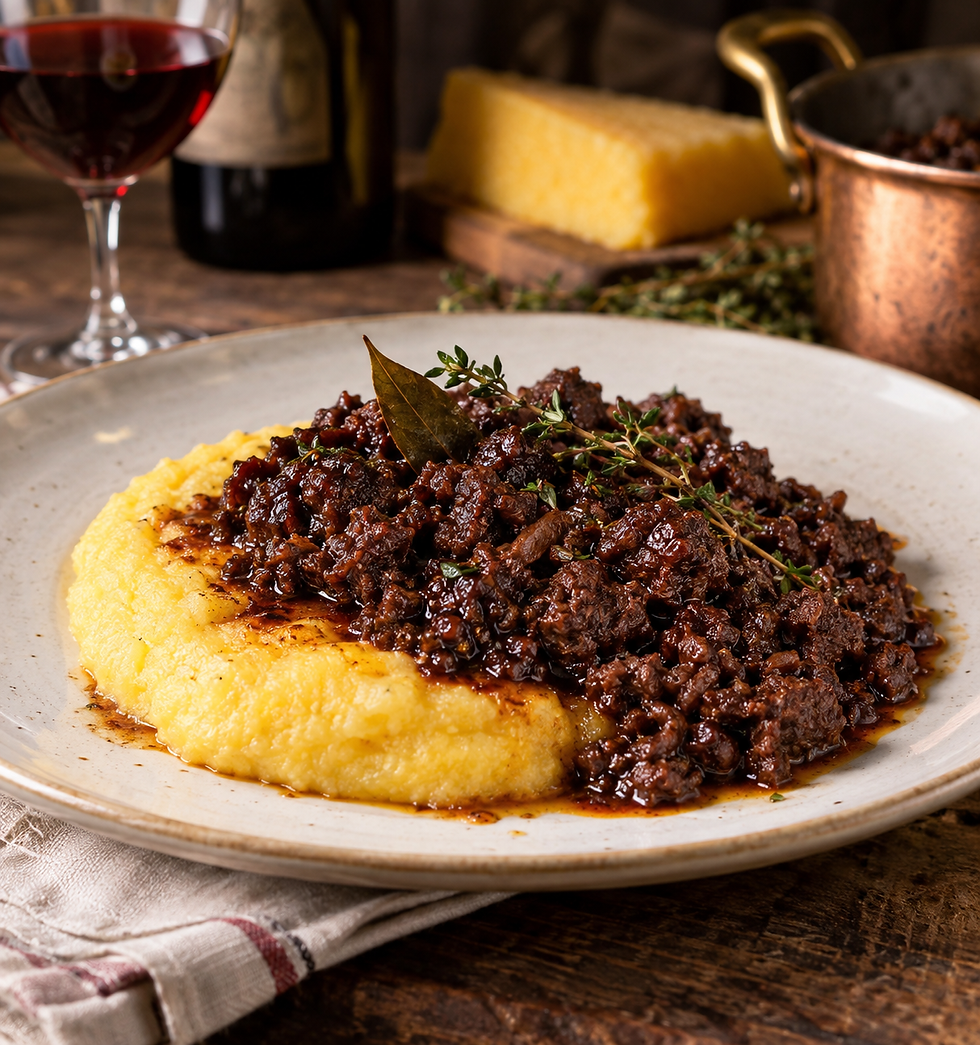
Tapulon di Borgomanero con Polenta: A stew of minced meat from the province of Novara, close to Biella, slowly cooked with wine and served on polenta. This is the stewed-meat pairing the brewery points to: the caramel of the malt follows the browned meat and the sweetness of the corn, and the dry finish keeps the dish from feeling heavy.
Polenta con Funghi e Castelmagno: Aged cheese and Alpine cooking together. Castelmagno, crumbly and savory, needs a beer with malt and body; the Ambrata answers the cheese with sweetness and the mushrooms with toast, and the carbonation clears the palate after every spoonful of creamy polenta.
Petto di Pollo con Nocciole, Porri e Timo: Chicken, the second family on Menabrea's list, with the hazelnuts of Piedmont. Toasted hazelnut and toasted malt speak the same language, the sweetness of the leeks meets the beer's soft attack, and the thyme finds the herbal note of the hops.
Grigliata di Gamberoni, Polpo, Cozze e Aragosta: Shellfish, as the brewery suggests, but from the grill. The char on prawns and lobster builds caramelized flavors that a pale lager cannot follow; the Ambrata matches them with malt, respects the sweetness of the crustaceans and, with only moderate bitterness, never turns metallic against the iodine.
What to Avoid
Ambrata loses against very delicate dishes. Raw fish, crudo and oysters, steamed white fish and light salads are covered by its toasted malt; they ask for a pale lager, a blanche or a crisp white wine. Very hot, chili-driven dishes also work against it, because heat amplifies both alcohol and bitterness.
At the other extreme, the most powerful red-wine braises, such as brasato al Barolo or game with dark, concentrated sauces, need more body than a 5% amber can give. Rich desserts and chocolate make it taste bitter and thin. The problem is never quality, only proportion.
Price and Availability
Ambrata belongs to Menabrea's main range, the same family as the Bionda, and in Italy it is widely available in supermarkets, bars and restaurants, in bottles and on draft. Outside Italy, availability depends on importers and local distribution; prices vary by state, format and retailer, so we print no reference price.
In some markets Menabrea is brewed locally: in the United Kingdom the brand's own site states that its beers are brewed in the UK. In the United States, look for bottles imported from Italy in shops and restaurants specializing in Italian or imported beer, read the label to see where the beer was brewed and check the best-before date.
The Beer Across a Meal
In an Italian menu, Ambrata belongs in the middle of the meal: with risotto, with polenta dishes, with boiled and stewed meats and with the cheese course, where a medium-bodied red or an aged white would normally be poured. It is at its best when the food has browned, toasted or melted flavors.
Ambrata should be drunk fresh, when its malt is bright and its finish clean. In the glass it changes as it warms: from bread crust and light caramel at 43°F (6°C) to fuller, rounder malt toward 50°F (10°C). Serving it cold and letting it open during a course is the best way to see both faces. That balance of flavor and restraint makes it a beer for the table, not only for refreshment.


Comments