
Italian Hazelnut Chicken Breast | Petto di Pollo con Nocciole, Porri e Timo

This is a Langhe plate in everything but the meat. The hazelnut is the subject: Tonda Gentile, toasted until the skins crack and slip, part of it crushed into the sauce where it thickens and part kept back as coarse granella that goes on last and still crunches at the table. Chicken breasts are seared, leeks are stewed slowly in the same pan until sweet and almost melting, and a little white wine and stock pull it into a light pan sauce.
Nothing is bound with cream or flour. The body of the sauce comes from crushed toasted hazelnut and a knob of cold butter, which is why toasting matters more than any other step. Undertoasted, the nut tastes of raw skin. Sixty seconds too far and it turns bitter, with no correction. Between those points is a narrow window where hazelnut oil turns fragrant and sweet, and that window is what this recipe is about.
Yield: 4 servings. Prep: 25 minutes. Cook: 35 minutes. Rest: 6 minutes. Total: about 1 hour 5 minutes. Difficulty: intermediate. Course: secondo piatto. Region: Piedmont, the Langhe and the Alta Langa.
The Story
The hazelnut of the Langhe is a consolation prize that became a treasure. When phylloxera tore through Piedmontese vineyards at the end of the nineteenth century, the higher and poorer hillsides of the Alta Langa, above Cortemilia and around Cravanzana, were never replanted to vines. They went to hazelnut instead, a tree that tolerates thin soil, steep ground and cold, and the growers found that the cultivar they had, Tonda Gentile Trilobata, was better than anything else in Europe.
What makes it better is measurable. The kernel is round, so it roasts evenly. The skin, the pellicle, detaches cleanly after toasting instead of clinging in bitter fragments. The oil content is high and the flavour holds for months. Those qualities are why the confectionery industry of Turin built itself on this nut, and why the Nocciola Piemonte IGP, recognised in 1993, is written into gianduia, torta di nocciole and baci di dama.
In the kitchen, rather than the pastry shop, the hazelnut goes with poultry and rabbit and with the mild alliums of the same valleys. Leeks belong to that cooking: cheap, patient, grown through the cold months, turned sweet by slow cooking rather than by sugar. Thyme grows wild on the same slopes. Putting the three over a chicken breast is not an invention, it is the ordinary arithmetic of a Langhe kitchen in autumn.
Ingredients
For the chicken
Boneless skinless chicken breasts, 4, about 7 oz (200 g) each
Fine sea salt, 1 1/4 tsp (7 g)
Freshly ground black pepper, to taste
Extra virgin olive oil, 2 tbsp (30 ml)
For the hazelnuts
Whole shelled hazelnuts, Tonda Gentile if possible, 4 oz (115 g)
For the leeks
Leeks, white and pale green parts only, 3 large, about 1 lb (450 g) trimmed
Unsalted butter, 2 tbsp (28 g)
Shallot, finely chopped, 1
Fresh thyme sprigs, 6
Fine sea salt, 1/2 tsp (3 g)
For the pan sauce
Dry white wine, Roero Arneis or similar, 2/3 cup (160 ml)
Chicken stock, unsalted, 1 cup (240 ml)
Unsalted butter, cold and cubed, 1 1/2 tbsp (21 g)
Lemon juice, 1 to 2 tsp (5 to 10 ml)
Freshly ground black pepper, to taste
For finishing
Toasted hazelnut granella, reserved from the 4 oz above
Fresh thyme leaves, 1 tsp
Extra virgin olive oil, a few drops per plate
Flaky sea salt, a small pinch per portion
Preparation
Step 1

Season the chicken, clean the leeks and toast the nuts. Pat the breasts dry and season every surface with the fine sea salt and pepper, then leave them at room temperature while you work. Trim the leeks, split them lengthways, slice them into half moons about 1/4 inch (6 mm) thick and wash them in a bowl of cold water, lifting them out so the grit stays at the bottom. Meanwhile toast the hazelnuts at 325°F (165°C) for 10 to 12 minutes, until the skins crack and the kitchen smells sweet, then rub them in a clean towel to remove most of the skins.
Step 2

Sear the breasts. Heat the olive oil in a wide heavy skillet over medium high heat until it shimmers. Lay the breasts in without crowding and leave them undisturbed for 4 to 5 minutes, until the underside is deep golden and releases on its own. Turn once and give the second side 4 minutes. They are not cooked through and should not be: they come back later. Lift them onto a plate and keep any juices, which go into the sauce at the end.
Step 3
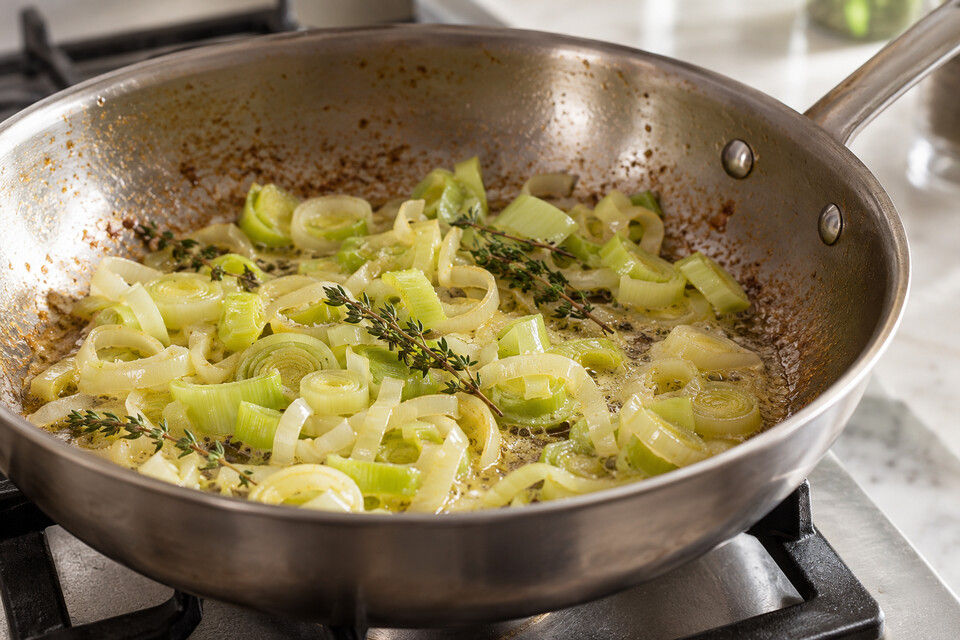
Stew the leeks. Lower the heat to medium, add 1 tablespoon of the butter and the drained leeks with a pinch of salt and three thyme sprigs. Cook, stirring often and scraping up the browned residue left by the chicken, for 10 to 12 minutes. The leeks should collapse into something soft and sweet without taking colour. If they catch, add a spoonful of water rather than more fat. Sweetness here comes from time, never from browning.
Step 4
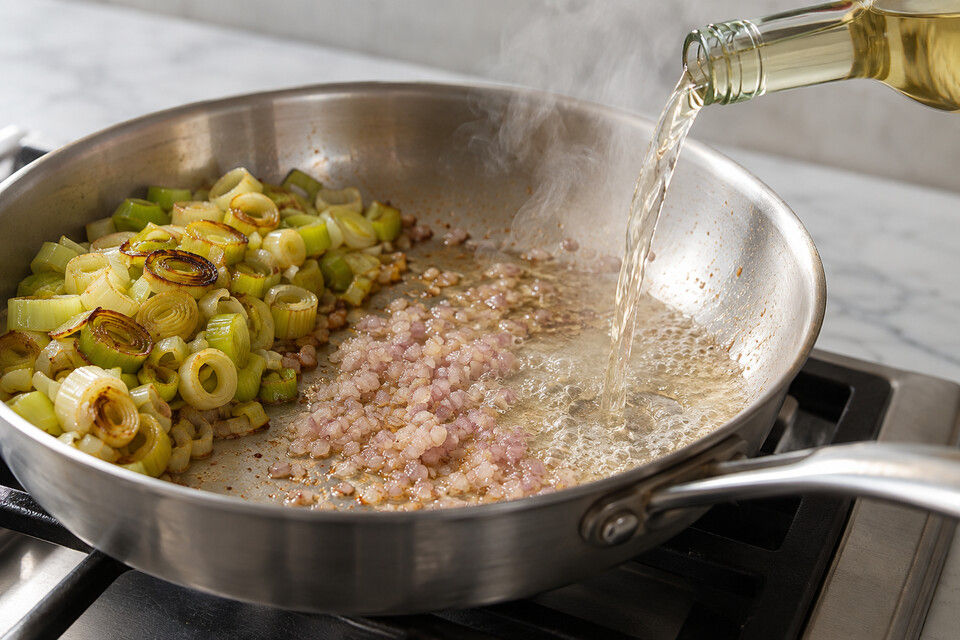
Add the shallot and deglaze. Push the leeks to one side, drop the chopped shallot into the cleared space with the remaining butter and cook it a minute until translucent. Pour in the white wine, stir everything together and scrape the base clean. Reduce by half over medium heat, about 3 minutes, which drives off the raw alcohol while leaving the acidity that keeps the sauce from tasting flat.
Step 5

Return the chicken and finish cooking. Add the stock and the remaining thyme, then settle the breasts back among the leeks with any juices from the plate. Simmer gently, uncovered, 8 to 10 minutes, spooning liquid over now and then. Check with an instant read thermometer from 7 minutes and take the pan off the heat when the thickest part reads 160°F (71°C). Move the breasts to a warm plate and rest them 6 minutes while you finish the sauce.
Step 6

Build the sauce with the hazelnuts. Crush the toasted hazelnuts coarsely, keeping a third back as granella for the plate. Stir the rest into the pan and let it bubble a minute: the crushed nut absorbs liquid and gives body without flour. Take the pan off the heat and whisk in the cold butter a cube at a time for gloss, then sharpen with lemon juice and pepper. Taste and correct, remembering the reduced stock needs little salt.
Step 7

Slice and plate. Cut each breast into three or four slices on a slight angle, carving against the grain so each slice stays tender. Spoon the leeks and sauce onto warm plates, set the chicken over them and scatter the reserved granella and thyme leaves on top. Add the nut last, after the sauce, or it softens within a minute and the point of it is gone.
Plating
Warm the plates, and choose shallow bowls rather than flat ones. There is more liquid here than in a roasted dish, the leeks are loose, and a rim keeps the sauce gathered under the meat.
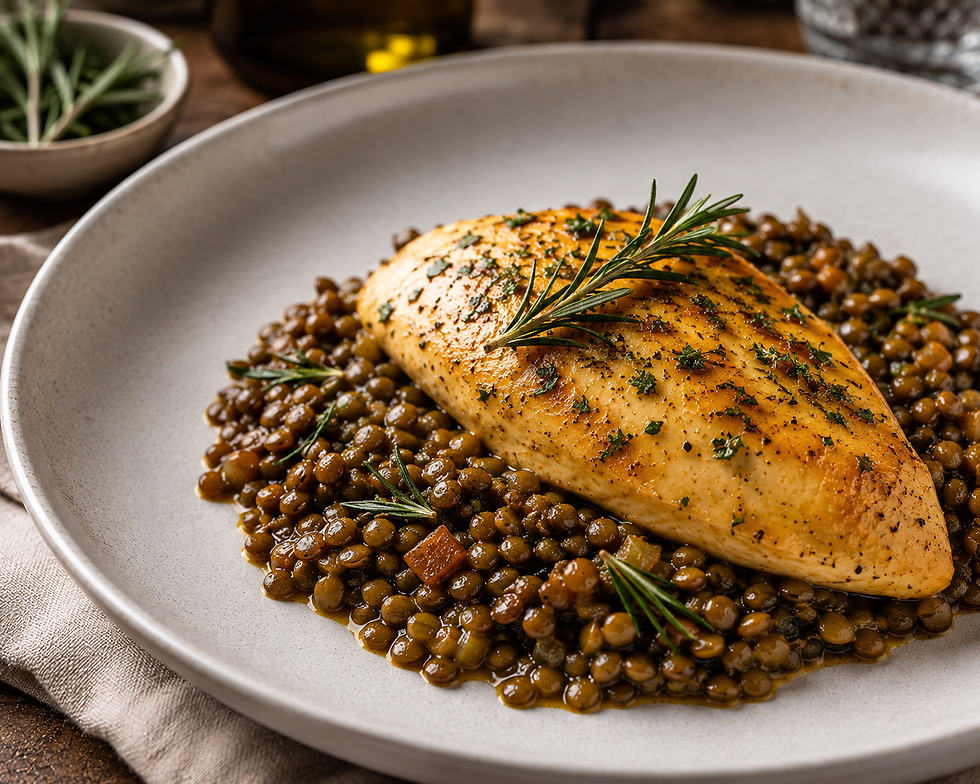
Build from the bottom up. Leeks and sauce go down first, spread into a rough oval rather than a neat circle. The sliced chicken lies over them, fanned and slightly overlapping, cut faces turned towards the diner so the white of the meat sits against the pale green. Scatter the granella over and around it, never stirred in, and finish with thyme leaves, a few drops of olive oil and a pinch of flaky salt on the meat. Buttered potatoes, soft polenta or plain steamed rice belong alongside, and nothing else needs adding.
Professional Technique
Toasting is the technique this dish lives on. A raw hazelnut tastes of almost nothing and its pellicle is astringent. Heat changes both: the nut loses moisture, its sugars and amino acids brown, and the oils that carry the aroma become volatile. The skin dries at a different rate from the kernel and shrinks away from it, which is why a few minutes in the oven and thirty seconds of rubbing in a towel take off what no peeling would. Stop while the kernel is pale straw at the centre, not brown, because the same oils that turn fragrant will turn acrid, and there is no way back. Toast on a tray in the oven, not in a pan, which browns the contact face while the top stays raw.
The leek is the other half and works on the opposite principle: no browning at all. Leeks are high in water and in inulin, a sugar that needs slow gentle heat to break into sweetness. Cooked hard they colour, catch and turn faintly bitter; cooked slowly with butter, salt and a little moisture they collapse into a soft sweet mass that behaves almost like a sauce. The half moon cut lets the layers separate and cook evenly, and washing after slicing is the only reliable way to get grit out of the concentric rings. Salt the leeks early, since salt draws their water out and speeds the collapse.
Texture and Moisture Control
Three textures have to reach the table intact and each fails differently. The chicken dries past 160°F (71°C), because breast is lean fast twitch muscle with nothing in reserve once the fibres contract. The leeks turn watery if the pan is covered and stringy if rushed over high heat. The granella goes soft within a minute of touching the sauce, which is why it is the last thing on the plate. Cooking the breasts in two stages, a hard sear then a gentle simmer, keeps the browned exterior while the interior comes up slowly.
The sauce is thickened by the crushed nut and finished with cold butter off the heat. Hazelnut particles absorb liquid and swell, giving a slightly grainy body no starch reproduces, but the same particles release oil if the sauce boils hard, and the butter emulsion breaks at the same point. Keep the pan off the flame from the moment the butter goes in. The six minute rest does double duty: the juices redistribute, and it is exactly the time the sauce needs. Any liquid the breasts give up goes back into the pan.
Professional Mise en Place
This is a single pan dish and the pan is busy throughout, so everything that can be cut, washed or toasted in advance should be.
Equipment and tools
Wide heavy skillet, at least 12 inches (30 cm), for four breasts without crowding
Sheet tray and a clean towel for toasting and skinning the hazelnuts
Instant read digital thermometer
Large bowl for washing the leeks, and a colander
Heavy knife or the base of a pan for crushing the nuts
Prepared ahead
Hazelnuts toasted, skinned and crushed, up to 2 days ahead in a sealed jar
Leeks sliced and washed, up to 1 day ahead, kept covered
Chicken seasoned and refrigerated, up to 4 hours ahead
Shallot chopped, thyme picked, wine and stock measured out
Service setup
Stock hot in a small pan beside the stove
Cold cubed butter in a dish over ice
Granella in a separate bowl, away from any steam
Shallow bowls warming, lemon halved and ready
Chef Tips
Buy hazelnuts whole and in their skins, not pre chopped or blanched. A cut nut oxidises from the moment it is broken, and the high oil content that makes Tonda Gentile worth using is what turns rancid on a shelf. Taste one first: any paint or cardboard note and no toasting will hide it.
Crush the nuts with the flat of a knife or the base of a heavy pan, never in a food processor, which gives dust and whole nuts at the same time. You want irregular pieces from lentil size down to a coarse grit: the small fragments thicken the sauce, the larger ones survive on top of the meat.
Wash the leeks after slicing, not before. Grit sits between the concentric layers and a whole leek rinsed under a tap keeps almost all of it. Slice first, swirl the half moons in cold water and lift them out with your hands: the sand stays in the bowl.
Hold the lemon until the end and add it in small amounts. The stock has reduced, the leeks are sweet and the nut is rich, so the sauce needs acidity rather than salt. One teaspoon may be enough, two is often right, a whole lemon turns a Piedmontese pan sauce into something that tastes of the coast.
Common Mistakes
Toasting the hazelnuts too far. Sixty seconds past the point and the oils turn acrid, which contaminates the sauce and cannot be corrected. Pull them when the skins crack and the centre is pale straw, and let carryover heat on the hot tray finish them.
Browning the leeks. Colour here means bitterness, not depth. Leeks want slow gentle heat, a little salt and a spoonful of water when they start to catch, so their sugars soften rather than caramelize.
Stirring the granella into the sauce. It absorbs liquid and goes soft within a minute, and the crunch that gives the dish its contrast is gone. Keep a third of the crushed nut aside and scatter it after plating.
Cooking the chicken in one stage. Searing the breasts all the way through gives a dry interior by the time the outside is right. Sear hard, take them out, then finish them gently in the liquid to 160°F (71°C).
Boiling the sauce after the butter goes in. The emulsion breaks, the hazelnut releases its oil and the sauce turns greasy instead of glossy. Take the pan off the heat before the first cube of butter, and keep it off.
Wine Pairing
Roero Arneis DOCG: The white of the sandy hills across the Tanaro from Alba, and the most natural match on the list. Arneis carries pear and white flower aromatics over a distinctly nutty finish that runs straight alongside the toasted hazelnut. Its moderate acidity handles the butter without stripping it, and it has enough weight not to vanish under the sweet leeks.
Alta Langa DOCG: A metodo classico sparkling made in the same high hills where the hazelnut groves are, from Pinot Nero and Chardonnay, aged on the lees for at least thirty months. That lees ageing gives a toasted bread and nut character that mirrors the granella, while the bubbles and the firm acidity scrub the butter mounted sauce clean between mouthfuls.
Nebbiolo d'Alba DOC: For a red that will not bulldoze white meat. Lighter and earlier drinking than Barolo, it keeps the rose and tar perfume and the bracing acidity of the grape while the tannin stays fine and manageable. That acidity is the key here: it cuts the richness of the nut and the butter, and the savoury dried herb note picks up the thyme.
Barbera d'Asti DOCG: The everyday red of the Monferrato, high in acidity and low in tannin, which is exactly the profile a lean seared breast wants. Dark cherry and plum fruit sits comfortably against the sweetness of the stewed leek, and with so little tannin there is nothing to clash with the delicate meat. Choose an unoaked bottling rather than a barrique aged one.
Erbaluce di Caluso DOCG: From the morainic hills north of Turin, and the sharpest choice of the five. Erbaluce is high in acidity with green apple and citrus fruit and a firm mineral finish, and that cut is welcome when the sauce is rich with nut and butter. Take the still dry version, which is lean enough to reset the palate between bites without adding any sweetness.
Storage & Reheating
Store the chicken and leeks together with the sauce in an airtight container in the refrigerator for up to 3 days, but keep the granella in a sealed jar at room temperature, never with the wet components. Leave the breasts whole rather than sliced, since every cut face dries overnight. The leeks and sauce improve on the second day, once the hazelnut has given more of itself to the liquid.
Reheat gently in a covered pan over low heat with a splash of stock, turning once and stopping as soon as it is warm through, around 130°F (55°C). Never let it boil, which splits the emulsion and drives the last moisture out of the breast, and never microwave it. Scatter fresh granella at the table, since yesterday granella has softened. The leeks and sauce freeze well alone for 2 months; cooked breast does not and comes back stringy.
Nutrition
Per serving, based on 4 portions of one whole breast with leeks and sauce:
Calories: 590 kcal
Total Fat: 34 g
Saturated Fat: 9 g
Trans Fat: 0.3 g
Unsaturated Fat: 24 g
Cholesterol: 150 mg
Sodium: 720 mg
Total Carbohydrates: 17 g
Fiber: 4 g
Total Sugars: 5 g
Added Sugars: 0 g
Protein: 50 g
Lactose: 0.3 g
Principal micronutrients: vitamin E, manganese, copper, magnesium, niacin, vitamin B6, selenium, folate
These figures are estimates. Fat and calories depend mostly on the hazelnuts and the butter, and sodium on whether the stock is salted, since the recipe assumes it is not.



Comments