
Italian Sardinian Fish and Shellfish Stew | Cassola Sarda di Pesce e Crostacei

Cassola is the fish soup of Cagliari, and the name belongs to the pot rather than to the catch. It comes from the Spanish cazuela, the shallow earthenware dish the Aragonese brought to Sardinia, and for four centuries that dish sat on the fires of the Marina quarter behind the port, holding whatever the boats had not sold. The recipe is an inventory rather than a formula: rockfish, a share of shellfish, tomato, garlic, chilli and bread already gone stale.
What separates it from the stews of the mainland is the ratio of broth to solids and the presence of real heat. Cassola is looser than cacciucco and more direct than the Adriatic brodetti. The tomato sharpens and colours rather than building a sauce, and the peperoncino is a measurable element, one of the clearest Spanish fingerprints left on the southern Sardinian table. The broth is meant to be soaked up by bread and is thickened by nothing except the heads and bones that went into it.
Yield: 6 servings. Prep: 50 minutes. Cook: 55 minutes. Total: about 1 hour 45 minutes. Difficulty: intermediate. Course: secondo or one dish meal. Region: Sardinia, Cagliari and the southern coast.
The Story
Sardinia was ruled from Barcelona and then from Madrid from 1323 until 1720, and nowhere did that leave deeper marks than in Cagliari. The old fishing quarters of the Marina and Stampace kept Catalan words for their streets, their trades and their food, and cassola is one of the survivors: a cazuela in name, in shape and in method, on a coast where the catch was different but the pot was not. Alghero kept the language; Cagliari kept the cooking.
The fish are the rocky bottom species that never travelled well and so stayed home: scorpionfish, gurnard, weever, small conger and moray, the heads of whatever larger fish had been filleted for the market, plus the arselle dug out of the Santa Gilla lagoon and the mussels farmed there since the eighteenth century. This is not a recipe with a fixed cast, it is a technique applied to a variable one.
The bread underneath is civraxiu, the round semolina loaf of the Campidano plain, cut thick and used two or three days old. In poor households the bread carried the dish and the broth was stretched with water, so that six people could eat from four modest fish. That arithmetic is still visible in the proportions, which is why cassola is brothy where a restaurant stew would be dense.
Ingredients
For the fish
Whole scorpionfish, scaled and gutted, 1 1/2 lb (680 g)
Whole gurnard or red mullet, scaled and gutted, 1 1/4 lb (570 g)
Monkfish tail, skinned, 12 oz (340 g)
Conger or moray, cleaned and cut into thick rounds, 10 oz (285 g)
For the shellfish
Mussels, scrubbed and debearded, 1 1/2 lb (680 g)
Clams or arselle, purged, 1 lb (450 g)
Large red prawns, shell on, 12 oz (340 g)
Dry white wine for opening the shellfish, 1/2 cup (120 ml)
For the broth and the base
Water, 6 cups (1.4 litres)
Extra virgin olive oil, 1/3 cup (80 ml)
Garlic cloves, thinly sliced, 5
Flat leaf parsley, leaves and stems separated, 1 large bunch
Dried peperoncino, crumbled, 1 tsp (2 g), or to taste
Tomato passata, 1 1/2 cups (360 ml)
Sun dried tomatoes in oil, chopped, 2 tbsp (20 g)
Dry white wine, 3/4 cup (180 ml)
Bay leaf, 1
Fine sea salt, 1 tsp (6 g), added only at the end
Freshly ground black pepper, to taste
For serving
Civraxiu or other dense country bread, 2 days old, 6 thick slices
Garlic clove for rubbing the toast, 1
Extra virgin olive oil, for finishing
Preparation
Step 1

Purge the clams. Put them in cold water salted to about 3 percent, roughly 1 tablespoon per quart, and leave them somewhere cool and dark for 2 hours: they spit sand only in water that tastes of the sea. Lift them out by hand so the grit stays behind, and discard any that stay open when tapped. Scrub and debeard the mussels meanwhile.
Step 2

Break down the fish. Fillet the scorpionfish and the gurnard, or have the fishmonger do it and hand back every scrap. Cut the fillets into pieces of about 2 oz (55 g), the monkfish into thick medallions, and leave the conger in rounds on the bone. Keep the four kinds separate on a tray, since they enter the pot at four different moments.
Step 3

Draw the broth. Put the heads and bones in a wide pan with the water, the parsley stems and the bay leaf, bring to a bare simmer and hold it for 20 minutes, skimming the grey foam. Never let it boil, which clouds the liquid and pulls bitterness out of the gills. Strain without pressing: you want about 4 cups (950 ml).
Step 4

Open the shellfish. Heat a wide lidded pan over high heat, add the wine and the mussels, cover and shake until they open, about 3 minutes, then lift them out. Repeat with the clams. Let the liquor settle, then pour it slowly into a bowl and stop before the sandy bottom follows. That liquor is the salt of the finished dish.
Step 5

Build the soffritto. Set the terracotta cassola or a heavy shallow pan over medium low heat with the olive oil, the sliced garlic and the crumbled peperoncino. Sweat them 3 or 4 minutes, until the garlic is pale gold and the oil has taken the heat of the chilli. Garlic browned hard turns bitter, and that bitterness stays in the broth.
Step 6

Reduce the tomato. Add the chopped sun dried tomatoes, stir once, then pour in the passata and cook over medium heat for 8 to 10 minutes, until it darkens and the oil separates at the edges. Add the white wine and let it reduce by half. The tomato is a seasoning rather than a sauce, and reducing it lets a small amount carry the whole pot.
Step 7

Bring the base together. Pour in the fish broth and the strained shellfish liquor, add half the parsley and simmer gently for 10 minutes. Taste: it should taste of the sea, be mildly spicy and not yet salty. Adjust the chilli now, because everything added from here is fish.
Step 8

Cook the firm fish. Slide in the conger rounds and the monkfish medallions, which need the longest, and simmer 5 minutes without stirring. Move the pot by the handles rather than reaching for a spoon, which breaks the pieces and clouds the broth. The liquid should barely tremble.
Step 9

Add the delicate fish and the prawns. Lay in the scorpionfish and gurnard and cook for 4 minutes, then add the prawns in their shells for 2 minutes more. The shells release colour and a sweetness into the broth that peeled prawns cannot. The fish is done the moment the flesh turns opaque and slides off the bone.
Step 10
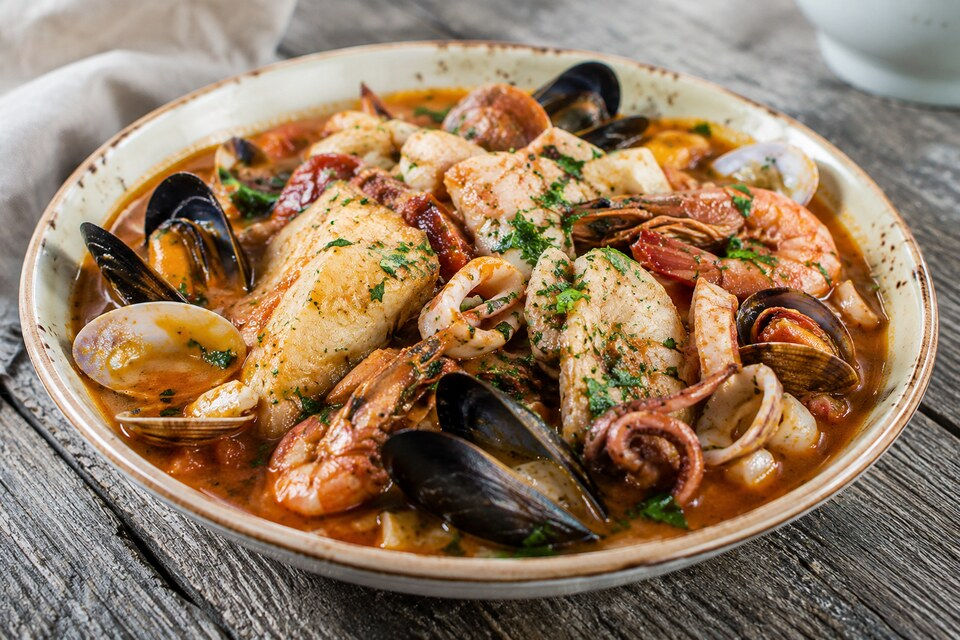
Finish and rest. Return the mussels and clams in their shells, scatter the rest of the parsley, grind over black pepper and turn off the heat. Taste, and add salt only now and in small amounts. Cover and let the pot stand for 5 minutes while you toast the bread, rub it with the raw garlic clove and set a slice in each warmed bowl.
Plating
Cassola is served in wide shallow bowls that have been warmed, never in soup plates or the deep bowls used for pasta. The toasted bread goes in first, one slice per person, rubbed on one side only with raw garlic. On top go the pieces of fish, arranged so each bowl carries a share of every species, then the shellfish in their shells around the edge, where fingers can reach them.
The broth is ladled over last and generously. A bowl that looks slightly too wet is correctly served, because the bread takes up a third of that liquid within two minutes. Finish with a thread of raw olive oil, a little parsley and nothing else. No lemon and no cheese: on the Cagliari waterfront the dish is judged on the clarity of what it already contains.
Professional Technique
The defining technique of cassola is the separation of the pot into three liquids recombined at the end: a clear broth drawn from the trimmings, a filtered shellfish liquor and a reduced tomato base. Most home versions collapse them into one pan and produce a cloudy stew that tastes uniformly of tomato. Kept apart, each can be judged on its own: the broth stays below a simmer so it never clouds, the liquor is decanted rather than poured, and the tomato is reduced hard enough that a small quantity seasons six portions.
The second is the staged entry of the catch, the only reliable way to cook four species with different protein structures in one pot. Conger and monkfish carry dense muscle and connective tissue and need about 9 minutes. Scorpionfish and gurnard are fine flaked and need 4. Prawns need 2, mussels and clams none at all, since they go back only to warm through. Work backward from the most delicate element and the pot runs itself.
Texture and Moisture Control
The body of the broth comes entirely from gelatin, not from flour, cream or reduction. Fish heads, skin and the collagen rich frames of rockfish release it between about 160°F (70°C) and a bare simmer, and a broth drawn correctly sets lightly when it cools. Boil it and the gelatin emulsifies with the fat into a permanent cloud while the gills give up a lasting bitterness.
Fish proteins contract and squeeze out moisture at a far lower temperature than meat, which is why every timing here is short. Judge doneness by the way the flesh separates from the bone rather than by the clock, and remember the pieces keep cooking during the 5 minute rest under the lid. A mussel held at a simmer for three minutes is rubber, which is why they are opened apart and returned off the heat.
Salt is the last variable and the one that ruins the most pots. Mussel and clam liquor can run above 3 percent salinity, and once that goes into a base that was already seasoned the dish is finished. Season at the end, in small additions, with the unsalted toast in mind.
Professional Mise en Place
Almost everything in cassola can be prepared in advance and almost nothing can be cooked in advance. Have the broth, the liquor and the tomato base finished and cool before service, with the fish waiting cold on a tray.
Equipment and tools
Wide terracotta cassola or a heavy shallow pan of at least 12 inches (30 cm)
Second wide lidded pan for opening the shellfish
Fine mesh sieve and a ladle for the broth
Fish spatula and a tray divided into four for the staged fish
Prepared ahead
Fish broth, drawn and strained, up to 1 day ahead and kept cold
Shellfish opened, liquor decanted, both refrigerated on the day
Tomato base reduced with the garlic and chilli, up to 1 day ahead
Fish cut into portions and grouped by cooking time on a cold tray
Bread sliced and left uncovered so it dries rather than staling damp
Service setup
Base at a bare simmer, uncovered, tasted and adjusted for chilli
Bowls warming and bread toasting as the firm fish cooks
Parsley chopped in two portions, one for the pot and one for the bowls
Salt within reach and used only after the shellfish go back in
Chef Tips
Buy the fish whole and refuse the fillets. The trimmings are half of this recipe, and a cassola built on bought fillets and bottled stock tastes thin however good the fish was.
Use at least three species and resist the expensive ones. The dish is built on scorpionfish, gurnard and conger precisely because their bones and heads give the broth what sea bass and turbot cannot. Farmed fish with soft flesh disintegrates in the pot and leaves you with tomato soup.
Judge the chilli in the oil, not in the broth. Peperoncino keeps releasing capsaicin into hot liquid for the whole cooking time, so a base that tastes right at the start is noticeably hotter twenty minutes later. Start with less than you want and add the rest when the broth goes in.
Let the pot stand off the heat for 5 minutes and never hold it warm longer. The rest lets the broth settle and the fish absorb it, while ten minutes on a low flame overcooks every piece. Cassola is a dish you time the guests around.
Common Mistakes
Boiling the fish broth. A rolling boil emulsifies fat and gelatin into a permanent cloud and draws bitterness out of the gills, and no straining afterwards brings the clarity back. Hold it just below a simmer and skim.
Pouring the shellfish liquor straight in. The last spoonful of it is sand, and it ends up between the teeth of every guest. Let it settle and decant slowly, stopping well before the bottom, or pass it through a damp cloth.
Salting the base early. Mussel and clam liquor is saltier than seawater and goes in at the end, so a base seasoned at the start is inedible by the time the dish is finished. Salt only after the shellfish return to the pot.
Putting all the fish in at once. Conger needs more than twice as long as scorpionfish, and prawns a fraction of either. A single addition guarantees something raw and something disintegrated. Work backward from the most delicate piece.
Serving it over fresh bread. Soft new bread dissolves into paste within seconds and the bowl turns to porridge. The bread must be dense, two days old and toasted, so it drinks the broth and still holds its structure.
Wine Pairing
Nuragus di Cagliari DOC: The wine of the same plain that grows the bread and the tomatoes, and the most honest match here. Light, low in alcohol and high in acidity, with green apple and a herbal edge, it cleans the palate between spoonfuls without adding another flavour to a bowl that already carries chilli, tomato and shellfish.
Cagliari DOC: The Vermentino bottled under the city appellation is a step up in body and what the richer version of this pot asks for. Ripe citrus, a saline finish and a light bitterness on the back palate meet the mussel liquor head on. Serve it at 50°F (10°C): colder than that mutes the salinity the pairing depends on.
Alghero DOC: The other Catalan corner of Sardinia, a choice that echoes the history of the dish. The whites of this appellation, Torbato above all, are dry, firmly structured and more mineral than fruity, with the grip to stand up to the peperoncino instead of being erased by it. Chilli heat needs a wine with no residual sugar, and this has none.
Campidano di Terralba DOC: A light Bovale red from the plain north of Cagliari, for anyone who wants red wine with fish. Served cool at around 57°F (14°C), its low tannin and bright red fruit follow the tomato base without clashing with the shellfish, as a tannic red would. Best when the pot is heavy on conger and monkfish.
Grillo Sicilia DOC: The other island alternative when the Sardinian bottles are out of reach. Grillo has the weight for a spicy tomato broth, a citrus and white peach profile that lifts the prawns, and a firm dry finish that handles the chilli. Choose an unoaked bottling, since oak and fish broth have nothing to say to each other.
Storage & Reheating
Cassola does not improve overnight and should be cooked for the number at the table. If there is a surplus, separate it at once: fish and shellfish in one container, broth in another, both refrigerated within the hour. Stored together the fish keeps cooking and then sits in acid, and by the next day it is woolly. Kept apart, both hold for 2 days.
To bring it back, heat the broth alone to a bare simmer, take it off the heat, add the cold fish and shellfish and warm them under the lid for 2 minutes. Never reheat an assembled bowl in a microwave. Toast fresh bread rather than reusing yesterday's slice, which will have turned to pulp.
The broth alone freezes well for up to 3 months and is worth making in double quantity, since it becomes the base of a risotto, a fregola or the next cassola. Do not freeze the cooked fish or the shellfish, which lose moisture on thawing and turn tough. Label the frozen broth with the chilli level, because the heat stays in it.
Nutrition
Per serving, based on 6 portions, including one slice of bread:
Calories: 480 kcal
Total Fat: 20 g
Saturated Fat: 3 g
Trans Fat: 0 g
Unsaturated Fat: 16 g
Cholesterol: 185 mg
Sodium: 890 mg
Total Carbohydrates: 26 g
Fiber: 3 g
Total Sugars: 6 g
Added Sugars: 0 g
Protein: 46 g
Principal micronutrients: iodine, selenium, iron, zinc, vitamin B12, vitamin D, potassium, phosphorus
These figures are estimates and move with the catch. Sodium depends on the shellfish liquor and on how hard the clams were purged, and the fat rises with the finishing oil.


Comments