
Italian Sorrentina Gnocchi | Gnocchi alla Sorrentina
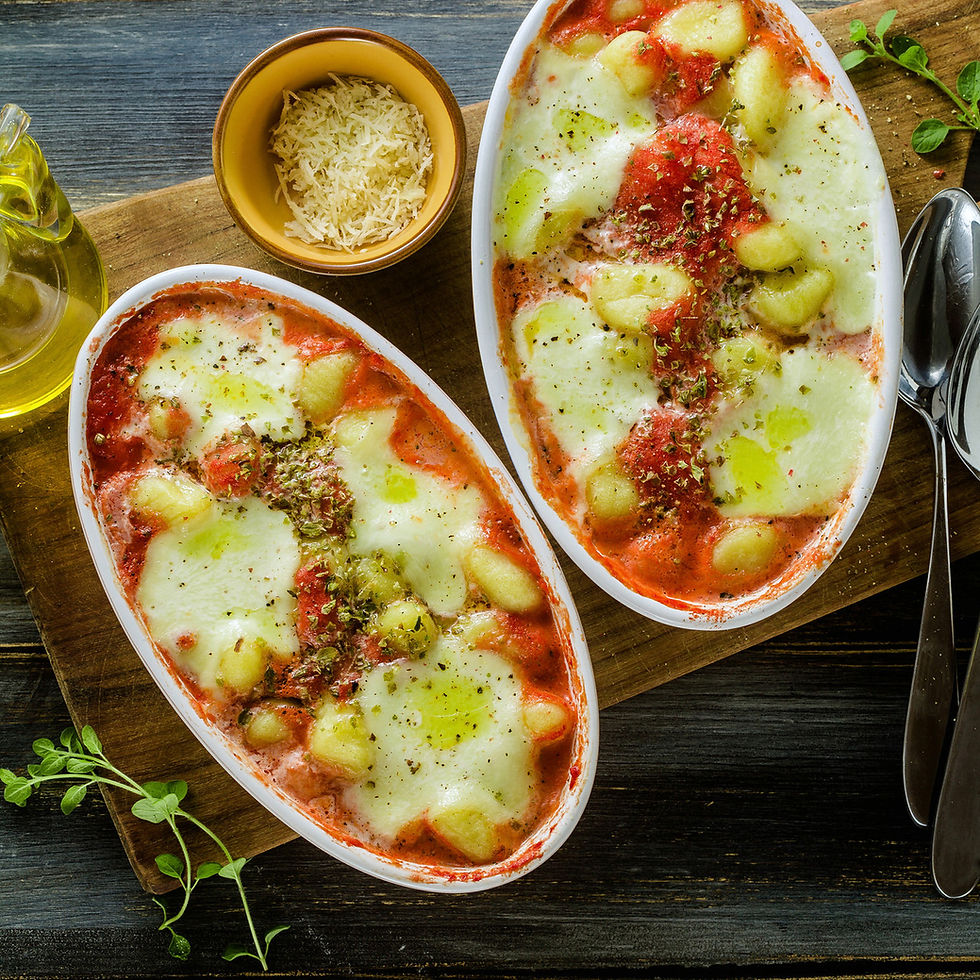
Gnocchi alla Sorrentina is three ingredients and no margin for error. Potato gnocchi, a long cooked tomato sauce and fior di latte, baked briefly in a small terracotta dish until the cheese pulls and the surface blisters. Nothing is hidden in it. If the gnocchi are heavy the dish is heavy, if the sauce is thin the cheese weeps into it, and if the fior di latte goes in wet the whole thing turns to soup under a brown crust.
Everything therefore happens before the oven. The potatoes are baked rather than boiled so they carry as little water as possible, the flour is kept to the minimum the dough will hold together with, and the cheese is cubed and drained hours ahead. The bake itself is short, five to seven minutes under strong top heat, and it is finishing rather than cooking.
Yield: 4 servings. Prep: 1 hour. Cook: 1 hour 15 minutes for the sauce, 7 minutes to bake. Total: about 2 hours 15 minutes. Difficulty: intermediate. Course: primo piatto. Region: Campania, the Sorrento peninsula.
The Story
The dish takes its name from Sorrento and belongs to the whole peninsula that runs from Castellammare di Stabia round to Positano, but its three components come from three separate places on that small stretch of coast. The tomatoes are from the Sarno valley at the foot of Vesuvius, where San Marzano has grown in volcanic ash since the eighteenth century. The fior di latte is from Agerola, a village on a shelf of the Lattari mountains above Amalfi where cows are kept and the cheese is stretched daily. The basil is from wherever a pot stands on a windowsill.
Potato gnocchi arrived late. Gnocchi in Italy predate the potato by centuries, made with bread, semolina or chestnut flour, and the potato version only spread through the south in the nineteenth century, once the tuber had lost its reputation as animal feed. In a region where poverty was structural and wheat was expensive, a dumpling made mostly of potato with a little flour was a way to eat a filling first course for almost nothing.
What makes it Sorrentina rather than simply gnocchi with tomato is the pignatiello, the small glazed terracotta dish it is baked and served in. Each portion goes into its own, it comes to the table still bubbling, and the diner eats from the vessel it cooked in. That is not presentation, it is thermal engineering: terracotta holds heat long enough for the cheese to stay molten from the first forkful to the last, which a plate never does.
Ingredients
For the gnocchi
Starchy potatoes, russet or similar, 2 lb (900 g)
All purpose flour, 1 1/4 cups (160 g), plus more for the bench
Egg yolk, large, 1
Fine sea salt, 1 tsp (6 g)
Freshly grated nutmeg, 1 small pinch
For the tomato sauce
Canned San Marzano tomatoes, 28 oz (800 g)
Extra virgin olive oil, 3 tbsp (45 ml)
Garlic cloves, lightly crushed, 2
Fine sea salt, 1 tsp (6 g)
Fresh basil, 1 large sprig plus 10 leaves to finish
For the assembly
Fior di latte, 9 oz (250 g), cubed and drained
Parmigiano Reggiano, finely grated, 1/2 cup (45 g)
Extra virgin olive oil, 1 tbsp (15 ml)
Freshly ground black pepper, to taste
Coarse salt for the gnocchi water, 2 tbsp (30 g) per 4 quarts
Preparation
Step 1
Bake the potatoes. Heat the oven to 400°F (200°C), prick the potatoes and bake them whole on a rack for 55 to 70 minutes until a skewer meets no resistance. Do not boil them. A boiled potato absorbs water through the skin and every drop of that water has to be balanced later with more flour, which is the single most common reason gnocchi come out heavy. Baking drives moisture off instead of adding it.
Step 2
Rice them hot. Split each potato the moment you can hold it, scoop out the flesh and push it through a ricer or a food mill straight onto a cool work surface. Spread the riced potato in a loose layer and leave it two or three minutes to let the steam escape. Working it hot matters, since potato starch turns gluey once it has cooled, and a cold potato needs more flour for the same result.
Step 3
Make the dough. Scatter the salt, the nutmeg and about two thirds of the flour over the potato, add the egg yolk and bring it together with a bench scraper, folding rather than kneading. Add the rest of the flour only if the dough still sticks to your palm. Stop the moment it holds. Twenty seconds too long and the gluten develops, the gnocchi tighten in the water and nothing later in the recipe will loosen them again.
Step 4
Shape and ridge. Cut the dough into six pieces, roll each into a rope about 3/4 inch (2 cm) thick on a lightly floured bench and cut it into pieces of the same width. Roll each piece down a gnocchi board or the back of a fork with your thumb so it curls and takes ridges on one side and a hollow on the other. Both surfaces exist to hold sauce. Lay them on a floured tray in a single layer, not touching.
Step 5
Build the sauce. Crush the tomatoes by hand into a bowl, discarding the hard cores. Warm the olive oil in a wide saucepan over low heat with the crushed garlic and let it perfume the oil for 3 minutes without colouring. Lift the garlic out, add the tomatoes and the salt, drop in the basil sprig, and simmer uncovered over the lowest heat for 60 to 75 minutes, stirring occasionally, until the sauce has reduced and turned deep brick red.
Step 6
Judge the sauce. It must be thick enough to hold a channel for a second when you draw a spoon through the pan. This matters more here than in any pasta dish, because the fior di latte will release liquid in the oven and a sauce that was merely correct in the pan becomes watery in the dish. Remove the basil sprig, which has given what it has and will turn bitter, and taste for salt.
Step 7
Drain the cheese. Cut the fior di latte into cubes of about 1/2 inch (1 cm) at least 2 hours ahead, spread them on a tray lined with absorbent paper and refrigerate uncovered. Fresh fior di latte is sold sitting in its own whey and carries a great deal of water. Cubed and drained, it melts into strands; used straight from the tub, it floods the dish. Blot the cubes once more before they go in.
Step 8
Boil, combine and bake. Heat the broiler and bring 4 quarts of water to a rolling boil with the coarse salt. Slide the gnocchi in, keep the water moving, and lift each one out with a slotted spoon about 20 seconds after it rises to the surface. Fold them gently into the hot sauce with half the cheese and half the Parmigiano, divide between four terracotta dishes, top with the rest and give them 5 to 7 minutes under the broiler until blistered.
Plating
This is served in the vessel it was baked in, which removes most plating decisions and makes the remaining ones matter. Use individual glazed terracotta pignatielli of about 1 1/2 cups (350 ml), or small cast iron dishes. They go into the oven already warm from the sauce, they come out at close to 400°F (200°C), and they sit on a folded cloth or a wooden board at the table, never directly on linen.
Let each dish stand 2 minutes before it goes out. Straight from the broiler the cheese is liquid enough to run off the fork and hot enough to burn a mouth, and two minutes is exactly long enough for it to pull into strands instead. Tear the fresh basil over the top at the last second rather than cutting it, since a blade bruises the leaf and blackens the edges, and finish with a turn of black pepper and a thread of raw olive oil.
Professional Technique
The whole recipe is governed by one number: the ratio of flour to potato, and that ratio is not fixed. A potato holds between seventy five and eighty percent water depending on variety, age and storage, so the same weight of two different sacks needs meaningfully different amounts of flour. This is why a published quantity can only be a starting point and why the method says to hold back a third of it. The way to judge is by feel, not by scale: the dough is ready when it stops sticking to the heel of the hand and not one gram sooner.
The second control is the double sauce contact. Gnocchi are folded into the sauce in the pan before they are divided into dishes, rather than being sauced in the dish, so every dumpling is coated on all sides while its surface starch is still warm and receptive. That starch is what binds sauce to gnocchi. Sauce ladled over the top in the dish sits there instead, and the gnocchi underneath arrive at the table bare.
Texture and Moisture Control
Three separate water sources have to be managed and each one arrives at a different moment. The potato brings the first, which is why it is baked rather than boiled and riced while steam is still leaving it. The cooking water brings the second, which is why the gnocchi come out twenty seconds after they float rather than being left to sit, and why they are lifted with a slotted spoon instead of being tipped into a colander where they bruise and stick. The fior di latte brings the third and largest, which is why it is cubed and drained hours ahead.
The texture target for the gnocchi themselves is a dumpling that yields completely to the side of a fork with no resilience and no chew. Resilience means gluten, and gluten means either too much flour or too much handling. Test one before you shape the rest: drop a single gnocchi into boiling water, and if it rises quickly and eats soft, the dough is right. If it sinks and comes up rubbery, the batch is already beyond saving, and it is far better to know that with the dough still on the bench.
Professional Mise en Place
The sauce and the cheese are both prepared well ahead. Only the boiling and the bake happen at service, and together they take under ten minutes.
Equipment and tools
Potato ricer or food mill, bench scraper and a gnocchi board or a fork
Wide saucepan for the sauce and a large pot for boiling
Slotted spoon, floured trays and a clean cloth
Four individual terracotta dishes of about 1 1/2 cups (350 ml)
A broiler or an oven that reaches 475°F (245°C) with strong top heat
Prepared ahead
Tomato sauce made up to 3 days ahead and refrigerated, or frozen for 3 months
Fior di latte cubed and drained on paper at least 2 hours ahead, kept cold
Parmigiano grated and basil picked, both covered and kept cool
Gnocchi shaped up to 3 hours ahead on floured trays, refrigerated uncovered
Terracotta dishes wiped and set out beside the stove
Service setup
Sauce warm in a wide pan large enough to hold all the gnocchi at once
Salted water at a rolling boil and the broiler already hot
Cheese blotted once more and divided into two portions, half for folding
Slotted spoon and a tray for the lifted gnocchi within arm's reach
Boards or folded cloths ready on the table for the hot dishes
Chef Tips
Use old potatoes rather than new ones. A potato that has been stored for a few months has converted more of its water and carries more free starch, which is exactly what you want. New potatoes are waxy and wet and will drive the flour quantity up by a third.
Buy fior di latte, not buffalo mozzarella, and not the low moisture block sold for pizza. Buffalo milk mozzarella is wetter and more acidic and it separates under a broiler. Fior di latte from cow milk melts into clean strands, which is why the Sorrento peninsula uses it for this dish despite sitting beside the best buffalo herds in Italy.
Cook the sauce longer than feels necessary. An hour is the minimum and ninety minutes is better. You are not just reducing water, you are letting the acidity soften and the sweetness come forward, and a short sauce tastes sharp under cheese in a way that no pinch of sugar fixes.
If you want to freeze gnocchi, do it raw. Spread them on a floured tray, freeze them solid, then bag them, and cook them from frozen in boiling water without thawing. Thawed raw gnocchi collapse into paste, and cooked gnocchi that have been frozen come back rubbery.
Common Mistakes
Boiling the potatoes. They take on water through the skin and force you to add flour to compensate, which is the direct cause of heavy gnocchi. Bake them whole on a rack, or steam them if you must, but never submerge them.
Kneading the dough. Gnocchi dough is folded together and stopped, not worked. Every extra pass develops gluten, and gluten turns a dumpling that should dissolve on the tongue into something that bounces off a fork.
Using wet fior di latte. Cheese taken straight from its whey releases a surprising amount of liquid under the broiler and turns a thick sauce into a pool. Cube it, drain it on paper for at least two hours and blot it again before use.
Leaving the gnocchi in the water. They are done twenty seconds after they float, and an extra minute of boiling waterlogs them from the outside in. Lift them with a slotted spoon as they rise rather than waiting for the last one.
Saucing in the dish instead of the pan. Folding the hot gnocchi through the sauce coats them while their surface starch is still receptive. Sauce poured over the top in the terracotta stays on the top, and the bottom layer arrives naked.
Wine Pairing
Lacryma Christi del Vesuvio DOC: The local red, grown in volcanic ash on the same slopes as the tomatoes. Piedirosso gives a light bodied wine with soft tannin, sour cherry fruit and a faintly smoky mineral edge that meets the roasted tomato directly. Its acidity is high enough to cut the melted fior di latte without stripping it.
Falanghina del Sannio DOC: The Campanian white answer, and a better match than most people expect with a tomato sauce. Brisk citrus and green apple acidity slices straight through the cheese, while a soft floral lift runs alongside the basil. Serve it cold, at around 50°F (10°C), as a contrast to a dish that arrives at the table very hot.
Aglianico del Taburno DOCG: For a richer version of the dish, with more cheese or a longer bake. Aglianico brings firm tannin and real structure, and its dark plum and tobacco character stands up to the concentrated tomato. Choose a bottle with a few years on it, since young Aglianico is austere enough to fight the gnocchi rather than support them.
Chianti Classico DOCG: The reliable mainland alternative. Sangiovese has the highest natural acidity of the classic Italian reds, which is precisely what a cooked tomato sauce asks for, and its sour cherry fruit and dried herb finish sit comfortably with basil. Medium bodied enough not to overwhelm a potato dumpling.
Barbera d'Asti DOCG: A northern choice that works on acidity alone. Barbera is high acid and low tannin, so it refreshes the palate between forkfuls of melted cheese without adding any grip of its own. The dark fruit is generous and simple, which suits a dish built on three ingredients and no complication.
Storage & Reheating
Baked gnocchi alla Sorrentina keeps refrigerated in a sealed container for up to 2 days, though the texture is never quite what it was, since the dumplings keep absorbing sauce overnight and soften. The tomato sauce on its own keeps 3 days refrigerated in a jar under a film of olive oil, and freezes well for 3 months in portions.
Reheat the assembled dish covered with foil in an oven at 325°F (165°C) for about 15 minutes, then uncover it for the last 3 minutes to bring the surface back. Never use a microwave, which boils the water inside the gnocchi and turns them to paste while leaving the cheese rubbery. If the sauce has been absorbed and the dish looks dry, add two tablespoons of warm sauce or water before it goes in.
Raw shaped gnocchi freeze better than anything else here. Spread them on a floured tray, freeze until solid, then transfer to a bag for up to 2 months and boil them from frozen, allowing about a minute longer. Do not freeze the assembled dish: the cheese separates on thawing and the sauce splits.
Nutrition
Per serving, based on 4 servings:
Calories: 640 kcal
Total Fat: 26 g
Saturated Fat: 12 g
Trans Fat: 0 g
Unsaturated Fat: 13 g
Cholesterol: 75 mg
Sodium: 1050 mg
Total Carbohydrates: 78 g
Fiber: 6 g
Total Sugars: 9 g
Added Sugars: 0 g
Protein: 25 g
Lactose: 2.5 g
Principal micronutrients: calcium, potassium, vitamin C, lycopene, vitamin A, phosphorus
These figures are estimates and move most with the cheese. Using the full 9 oz of fior di latte rather than a lighter hand adds roughly 60 calories and 4 g of saturated fat per serving.


Comments