
Baked Sicilian Pasta with Sardines | Pasta con le Sarde al Forno

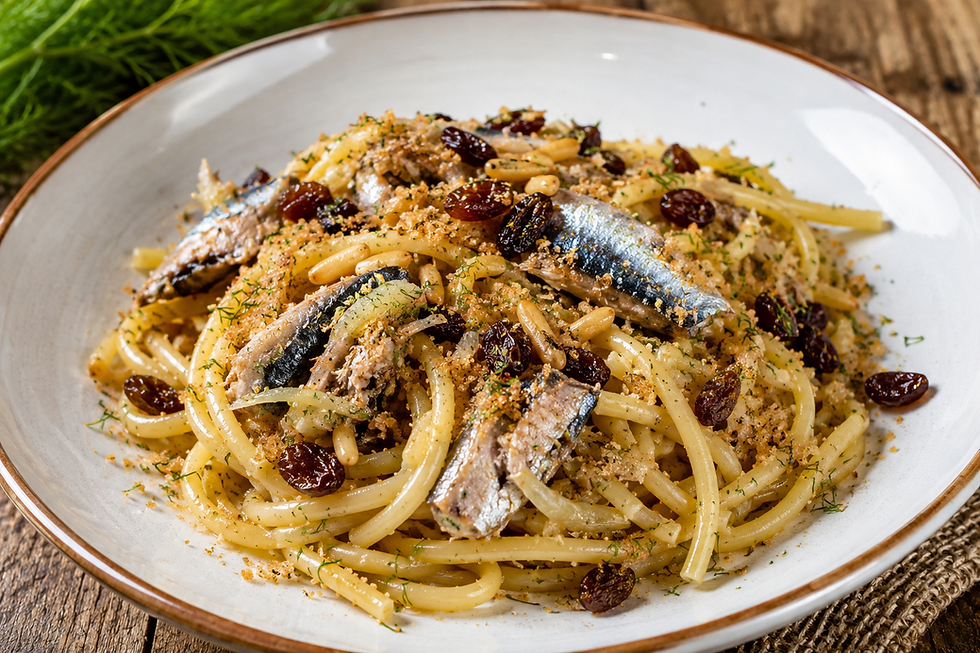
Pasta con le sarde al forno is the version of the most famous pasta in Palermo that almost never leaves the island. The sauce is the one Sicily has built for centuries, fresh sardines broken down with wild fennel, saffron, raisins and pine nuts, but instead of going from pan to plate it is folded through bucatini, pressed into a baking dish, covered with toasted breadcrumbs and baked until the surface sets into a crust.
Then it is left alone for twenty minutes, and that rest decides everything. The pasta finishes drinking the fennel water it was boiled in, the saffron colour spreads through the starch instead of streaking, and the raisins release their sweetness into the strands. What comes out is firmer and far more integrated than the pan version, and it cuts into squares instead of being twirled onto a fork.
This is the form the dish takes for feast days, for the table of San Giuseppe on the nineteenth of March, and whenever the pasta has to be finished hours early. Everything below assumes fresh sardines and fresh wild fennel, because there is no honest way around either.
Yield: 6 servings. Prep: 45 minutes. Cook: 50 minutes. Rest: 20 minutes. Total: about 2 hours. Difficulty: intermediate. Course: primo piatto. Region: Sicily, Palermo and the western coast.
The Story
Palermo tells the founding legend with a straight face: a cook in the army of the Arab general Eufemio, landing near Mazara del Vallo in the ninth century and short of supplies, fed the troops on what the hillside and the water gave him, wild fennel from the slopes and sardines from the boats. Whether or not it happened that way, the flavour map is Arab beyond argument, and saffron, raisins and pine nuts reached Sicily with the same rulers who brought citrus.
The baked form belongs to the religious calendar rather than to the restaurant. On the nineteenth of March, Sicilian families build the tavolata di San Giuseppe, a table loaded with bread sculptures and meatless dishes, and this is one of the few pasta dishes that can stand on it for hours and still be worth eating. The breadcrumb crust is not decoration. With cheese kept off the Lenten table, toasted muddica did the work of grated cheese, which is why Sicilians still call it the cheese of the poor.
Wild fennel is the limiting ingredient and the reason the dish has a season. Finocchietto selvatico grows along the roadsides of western Sicily and is gathered from late winter into May, while the fronds are soft and intensely aromatic. It is not the bulb sold in supermarkets and it is not fennel seed. Without it the sauce loses its backbone and becomes a sweet and sour fish sugo, pleasant enough, but no longer this dish.
Ingredients
For the pasta
Bucatini, 1 lb (450 g)
Wild fennel fronds, cleaned, 1 lb (450 g)
Water for boiling, 5 quarts (4.7 liters)
Coarse sea salt, 3 tbsp (45 g)
For the sardine sauce
Fresh sardines, whole, 2 lb (900 g), about 1 lb (450 g) cleaned
Yellow onion, finely chopped, 1 large, 7 oz (200 g)
Extra virgin olive oil, 1/3 cup (80 ml)
Salted anchovy fillets, rinsed, 4
Saffron threads, 1 generous pinch, about 0.3 g
Golden raisins, 1/3 cup (50 g)
Pine nuts, 1/3 cup (45 g)
Dry white wine, 1/4 cup (60 ml)
Fine sea salt, 1 tsp (6 g)
Freshly ground black pepper, to taste
For the breadcrumb topping
Coarse dry breadcrumbs from stale semolina bread, 1 1/4 cups (120 g)
Extra virgin olive oil, 3 tbsp (45 ml)
Fine sea salt, 1 small pinch
For finishing
Extra virgin olive oil for the dish and the surface, 2 tbsp (30 ml)
Reserved fennel cooking water, 1 cup (240 ml)
Wild fennel fronds, small, for the top, a few
Freshly ground black pepper, to taste
Preparation
Clean and butterfly the sardines
Pull the head off each sardine so the guts come away with it, run a thumb along the backbone from head to tail and lift the spine out in one piece. Open the fish flat like a book, rinse briefly and lay the fillets on paper to dry. Keep six of the best looking ones whole for the surface of the dish; everything else breaks down into the sauce, so perfect fillets do not matter.
Boil the wild fennel and save the water
Bring the 5 quarts of water to a rolling boil with the coarse salt, drop in the fennel fronds and cook for about 10 minutes, until a stem crushes between two fingers. Lift the fennel out with a spider and leave the water on a low flame. That green water is the most important thing in the recipe, because the bucatini cooks in it later and the dish is seasoned through it. Squeeze the fennel dry and chop it finely.
Toast the muddica atturrata
Put a wide skillet over medium heat with the 3 tablespoons of olive oil, add the coarse breadcrumbs and the pinch of salt, and stir constantly until they turn a deep even gold, about 4 minutes. Stay with the pan: crumbs go from golden to burnt in the time it takes to answer the door. Tip them onto a cold plate the moment the colour is right and leave them uncovered so they stay dry.
Soften the onion and bloom the saffron
Soak the raisins in warm water for 15 minutes and crumble the saffron into 3 tablespoons of warm fennel water so it can release its colour. In a large deep skillet warm the 1/3 cup of olive oil over low heat, add the onion and cook for 12 to 15 minutes without letting it colour, until completely soft. Add the rinsed anchovies and press them with a spoon until they dissolve into the oil, which builds the savoury floor of the sauce.
Build the sardine sauce
Raise the heat to medium, add the sardines kept for the sauce and cook for 3 minutes, breaking them up gently as they go opaque. Pour in the white wine and let it evaporate. Add the chopped fennel, the drained raisins, the pine nuts and the bloomed saffron with its liquid, season, and add 1/2 cup (120 ml) more fennel water. Simmer uncovered for 10 minutes, until the sauce is thick and just moist. Correct the salt now.
Cook the bucatini in the fennel water
Bring the reserved fennel water back to a full boil and cook the bucatini in it, stirring for the first minute so the strands do not weld together. Drain a full 3 minutes short of the time on the packet, because they still have 25 minutes in the oven ahead. They should be clearly firm, close to raw at the centre. This is where most home versions fail: pasta boiled to the usual al dente comes out of the oven swollen.
Combine and assemble the dish
Tip the drained bucatini into the skillet with the sauce, off the heat, and turn everything with tongs until each strand carries colour. If it looks tight, loosen it with more fennel water, since baking takes moisture out and never puts it back. Oil a dish of about 9 by 13 inches (23 by 33 cm), scatter a third of the crumbs across the base and pack the pasta in evenly without pressing it flat. Lay the reserved sardines on top, cover with the remaining crumbs and trickle the last oil over.
Bake and rest
Bake at 400°F (200°C) for 20 to 25 minutes, until the crust is deep gold and the edges are faintly crisp where the pasta meets the dish. If the surface colours early, lay foil over it loosely rather than dropping the temperature. Then leave it on the counter for a full 20 minutes. It will not go cold, it will set, and only then will it cut cleanly.
Plating
Serve this warm rather than hot, at around 140°F (60°C), which is where the saffron and the fennel are most legible. Straight from the oven the fat is loud and the raisins sit forward; after the rest the elements have settled into each other. Use a square edged spatula and cut portions rather than scooping them, taking a piece of crust with every serving.
Plates should be warm but not hot, and plain. Set the portion down with the crust up and the cut side visible, so the saffron colour running through the bucatini can be seen. Put one whole sardine on each piece, scatter a few crumbs around the plate rather than over the fish, and finish with two or three fronds of raw wild fennel. No cheese goes anywhere near it.
Professional Technique
The technique that defines this recipe is cooking the pasta in the fennel water. Boiling the fronds produces a deeply aromatic green liquid carrying anise oils, chlorophyll and salt, and a pound of bucatini absorbs a surprising amount of it. That flavour ends up inside the strand rather than on it, which is why the baked version tastes seasoned all the way through. Throwing that water away is the worst shortcut here.
The second is deliberate undercooking. Baked pasta keeps absorbing liquid for the whole time it is in the oven and for minutes after, so the strand has to enter the dish underdone. Three minutes short of packet time sounds severe and is not: the bucatini will be properly al dente when it is cut. The hollow centre matters too, because it fills with sauce during the bake and carries seasoning into the middle of the portion.
The third is the double role of the breadcrumbs. The layer underneath absorbs the fat and liquid that migrate downwards and keeps the base from turning greasy, while the layer on top sets into a crust that holds the portion together when it is cut. Both have to be toasted before they go in, because raw crumbs baked this way go pale and dusty and never develop the roasted note that stands in for cheese.
Texture and Moisture Control
This dish sits on a narrow moisture window. Too wet and the crust never sets and the crumbs underneath turn to paste. Too dry and the bucatini goes chalky and the sauce breaks into oil and fish. The control point is the fennel water: the sauce should look slightly looser than you want the finished dish to be when the pasta goes in, because the oven removes moisture and the pasta keeps drinking for the first ten minutes of the bake.
Starch does the binding here, not cream and not egg. The bucatini gives up surface starch when it is tossed off the heat, and that starch thickens the fish and oil mixture into something that clings to the strands and sets during baking. Tossing in the pan rather than in the baking dish is what builds it. Temperature at service is the last control: the rest lets the starch gel firm and the internal steam redistribute, which is what turns a loose bake into a dish that cuts cleanly.
Professional Mise en Place
The work splits between the day before and the hour of service. With the fennel, the crumbs and the sauce done in advance, final assembly takes fifteen minutes.
Equipment and tools
Large stockpot for the fennel and the pasta, plus a spider
Wide deep skillet, big enough to toss a pound of bucatini
Separate skillet for toasting the breadcrumbs
Baking dish of about 9 by 13 inches (23 by 33 cm)
Square edged serving spatula and long tongs
Prepared ahead
Sardines cleaned and butterflied, kept on ice, same day only
Wild fennel boiled, squeezed and chopped, up to 1 day ahead
Fennel cooking water measured and chilled, up to 1 day ahead
Breadcrumbs toasted and cooled, up to 3 days ahead, sealed
Sardine sauce completed, up to 1 day ahead
Service setup
Fennel water at a rolling boil before the bucatini goes in
Sauce warm in the skillet, off the heat for the toss
Oven fully up to 400°F (200°C), rack in the upper third
Breadcrumbs divided into two bowls, one third and two thirds
A timer set for the rest, not only for the bake
Chef Tips
Buy the sardines whole and clean them yourself, even if the fishmonger offers. Ready fillets are usually a day older and the oil in them turns quickly. Press the flank of a whole fish: it should spring back and the gills should be bright red. If the belly is soft, cook something else today.
If wild fennel is out of season, the honest substitution is the frond tops of cultivated bulbs, a full bunch of dill, and a teaspoon of crushed fennel seed added to the onion. Call it what it is, an approximation. What you must not do is use only the bulb, which is watery and gives none of the anise intensity the sauce is built around.
Make the crumbs from real stale semolina bread and grate them coarsely rather than blitzing them to powder. Fine crumbs turn sandy under the pasta; coarse irregular crumbs take colour better and give the crust an audible crack. Bread dried two days on the counter beats bread dried in the oven, which toasts twice and ends up bitter.
Taste the sauce for salt before the pasta goes in, not after. Once a pound of bucatini is folded through, every correction needs a large amount of salt to register and you will overshoot. The anchovies, the fennel water and the crumbs all carry salt of their own.
Common Mistakes
Throwing away the fennel water. It is the seasoning system of the whole dish, and pasta boiled in plain water tastes hollow however good the sauce is. Keep the pot on a low flame from the moment the fennel comes out.
Cooking the bucatini to al dente before baking. Twenty five minutes in a hot oven finishes the job, so pasta already perfect at the drain will be swollen at the table. Drain it a full 3 minutes early, while the core is still clearly firm.
Using fennel seed or bulb instead of wild fennel. Seed alone gives a flat single note and bulb alone gives water and sweetness. Combine bulb fronds, dill and a little crushed seed if you must, and accept that it is a substitute.
Cutting the dish straight out of the oven. Without the rest the starch has not set and the portion collapses on the spatula. The dish is finished twenty minutes after the timer, not when it goes.
Adding grated cheese. Pecorino or Parmigiano fights the sweetness of the raisins and flattens the saffron, and the toasted crumb layer already does the work cheese would do. This is one of the few baked pastas where cheese is genuinely wrong.
Wine Pairing
Grillo Sicilia DOC: The most direct Sicilian answer to this plate. Grillo has the weight to stand up to oily sardines and the citrus and white peach lift to cut through them, while its saline finish echoes the sea note in the fish. Choose a stainless steel version with no oak, served at about 50°F (10°C).
Etna Bianco DOC: Carricante grown on volcanic soil gives an almost flinty minerality and very high natural acidity, which is what the sweet and savoury tension of this dish asks for. That acidity resets the palate after the raisins, and the herbal edge of the wine sits beside the wild fennel instead of competing with it.
Cerasuolo di Vittoria DOCG: The Sicilian red that works with fish, because the Frappato brings red berry perfume and almost no tannin while the Nero d'Avola supplies structure. Served cool at around 57°F (14°C) it picks up the saffron and the caramelised crust, and its sour cherry acidity handles the fruit sweetness without tasting heavy.
Faro DOC: A rarity from the hills above Messina and the most interesting bottle here. Nerello Mascalese and Nerello Cappuccio give a pale, fragrant, savoury red with fine tannin and a smoky herbal character that runs alongside the baked sardines. Its firm acidity manages the oil and its light body never buries the fennel.
Storage & Reheating
Baked pasta con le sarde keeps better than almost any other seafood pasta, which is precisely why the baked version exists. Cover the dish tightly once it has cooled and refrigerate for up to 2 days. Beyond that the sardines taste strongly of fish oil and no reheating will correct it. Store cut portions in a single layer in a shallow airtight container so the crust does not sit in moisture.
Reheat only in the oven, never in a microwave, which steams the crust soft and dries the pasta at once. Bring portions to room temperature for 20 minutes, set them on a tray, sprinkle a tablespoon of water around them rather than on them, cover loosely with foil and warm at 325°F (165°C) for about 15 minutes, uncovering for the last 4 to bring the crust back.
Freezing works and is a genuine Sicilian practice around feast days. Freeze the assembled unbaked dish, double wrapped, for up to 1 month, then bake from frozen at 375°F (190°C) for about 45 minutes, foil on for the first 30. Do not freeze it baked: the crust turns to sand on thawing.
Nutrition
Per serving, based on 6 servings:
Calories: 620 kcal
Total Fat: 26 g
Saturated Fat: 4 g
Trans Fat: 0 g
Unsaturated Fat: 21 g
Cholesterol: 55 mg
Sodium: 640 mg
Total Carbohydrates: 72 g
Fiber: 5 g
Total Sugars: 9 g
Added Sugars: 0 g
Protein: 27 g
Lactose: 0 g
Principal micronutrients: omega 3 fatty acids, vitamin B12, vitamin D, calcium, iron, selenium, phosphorus
These figures are estimates. Most of the salt used for the fennel and the pasta water is discarded, so the final sodium depends mainly on the anchovies.


Comments