
Vegan Salted Caramel and Hazelnut Tart, Reinterpreted | Crostata Vegana al Caramello Salato e Nocciole Rivisitata

This tart brings together two great sweet traditions: the Italian crostata, a crisp shortcrust shell, and the deep, bittersweet taste of salted caramel. The classic version is made with a shortcrust of butter and egg yolks and a caramel of heavy cream and butter; this tart is a vegan reinterpretation of it. The shell is a plant-based pasta frolla, short and sandy, baked until golden. Inside, whole toasted hazelnuts from Piedmont are held in a glossy caramel made with coconut cream and plant butter, cooked to the exact temperature that keeps it soft enough to cut and firm enough to hold its shape. A few flakes of sea salt on top sharpen every flavor. It is a dessert of pure technique: no flour in the filling, no shortcuts, only sugar, nuts and controlled heat.
Yield: one 9 inch (23 cm) tart, 10 servings. Prep: 45 minutes. Cook: 50 minutes. Rest: 1 hour for the pastry, 2 hours for the filling to set. Course: dessert. Origin: Italian crostata with a salted caramel filling.
The Story
The crostata is one of the pillars of Italian home baking. Across the country it is the tart of Sunday and of the afternoon, a shell of pasta frolla, the Italian shortcrust, filled with jam, pastry cream, ricotta or fruit. Pasta frolla means tender or crumbly pastry, and its character comes from fat worked into flour and sugar so that gluten barely forms. In Italian pastry it is the base of a whole family of tarts and cookies, and every region and every family has its own proportions.
Salted caramel is not Italian. The modern fashion for it began in Brittany, in northwestern France, a region where butter has traditionally been salted, and where caramels made with that butter became a local specialty. From there salted caramel spread across Europe and the world in the late twentieth century and became a classic flavor of pastry shops and ice cream parlors, including in Italy. This tart is honest about that double origin: an Italian shell with a filling that speaks French.
The hazelnut is the Italian heart of the recipe. In the Langhe and the Roero of southern Piedmont, the Tonda Gentile Trilobata variety is protected as Nocciola Piemonte IGP, prized for its round shape, its thin skin that comes away easily after roasting and its sweet, persistent aroma. Turin made the hazelnut famous in chocolate: tradition says that gianduja, the paste of chocolate and hazelnuts, was born in the early nineteenth century, when cocoa was scarce and expensive and Turin's chocolate makers stretched it with ground local hazelnuts. Hazelnut and caramel are one of the most natural pairings in pastry, since both develop their flavor through roasting and browning.
A classic caramel tart is not vegan. In the original, the shortcrust is made with butter and usually egg yolks, and the caramel is finished with heavy cream and butter. This recipe replaces each of them. The frolla uses a firm plant butter and ice water, which keep it short and crisp. The caramel uses full fat coconut cream for body and richness and a plant butter for gloss and rounded flavor, cooked to a precise temperature so it sets exactly as a dairy caramel would. The method remains classical: a blind-baked shell, a caramel cooked by thermometer, a filling that sets slowly at room temperature.
Ingredients
Buy hazelnuts already shelled but still raw, ideally Nocciola Piemonte IGP, and roast them yourself: freshly roasted nuts are far more aromatic than pre-roasted ones. For the pastry, choose a firm plant butter sold in blocks, with at least 75 percent fat, not a soft spread in a tub, which contains more water and makes the pastry tough. Use canned full fat coconut cream with at least 20 percent fat. Use a white cane sugar for the caramel, so you can read the color precisely. A flaky sea salt finishes the tart.
For the plant-based pasta frolla
Italian 00 flour or all-purpose flour, 1 2/3 cups (210 g), plus extra for rolling
Powdered sugar, 1/2 cup (60 g)
Almond flour, blanched, 1/4 cup (25 g)
Fine sea salt, 1/4 tsp (1.5 g)
Finely grated lemon zest, 1/2 tsp (1 g)
Firm plant butter block, cold, cubed, 1/2 cup (115 g)
Ice water, 2 to 3 tbsp (30 to 45 ml)
Pure vanilla extract, 1/2 tsp (2.5 ml)
For the hazelnuts
Raw hazelnuts, whole, 1 1/2 cups (200 g)
For the salted caramel
Granulated cane sugar, 1 cup (200 g)
Water, 1/4 cup (60 ml)
Light corn syrup or glucose syrup, 2 tbsp (40 g)
Full fat coconut cream, warm, 3/4 cup (180 ml)
Firm plant butter block, cubed, 3 tbsp (42 g)
Fine sea salt, 3/4 tsp (4.5 g)
Pure vanilla extract, 1 tsp (5 ml)
For finishing
Flaky sea salt, 1/2 tsp (1 g)
Dark chocolate, 60 to 70 percent, dairy-free, melted, 1 oz (30 g), optional
Preparation
Step 1

Make the pastry. In a bowl, whisk the flour, powdered sugar, almond flour, salt and lemon zest. Add the cold plant butter and rub it in with your fingertips, or pulse it in a food processor, until the mixture looks like coarse sand with a few pea-sized pieces of fat. Add the vanilla and 2 tbsp (30 ml) of ice water and press the dough together with a fork, adding the last spoonful only if it stays crumbly. Shape it into a flat disc, wrap it and refrigerate for 1 hour. Coating the flour with fat before the water goes in limits gluten, which keeps the pastry short; cold fat stays in small pieces that make it crisp.
Step 2

Line the tart pan. Roll the dough on a lightly floured sheet of parchment into a round about 11 inches (28 cm) wide and 1/8 inch (3 mm) thick. Lift it over a 9 inch (23 cm) tart pan with a removable base, ease it into the corners without stretching and press it against the fluted sides. Roll the pin across the top to cut off the excess. Prick the base all over with a fork and freeze the lined pan for 20 minutes. Stretched dough shrinks in the oven; a chilled shell holds its shape because the fat is firm when the heat reaches it.
Step 3

Blind bake the shell. Heat the oven to 350°F (175°C). Line the frozen shell with a sheet of parchment, fill it to the top with baking beans or dried beans and bake for 20 minutes. Lift out the parchment and beans and bake for another 12 to 15 minutes, until the base is dry and the whole shell is evenly golden. Let it cool completely in the pan. The caramel filling is not baked, so the shell must be fully cooked now: a pale base stays soft and tastes of raw flour under the caramel.
Step 4

Roast the hazelnuts. Lower the oven to 325°F (165°C). Spread the hazelnuts on a tray and roast for 12 to 15 minutes, until the skins crack and the nuts are golden inside when you cut one in half. Tip them into a clean towel, wrap them and rub firmly to remove most of the skins. Let them cool, then keep about 30 whole for the top and cut the rest in half. Gentle roasting browns the nuts evenly to the center and releases their oils; the loose skins are bitter and papery, so remove as much as you can.
Step 5

Cook the caramel. In a heavy, light-colored saucepan, stir the sugar, water and corn syrup together, then cook over medium heat without stirring. Brush the inside walls with a wet pastry brush to dissolve any crystals. When the syrup starts to color, swirl the pan gently so it browns evenly, and cook to a deep amber, 340 to 345°F (171 to 174°C). Take it off the heat and pour in the warm coconut cream in three additions, standing back, because it bubbles up violently. Return the pan to medium heat and cook, stirring with a heatproof spatula, until the caramel reaches 230 to 234°F (110 to 112°C). The corn syrup prevents the sugar from recrystallizing, and the final temperature decides how firm the caramel will be when cool.
Step 6

Finish the caramel and fill the tart. Off the heat, stir in the plant butter, the fine salt and the vanilla until the caramel is smooth and glossy. Let it cool for 10 minutes, to about 195°F (90°C). Scatter the halved hazelnuts over the base of the cooled shell, then pour the caramel over them, filling the shell almost to the rim. Arrange the whole hazelnuts on top in a ring or in a loose pattern, pressing them in lightly. Slightly cooled caramel is thick enough to hold the nuts in place and not so hot that it softens the pastry.
Step 7
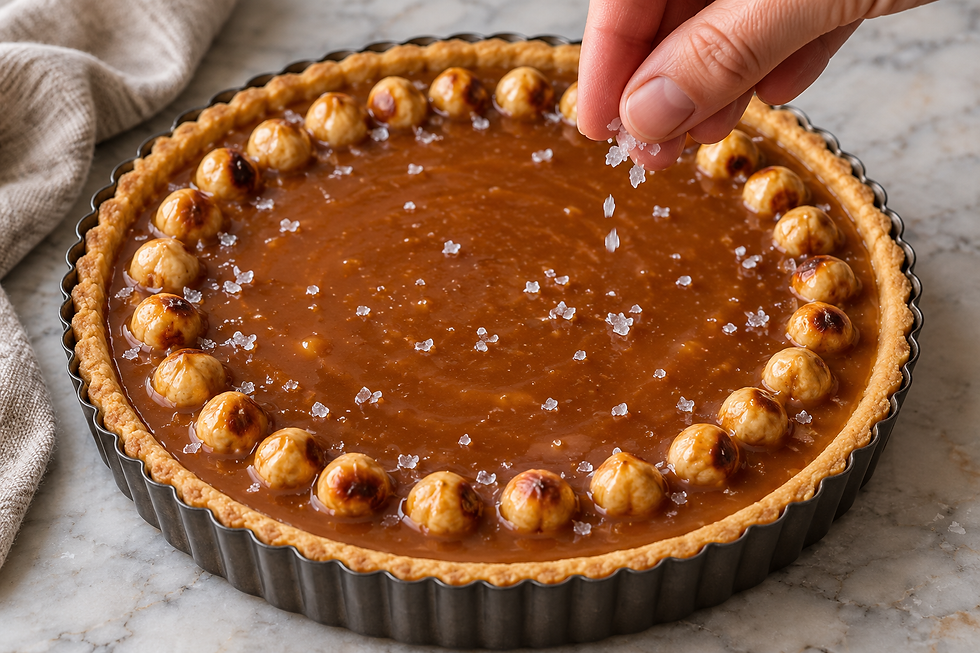
Set and finish the tart. Leave the tart at room temperature for at least 2 hours, until the caramel has set and no longer flows when the pan is tilted. Do not refrigerate it to speed up the setting, because the cold makes the caramel cloudy and the pastry absorbs moisture. If you use the chocolate, drizzle it in thin lines over the top with a spoon or a paper cone. Just before serving, scatter the flaky sea salt over the caramel. Salt added too early dissolves into the surface and loses its crunch.
Plating
Serve the tart at room temperature, about 68 to 72°F (20 to 22°C), when the caramel is soft and supple and the hazelnuts are crisp. Remove the ring of the tart pan by setting the pan on a large can and letting the ring drop, then slide the tart off its base onto a flat serving plate. Cut it with a sharp, heavy knife warmed in hot water and wiped dry, pressing straight down through the nuts and the pastry rather than sawing, which would crack the shell.
Place each slice on a flat plate with the point toward the guest. A spoonful of lightly whipped coconut cream or a small scoop of vegan vanilla ice cream beside it gives a cool contrast to the dense caramel. Finish with a few extra flakes of salt and one or two roasted hazelnuts, lightly crushed. The guest should find a crisp, sandy crust, a soft, glossy, bittersweet caramel and the crunch of the nuts in every forkful, with a final spark of salt.
Professional Technique
The key number is the final temperature of the caramel after the cream goes in. At 230 to 234°F (110 to 112°C) the caramel sets soft and sliceable at room temperature, like a firm toffee sauce. At 225°F (107°C) it stays runny and floods the plate when cut; at 240°F (116°C) or above it becomes chewy and hard to bite through. Use an accurate thermometer and check it in boiling water before you start: at sea level it should read 212°F (100°C).
The hidden variable is the color of the dry caramel before the cream. Sugar starts to caramelize around 320°F (160°C), and between 340 and 345°F (171 to 174°C) it develops the deep amber color and the complex, slightly bitter notes that make a salted caramel taste adult rather than simply sweet. Pale caramel tastes flat and sugary; caramel taken past 355°F (180°C) turns acrid. Judge the color in a light-colored pan, or drop a little on a white plate.
The doneness test for the whole tart is the tilt. After 2 hours at room temperature, tip the tart gently: the caramel should move slightly, like a thick gel, but not flow. A knife should cut a clean slice, and the edge of the caramel should hold its line for a few seconds before slowly relaxing.
Caramel and Crystallization Control
Caramel can fail in two directions. The first is crystallization: undissolved sugar crystals on the walls of the pan or a spoon stirred into the syrup can trigger a chain reaction that turns the whole pan into a grainy, opaque mass. Dissolve the sugar fully before boiling, do not stir once it boils, brush down the walls with water and add a little corn syrup or glucose, whose different sugars interfere with crystal formation.
The second failure is separation. When the hot caramel meets the coconut cream, fat and sugar must form an emulsion. If the cream is cold, the caramel seizes into hard lumps and the fat separates. Warm the coconut cream before adding it, pour it in three parts and stir until smooth before cooking further. If the finished caramel looks greasy, blend it for a few seconds with an immersion blender to bring the emulsion back together.
Water controls the texture of the shell. Caramel is hygroscopic: it draws moisture from the air and from anything it touches. A fully baked, dry shell resists that moisture for a day or two; an underbaked one softens within hours. For extra protection, brush the inside of the baked shell with a thin layer of melted dark chocolate and let it set before filling. The chocolate forms a barrier between the caramel and the pastry.
Professional Mise en Place
Make the pastry the day before or in the morning, and cook the caramel only when the shell and the hazelnuts are ready and cool. Caramel work moves fast: once the sugar starts to color, everything must already be measured beside the stove.
Equipment and tools
9 inch (23 cm) fluted tart pan with removable base, rolling pin, parchment
Baking beans or dried beans for blind baking, baking tray
Heavy, light-colored saucepan, heatproof spatula, wet pastry brush
Accurate candy or instant-read thermometer, clean kitchen towel
Prepared ahead
Pastry dough wrapped and chilled, up to 2 days ahead
Shell blind-baked and cooled, up to 1 day ahead, kept dry
Hazelnuts roasted, skinned and sorted into whole and halved
Coconut cream warmed, plant butter cubed, salt and vanilla measured
Service setup
Tart set at room temperature for at least 2 hours
Heavy knife, jug of hot water and towel for cutting
Flaky sea salt, whipped coconut cream or vegan vanilla ice cream
Flat dessert plates at room temperature
Chef Tips
Warm the coconut cream to about 160°F (70°C) before adding it to the caramel. The smaller the temperature difference between the two, the less violently the caramel bubbles and the smoother the emulsion. Shake the can well before measuring, so the cream and the liquid are evenly mixed.
If the caramel overshoots the target temperature and you fear it will be too hard, add 1 to 2 tbsp (15 to 30 ml) of hot water off the heat and stir: the water lowers the concentration of sugar. If it is too soft once cooled, warm it back up, cook it a few degrees higher and pour it again over the nuts.
For a more intense hazelnut taste, grind 1/4 cup (35 g) of the roasted hazelnuts into a fine paste and stir it into the finished caramel with the plant butter. The caramel becomes slightly opaque and develops a deeper, gianduja-like character, a nod to the hazelnut tradition of Turin.
Clean the caramel pan easily by filling it with water and bringing it to a boil: the hardened caramel dissolves in minutes. Never try to scrape it off cold.
Common Mistakes
Using a soft vegan spread. Tub spreads contain more water and less fat, and the pastry turns tough and pale. Use a firm plant butter block with at least 75 percent fat.
Underbaking the shell. The filling is never baked, so a pale shell stays soft and raw under the caramel. Bake it until evenly golden, base included.
Stirring the boiling syrup. Stirring drives crystals into the syrup and makes it grainy. Swirl the pan and brush the walls with water instead.
Stopping at a pale caramel. Light caramel tastes only sweet and gives a flat filling. Cook it to a deep amber, 340 to 345°F (171 to 174°C).
Adding cold coconut cream. Cold cream seizes the caramel and splits the fat. Warm it first and add it in three additions.
Guessing the final temperature. A few degrees decide between runny and chewy. Cook the caramel to 230 to 234°F (110 to 112°C) with a reliable thermometer.
Refrigerating the tart. Cold makes the caramel dull, hard and sweaty, and the shell softens. Set and keep the tart at cool room temperature.
Wine Pairing
Moscato d'Asti DOCG: From the same hills of southern Piedmont that grow the hazelnuts, a lightly sparkling, low-alcohol Moscato with peach, sage and orange blossom. Its freshness and fine bubbles lift the dense caramel and keep the palate clean. Serve it at about 43 to 46°F (6 to 8°C).
Vin Santo del Chianti Classico DOC: The Tuscan dessert wine made from dried grapes and aged for years in small barrels, with notes of dried apricot, toasted nuts and caramel. Its own nutty, oxidative character mirrors the roasted hazelnuts and the caramel almost perfectly. Serve it at about 54 to 57°F (12 to 14°C).
Colli Orientali del Friuli Picolit DOCG: A rare sweet white from the hills of eastern Friuli, made from the Picolit grape, with acacia flowers, candied fruit and an elegant, silky texture. Its finesse balances the salt and the bitter edge of the caramel. Serve it at about 50 to 54°F (10 to 12°C).
Ramandolo DOCG: A sweet white from the Verduzzo Friulano grape in the hills north of Udine, with dried fruit, chestnut notes and a light tannic grip. That faint tannin cuts through the sugar and fat of the filling. Serve it at about 50 to 54°F (10 to 12°C).
Storage & Reheating
Keep the tart at cool room temperature, below 72°F (22°C), loosely covered with a cake dome or a large inverted bowl, for up to 3 days. The pastry stays crisp for the first 2 days, then slowly softens as it absorbs moisture from the caramel. Avoid the refrigerator unless your kitchen is very warm; if you must refrigerate it, cover it well and let each slice stand at room temperature for 30 minutes before serving. Freezer: the baked, unfilled shell freezes well for up to 1 month, wrapped tightly. The filled tart does not, because the caramel weeps and the pastry turns soggy on thawing.
This tart is not reheated. If the caramel has become too firm in a cold room, warm each slice for 5 to 8 seconds in the microwave at low power, just enough to soften the surface, or leave it near a warm oven for a few minutes. Leftover caramel can be warmed gently in a small pan over low heat, stirring, and served as a sauce over vegan ice cream.
Nutrition
Per serving, based on 10 servings:
Calories: 470 kcal
Total Fat: 29 g
Saturated Fat: 10 g
Trans Fat: 0 g
Unsaturated Fat: 18 g
Cholesterol: 0 mg
Sodium: 240 mg
Total Carbohydrates: 49 g
Fiber: 3 g
Total Sugars: 30 g
Added Sugars: 29 g
Protein: 6 g
Principal micronutrients: vitamin E, manganese, copper, magnesium, iron, folate
These figures are estimates, calculated on the quantities listed and rounded to the nearest whole number, without the optional chocolate and the side served with the tart. They vary with the brand of plant butter and coconut cream and the size of the slices.


Comments