

Nero d'Avola vs Cannonau
- 2 hours ago
- 4 min read
Updated: 1 hour ago
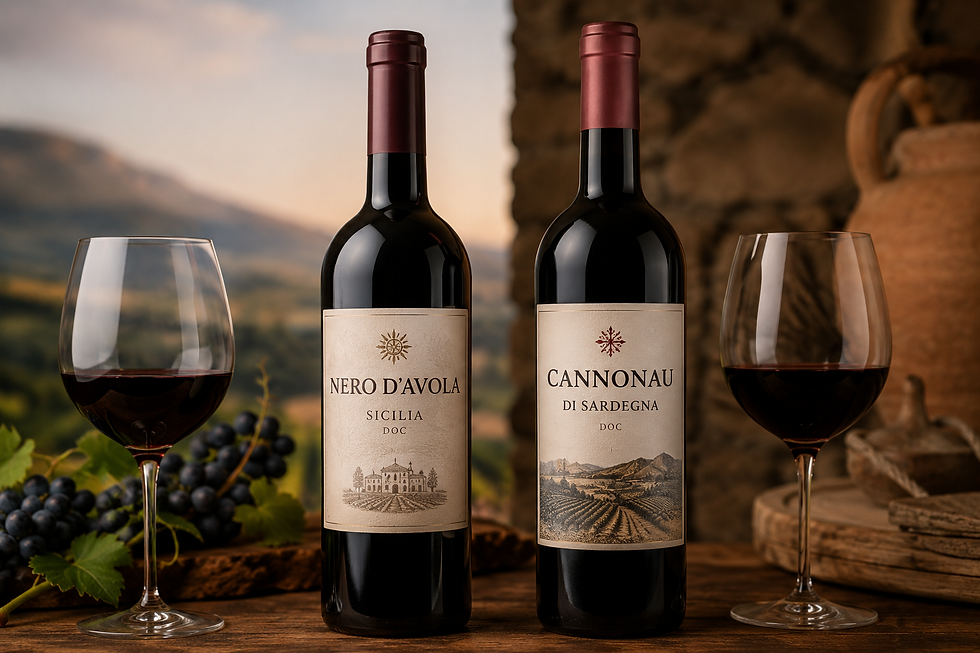
Sicily vs Sardinia: Which Mediterranean Red Wine Reigns Supreme?
Italy's two largest islands are home to two of the country's most iconic native red wines. Nero d'Avola, the pride of Sicily, and Cannonau, the flagship grape of Sardinia, are both deeply rooted in Mediterranean culture, yet they offer remarkably different expressions of terroir, history, and winemaking.
Nero d'Avola is celebrated for its bold fruit, smooth texture, and versatility, while Cannonau has earned worldwide recognition not only for its character but also for its association with the extraordinary longevity of Sardinia's Blue Zone population.
Both wines thrive under the Mediterranean sun, both pair beautifully with traditional Italian cuisine, and both deserve a place in every wine lover's collection. But which one is right for your table?
Let's discover what makes these two island legends unique.
The Regions
Nero d'Avola
Nero d'Avola originated near the town of Avola, in southeastern Sicily, and today it is planted throughout the island.
Sicily's climate offers:
Long, sunny summers
Mild winters
Coastal breezes
Volcanic, limestone, and clay soils
These conditions allow grapes to ripen fully while maintaining freshness.
Cannonau
Cannonau is cultivated across Sardinia but reaches its highest expression in regions such as:
Ogliastra
Nuoro
Jerzu
Oliena
Mamoiada
Gallura
Many vineyards are planted on granite hillsides overlooking the Mediterranean, where constant sea breezes and significant day-to-night temperature swings preserve acidity and aromatic complexity.
History
Nero d'Avola
Known as the "Black Grape of Avola," Nero d'Avola has been cultivated for centuries and became Sicily's signature red during the twentieth century.
Today it represents one of Italy's fastest-growing premium native varieties.
Cannonau
Most wine historians agree that Cannonau is genetically linked to Grenache (Garnacha), although Sardinians proudly argue that the grape has ancient roots on the island dating back thousands of years.
Archaeological discoveries suggest that Cannonau may have been cultivated in Sardinia long before the Romans arrived.
The Grapes
Nero d'Avola
Produces wines with:
Thick skins
Deep color
Moderate acidity
Soft tannins
Rich fruit concentration
Cannonau
Typically offers:
Medium color
Higher alcohol
Silky tannins
Bright acidity
Complex herbal character
Old vines often produce exceptionally concentrated fruit.
Appearance
Nero d'Avola
Deep ruby
Purple reflections
Dense color
Cannonau
Ruby red
Garnet highlights with age
Slightly lighter appearance
Aromas
Nero d'Avola
Typical aromas include:
Black cherry
Blackberry
Plum
Licorice
Cocoa
Black pepper
Sweet spices
Mediterranean herbs
Cannonau
Expect aromas of:
Wild strawberry
Raspberry
Red cherry
Dried rose
Myrtle
Rosemary
Sage
Leather
Tobacco
Juniper
The herbal profile reflects Sardinia's rugged Mediterranean landscape.
Taste
Nero d'Avola
Known for:
Full body
Smooth tannins
Rich fruit
Balanced acidity
Velvety finish
Its style is generous, approachable, and crowd-pleasing.
Cannonau
Offers:
Medium to full body
Elegant tannins
Bright acidity
Savory complexity
Long mineral finish
It often feels more refined and earthy than Nero d'Avola.
Alcohol Content
Nero d'Avola
Usually:
13–14.5% ABV
Cannonau
Generally:
14–15.5% ABV
The warm Sardinian climate frequently produces wines with naturally higher alcohol.
Aging Potential
Nero d'Avola
Most quality wines evolve beautifully for:
5–10 years
Top reserve bottlings can age for 15 years or more.
Cannonau
Premium examples can mature gracefully for:
10–20 years
Old-vine Cannonau often develops remarkable complexity with bottle age.
Food Pairings
Nero d'Avola
Excellent with:
Eggplant Parmigiana
Pasta alla Norma
Grilled sausage
BBQ ribs
Lasagna
Beef burgers
Aged Pecorino Siciliano
Cannonau
Perfect alongside:
Roast lamb
Suckling pig (Porceddu)
Wild boar stew
Grilled steak
Pecorino Sardo
Mushroom risotto
Charcoal-grilled vegetables
Its savory character makes it a natural companion to traditional Sardinian cuisine.
Price Comparison
Nero d'Avola
Typical prices:
Excellent bottles: $15–35
Premium labels: $40–70
Outstanding value for everyday drinking.
Cannonau
Typical prices:
Quality bottles: $20–45
Top producers: $50–100
Old-vine Cannonau offers exceptional quality at prices well below many famous Italian reds.
Famous Producers
Nero d'Avola
Planeta
Donnafugata
Feudo Maccari
Cusumano
Tasca d'Almerita
Feudi del Pisciotto
Firriato
Mandrarossa
Cannonau
Argiolas
Sella & Mosca
Cantina di Jerzu
Pala
Giuseppe Sedilesu
Olianas
Audarya
Cardedu
Which Wine Should You Choose?
Choose Nero d'Avola if you enjoy:
Bold fruit
Smooth texture
Rich, approachable reds
Excellent value
Versatile food pairings
Choose Cannonau if you prefer:
Greater complexity
Herbal Mediterranean aromas
Higher elegance
Minerality
Wines with aging potential
Final Verdict
Although both wines are born under the Mediterranean sun, they tell very different stories.
Nero d'Avola captures the warmth and generosity of Sicily. Its dark fruit, velvety texture, and approachable style make it one of Italy's finest everyday red wines and an exceptional value for wine lovers seeking richness without excessive tannins.
Cannonau, on the other hand, reflects the rugged beauty of Sardinia. With its wild herbs, red berries, mineral backbone, and remarkable balance, it offers a more savory and refined interpretation of Mediterranean winemaking. It is a wine that speaks of granite hills, sea breezes, and centuries of tradition.
Neither wine is superior—they simply express the unique identity of their islands. Nero d'Avola is bold and comforting, while Cannonau is elegant, earthy, and deeply connected to Sardinia's landscape and culture.
Chef Gianluca's Recommendation
If you're preparing Pasta alla Norma, grilled meats, or a hearty family dinner, open a bottle of Nero d'Avola. Its generous fruit and smooth tannins make it an easy crowd-pleaser.
If you're serving roast lamb, Sardinian porceddu, wild boar, or aged Pecorino Sardo, reach for Cannonau. Its herbal complexity and mineral character create one of the most authentic food-and-wine pairings Italy has to offer. Every serious wine enthusiast should experience both, as together they represent the soul of Italy's two great Mediterranean islands.


Comments