
Italian Rosemary Roasted Potatoes | Patate Arrosto Croccanti al Rosmarino

A roast potato is decided long before it goes into the oven. The variety fixes how much starch there is to work with, the boiling water decides how soft the outer millimetre becomes, and the temperature of the fat when the potato lands in the pan decides whether a crust forms at all. Everything that separates a pale disappointing tray from a shattering golden one happens in the twenty minutes before roasting starts.
The method is built on three moves. A parboil in properly salted water, which seasons the potato through and softens the surface. A hard shake in the dry pan afterwards, which roughs that surface into a fleece of broken starch. And a roasting pan of oil already smoking hot when the potatoes go in, so the outside seizes on contact instead of absorbing fat.
The variety matters more than any other single choice. Yellow fleshed potatoes of moderate starch, the kind Italy grows on the Bologna plain and on the Fucino and Sila uplands, hold their shape through the parboil and still go fluffy inside. A waxy salad potato will never crust properly and a very floury baking potato collapses in the water.
Yield: 6 side servings. Prep: 20 minutes. Cook: 1 hour. Total: about 1 hour 20 minutes. Difficulty: easy. Course: contorno. Region: eaten the length of Italy, with the strongest habits in Lazio, Abruzzo and Emilia.
The Story
The potato reached Italy in the second half of the sixteenth century and then sat almost unused for two hundred years, grown as curiosity and animal feed and distrusted because it came from underground. What broke the resistance was hunger and a handful of determined writers. Vincenzo Corrado, the Neapolitan cook and philosopher, published a treatise on the potato in 1798 arguing that it belonged on a proper table, and through the famines that followed landowners and agronomists pushed it into the fields because it yielded where grain had failed.
Once accepted it was adopted region by region and specific varieties took root. The Patata di Bologna DOP is the Primura, a yellow fleshed potato grown on the alluvial plain around the city. The Patata del Fucino IGP comes from a drained lake bed in Abruzzo, and the Patata della Sila IGP grows on the Calabrian plateau above 900 metres, where cool nights give a dense yellow flesh. All three share the moderate starch this method needs.
The habit of roasting them alongside meat is older than the potato itself, inherited from the vegetables that went under the spit before it. In Rome patate al forno are inseparable from abbacchio, the milk fed lamb of the Castelli, and the pieces are dropped straight into the roasting tin so the fat falling off the meat does the cooking. Rosemary comes from the same instinct, since it grows wild on stony ground across the peninsula and it is the one herb that survives an hour in a hot oven.
Ingredients
For the potatoes
Yellow fleshed potatoes, Yukon Gold or Desiree, 3 lb (1.35 kg)
Water for the parboil, about 3 quarts (2.8 L)
Coarse sea salt for the water, 2 tbsp (30 g)
Baking soda, 1/2 tsp (3 g)
For the roasting fat
Extra virgin olive oil, 1/2 cup (120 ml)
Fine sea salt, 1 tsp (6 g)
For finishing
Fresh rosemary sprigs, 4
Garlic cloves, unpeeled and lightly crushed, 2, optional
Flaky sea salt, to taste
Freshly ground black pepper, to taste
Preparation
Step 1: Choosing and cutting the potatoes

Peel the potatoes and cut them into pieces of roughly 2 inches (5 cm), aiming for chunks with several flat faces rather than neat cubes or rounds. Flat faces are what meet the pan and become crust, so a piece with four of them browns on four sides. Keep every piece within about half an inch of the same size, since mixed sizes give you burnt small ones and raw large ones from the same oven.
Step 2: The salted parboil

Put the potatoes in a large pot, cover with cold water by an inch, add the coarse salt and the baking soda and bring to a boil. Starting in cold water lets the outside and the centre heat together. The salt seasons the potato all the way through, which is the only chance you get, and the baking soda raises the pH so the surface starch breaks down faster. Boil for 8 to 10 minutes, until a knife enters the edge easily and meets resistance at the core.
Step 3: Draining and steam drying

Drain into a colander and leave the potatoes uncovered for 3 to 4 minutes, until the visible steam stops and the surfaces turn matt and chalky. Water on the surface has to boil off in the oven before any browning can begin, and every minute spent doing that is a minute the inside spends overcooking. Never rinse them and never cover them, since trapped steam condenses straight back onto the potato.
Step 4: Scuffing the surfaces
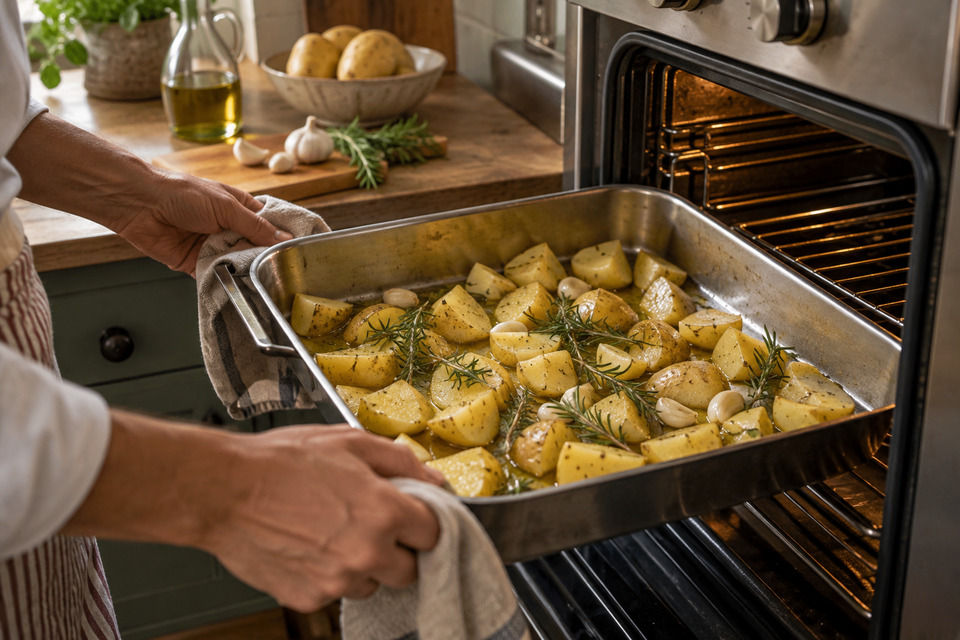
Return the drained potatoes to the dry pot, put the lid on and shake hard three or four times, or turn them with a spoon until the edges look ragged. You are not trying to break them, only to rough up the outer millimetre that the parboil softened into a slurry of starch. That ragged fleece is the entire crust. A potato that goes into the oven smooth roasts into something pleasant and completely unmemorable.
Step 5: Heating the fat in the roasting pan

Heat the oven to 425°F (220°C) with a heavy metal roasting pan inside it, the oil already poured in, and give it a full 10 minutes. The oil should be shimmering and just short of smoking when the potatoes arrive. Use metal, never glass or ceramic, which hold heat badly and give it back too slowly. This preheated fat is what separates a potato that seizes on contact from one that sits in cooling oil and drinks it.
Step 6: The first roast, undisturbed

Slide the pan out, add the fine salt to the oil and tip the potatoes in, spreading them in a single layer with clear space around each piece. They should hiss immediately. Roast for 25 minutes without touching them and without opening the door. The underside needs that uninterrupted contact with hot metal and hot fat to set into a shell, and a piece lifted too early tears and leaves its crust behind.
Step 7: Turning, adding rosemary and building the final crust
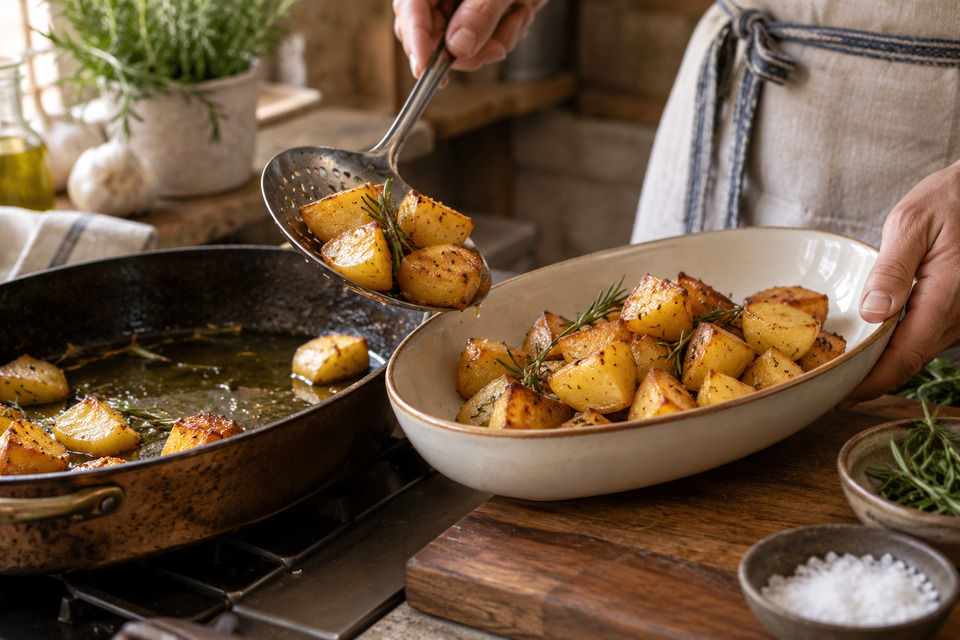
Turn each piece with a thin metal spatula, sliding under rather than prying. Tuck in the rosemary sprigs and the crushed garlic if you are using it, raise the oven to 450°F (230°C) and roast for a further 20 to 25 minutes until every visible face is deep gold. The rosemary goes in now and not at the start, because an hour at this temperature turns it black and bitter.
Plating
Lift the potatoes out with a slotted spoon, let them drain for a few seconds and tip them into a warmed shallow dish rather than a deep bowl. Depth is the enemy: a heap three layers thick traps steam from the pieces underneath and the crust on the bottom half is soft before the dish reaches the table. Spread them out, one or two layers at most.
Season at the last moment with flaky sea salt and coarsely ground black pepper. Salt added in the pan dissolves into the oil and disappears, while salt added on the way to the table stays in crystals on the crust, which is why a good roast potato tastes seasoned in bursts. Pull out the roasted rosemary sprigs, strip the needles, scatter a few over and discard the stems.
Serve within 10 minutes of leaving the oven, uncovered, never under foil. Beside roast lamb, pork or chicken, spoon the meat juices onto the plate rather than over the potatoes and let the diner decide how much crust to sacrifice.
Professional Technique
The parboil is doing chemistry, not just cooking. Heat and water make the starch granules in the outer layer swell and burst, and the small amount of baking soda raises the pH of the water, which accelerates the breakdown of pectin holding the surface cells together. The result is a thin layer of gelatinised starch slurry sitting on a still firm potato. Shaking the pan smears that layer into a ragged fleece with an enormous surface area, and surface area is precisely what browning needs.
The preheated fat is the second half of the same argument. Oil at around 400°F (200°C) transfers heat into the potato far faster than hot air can, so the outer layer dehydrates and sets within seconds of contact. Oil poured cold into a cold pan takes several minutes to reach that point, and during those minutes the potato behaves like a sponge. The same quantity of oil gives a crisp potato in one case and a greasy one in the other.
Choosing olive oil rather than a neutral fat is a real decision at these temperatures. A decent extra virgin olive oil smokes at around 410°F (210°C), which is why the first stage sits at 425°F (220°C) rather than higher and why the final push to 450°F (230°C) lasts only twenty minutes. Used that way it browns cleanly and leaves a flavour no seed oil can give.
Texture and Moisture Control
A roast potato is a contrast between two states of the same vegetable, and both have to be managed independently. The inside should be soft, dry and slightly floury, which means it needs to finish above about 200°F (93°C) internally so the starch fully gelatinises. The outside needs to lose almost all of its free water, because browning cannot start while a surface is still at boiling point.
Crowding is the most common way this fails. Potatoes give off water for the first fifteen minutes in the oven, and a pan packed edge to edge holds that water as a layer of steam, so the pieces poach in their own moisture instead of frying. Give each piece visible space and use two pans if you have to. If the pan stops sizzling after the first minute, it is too full.
Once out of the oven the crust starts to die immediately, defeated by the steam still escaping from inside each piece. That is why they never go under foil, into a covered dish or into a deep pile. Fifteen minutes on a warm open platter is about the limit before the shatter turns to chew.
Professional Mise en Place
This is a timing dish rather than a complicated one. The parboil can be done well ahead but the roast cannot, so work backwards from when you want to eat and reserve the last hour of oven time for the potatoes alone.
Equipment and tools
Heavy metal roasting pan, large enough for a single layer
Large pot for the parboil, with a well fitting lid for the shake
Colander, thin metal spatula and a slotted spoon
Oven thermometer, since domestic ovens routinely run cool
Warmed shallow serving dish, never a deep bowl
Prepared ahead
Potatoes peeled and cut, up to 4 hours ahead, held in cold water
Potatoes parboiled, shaken and cooled on a rack, up to 1 day ahead, uncovered in the refrigerator
Rosemary picked over and garlic crushed, on the day
Oven and roasting pan preheating 15 minutes before the potatoes go in
Service setup
Oven at 425°F (220°C) with the oiled pan already inside
Flaky salt and a pepper mill beside the serving dish, not in the kitchen
Serving dish warmed and left uncovered
Meat resting before the potatoes come out, so nothing waits on them
Chef Tips
Weigh the potatoes after peeling, not before. Peeling loses between 15 and 20 percent, and a recipe built on 3 lb (1.35 kg) of prepared potato in a single layer stops working if you start with 3 lb unpeeled.
If your oven runs cool, and most do by 20 to 40 degrees, the whole method suffers and you will blame the potatoes. Buy an oven thermometer, leave it inside permanently and set the dial to whatever actually delivers 425°F (220°C). It is the cheapest improvement available to a home cook.
Parboil the day before if you are cooking a large meal. Cooled uncovered on a rack in the refrigerator overnight, the scuffed surfaces dry out further and crisp even better than fresh ones. Take them out while the oven heats so they are not going into hot fat straight from the cold.
Save the flavoured oil left in the pan. Strained into a jar and refrigerated it keeps for two weeks, and it is excellent for frying eggs or starting a soffritto. Do not reuse it for a second batch of roast potatoes, since it has already darkened.
Common Mistakes
Using the wrong potato. Waxy salad varieties hold too little starch to build a crust, while very floury baking potatoes disintegrate during the parboil. A yellow fleshed potato of moderate starch does both jobs.
Putting potatoes into cold oil. Fat that is not already hot is absorbed before the surface can seal, and the result is heavy and greasy rather than crisp. The pan and the oil go into the oven ten minutes before the potatoes do.
Skipping the shake. Without it there is no ragged starch layer and very little surface for browning. Smooth parboiled potatoes roast smooth and pale, and no amount of extra oven time fixes it.
Crowding the pan. Pieces touching each other trap steam between them and poach instead of roasting. Use two pans rather than squeeze everything into one.
Turning them too early or too often. The first side needs a full 25 uninterrupted minutes to set, and a piece lifted before then tears and leaves its crust stuck to the metal. Turn once, at the halfway point.
Adding the rosemary at the start. Fifty minutes at this temperature reduces rosemary needles to black bitter splinters. Add the sprigs whole at the turn, when there are twenty minutes left.
Wine Pairing
Colli Bolognesi Pignoletto DOCG: From the hills above the plain that grows the Patata di Bologna, which makes it the most local white available. Its dry, faintly bitter finish and lively acidity cut the olive oil cleanly, and the green pear and white flower aromatics sit against roasted rosemary rather than competing with it.
Frascati Superiore DOCG: The Roman answer, poured beside a tray of patate al forno and roast lamb in the Castelli for a very long time. Dry, brisk and moderately structured, it refreshes the palate between forkfuls of fried starch without adding weight, and its faint almond bitterness picks up the browned edges.
Verdicchio dei Castelli di Jesi Classico Riserva DOCG: The choice when the potatoes are the main event rather than a side. A Riserva has the body and the saline depth to stand up to a plate of nothing but crust and salt, and its high acidity keeps working through a fatty mouthful where a softer white would give up after two.
Montepulciano d'Abruzzo DOC: The red from the region of the Fucino potato, and the right choice when these arrive beside roast pork. Its soft round tannin does not fight the starch, the dark plum fruit meets the caramelised surfaces, and there is enough acidity underneath to stop the combination turning heavy.
Chianti Rufina DOCG: The most structured option here and the one for a full Sunday roast. Grown at higher altitude than the rest of Chianti, it keeps a firm acidity and a savoury herbal edge that echoes the rosemary directly, while its tannin has the grip to handle both the meat and the oil the potatoes carry.
Storage & Reheating
Cooked roast potatoes keep in the refrigerator for 3 days in a container left slightly open rather than sealed, because a tight lid traps moisture and turns the crust to paste overnight. Let them cool completely on a rack first, and never wrap them in foil.
Reheat only in a very hot oven, 450°F (230°C), spread on a preheated metal tray for 8 to 10 minutes, and do not add fresh oil. This drives off the moisture the crust absorbed in the refrigerator and brings back most of the original snap. A microwave cannot work here, since it heats by exciting water and puts the potato back into the state you spent an hour removing.
Parboiled and scuffed potatoes freeze extremely well and are worth making in quantity. Cool them completely, freeze them spread on a tray until firm, then bag them for up to 3 months. Roast from frozen straight into the preheated fat, adding about 10 minutes to the first stage. Fully roasted ones freeze too but come back noticeably duller.
Nutrition
Per serving, based on 6 side servings:
Calories: 285 kcal
Total Fat: 14 g
Saturated Fat: 2 g
Trans Fat: 0 g
Unsaturated Fat: 12 g
Cholesterol: 0 mg
Sodium: 390 mg
Total Carbohydrates: 37 g
Fiber: 4 g
Total Sugars: 2 g
Added Sugars: 0 g
Protein: 4 g
Lactose: 0 g
Principal micronutrients: vitamin C, potassium, vitamin B6, magnesium, iron, niacin
These figures are estimates. Fat is the variable, since the amount of oil actually absorbed depends almost entirely on how hot the pan was when the potatoes went in.


Comments