
Italian Salt Crusted Fish | Pesce al Sale

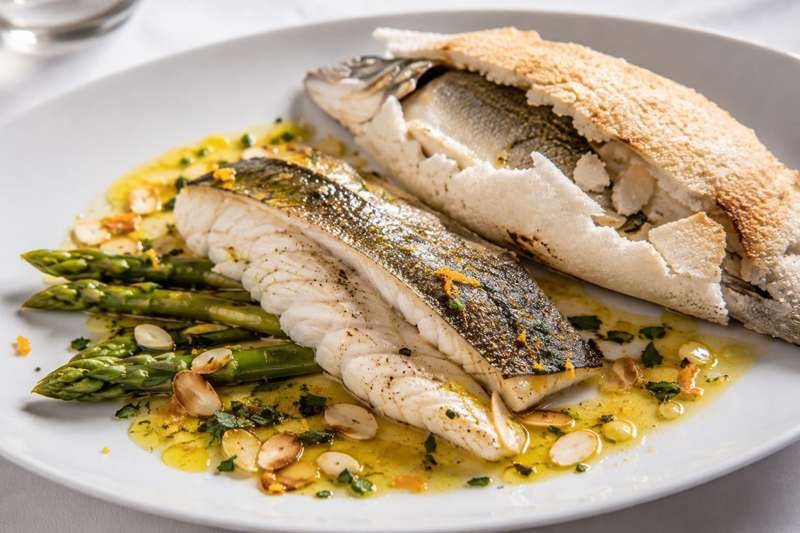
Pesce al sale is the only way of cooking a whole fish in which the cook builds the oven around the fish. A branzino is laid on a bed of coarse sea salt bound with egg white and a little water, buried under more of the same, and sent into a hot oven. The salt sets into a rigid dome within minutes, and from then on the fish steams inside a chamber of its own making at a humidity that never drops. Nothing evaporates because nothing can leave.
The result surprises people who have never eaten it: the fish is not salty. Its skin and its scales, left deliberately in place, stand between the flesh and several pounds of salt, which is why a fish for the crust is gutted but never scaled. The crust comes out the colour of dry clay and is cracked open in front of whoever is eating.
Yield: 2 servings, or 4 as part of a larger meal. Prep: 20 minutes. Cook: 30 to 35 minutes. Rest: 5 minutes. Total: about 1 hour. Difficulty: intermediate. Course: secondo di pesce. Region: the Italian coast.
The Story
Cooking in salt is one of the oldest documented techniques in the Mediterranean and it predates the oven as we understand it. Roman writers describe fish and birds baked in a shell of salt and clay, and the logic was practical rather than refined: salt was abundant on any coast where the sun did the work, and a sealed case of it let a cook roast something over a fire without drying it out and without a vessel.
The salt itself is Italian history. The saline of Trapani on the western coast of Sicily have been worked since Phoenician times and still turn out the coarse marine salt Sicilian kitchens reach for. Cervia in Romagna supplied the Papal States and kept a reputation for sweet salt low in bitter magnesium. Margherita di Savoia in Puglia is still one of the largest salt works in Europe.
On the coast the technique attached itself to whatever came out of the boats whole and firm: branzino above all, orata, dentice. It belongs to no single region, and anyone who claims one is guessing. What it belongs to is a kind of restaurant, the seafood place where the catch is shown to the table on ice before it is cooked. The crust is carried out whole, cracked open in the dining room, the steam comes up smelling of bay and lemon, and the fish is filleted in front of the person who ordered it.
Ingredients
For the fish
Whole branzino, European sea bass, gutted and gilled but NOT scaled, 2 lb (900 g)
Lemon, sliced into thin rounds, 1/2
Fresh bay leaves, 2
Wild fennel fronds or dill, 1 small handful
Flat leaf parsley, 4 sprigs
Freshly ground black pepper, to taste
For the salt crust
Coarse sea salt, 4 lb (1.8 kg)
Egg whites, large, 3
Cold water, 1/4 cup (60 ml), approximately
For finishing
Extra virgin olive oil, 3 tbsp (45 ml), the best bottle in the house
Lemon wedges, 2
Flaky finishing salt, a very small pinch, only if needed
Freshly ground black pepper, to taste
Oven temperature: 425°F (220°C), conventional heat, rack in the middle. Target internal temperature: 131°F to 135°F (55°C to 57°C).
Preparation
Step 1
Choose the fish. No technique rescues a tired fish sealed in salt. The eye should be clear, domed and wet looking, never sunken or clouded. Lift the gill cover: the gills must be bright red and clean. The body should be rigid enough to stay horizontal on your flat palm, and it should smell of clean seawater and nothing else. Ask the fishmonger to gut it and take the gills out through the belly but to leave the scales on, and say so twice, because scaling is automatic behaviour behind most fish counters.
Step 2
Dry it and fill the cavity. Rinse the belly cavity to clear any blood, then dry the fish thoroughly inside and out. Surface water thins the crust where it touches and can open a channel for salt to reach the flesh. Slide the lemon rounds, bay leaves, fennel fronds and parsley into the cavity with a few grinds of pepper. Do not salt the cavity and do not cut the skin anywhere. These aromatics perfume the steam trapped inside the crust, so on a fish this delicate three or four scents are plenty.
Step 3
Mix the salt. The working ratio is roughly 2 pounds of coarse salt for every pound of fish, so a 2 lb (900 g) branzino wants about 4 lb (1.8 kg). Whisk the egg whites to a loose foam, frothy rather than to peaks, and fold them through the salt with your hands. Add cold water a tablespoon at a time until a squeezed fistful holds its shape and feels like wet sand at the edge of the tide. Too dry and it will not set. Too wet and it seeps.
Step 4
Build the bed and bury the fish. Line a heavy sheet pan with parchment and spread about one third of the salt in a layer roughly 1/2 inch (1.25 cm) thick, a little longer and wider than the fish. Lay the branzino on it and pack the rest over the top, pressing firmly against the flanks and moulding a smooth dome that follows the body. Every square inch must be covered, head and tail included. A single gap is a vent: steam escapes, the salt around it crumbles, and that side cooks unevenly.
Step 5
Bake by weight, then measure. Into the oven at 425°F (220°C). The rule worked by cooks on the coast is 15 to 18 minutes per pound of whole fish, or 30 to 40 minutes per kilo, which puts this branzino at 30 to 35 minutes. Treat it as a window and read the crust, which turns from grey and damp to matt and dry as fine cracks open across the dome. Then take the only reliable measurement: push an instant read probe through the salt into the thickest flesh behind the head, alongside the backbone, and pull the pan at 131°F to 135°F (55°C to 57°C).
Step 6
Rest, crack it at the table and fillet. Let the sealed fish stand 5 minutes, enough for the heat to even out and not so long that the crust hardens further. Carry the pan out whole and tap around the base of the dome with the back of a heavy spoon until it fractures, then lift the pieces off. The skin comes away with the crust in sheets, taking the scales and every grain of salt with it. Run a spoon along the backbone, lift the top fillet, remove the spine from the tail end and the second fillet lifts clean. Pour good olive oil over it raw and let that be the only sauce.
Plating
Warm the plates, because this fish loses heat faster than almost anything else you will serve and it is dressed with cold oil. Lay each fillet with the side that faced the crust downward and keep it intact rather than cutting it into portions.
The plate should stay close to empty. A spoonful of olive oil across the fish, a turn of black pepper, one lemon wedge to the side and nothing more. Boiled potatoes dressed in the same oil, spinach wilted in garlic, or raw fennel sliced thin are the accompaniments this dish has always had on the coast, and they belong beside it rather than under it. A fish cooked this way has one flavour to show and every addition takes something off it.
Professional Technique
The salt crust is a cooking chamber, and that is the whole of the technique. Coarse salt on its own is a loose pile of crystals; bound with whisked egg white and a little water it becomes a mouldable mass, and once the oven drives off the surface moisture the albumen coagulates between the crystals and cements them into a rigid shell. From that point the fish is not roasting. It is steaming, in nothing but the water leaving its own flesh, inside a sealed vessel where the humidity sits at saturation and cannot fall. Dry oven air never touches it and there is no evaporative loss at all.
The second half of the technique is the barrier, and it explains the instruction that surprises everyone. Salt travels into flesh only through water, and a whole fish that still has its scales and unbroken skin presents a surface salt cannot cross in thirty minutes. The scales are overlapping plates of hard keratinised tissue and the skin beneath them is dense connective tissue: together they take the salt and the flesh does not. That is why the fish is gutted and gilled but never scaled, why the skin must not be slashed, and why the belly is never salted.
The crust also has to come off, and it does so in a way no other method offers. Salt bound with albumen contracts as it dries and ends up under tension, so a sharp tap propagates a crack right through the dome instead of crumbling it. As the shell releases it takes the skin with it, having been pressed against the setting salt for half an hour, and scales, skin and salt lift away together in sheets. That is why the crust is broken in the dining room and not in the kitchen: it is not decoration, it is the last step of the cooking.
Texture and Moisture Control
Inside the crust the humidity is fixed and the only variable left is temperature, so the internal reading is the whole of the control. Fish muscle is short fibres in thin sheets held by very little connective tissue, and those proteins set between about 122°F and 140°F (50°C and 60°C). Taken out at 131°F to 135°F (55°C to 57°C) the flesh has just turned opaque and separates into large moist flakes. A sealed crust protects you from dry heat but not from overcooking, and it hides every visual cue, which is exactly why the probe is not optional.
The consistency of the salt mixture is the other control. Wet sand is the target: a squeezed fistful should hold and not weep. Too little water and the crust never sets hard and collapses when you lift it. Too much and the salt runs off the flanks and pools under the fish, and wet salt sitting against the belly skin for half an hour is the one route by which the fish really can come out too salty. The five minute rest lets the heat even out while the crust is still warm enough to fracture cleanly.
Professional Mise en Place
There is almost nothing to hold here and almost nothing to fire: the fish goes into the oven once and comes out finished. What has to be ready is the salt, the plates and the space to break the crust.
Equipment and tools
Heavy rimmed sheet pan, larger than the fish at every edge
Instant read probe thermometer, the most important tool here
Large bowl for the salt and a whisk for the egg whites
Heavy spoon for cracking the crust, two spoons for filleting
Prepared ahead
Fish bought the same day, gutted, gills out, scales on, kept on ice
Salt mixed up to 2 hours ahead, covered so it does not dry
Lemon sliced and herbs picked, cavity filled just before burying
Plates and serving platter warming, since this dish cools fast
Service setup
Oven at full temperature and stable before the pan goes in
Timer set to the low end of the window, then the probe
Olive oil at room temperature, lemon wedges cut
A tray to take the broken crust away from the table
Chef Tips
Tell the fishmonger not to scale it and then check the fish yourself before you leave the counter. This is the instruction ignored most often and the one the dish cannot survive. Run a thumb backwards along the flank and you should feel the scales catch.
Buy coarse marine salt in a large bag. Fine table salt packs dense, sets closer to concrete, dissolves far more readily against the skin and is a waste of money at this volume.
Weigh the fish at home and write the time on the pan. Minutes per pound is a useful rule until you are facing a sealed white dome with no idea how long it has been in there.
Keep the aromatics quiet. Bay, lemon, parsley and a little wild fennel are traditional and sufficient. Rosemary, thyme and garlic all steam hard inside a sealed crust and cover the delicate sweetness of a branzino.
Common Mistakes
Using a scaled fish. Without scales and unbroken skin there is no barrier, the salt reaches the flesh directly and the fish comes out inedible. Check at the counter, not at home.
Leaving a gap in the crust. Any uncovered patch, most often at the tail, vents the steam and turns a sealed chamber back into an open oven. Mould the salt over both ends.
Getting the salt mixture wrong. Too dry and the crust collapses when you lift it. Too wet and it runs off and pools under the belly. A fistful should hold like wet sand and release no water.
Cooking to the clock alone. The weight rule gives a window, not a finishing point, and the crust hides every cue. Probe through the salt and pull the fish at 131°F to 135°F (55°C to 57°C).
Salting the cavity or slashing the skin. Both open a direct route for salt into the flesh. The cavity takes lemon, herbs and pepper and nothing else.
Breaking the crust in the kitchen. The fish loses heat on the way to the table and the dish loses the one moment that makes it memorable. Carry the pan out whole.
Wine Pairing
Vermentino di Gallura DOCG: The reference match. Grown on decomposed granite in northern Sardinia, it carries a saline bite that meets the sea character of the fish head on, and its citrus acidity cuts the raw olive oil poured over the fillet. The faintly bitter almond finish keeps the palate awake through a dish with no sauce.
Etna Bianco DOC: Carricante grown high on volcanic soil, flinty and taut, with an acidity that stays straight rather than fruity. That austerity is why it works: a branzino cooked in salt has a clean sweetness and very little fat, and a wine with this little aromatic noise leaves the fish audible.
Verdicchio dei Castelli di Jesi Classico Riserva DOCG: An Adriatic white with more body than most, which matters when a whole fish is eaten slowly. The riserva has texture enough to stand beside the oil, a firm saline undertow from vineyards near the sea, and the bitter almond finish Verdicchio always shows. No oak sweetness, nothing aromatic.
Franciacorta DOCG: The metodo classico option, to open while the crust is being cracked. Bottle fermentation gives fine persistent bubbles and a bready depth, the acidity is high and the dosage low enough to keep it properly dry. Carbon dioxide and acidity together scour the oil off the palate between mouthfuls.
Cinque Terre DOC: A Ligurian blend from terraces cut into cliffs above the water, and the most delicate wine here. Light, dry, faintly salty and almost neutral, which is precisely its argument: an aromatic white would bury a fish this subtle under lychee or cut grass. This one stands next to it.
Storage & Reheating
This is a dish to cook and eat, not to keep, and that is the one weakness of the method. Break the crust and the protection is gone. Take every piece of flesh off the bone while it is still warm, remove all skin and stray crystals, and refrigerate the fillets in an airtight container with a spoonful of olive oil over them. They keep 2 days and no longer, and never inside the broken crust, which goes on drawing water out of the flesh.
Do not reheat it in an oven, which finishes the drying the crust prevented. Better not to reheat it at all: bring the fillets to room temperature for 20 minutes and eat them cold with oil, lemon and parsley, which is how coastal kitchens have always used the second day. If you want them warm, lay the pieces in a covered pan with a tablespoon of water on the lowest flame for 2 minutes. Cooked fish freezes badly, so do not freeze it. The bones are another matter: simmer them 20 minutes for a light fumetto and freeze that instead.
Nutrition
Per serving, based on 2 main course portions:
Calories: 400 kcal
Total Fat: 24 g
Saturated Fat: 4 g
Trans Fat: 0 g
Unsaturated Fat: 19 g
Cholesterol: 115 mg
Sodium: 480 mg
Total Carbohydrates: 1 g
Fiber: 0 g
Total Sugars: 0 g
Added Sugars: 0 g
Protein: 42 g
Lactose: 0 g
Principal micronutrients: omega 3 fatty acids, vitamin D, vitamin B12, selenium, iodine, potassium, phosphorus
These figures are estimates. The sodium number looks improbable next to 4 lb of salt and it is correct: the crust is discarded whole and the skin and scales stop almost all of it.


Comments