
Slow Cooked Octopus in a Terracotta Pot | Polpo alla Pignata

Polpo alla pignata is named after a pot, not after a technique or a town. The pignata is the round bellied terracotta vessel of Puglia, wide at the base and drawn in at the neck, built to sit at the edge of a wood fire for hours and then be ignored. Inside it an octopus cooks with onion, garlic, tomato, parsley and olive oil until the tentacles part under the side of a spoon.
The pot is not nostalgia. Fired clay is slow to heat and slow to let go of it, so the contents hold a steady bare simmer instead of following the flame, and the narrow neck slows evaporation enough for an octopus to cook for over an hour in liquid it made itself. In a metal pan you recreate that on purpose: heavy base, a lid that seals, a burner lower than instinct says.
There are two traditional versions and both are here. The coastal one, from the fishing towns of the Salento, stays lean and is eaten with bread. The inland one, from Lecce up onto the Murgia, adds potatoes that finish in the sauce and turn the braise into a whole supper from one vessel. Neither takes a drop of added water.
Yield: 6 servings. Prep: 20 minutes. Cook: 50 to 80 minutes. Rest: 10 minutes. Total: about 1 hour 50 minutes. Difficulty: intermediate. Course: secondo piatto. Region: Puglia, the Salento and the Murgia.
The Story
The pignata belongs to the ceramic tradition of the Salento, where towns such as Grottaglie and Cutrofiano built whole economies on fired clay and still do. A kitchen kept several in different sizes, and the shape was engineering rather than decoration: the narrow neck held steam in, the bulging belly let the contents turn in a slow convection, and the porous walls took heat from embers instead of from a flame. The same pot cooked fava beans, chickpeas and lentils, which is why the vessel lends its name to a family of Pugliese dishes rather than to one recipe.
Octopus reached it from the two coasts that squeeze the peninsula between them, Gallipoli and Porto Cesareo on the Ionian side, Otranto and Castro on the Adriatic. The catch was worked on the quay long before it saw a kitchen: fishermen beat and swirled the octopus against wet rock, the gesture the Pugliesi call arricciare il polpo, curling the octopus, which breaks the muscle down and sets the tentacles into their spiral. What did not sell fresh went home to be cooked long and slow.
Inland the dish becomes another one. Up on the limestone plateau of the Murgia, potatoes go into the pot, a move that belongs to a farming economy rather than a fishing one and stretches an expensive protein into a family meal. The potatoes drink the marine liquid, the starch rounds the tomato, and one vessel comes to the table.
Ingredients
For the octopus and the base
Cleaned octopus, whole or in large pieces, 3 lb (1.36 kg)
Extra virgin olive oil, 3 tbsp (45 ml)
Yellow onion, thinly sliced, 1 medium
Garlic cloves, lightly crushed, 3
Flat leaf parsley stems, from 1 small bunch
For the sauce
Crushed peeled tomatoes, 2 cups (480 g)
Dry white wine, optional, 1/2 cup (120 ml)
Dried peperoncino, small, 1
Bay leaf, 1
Freshly ground black pepper, to taste
Fine sea salt, at the end only and only if needed
For finishing and the inland version
Waxy potatoes, peeled, in large chunks, 1 lb (450 g), inland version
Flat leaf parsley leaves, chopped at the last moment
Extra virgin olive oil, raw, 2 tbsp (30 ml) for the table
Country bread, grilled, 6 thick slices
Preparation
Six movements over about an hour and a half, and only the first twenty minutes ask anything of you. The one decision that ruins this dish, adding liquid, is made in the first five.
Step 1
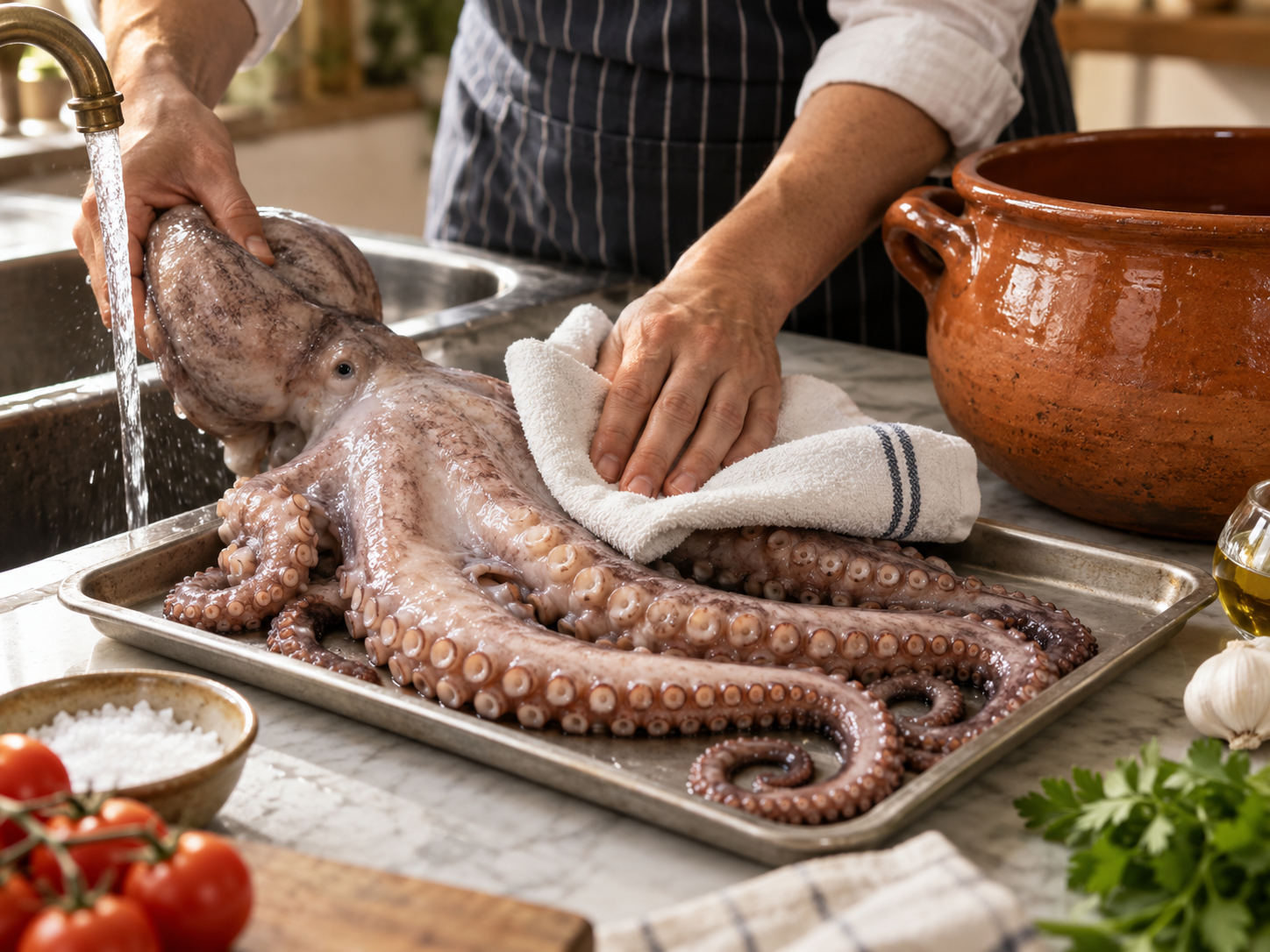
Rinse the cleaned octopus under cold water and pat it completely dry. Leave it whole if the pot takes it, or cut it into two or three large pieces at most: every cut is a place where juice escapes, and small pieces dry out long before their collagen softens. Octopus frozen and thawed slowly in the refrigerator is not a compromise here and is often the better buy.
Step 2
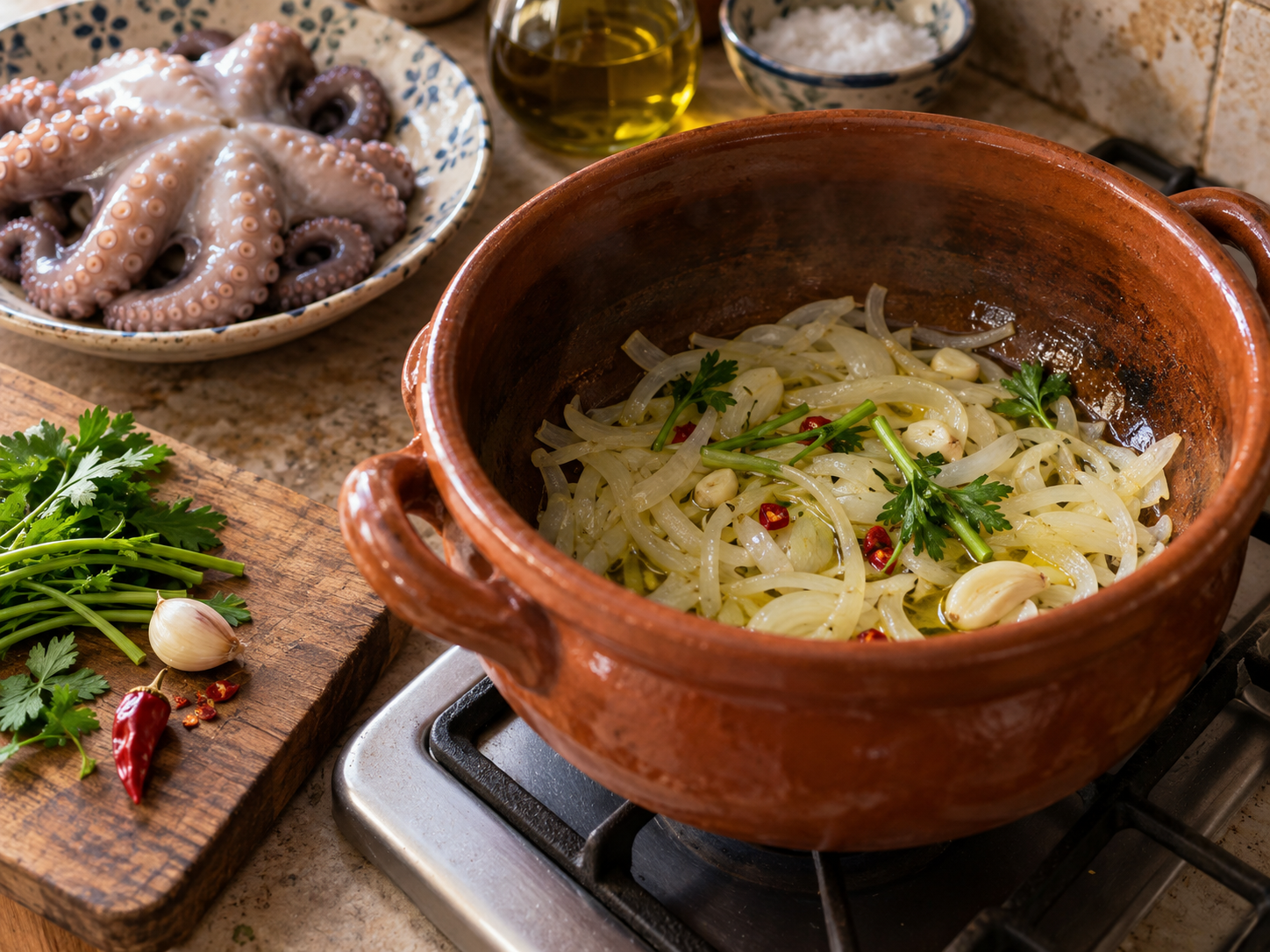
Set the pignata or a heavy pot over medium low heat and warm the oil without letting it shimmer. Soften the sliced onion for 6 to 8 minutes until translucent but still pale, then add the crushed garlic, the parsley stems and the dried peperoncino for 1 minute more. Nothing should colour: browned garlic in a braise this long turns bitter and stays bitter.
Step 3
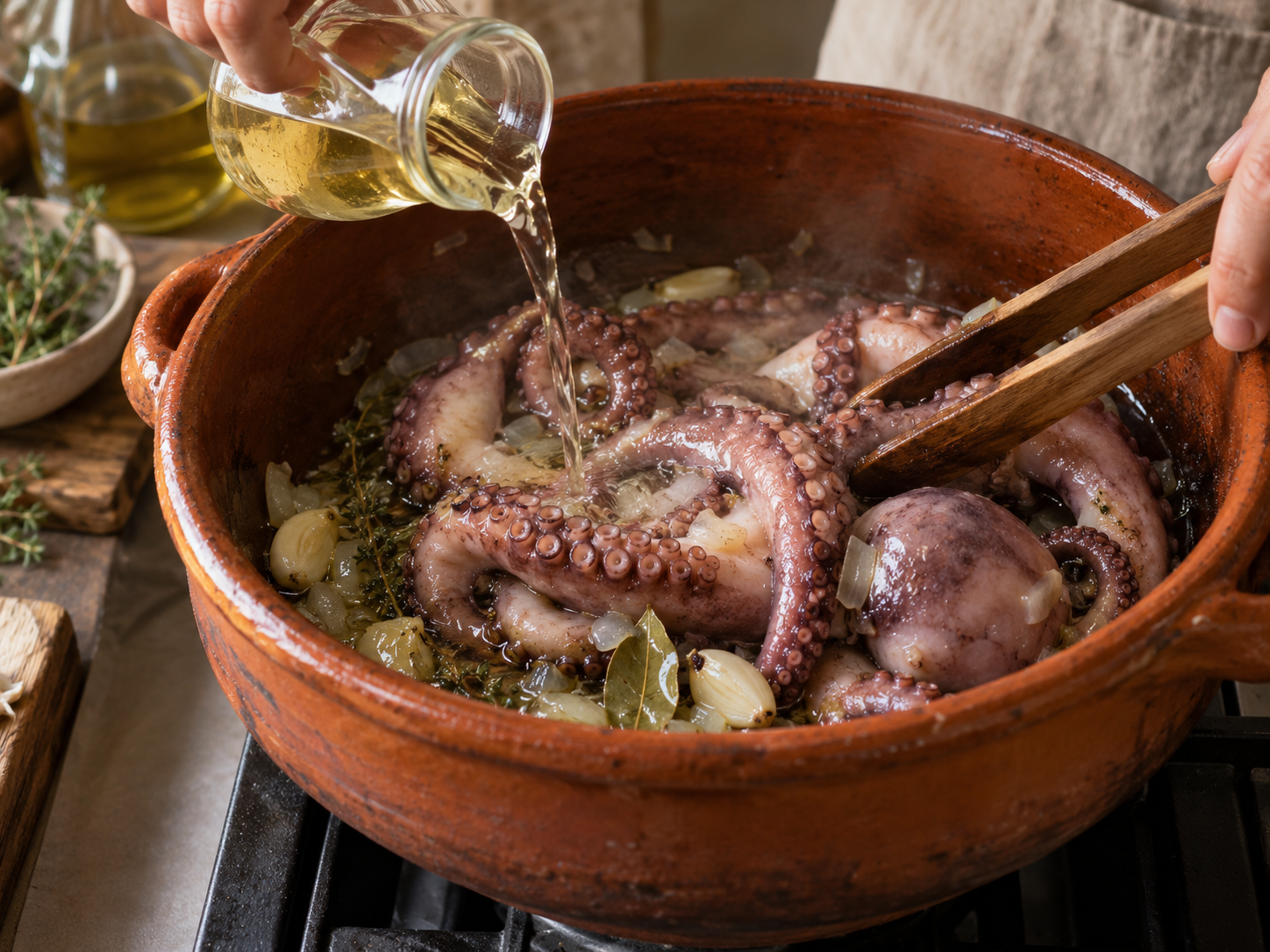
Slide in the octopus and turn it in the oil for 2 to 3 minutes. The skin tightens, takes colour and begins to weep, and liquid appears in the pot that was not there before. That liquid is the stock of the dish. If you are using wine, add it now and let the sharp alcohol smell go. Add no water, stock or broth, now or later.
Step 4
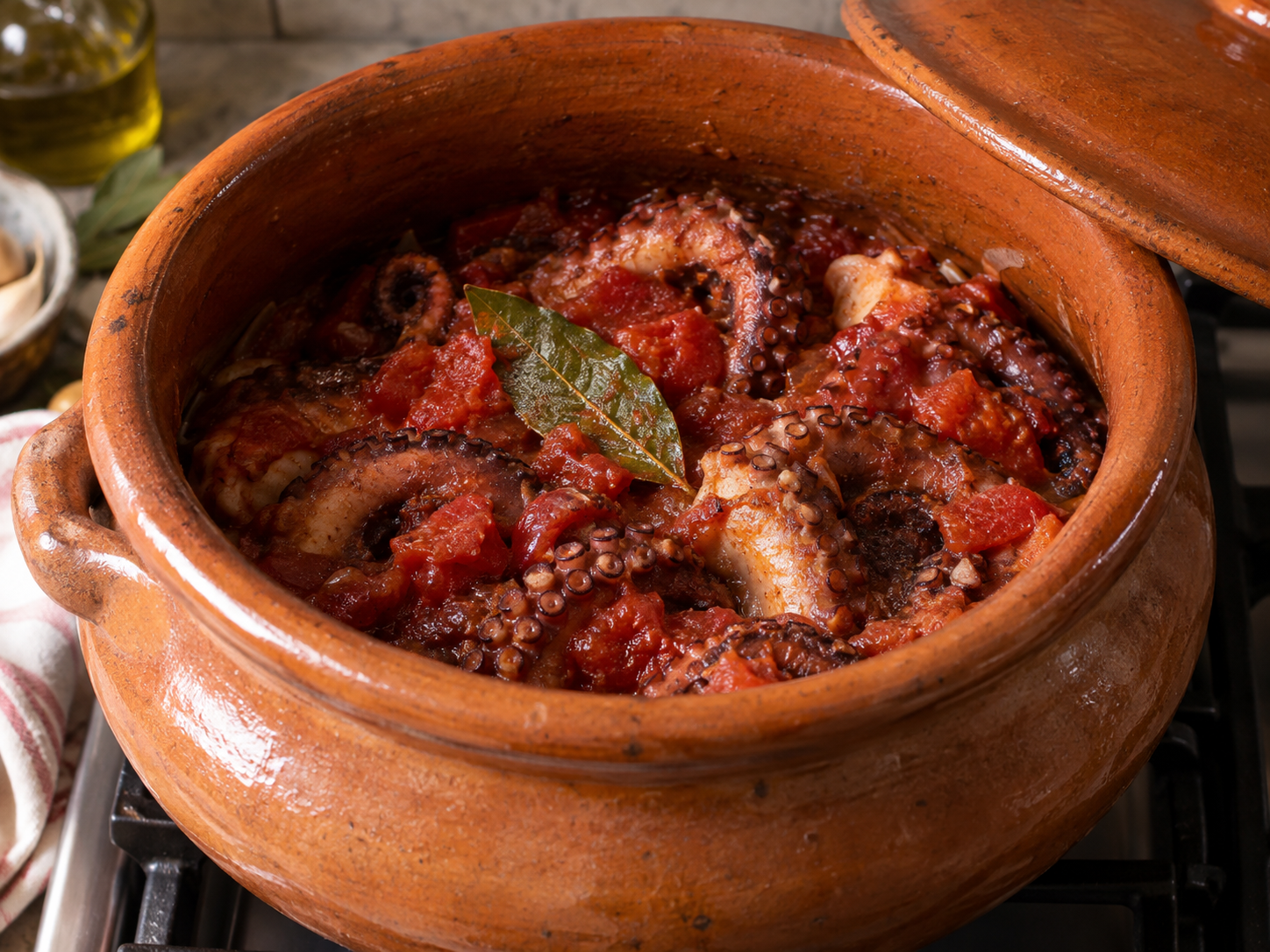
Add the crushed tomatoes and the bay leaf, stir once so the tomato meets the released juices, and seal the lid. Drop the heat to the lowest setting that keeps a lazy movement on the surface, around 185°F (85°C). Terracotta needs almost no adjustment; in metal, check after 10 minutes and lower it again if the pot is bubbling rather than shivering.
Step 5
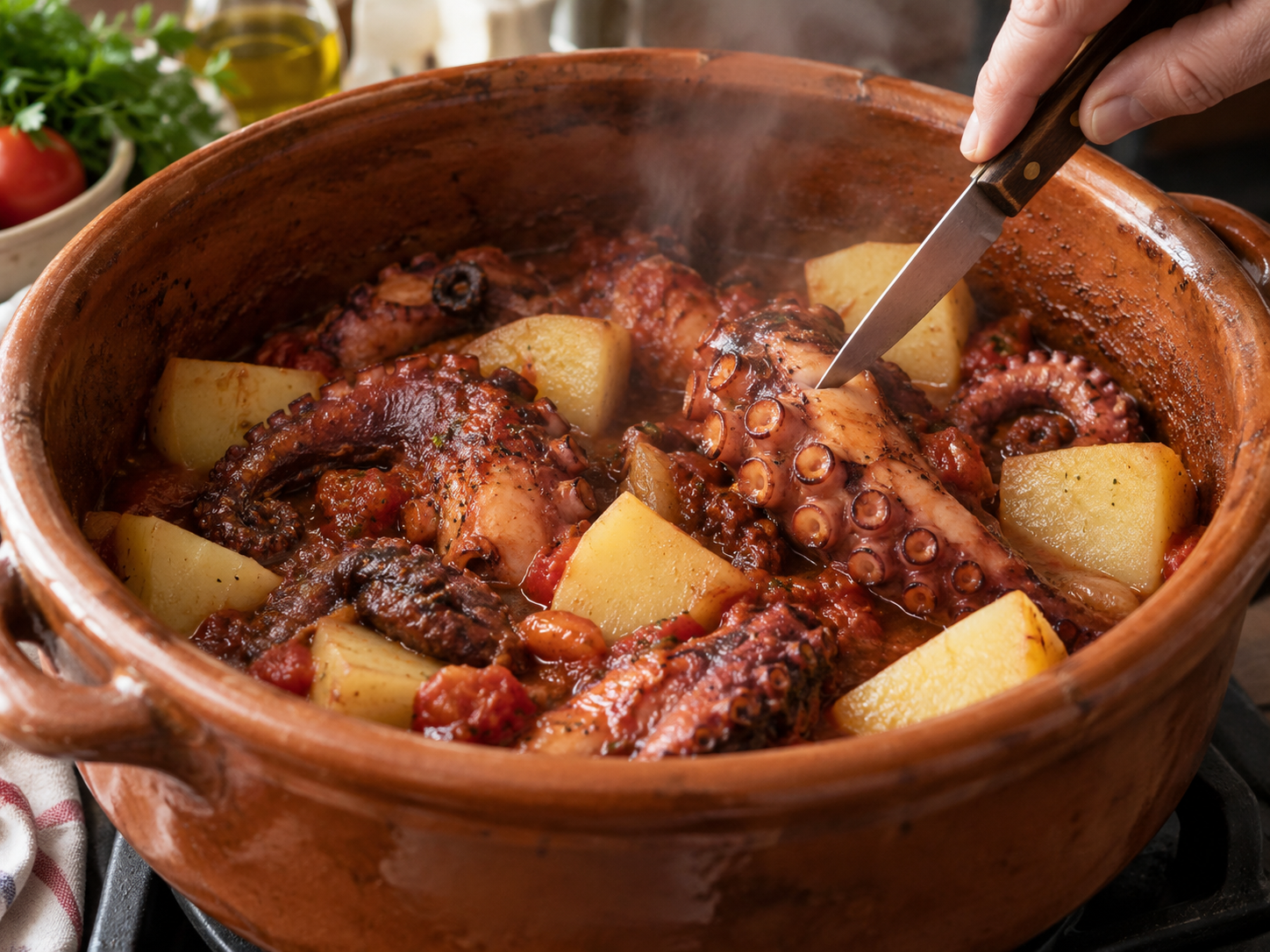
Cook for 50 to 80 minutes, testing at 50 with a thin knife pushed into the thickest part of a tentacle where it meets the head. It should enter with slight resistance and withdraw cleanly. Judge by feel, not by the clock, since size, age and freezing all move the time. For the inland version, add the potatoes when the octopus is two thirds tender and replace the lid.
Step 6
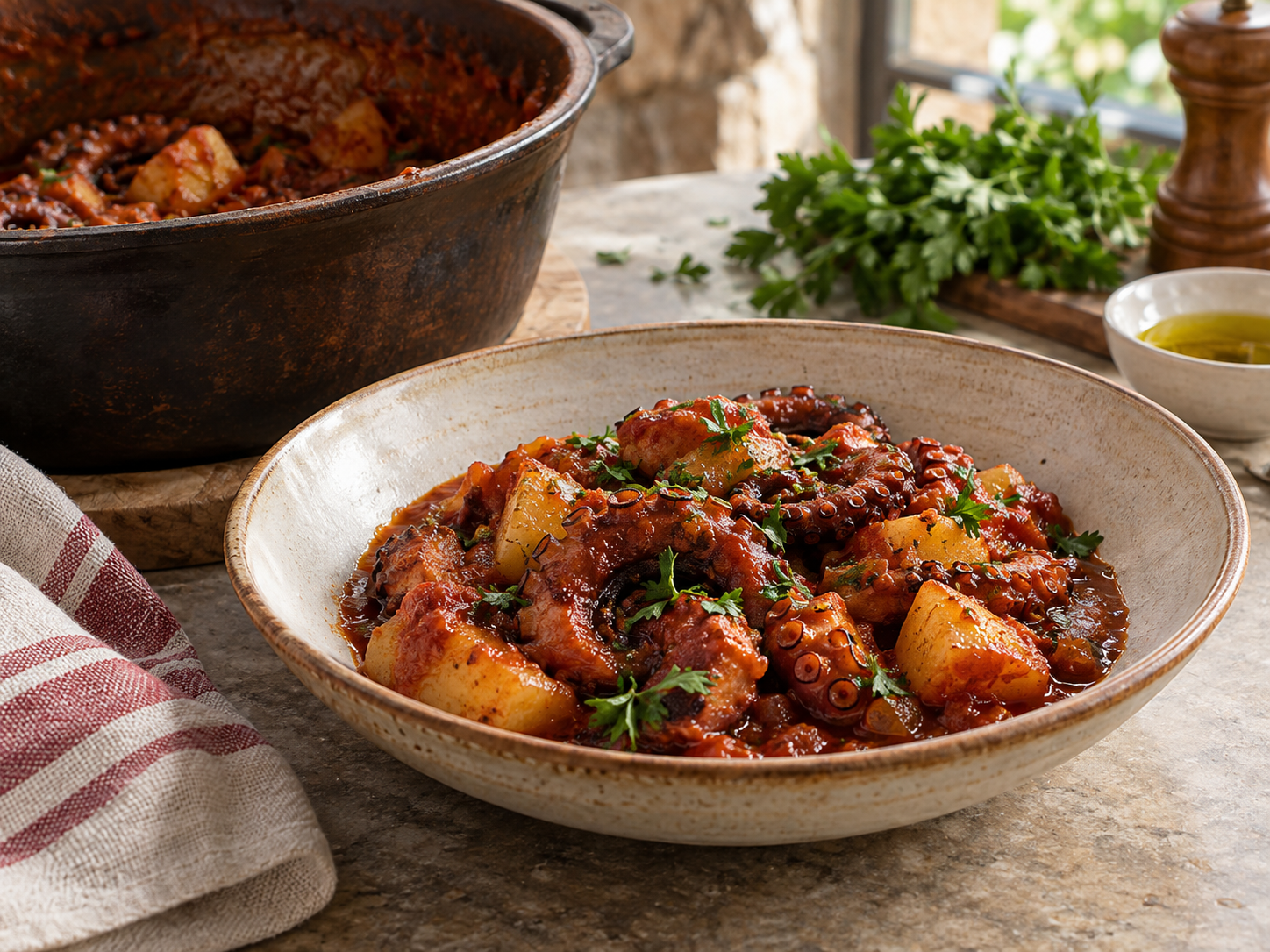
When the octopus gives, take the lid off and reduce for 5 to 15 minutes until the sauce coats a spoon. If the meat is ready before the sauce is, lift it out, reduce the sauce alone and return it. Taste off the heat and only now decide about salt. Rest covered for 10 minutes, cut the tentacles, finish with parsley and raw oil.
Plating
Use a warm shallow bowl rather than a flat plate, so the sauce pools instead of running to the rim and stranding the meat. Lay two or three tentacle sections per portion with the suckers facing upward: they are the most recognisable part of the dish and the proof that the tenderness was judged right, since an overcooked tentacle loses them into the sauce. If potatoes are in the pot, set them underneath as a base, not as a scattered garnish.
Spoon the sauce over the octopus rather than around it, so every piece is glazed and nothing dries while it waits. Finish with chopped parsley and a thread of raw olive oil at the last moment, then add nothing else: no basil, no lemon wedge, no cheese. Grilled bread goes on the side to collect sauce. Serve warm rather than scalding, around 140°F (60°C), where the meat tastes sweeter and the raw oil stays fragrant.
Professional Technique
The technical heart of this recipe is thermal mass, which is why the pot gives the dish its name. Fired clay is a poor conductor and a good reservoir: slow to reach temperature, then unwilling to leave it, so the contents barely register a change at the burner. That damping holds an octopus at a bare simmer for an hour with nobody watching. Heavy enamelled cast iron is the honest substitute; a thin stainless pan is not, and in a fast responding vessel the juices evaporate while the connective tissue is still tight.
Octopus muscle is bound by a dense collagen network and passes through three stages: briefly tender when raw, then rubbery as the proteins contract and squeeze water out, then tender again once that collagen has turned to gelatin. This recipe aims at the third stage and there is no shortcut to it. A rolling boil tightens the outer layer faster than heat travels inward, so the surface toughens while the centre waits.
Previously frozen octopus tenderises more predictably, because ice crystals rupture part of the muscle structure and do mechanically what the fishermen of Gallipoli did against wet rock. Fresh octopus can be superb but expect it nearer 80 minutes. Neither benefits from the wine cork in the water, which is folklore. Salt is the last variable you touch: the meat is saline, its juices are saline, and the pot loses a third of its volume, so salting early is how a good braise becomes inedible.
Texture and Moisture Control
Everything here is governed by liquid that arrives on its own schedule. Most of what will ever be in the pot leaves the meat in the first twenty minutes, dark and faintly sweet and unmistakably marine, and no bought stock reproduces it. Adding one is not an extension of the sauce but a dilution. The right response to a pot that looks wet at minute fifteen is patience: that liquid reduces back into the tomato over the next hour.
The lid is the control device and it has two positions. On, it holds humidity around the octopus and keeps the whole surface in contact with liquid, which makes the cooking even from tip to thick end. Off, evaporation takes over and the sauce concentrates fast. Keep it on for the tenderising phase and remove it only for the final reduction. If the sauce is tight and the meat still firm, the answer is a lower flame and the lid back on, never water.
The potatoes of the inland version are a second moisture system inside the first: they absorb marine liquid and release starch that thickens the sauce independently of any reduction, which is why they go in late and in large chunks. The result can be read in the bowl. A pale watery pool means it was never reduced; dry matt tentacles under a thick paste mean it went too far. The sauce should coat a spoon and leave enough free liquid for bread. Gelatin keeps thickening it as it cools, so judge at serving temperature.
Professional Mise en Place
One of the rare braises that genuinely improves overnight, which makes it worth planning over two days.
Equipment and tools
Terracotta pignata, or heavy enamelled cast iron with a lid that seals
Thin bladed knife or metal skewer for testing the thickest tentacle
Wide saute pan for reducing the sauce separately
Tongs and slotted spoon, so the meat is lifted rather than poured
Warm shallow bowls and a small jug of raw finishing oil
Prepared ahead
Octopus cleaned, dried, cut no smaller than large pieces, kept cold
Onion sliced, garlic crushed, parsley split into stems and leaves
Potatoes peeled and cut, held in cold water and drained hard
The braise cooked the day before to just tender, cooled in its sauce
Bread sliced for the grill, oil and pepper within reach
Service setup
Portion the octopus cold, which cuts cleanly, then warm it in its sauce
Reduce the sauce separately if it needs concentration, then reunite
Chop the parsley at the moment of service so it keeps its colour
Bowls warm but not hot, finishing oil at room temperature
Nothing finished more than a minute before it leaves the pass
Chef Tips
Trust the octopus to make its own liquid and keep the lid sealed while it does. The urge to help it along with half a glass of something is the most damaging instinct in this recipe, and it is always acted on before the meat has had time to weep.
Test with a skewer, not a timer, pushing it in where the thickest tentacle joins the head, the last place to give. Two octopuses of the same weight can be 20 minutes apart.
If the meat is ready but the sauce still tastes of raw passata, lift the octopus out and reduce the sauce alone. This spares a perfectly cooked tentacle the heat it does not need while the tomato loses its edge.
Do not skim the dark juices the octopus releases: they look murky and carry the flavour that identifies the dish. And cut only after the rest, since slicing straight from the heat loses liquid onto the board.
Common Mistakes
Adding water or stock at the start. The octopus supplies all the liquid the pot needs, and a braise that begins with added liquid ends as pale diluted tomato. If it truly runs dry near the end, add one spoonful at a time.
Salting early. The pot loses about a third of its volume and concentrates the natural salinity of the meat. Season only after the final reduction, tasting sauce and octopus separately.
Boiling instead of simmering. A hard boil tightens the outside of the tentacle before the collagen inside relaxes, and cooking longer does not undo it. Keep the surface barely moving for the whole tenderising phase.
Cutting the octopus small before cooking. Small pieces lose their juice and dry out well before they become tender. Cut only enough to make it fit the pot and portion after the rest.
Adding the potatoes at the beginning. They break apart over an hour, release all their starch and turn the braise into a heavy purée that buries the seafood. Put them in when the octopus is two thirds tender.
Cooking the parsley leaves for the full hour. They go grey and lose every trace of aroma. The stems belong in the braise from the start, the chopped leaves on top at the finish.
Wine Pairing
Locorotondo DOC: The white of the Valle d'Itria, built on Verdeca and Bianco d'Alessano. The acidity cuts and the alcohol is modest, so it goes through reduced tomato and olive oil without adding weight, and the chalky bitter almond finish leaves the marine sweetness of the octopus exposed. This is the bottle the recipe grew up beside.
Martina Franca DOC: A neighbouring Verdeca led white, drier and more austere, with green apple fruit and a saline mineral edge off the karst soils of the Murgia. That firmer frame makes it the better choice for the potato version, where the starch rounds the sauce and a lighter wine vanishes underneath it. The bitter finish picks up the parsley and the chilli.
Salice Salentino DOC: Negroamaro from the same countryside as the pot, with sour cherry fruit, a warm dried herb note and soft dusty tannin. The tannin is low enough not to clash with seafood and the acidity high enough to meet concentrated tomato, the narrow gap a red has to fit through here. Serve it lightly cool, around 60°F (16°C).
Primitivo di Manduria DOC: The bottle for a dark, long reduced pot that carries the whole chilli. Ripe black fruit and generous alcohol match the concentration of the sauce, and the low acidity keeps the wine from fighting the tomato for the same space. Choose a leaner, less oaked bottling, or sweetness and warmth will bury the octopus.
Castel del Monte Nero di Troia Riserva DOCG: From northern Puglia, firmer and far more tannic than the Salento reds, with violet aromatics and a savoury, almost peppery core. It works with the inland version, where potato starch and the gelatin from the octopus give that tannin something to bind to. Against the lean coastal version it is too much structure for too little fat.
Storage & Reheating
Refrigerator: keep the octopus submerged in its own sauce in a sealed glass or ceramic container for up to 3 days. Storing it in the sauce rather than drained is not optional, since exposed octopus firms and dries within hours. Cool the pot quickly instead of leaving it on the stove. The sauce sets to a soft jelly when cold, which is gelatin from the meat and a good sign.
Freezer: octopus and sauce freeze well for up to 2 months in a rigid airtight container with the sauce covering the meat. The potato version does not freeze, since the potatoes turn grainy on thawing, so freeze the octopus and sauce alone and cook fresh potatoes into it later. Thaw overnight in the refrigerator.
Reheating: warm it covered over low heat with a spoonful of water, not extra oil, until the sauce loosens and the meat is hot through, about 8 to 10 minutes. Do not boil it and do not reheat a portion twice: high heat tightens the outer layer before the centre is warm and undoes the whole hour. Finish with fresh parsley and new raw oil.
Nutrition
Estimated nutrition per serving, based on 6 servings and including the optional potatoes:
Calories: 330 kcal
Total Fat: 9 g
Saturated Fat: 1.5 g
Trans Fat: 0 g
Unsaturated Fat: 7 g
Cholesterol: 110 mg
Sodium: 720 mg
Total Carbohydrates: 26 g
Fiber: 4 g
Total Sugars: 5 g
Added Sugars: 0 g
Protein: 34 g
Lactose: 0 g
Principal micronutrients: iron 7 mg, vitamin B12 16 mcg, selenium 75 mcg, potassium 900 mg, copper 0.6 mg, vitamin C 18 mg
These are estimates. They move with the size of the octopus, how much liquid it gives up, how far the sauce is reduced and whether the potatoes are in the pot.



Comments