
Italian Stuffed Pork Rolls from Puglia | Bombette Pugliesi

Bombette are small rolls of pork neck wrapped around a baton of caciocavallo and cooked fast over live fire until the outside is deeply browned and the cheese inside has gone molten. They come from the Valle d Itria, the plateau of trulli between Bari, Brindisi and Taranto, and above all from Cisternino, where they are still bought raw at the butcher counter and grilled on the spot.
There is no marinade, no sauce and no long cooking. The whole dish is good pork, good cheese, salt, pepper and heat, so there is nothing to hide behind. A roll that is loose spills its cheese into the fire, one cut too thick burns before the centre is done, and one cut too thin tears as it is rolled.
What follows keeps the proportions the Valle d Itria butchers use, where the roll stays overwhelmingly pork and the cheese is a seasoning, and sets out the fire management that separates a browned crust with a molten centre from a grey roll leaking cheese onto the coals.
Yield: 6 servings, about 18 rolls. Prep: 40 minutes. Cook: 12 minutes. Rest: 5 minutes. Total: about 1 hour. Difficulty: intermediate. Course: main course. Region: Puglia, the Valle d Itria and Cisternino.
The Story
Bombette are butcher food, and that is not a figure of speech. In Cisternino, Martina Franca, Locorotondo and the smaller towns of the Murgia dei Trulli, the macellerie have a wood or charcoal grill at the back of the shop, the fornello pronto. You choose raw meat from the counter by weight, hand it over, and it is cooked in front of you while you wait at a paper covered table with bread and a glass of local white. The butcher is the cook and the shop is the restaurant.
The system exists because of the economics of a farming plateau. A butcher could cook what he had butchered without running a restaurant, and the customers were shepherds and farmers who wanted meat and fire and very little ceremony. Bombette were the natural product of that: they used the cheaper end of the pork neck, they were portioned small enough to sell by the piece, and they cooked in ten minutes on a grill that was already lit.
The cheese comes from the same country. Caciocavallo is the stretched curd cheese of the southern Apennines and the Murgia, aged on a string in pairs, and in this part of Puglia it sits in every larder. The pork neck, the capocollo, is the cut that gives Martina Franca its famous cured salume, and a butcher working with whole animals always had plenty of it. Nothing in a bombetta was bought in for the purpose, which is why the recipe has stayed exactly as it is.
Ingredients
For the pork
Boneless pork neck, capocollo or coppa, in one piece, 2 lb (900 g)
Fine sea salt, 2 tsp (12 g)
Freshly ground black pepper, 1 tsp (2 g)
For the filling
Caciocavallo, semi aged, 7 oz (200 g)
Pancetta, thinly sliced, 3 oz (85 g), optional
Flat leaf parsley, finely chopped, 3 tbsp (12 g)
Garlic clove, grated on a fine rasp, 1
Freshly ground black pepper, 1/2 tsp (1 g)
For grilling
Extra virgin olive oil, 2 tbsp (30 ml)
Fresh bay leaves, 12, optional, one between every second roll
Metal skewers, or wooden skewers soaked 30 minutes, 6
Lump charcoal or oak and olive wood, about 4 lb (1.8 kg)
For serving
Lemon, cut into wedges, 1
Crusty bread, such as pane di Altamura, 1 loaf
Flaky sea salt, a small pinch per serving
Preparation
Step 1: Slicing and flattening the pork
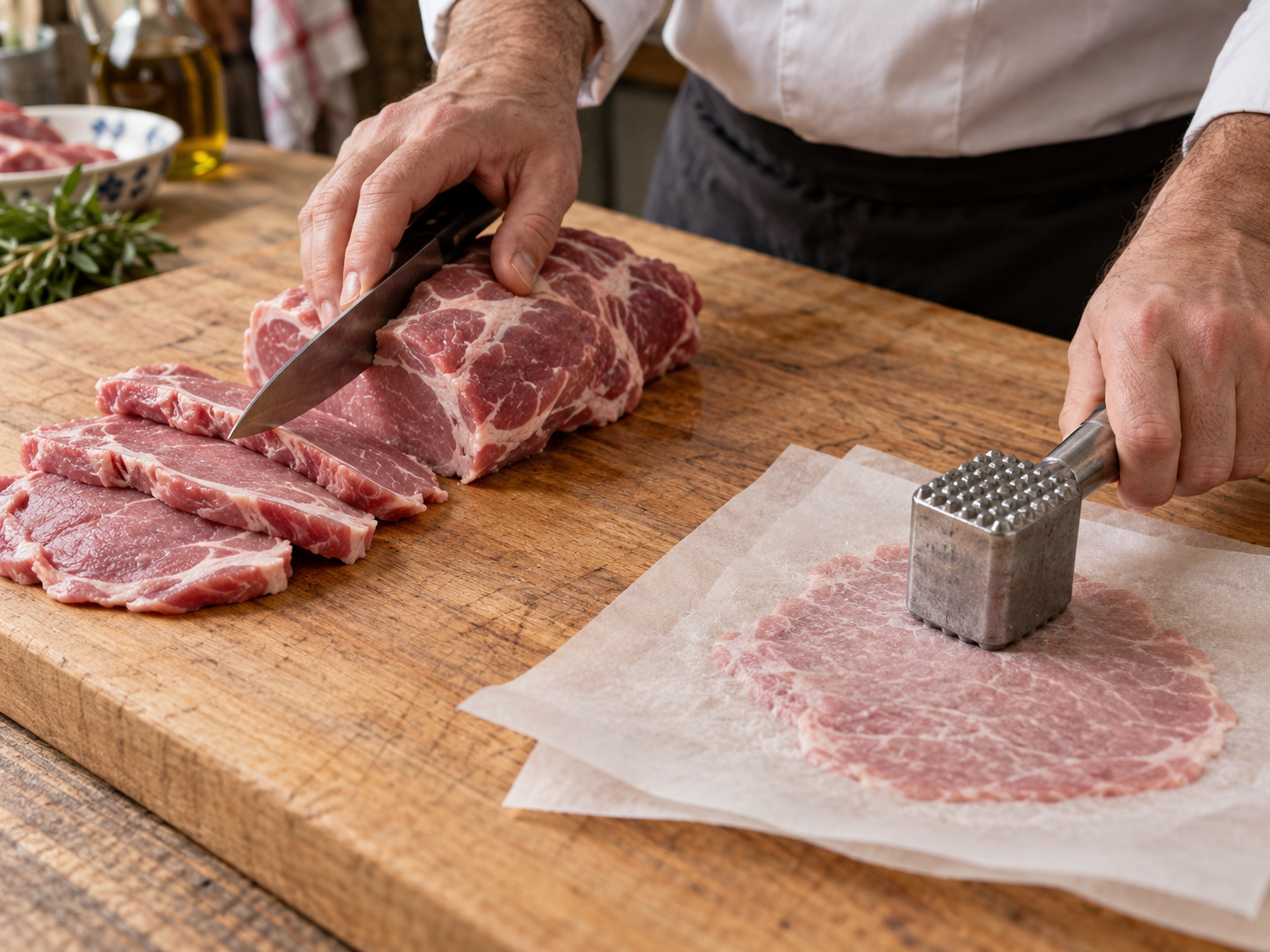
Chill the pork neck for 30 minutes so it firms up, then slice it across the grain into sheets about a quarter of an inch (6 mm) thick. Lay each slice between two pieces of parchment and beat it with the flat of a mallet, working from the centre outward, until it is an even eighth of an inch (3 mm) thick and roughly 4 by 3 in (10 by 8 cm). Even thickness matters more than exact size, since thick and thin slices on one skewer are never ready together.
Step 2: Seasoning the slices
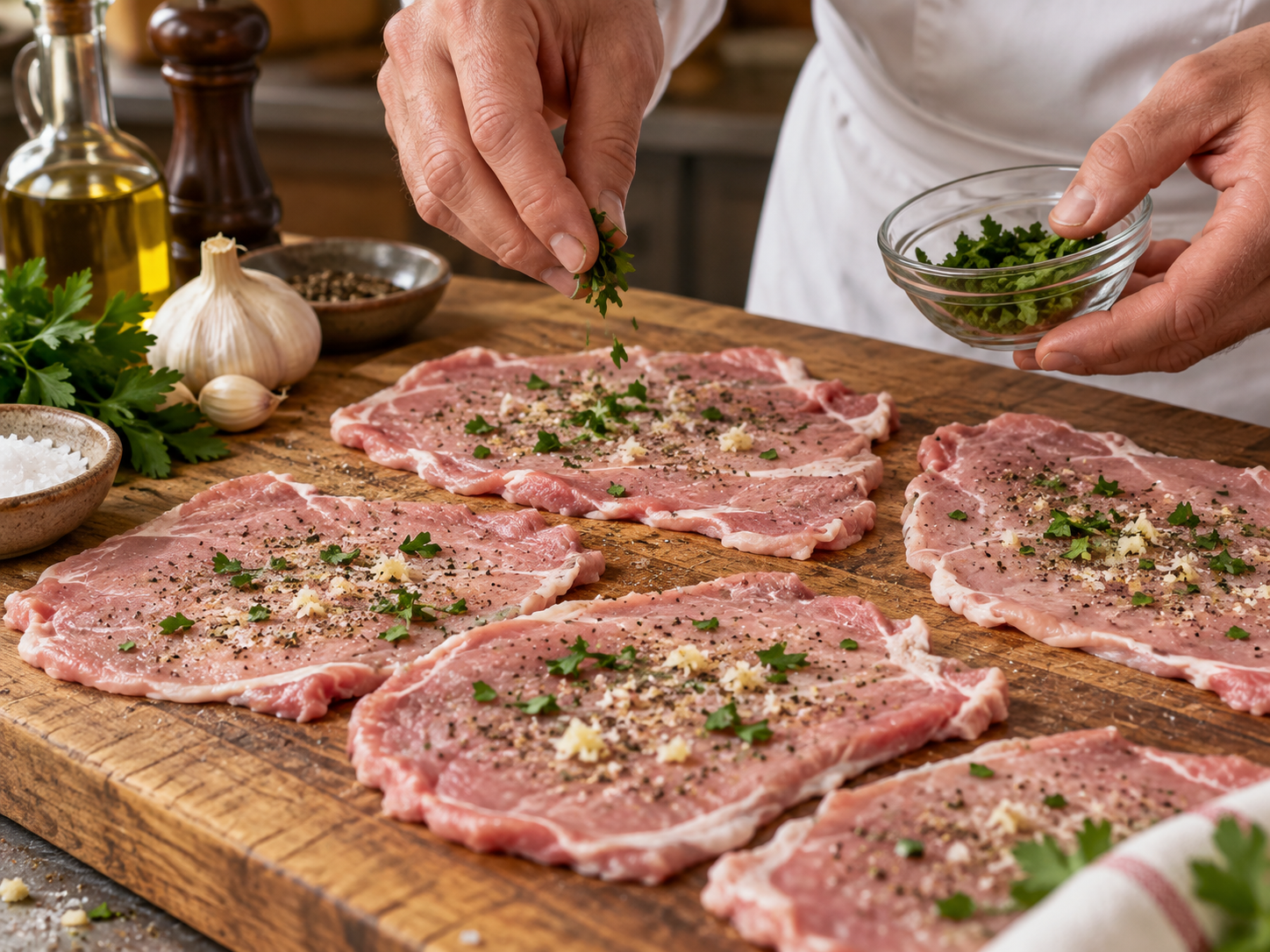
Lay the sheets out on a tray and season the upward face only, with the fine salt and a good grind of black pepper. Salt on both sides draws moisture to the surface and leaves the pork wet, and wet pork steams instead of browning. Scatter the grated garlic and two thirds of the parsley over the slices now, while the surface is still tacky enough to hold them.
Step 3: Cutting the cheese and filling
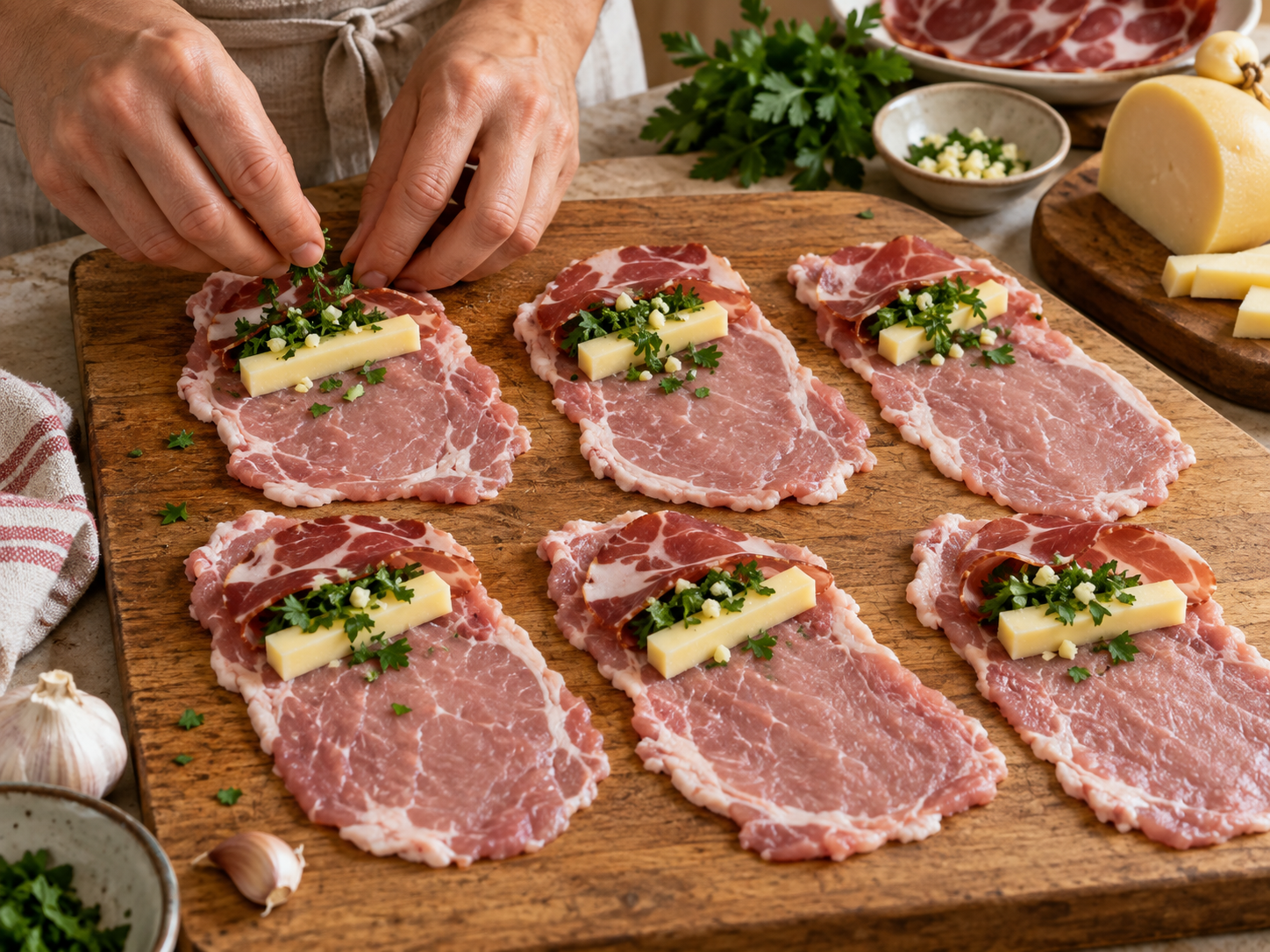
Cut the caciocavallo into batons roughly 1 1/2 in (4 cm) long and 1/2 in (12 mm) square, one for each slice. Keep them small: the Valle d Itria proportion is about one part cheese to four parts meat by weight, and more than that melts faster than the pork cooks. Set a baton across the narrow end of each slice with a pinch of the remaining parsley and, if you are using it, a small piece of pancetta laid alongside.
Step 4: Rolling and skewering
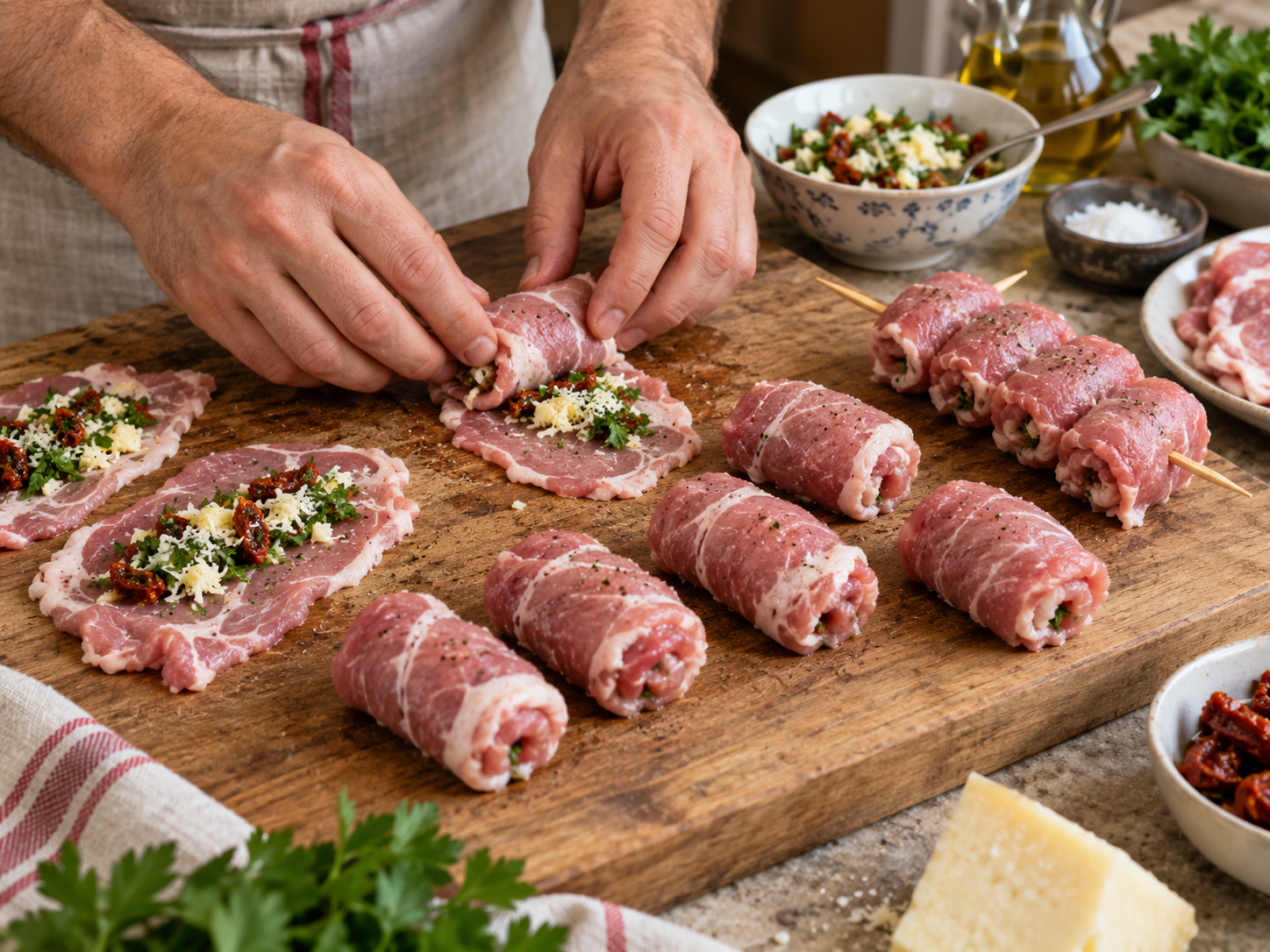
Fold the two long sides of the slice inward over the ends of the cheese, then roll it up tightly from the filled end under constant pressure so no air is trapped inside. The finished roll should be a firm cylinder about 1 1/2 in (4 cm) across with the seam closed. Thread three rolls onto each skewer through the seam, so the skewer pins it shut, leaving a finger width between them. Brush lightly with olive oil.
Step 5: Grilling over the fire
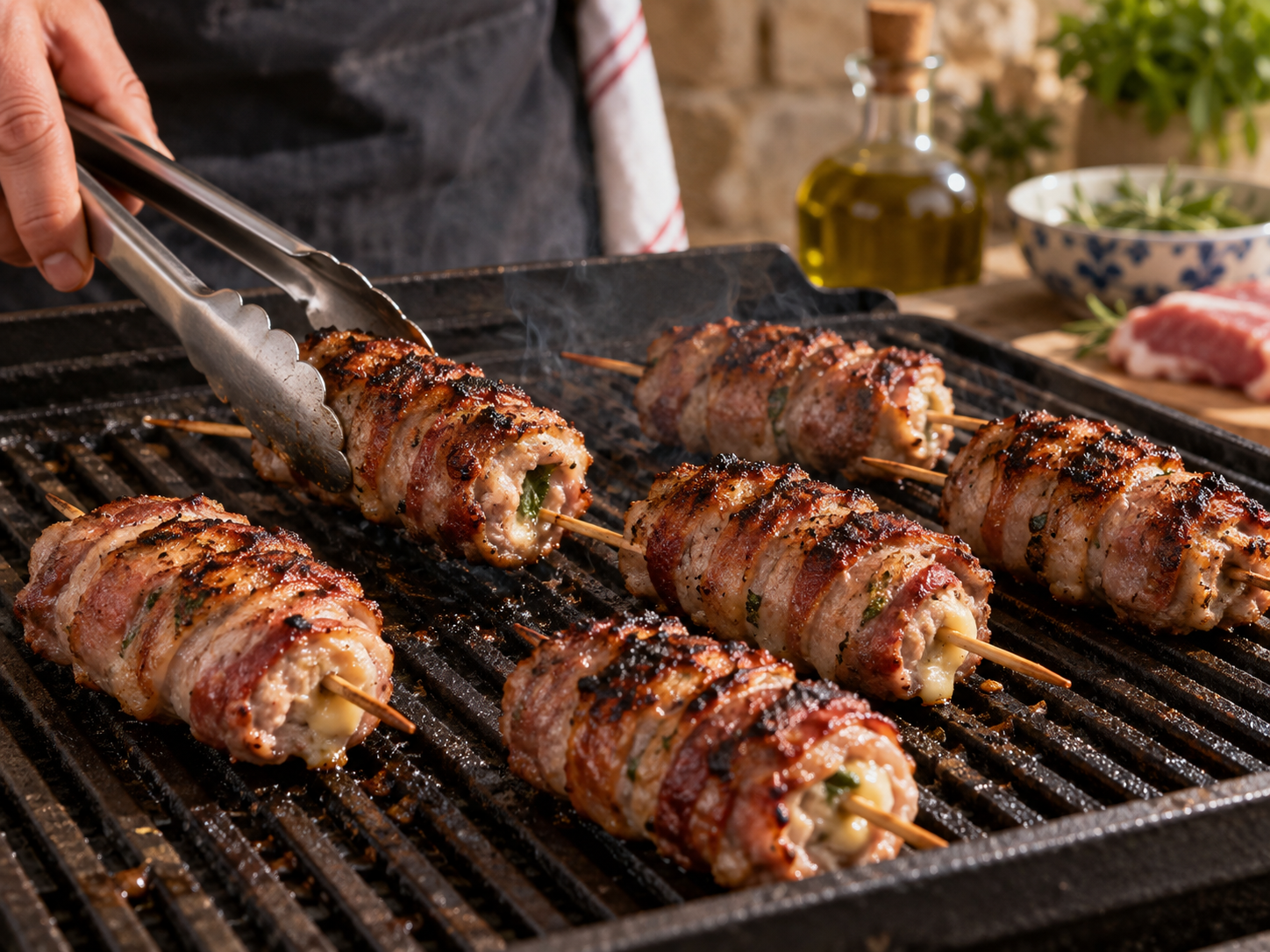
Build a charcoal bed and let it burn down until the coals are covered in grey ash and you can hold a hand 6 in (15 cm) above the grate for about 4 seconds. Grill the skewers over direct heat for 10 to 12 minutes in total, turning every 2 to 3 minutes so all four faces colour evenly. Keep a cooler zone free: pork neck is fatty, the drips will flare, and a flare that licks the rolls leaves soot rather than smoke.
Step 6: Resting and serving
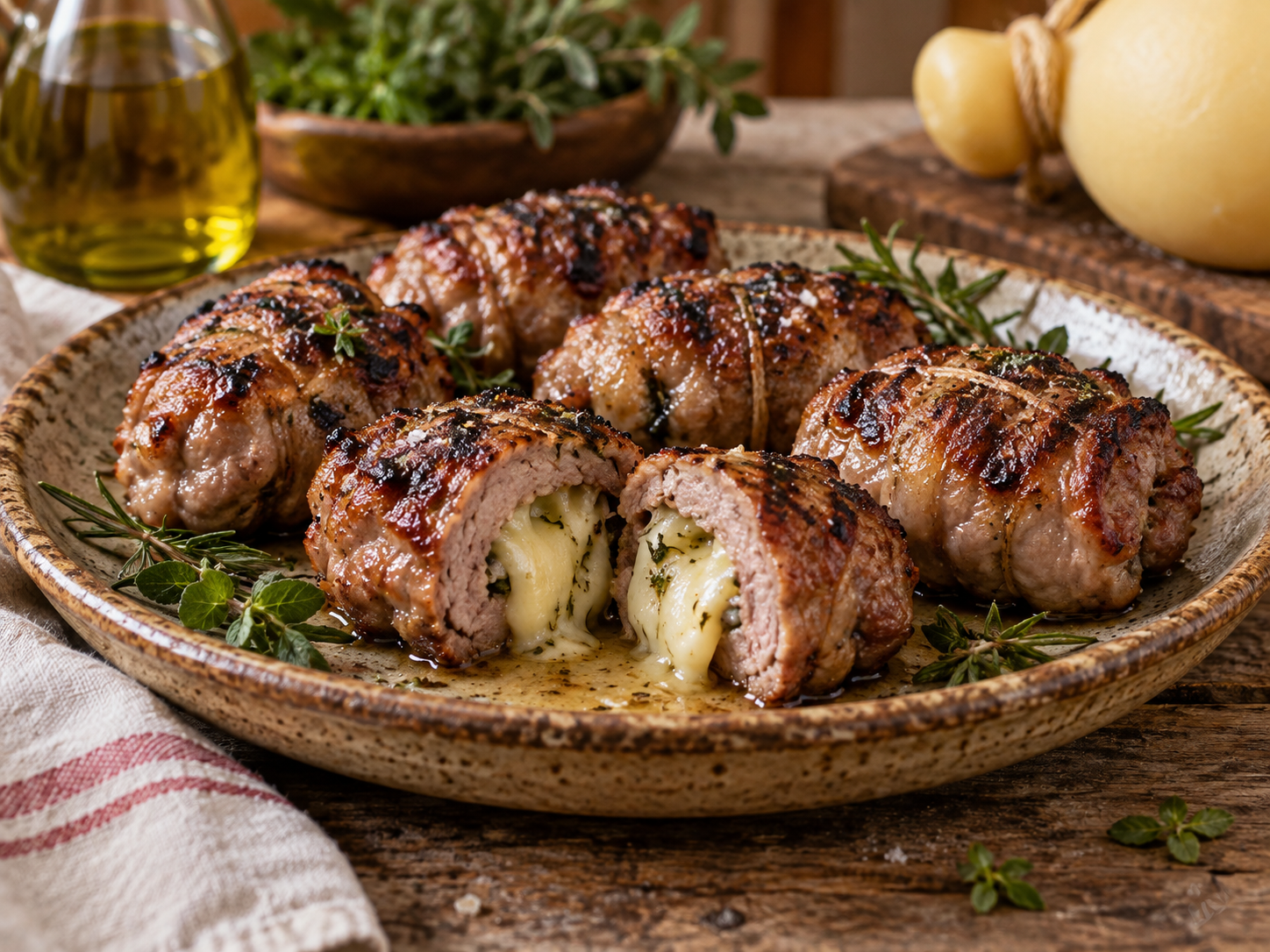
The rolls are ready when the outside is deeply browned all round, the meat springs back under a finger and the internal temperature reads 145°F to 150°F (63°C to 65°C). Rest the skewers on a warm plate for 5 minutes. This is not optional: the cheese inside is far hotter than the meat, and five minutes lets it settle from liquid to creamy so it stays in the roll when it is cut.
Plating
In Cisternino these arrive on a sheet of butcher paper over a bare table, and there is a good argument for leaving it there. If you are plating properly, use warmed plates and set three rolls per person in a short line rather than a pile, since stacked rolls trap steam and the crust softens within a minute.
Serve them whole and let each person cut into them, because a bombetta cut in the kitchen loses its cheese to the plate and the pull of the cheese as the roll opens is most of the pleasure. To show the cross section, halve one roll per plate at the last second and lean it against the others.
The traditional accompaniments are bread and a wedge of lemon. Grilled peppers, roast potatoes with rosemary or a bitter leaf salad all work. Keep sauces away entirely: there is enough fat and salt in the roll itself, and the Valle d Itria has never put anything on a bombetta beyond lemon and a pinch of flaky salt.
Professional Technique
The governing technique is the seal. A bombetta is a container under pressure: the cheese liquefies at around 130°F (55°C), long before the pork is cooked, and from that moment the only thing holding it in is the tension of the roll and the closed seam. That is why the slice is beaten even, why the long sides are folded in first, why the roll traps no air, and why the skewer goes through the seam rather than the middle.
The second is the cut. Pork neck carries fat in fine seams running through the muscle rather than as a cap outside, so it bastes itself over the fire and stays moist at a temperature that would dry out loin. Slicing across the grain shortens the fibres and lets the sheet stretch without splitting when pounded. Loin and tenderloin tear at the pounding stage and finish dry.
The third is fire management over a fatty meat. Rendered pork fat dripping onto live coals ignites, and flames touching the rolls deposit soot, which tastes acrid and nothing like smoke. The answer is a two zone bed, a grate the flare cannot reach, and constant turning. Turning every 2 to 3 minutes is not fussiness: it is what keeps four faces of a round object browning at the same rate.
Texture and Moisture Control
Three textures have to land together: a dark crisp exterior, pork that is juicy and just cooked, and cheese that is molten but not running. The crust comes from Maillard browning on a dry surface, which is why the slices are salted on one side only and go to the fire cold. The pork is ready at 145°F to 150°F (63°C to 65°C), above where loin would be pulled, because the fat in the neck needs that heat to soften.
The cheese is the difficult one. A semi aged caciocavallo of about four months has enough moisture to flow and enough structure to hold, and reaches that state in the same ten minutes the pork needs. A young, wet cheese liquefies in four and is gone into the coals before the crust forms, while a hard aged one never flows and finishes as a chalky core. Provolone piccante is the closest substitute.
Moisture is lost in two avoidable ways. Filled rolls left at room temperature sweat, the seam softens and the crust comes out pale. Rolls cooked past 155°F (68°C) contract and squeeze out juice and cheese at once. Keep them cold until they go on the grate, work to the thermometer rather than the clock, and give them the full 5 minute rest.
Professional Mise en Place
Everything except the grilling is done in advance, and the rolls are better made an hour ahead and held cold. Light the fire before you start rolling.
Equipment and tools
Charcoal grill with a lid and room for a two zone fire
Meat mallet with a flat face, or a small heavy pan
Long sharp slicing knife and parchment for pounding
Six metal skewers, or wooden ones soaked for 30 minutes
Instant read probe thermometer and a pair of long tongs
Prepared ahead
Pork neck chilled firm, sliced and pounded, up to 4 hours ahead
Caciocavallo cut into batons and kept cold, up to 1 day ahead
Parsley chopped and garlic grated, on the day
Rolls filled and skewered, up to 2 hours ahead, refrigerated uncovered
Charcoal lit 30 to 40 minutes before the rolls go on
Service setup
Skewers out of the refrigerator only as the coals reach grey ash
Two zone fire with a clear cool side for flare ups
Oil and brush, tongs and thermometer beside the grill
Warm plates and a resting plate ready before the first turn
Bread, lemon wedges and flaky salt on the table
Chef Tips
Ask the butcher for a whole boneless pork neck rather than ready cut slices. A single piece lets you slice across the grain and judge the thickness yourself. Ready cut pork slices are almost always taken from the loin and will tear.
Chill the neck before slicing and put the filled rolls back in the refrigerator until the coals are ready. Cold pork slices cleanly, cold cheese stays put while you roll, and a cold roll on a hot grate browns harder before its centre gives way.
Taste the caciocavallo first. It should be firm, faintly sharp and smell of grass and butter rather than ammonia. If all you can find is very young cheese, cut the batons smaller and dry them uncovered in the refrigerator for a few hours to slow the melt.
With no grill, a heavy ridged cast iron pan over medium high heat works, turning every 2 minutes for about 12 minutes. You lose the wood smoke and gain a more even crust. What you must not do is finish them in the oven, which cooks the cheese through long before the outside colours.
Common Mistakes
Rolling them loosely. Air trapped inside expands over the fire and forces the seam open, and the cheese follows it out. Roll under constant pressure and pin the seam with the skewer.
Using too much cheese. One part cheese to four parts pork is the Valle d Itria proportion. More melts faster than the meat cooks, breaks the roll open and leaves a hollow where the filling was.
Choosing loin instead of neck. Loin has no intramuscular fat, tears when pounded and finishes dry. Pork neck is fatty enough to baste itself and elastic enough to be beaten thin, and there is no real substitute.
Cooking over flames rather than coals. Dripping pork fat flares, and flames that touch the rolls leave acrid soot. Wait for grey ash, keep a cool zone free and move the skewers across whenever the fire jumps.
Salting both sides of the slice. Salt on the inside face draws moisture out and leaves the pork wet against the cheese, softening the seam. Season only the face that ends up outside.
Cutting them straight off the fire. The cheese is still liquid at that moment and will pour out onto the plate. Five minutes of rest lets it set to creamy and lets the meat reabsorb its juices.
Wine Pairing
Primitivo di Manduria DOC: The bottle most people reach for, and it works when the rolls have taken heavy colour. Ripe black fruit and warm alcohol meet the char and the rendered pork fat head on, while the soft round tannin wipes the palate without scraping it. Choose a lower alcohol bottling and serve it at 61°F (16°C), since a jammy Primitivo buries the cheese.
Salice Salentino DOC: Negroamaro gives this the bitter edge and dried herb note Primitivo lacks, and against grilled pork that bitterness reads as balance. The acidity underneath is enough to cut the fat of the neck and the tannin is fine rather than grippy. It is the better of the two Salento reds when bay leaf has gone onto the skewers.
Castel del Monte Nero di Troia Riserva DOCG: From the Murgia to the north, and the most structured red here. Nero di Troia has firm, slightly rustic tannin and dark spiced fruit that stands up to a heavily charred crust, and that tannin binds the fat of the pork neck as the softer southern reds do not. Give it an hour open.
Locorotondo DOC: The white of the Valle d Itria itself, from Verdeca and Bianco d Alessano grown in the towns where bombette are grilled. Pale, dry and low in alcohol with a faint almond bitterness, it is what the butchers pour at the fornello pronto. The acidity resets the palate between rolls and never competes.
Martina Franca DOC: The neighbouring white, from the same Verdeca base but a shade fuller and more aromatic. That extra weight lets it sit beside melted caciocavallo without being wiped out, while the dry, faintly bitter finish keeps cutting the fat. Serve it at 50°F (10°C).
Storage & Reheating
Raw filled rolls keep far better than cooked ones. Skewered and uncovered on a rack they hold in the refrigerator for 24 hours, and the surface dries a little, which helps the crust. They freeze well: firm them on a tray, bag them, keep them up to 2 months and thaw overnight before grilling. Never freeze them cooked, because the cheese turns grainy on thawing.
Cooked bombette keep in an airtight container in the refrigerator for 3 days. Cool them no more than 30 minutes first and keep them whole, since a cut roll dries from the inside out. They are good cold the next day in a sandwich of pane di Altamura.
To reheat, use a covered dry pan over medium heat, turning every minute for about 4 minutes, which softens the cheese and crisps the outside again. A microwave makes the pork tough and the cheese rubbery, and an oven takes long enough to dry the meat. Cut rolls go cut face down first so the exposed cheese seals.
Nutrition
Per serving, based on 6 servings of three rolls each:
Calories: 480 kcal
Total Fat: 34 g
Saturated Fat: 14 g
Trans Fat: 0 g
Unsaturated Fat: 19 g
Cholesterol: 125 mg
Sodium: 860 mg
Total Carbohydrates: 2 g
Fiber: 0 g
Total Sugars: 1 g
Added Sugars: 0 g
Protein: 40 g
Lactose: 0.4 g
Principal micronutrients: thiamine, vitamin B6, vitamin B12, zinc, selenium, phosphorus, calcium
These figures are estimates and exclude the bread. Fat and sodium depend on how much pork fat renders into the fire and on how aged the caciocavallo is.



Comments