
Italian Mixed Berry Sorbet | Sorbetto ai Frutti di Bosco
Updated: 22 hours ago

Frutti di bosco is not one fruit but a basket, and a sorbet made from it tastes of whatever the wood gave up that week. Blackberry brings depth, raspberry brings perfume, blueberry brings colour and weight, redcurrant brings the sharp edge that keeps the other three honest.
What follows is a mountain dessert built on control rather than improvisation: a short cooked syrup, a very brief blend, two passes through fine mesh, and a churn that stops while the sorbet is still soft enough to fold.
Yield: 6 servings, about 1 quart (950 ml). Prep: 30 minutes. Cook: 10 minutes. Chill: 4 hours. Churn: 25 minutes. Freeze: 3 hours. Difficulty: intermediate. Course: dolce. Region: Trentino and the Alpine valleys.
The Story
Sorbet reached Italy through Sicily, where Arab sharbat met snow carried down from Etna in insulated pits, and for centuries the word meant a cold sweetened drink rather than something eaten with a spoon. The berry version belongs somewhere else entirely. It comes from the north, from the Alpine valleys where wild brambles, bilberries and currants grow along the tree line and ripen late, in July and August, long after the lowland fruit is finished. Cold nights at altitude keep the acidity in that fruit high and the sugar modest, which is exactly the balance a sorbet wants and the reason mountain berries make a better one than glasshouse fruit ever will.
Trentino turned that wild harvest into an industry without losing the character of it. The Valsugana and the Val di Non have grown piccoli frutti commercially since the 1970s, when hillside families with plots too small and too steep for apples put in raspberry and blackberry rows instead, and pooled the fruit through cooperatives. The mountain refuges and the small gelaterie of those valleys have served sorbetto ai frutti di bosco ever since, usually in a steel cup with a long spoon, at the end of a lunch that was mostly polenta and cured meat.
The dish keeps one habit from foraging that no single fruit sorbet has: the mix is never the same twice. A basket picked in the woods above Levico is weighted toward blackberry one week and raspberry the next, and the cook adjusts rather than measures. That is why the traditional version is written down so rarely, and why the proportions below should be read as a starting point rather than a rule. What matters is that all four fruits are present and that no single one takes the whole spoon.
Ingredients
For the berries
Blackberries, ripe, 9 oz (255 g)
Raspberries, 7 oz (200 g)
Blueberries or wild bilberries, 5 oz (140 g)
Redcurrants, stripped from the stems, 3 oz (85 g)
For the syrup
Granulated sugar, 1 cup (200 g)
Water, 3/4 cup (180 ml)
Glucose syrup, or mild acacia honey, 2 tbsp (40 g)
Fine sea salt, 1 small pinch
For finishing
Lemon juice, strained, 1 tbsp (15 ml), plus more to taste
Fresh blackberries and raspberries, 12 to 18 pieces
Redcurrant sprigs on the stem, 6
Mint tips, small, 6
Crushed amaretti, 2 tbsp (15 g)
Preparation
Step 1

Sort and rinse the fruit. Tip the berries onto a tray and go through them one at a time. A single mouldy blackberry will flavour the whole quart, and soft fruit hides damage underneath. Rinse briefly in cold water, never soak, and spread the berries on a clean towel to drain. Strip the redcurrants from their stems with the tines of a fork. Weigh the fruit after cleaning, because trimming and losses run higher than people expect.
Step 2

Cook the syrup. Combine the sugar, water, glucose and salt in a small saucepan and bring to a simmer over medium heat, stirring only until the sugar has dissolved. Let it bubble for about 2 minutes, then take it off the heat. Do not let it reduce or colour: this is a plain syrup, not a caramel, and any browning will read as a cooked note in a dessert that should taste raw and cold.
Step 3

Warm the berries, briefly. Put the blackberries, blueberries and redcurrants in a wide pan with a quarter of the hot syrup and set it over low heat for 3 to 4 minutes, stirring once or twice, just until the skins begin to split and release juice. Take the pan off the heat and stir in the raspberries, which need no cooking at all and lose their perfume within a minute of heat. Cover and let it stand for 10 minutes.
Step 4

Blend for twelve seconds only. Scrape the fruit and all the remaining syrup into a blender and run it in two or three short pulses, about 12 seconds in total. Stop while you can still see fragments of skin suspended in the purée. A long blend looks tidier and tastes worse, and the reason is explained in the technique section below. If your blender has a low setting, use it.
Step 5

Sieve twice, the second time finer. Pass the purée through a medium sieve first, pressing with a ladle, and discard the seeds and skin left behind. Then pass the strained liquid through a conical fine mesh sieve without pressing, letting gravity do the work and helping it only with a gentle stir. Expect to lose roughly a fifth of the volume between the two passes, most of it seed and pulp. Do not force that loss back into the mix.
Step 6
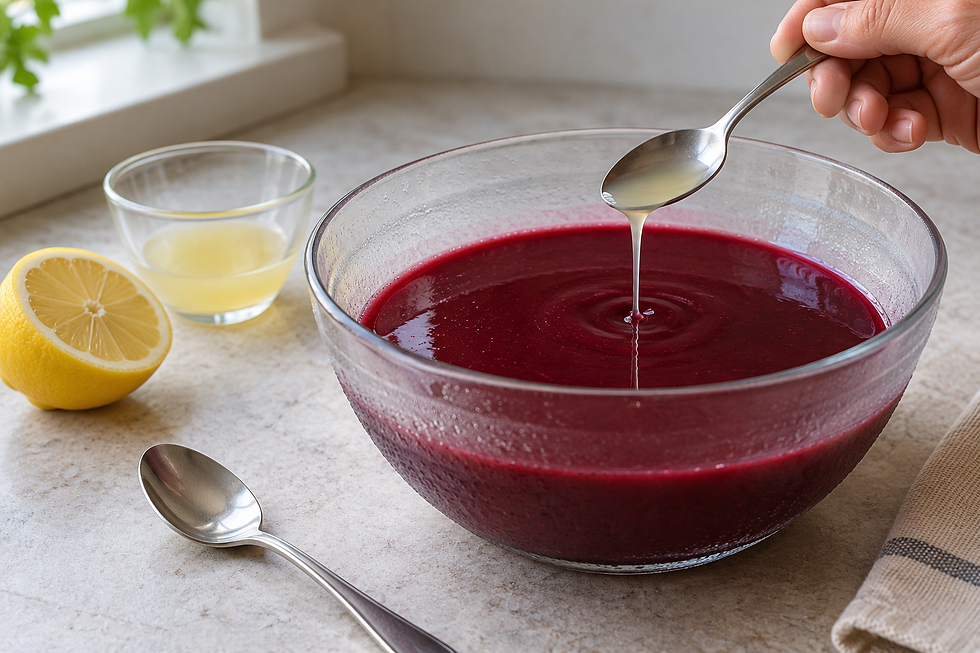
Balance the mix cold. Stir in the lemon juice, then taste. The mix should be perceptibly tart, sweeter than you want the finished sorbet to be, and clean on the finish with no grit on the tongue. Cold dulls sweetness and acidity alike, so anything that tastes exactly right at room temperature will taste flat when frozen. Adjust with a few drops more lemon rather than more sugar.
Step 7

Rest the mix, then churn. Cover the mix and refrigerate it for at least 4 hours, overnight if you can. This rest lets the sugar hydrate fully and drops the mix to around 39°F (4°C), so the machine spends its time freezing rather than cooling. Churn in an ice cream maker for 20 to 25 minutes, until the sorbet holds a soft ribbon off the paddle and looks matte rather than wet.
Step 8

Harden and hold. Scrape the sorbet into a shallow metal container, press a sheet of parchment directly onto the surface and freeze for 3 hours before serving. A shallow container freezes faster and more evenly than a deep one, and the parchment keeps ice from forming on top. Move the container to the back of the freezer, away from the door, where the temperature swings least.
Plating
Chill the glasses or bowls hard, at least 30 minutes in the freezer, and take the sorbet out of the freezer 5 minutes before you serve it. Use a warm scoop, dipped in hot water and wiped dry between portions, and shape two small quenelles rather than one large ball so more of the surface reads as deep purple.
Set the quenelles slightly apart in a shallow glass coupe. Tuck three or four fresh berries between them, hang one redcurrant sprig over the rim so the fruit stays visible and recognisable, and add a single mint tip low down rather than planted on top. Scatter the crushed amaretti at the last moment, on the plate beside the sorbet and never over it, so they keep their snap. Serve immediately, with a long spoon.
Professional Technique
A mixed berry sorbet has one technical problem that single fruit sorbets do not, and it is the seeds. Blackberries and raspberries each carry dozens of small hard seeds per fruit, and redcurrants add more, so a quart of this mix starts with several thousand of them. They are far harder than the flesh around them and they do not break down in a blender or soften in the freezer. A medium sieve holds back the large fragments and lets the small seeds straight through, and every one that reaches the machine ends up between the teeth. The result is not gritty in an obvious way, it is simply rough, and diners describe it as sandy without knowing why. The fix is the second pass through a genuinely fine conical mesh, and the cost is real: about a fifth of the volume stays in the sieve. That loss is the price of the texture, and pressing it through defeats the entire purpose.
The second problem is astringency, and it lives in the skins. Berry skins hold light tannins along with the colour, and tannin extracts into liquid with time and mechanical action. A blender running for a minute drives those tannins out of the skin fragments and into the mix, and the sorbet arrives at the table with a drying grip at the back of the palate that no amount of sugar or lemon will cover. So the blending is deliberately short, twelve seconds in pulses, enough to break the fruit and no more, and the purée goes into the sieve immediately rather than sitting in the blender jar. Keep the skins in contact with the liquid for as little time as you can and the sorbet finishes clean instead of tightening the mouth.
Texture and Moisture Control
Sorbet has no fat and no egg to hide behind, so its whole texture is a question of how large the ice crystals are allowed to grow. Three things keep them small. The mix goes into the machine properly cold, so freezing begins within the first minute instead of after ten. The glucose holds water and slows crystal growth without adding much sweetness. And the paddle keeps moving throughout, breaking every crystal as it forms. Stop the machine early and the sorbet is soupy; run it far too long and friction warms the batch and coarsens it.
Moisture control after churning matters just as much. The parchment pressed onto the surface stops water vapour condensing and refreezing as a crust, which is what gives home sorbet that layer of frost across the top. Keep the container shallow, keep it at the back of the freezer, and resist opening it to look. Every partial thaw and refreeze builds bigger crystals than the one before, which is why a sorbet served the day it was churned is noticeably smoother than the same sorbet a week later.
Serving temperature is the last variable. Around 10°F (minus 12°C) the sorbet is scoopable and the fruit aroma still comes through; much colder and the perfume disappears entirely, since cold suppresses volatile compounds long before it suppresses sweetness.
Professional Mise en Place
Everything here is done ahead except the scooping. The only timed element at service is how long the sorbet sits out of the freezer before it reaches the glass.
Equipment and tools
Ice cream maker, bowl frozen for 24 hours if it is the freezer bowl type
Blender with a low setting, plus a medium sieve and a fine mesh conical sieve
Small heavy saucepan and a wide shallow pan
Shallow metal container with a lid, parchment, digital thermometer
Ice cream scoop and a jug of hot water for warming it
Prepared ahead
Syrup, up to 2 weeks ahead, refrigerated in a sealed jar
Sieved berry mix, chilled at least 4 hours and up to 2 days before churning
Sorbet churned and hardened, up to 3 days ahead for best texture
Garnish berries and redcurrant sprigs sorted, dry, refrigerated on a tray
Service setup
Glasses in the freezer, at least 30 minutes
Sorbet moved from freezer to service 5 minutes before the first portion
Scoop in hot water, clean cloth beside it
Amaretti crushed at the last moment and kept covered and dry
Chef Tips
Buy the blackberries and raspberries the same day you churn. Both collapse within 48 hours in a refrigerator and the perfume goes first, well before the fruit looks tired. Frozen berries work and are often better than poor fresh ones, but thaw them in a sieve over a bowl and add the collected juice back to the mix.
Keep a tablespoon of the sieved mix aside in the refrigerator while the rest churns. If the finished sorbet tastes flat, a spoonful of the cold unfrozen mix folded through the soft sorbet lifts the fruit immediately, and it tells you whether the problem is the balance or the temperature.
Do not skip the glucose without replacing it. If you have none, use mild honey as the recipe allows, or 1 tablespoon of light corn syrup. Leaving it out entirely gives a sorbet that sets hard as a brick and shatters under the scoop.
Taste every sieve batch for tannin before you chill it. Hold the mix on the tongue for a few seconds: if the sides of the mouth feel drawn in, the skins have given up too much, and a further spoonful of syrup plus a little more lemon will mask it better than sugar alone.
Common Mistakes
Blending the fruit smooth. A long blend extracts tannin from the skins and turns a bright sorbet astringent. Pulse for about 12 seconds, no more, and sieve straight away.
Using one sieve and calling it done. A medium mesh lets the small berry seeds through and they survive freezing intact, so the sorbet eats rough. The second fine pass is not optional.
Pressing the fine sieve to save volume. Forcing the residue through puts back exactly the seed fragments and skin you just removed. Accept the loss of about a fifth of the batch.
Churning a mix that is not cold. A warm mix spends the first ten minutes cooling instead of freezing, and every crystal formed in that window grows large. Chill to refrigerator temperature first.
Cooking the raspberries. Their aroma is volatile and disappears within a minute over heat. Add them off the heat, after the other three fruits have split.
Serving it straight from a deep freezer. At very low temperature the fruit perfume vanishes and only cold and sweetness register. Give it 5 minutes out of the freezer.
Wine Pairing
Brachetto d'Acqui DOCG: The most natural match on the list. Its aroma is raspberry and rose almost literally, so it echoes the sorbet rather than contrasting with it, and the gentle carbon dioxide scrubs the palate clean between spoonfuls. Alcohol sits near 6 percent, low enough that the wine never burns against something served at freezing temperature, which is where most sweet wines fail with iced desserts.
Recioto della Valpolicella DOCG: A sweet red from dried Corvina grapes, and the one pairing here with real structure. Its sour cherry and dried blackberry fruit lines up with the darker end of the berry mix, while its acidity stays high enough to match the redcurrant. The tannin is ripe and soft, so it adds grip without turning astringent against the fruit skins already in the sorbet.
Moscato d'Asti DOCG: The safest choice when the dessert closes a long meal. Around 5 percent alcohol and lightly frizzante, with grape, peach and elderflower aromatics that sit beside the berries instead of competing. Its sweetness is moderate and its acidity brisk, so it reads as refreshing rather than heavy, and it will not flatten the tartness the sorbet is built on.
Recioto di Soave DOCG: The contrast option, and a considered one. Dried Garganega gives apricot, candied citrus and honey, flavours the sorbet does not contain, and the wine carries the high acidity that variety keeps even at high sugar. Serve it cool in a small glass: its density needs the cold fruit to cut it, and the two only balance in small quantities.
Storage & Reheating
Sorbet is never reheated, so storage here means protecting texture. Keep it in a shallow airtight metal container with parchment pressed onto the surface, at the back of the freezer, for up to 1 month. It is at its best in the first 3 days and clearly coarser after 2 weeks, since each temperature swing in a domestic freezer grows the crystals a little further.
The sieved mix keeps refrigerated in a sealed jar for 2 days before churning, and freezes flat in a bag for 2 months, which is the better way to store a glut of summer fruit. Thaw it in the refrigerator overnight, whisk it back together and churn as usual. Never refreeze sorbet that has melted past soft: rechurn it in the machine instead, which rebuilds small crystals, or blend the melted sorbet with a little fresh fruit and churn again from cold.
Nutrition
Per serving, based on 6 portions of about 5 oz (150 g):
Calories: 175 kcal
Total Fat: 0.6 g
Saturated Fat: 0 g
Trans Fat: 0 g
Unsaturated Fat: 0.5 g
Cholesterol: 0 mg
Sodium: 15 mg
Total Carbohydrates: 43 g
Fiber: 4 g
Total Sugars: 37 g
Added Sugars: 30 g
Protein: 1.2 g
Lactose: 0 g
Principal micronutrients: vitamin C, vitamin K, manganese, anthocyanins, potassium
These figures are estimates. They assume the seeds and skin left in the sieve are discarded, which removes part of the fibre, and they exclude the amaretti garnish.


Comments