
Italian Ricotta and Orange Soufflé | Soufflé Dolce alla Ricotta e Arancia
Updated: Sep 14
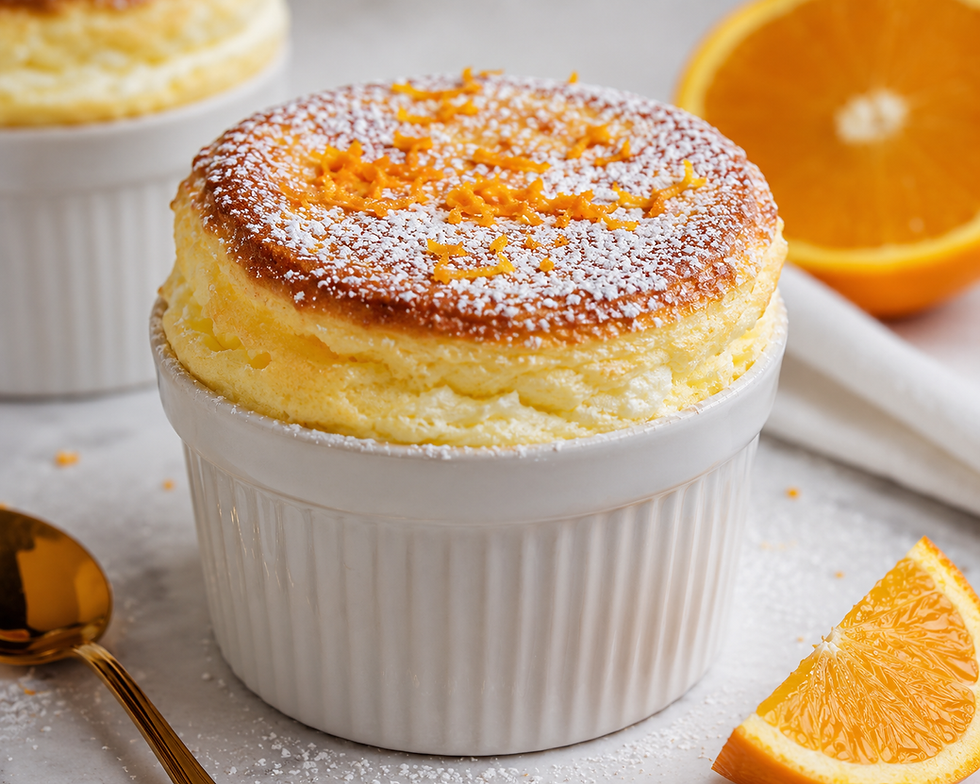
This is the classic hot soufflé: baked to order, carried to the table the moment it leaves the oven, eaten while it is still rising. There is no chilling stage and no rescue if you get it wrong. What makes it Italian rather than French is the base, which is drained ricotta lightened with yolks and orange instead of the flour bound pastry cream a pâtissier would normally use. Ricotta brings a clean lactic sweetness and a lighter body, and orange keeps a baked egg dessert from tasting flat.
Everything rests on two decisions. The ramekins are buttered in upward strokes and lined with granulated sugar, which gives the batter something to climb. The whites are stopped at a soft peak, glossy and still moving in the bowl, because whites whipped stiff have no stretch left and tear as the soufflé expands. Beyond that it is a question of nerve: the oven door stays shut, and the soufflé is served the instant it comes out.
Yield: 6 individual soufflés. Prep: 30 minutes. Draining: 4 hours. Bake: 13 to 15 minutes. Total: about 5 hours, of which 45 minutes is active work. Difficulty: advanced. Course: dessert, served hot. Region: Naples and Turin, where French technique entered Italian kitchens.
The Story
The soufflé is a French invention of the early nineteenth century, refined and codified by Antonin Carême, who worked out that a sweetened egg base lightened with whipped whites would expand dramatically in a hot oven and hold its shape long enough to reach a table. It entered Italy through two doors at almost the same moment. In Naples the Bourbon aristocracy employed French trained chefs known locally as monsù, a dialect corruption of monsieur, who brought the whole vocabulary of French pastry into the kitchens of the Palazzo Reale. In Turin the Savoy court did the same thing more formally, hiring from Paris and importing the equipment along with the recipes.
What the Italian kitchens changed was the base. A French dessert soufflé is built on a cooked pastry cream thickened with flour, which is stable and reliable and tastes faintly of the flour. Italian cooks had ricotta in the house every day, already sweet, already soft, and they used it, thickening only lightly with cornstarch and perfuming it with the citrus that came up from the south. The result is less rich and more fragrant than its French parent, and it collapses a little faster, which is part of why it stayed a domestic dessert rather than a restaurant one for most of its history.
Ingredients
For the ramekins
Soft unsalted butter, 2 tbsp (28 g)
Granulated sugar, 3 tbsp (38 g), for coating
For the ricotta base
Whole milk ricotta, 12 oz (340 g) before draining
Egg yolks, large, 4
Granulated sugar, 1/3 cup (65 g)
Cornstarch, 2 tbsp (16 g)
Finely grated orange zest, from 2 oranges
Freshly squeezed orange juice, 3 tbsp (45 ml)
Orange liqueur, 1 tbsp (15 ml), optional
Vanilla extract, 1/2 tsp (2.5 ml)
Fine sea salt, 1 small pinch
For the meringue
Egg whites, large, at room temperature, 5 (about 5 1/4 oz, 150 g)
Granulated sugar, 1/4 cup (50 g)
Cream of tartar, 1/4 tsp (1 g), or 1/2 tsp lemon juice
For finishing
Powdered sugar, for dusting
Orange segments, cut free of membrane, 12, to serve alongside
Finely julienned orange zest, 1 tsp, optional
Preparation
Step 1: Draining the ricotta
Set the ricotta in a fine mesh sieve over a bowl and refrigerate 4 hours, losing roughly 2 tablespoons of liquid. Free whey turns to steam in the oven, and steam arriving too early blows holes through a rising soufflé. Then push the ricotta through the sieve with the back of a ladle so no curd remains, since a grainy base rises unevenly.
Step 2: Preparing the ramekins
Brush six 6 oz (180 ml) straight sided ramekins with soft butter, working from the bottom upward in vertical strokes over the rim. Chill 10 minutes, butter a second time the same way, then add a spoonful of granulated sugar to each, rotate to coat the walls and tip out the excess. The vertical strokes leave microscopic channels the batter climbs. Refrigerate until you fill them.
Step 3: Heating the oven and a tray
Heat the oven to 375°F (190°C) with a heavy baking tray on the middle shelf, at least 30 minutes ahead. The tray stores heat and delivers it into the base of each ramekin, starting the rise from underneath. Do not use the fan setting: moving air sets the outside before the centre has expanded and produces a lopsided crown.
Step 4: Building the orange base
Whisk the yolks with the sugar until pale and slightly thickened, about 2 minutes. Whisk in the cornstarch, then the sieved ricotta, zest, juice, liqueur, vanilla and salt, until completely smooth with no cornstarch streaks. The base should fall thickly from the whisk. Leave it at room temperature: a cold base chills the meringue on contact and costs volume.
Step 5: Whipping the whites to a soft peak
Whip the whites with the cream of tartar at medium speed until opaque and foamy, then add the sugar in a slow stream and raise the speed. Stop at the soft peak stage, when the peak folds over on itself and the foam is glossy and still moving. This is the most important judgement in the recipe: whites taken stiff and dry have no elasticity left and crack rather than stretch.
Step 6: Folding the meringue
Stir a generous quarter of the meringue into the base without any care at all, to slacken it. Add the rest in two goes, cutting down through the middle, sweeping along the bottom and lifting over the top, turning the bowl as you work. Stop while a few pale streaks are still visible. A perfectly uniform batter is an overworked one, and the streaks vanish in the bake.
Step 7: Filling and setting the rim
Spoon the batter into the chilled ramekins, level with the rim, and smooth the tops with an offset spatula in one pass. Run a clean thumb around the inside edge to cut a shallow moat between batter and wall. That groove releases the batter from the lip of the dish and gives the classic top hat shape instead of a crown that leans.
Step 8: Baking and serving
Set the ramekins straight onto the hot tray and bake 13 to 15 minutes. Do not open the door before minute 12: cold air at the wrong moment collapses the structure before the proteins set. They are ready when risen 1 1/2 to 2 inches (4 to 5 cm) above the rim, deep gold on top, wobbling as one piece rather than sloshing. Dust and serve at once.
Plating
A hot soufflé is plated in the seconds it takes to cross the kitchen. Have the plates, a folded napkin for each and the powdered sugar sieve waiting by the oven before the timer goes. Set each ramekin on a small plate lined with a napkin so it does not slide, dust the top lightly with powdered sugar and go. Anything more elaborate costs height, and height is the entire point of the dish.
Serve the orange segments in a separate small dish rather than on the plate, with a few threads of julienned zest over them. They are there to cut the richness between mouthfuls, and their juice would soak the crust if they sat against it. The correct way to eat this is to crack the crown open with a spoon at the table, drop in a segment or a spoonful of cream, and eat the loose centre together with the set edges.
Professional Technique
A soufflé rises for two reasons at once, and they run on different clocks. Air beaten into the whites expands as it warms, a gentle steady lift. Water in the batter turns to steam, a violent one, and steam accounts for most of the height. Meanwhile the egg proteins coagulate into a mesh around those expanding bubbles. The craft is getting expansion and setting to finish together: too fast and the structure inflates before anything holds it, too slow and the proteins set while the soufflé is still short.
This is why the whites are stopped at a soft peak. Overwhipped whites are stretched close to their limit and their protein films have partly bonded; asked to expand again in the oven they tear, releasing the gas and leaving a heavy streak at the bottom of the ramekin. A soft peak foam still has slack in it, and it folds into a dense ricotta base in half the strokes, preserving more air than the extra whipping ever added.
The ramekin preparation is the part most people treat as a formality, and it is structural. Butter alone is slippery when hot, and a soufflé sliding on a greased wall rises crooked or not at all. Butter in upward strokes, then granulated sugar, gives a rough vertical surface the setting batter grips as it climbs, and the sugar caramelises into a thin crust that becomes part of the wall. Coat in circles instead and the batter follows those lines and spirals upward.
Texture and Moisture Control
A finished soufflé should be three things at once: a crisp caramelised lid, a set outer ring, and a centre that is still faintly loose. The French call that last stage baveuse, and it is not undercooking. A soufflé baked until the middle is firm has passed its peak and tastes dry and eggy however tall it looks. Judge by movement: the whole thing should quiver as one mass when the tray is nudged, and a centre moving independently of the edges needs another 90 seconds.
Water content is what you control before the oven. Ricotta from the tub carries free whey that flashes to steam early and punches irregular channels through the batter, which is why the 4 hour drain is not optional. The cornstarch does the opposite: it gelatinises around 175°F (80°C) and binds the remaining moisture just as the soufflé expands, holding the crumb without the heaviness flour would bring. Two tablespoons is the ceiling.
Temperature discipline runs through everything. Room temperature whites whip to greater volume, and a room temperature base folds without chilling the foam. A hot tray in a properly preheated oven drives the rise in the first four minutes, the window in which almost all the height is gained. Out of the oven it deflates at once, because the steam that lifted it condenses: two minutes on a pass costs a third of the crown.
Professional Mise en Place
A soufflé cannot be held, so the organisation is entirely about the last twenty minutes. Everything that can be done ahead is done ahead, and the meringue is the only thing made at the last moment.
Equipment and tools
Six straight sided ramekins, 6 oz (180 ml), and a pastry brush
Stand mixer or hand mixer with clean, completely grease free bowl and whisk
Heavy baking tray, preheated with the oven
Fine mesh sieve, large flexible spatula, small offset spatula
Oven thermometer, since a domestic oven dial is rarely accurate
Prepared ahead
Ricotta drained and sieved, up to 1 day ahead, refrigerated
Ramekins buttered twice and sugared, up to 1 day ahead, kept in the refrigerator
Ricotta base mixed complete with yolks and orange, up to 8 hours ahead, brought back to room temperature
Orange segments cut and drained, up to 2 hours ahead
Whites separated and left covered at room temperature for 1 hour
Service setup
Oven and tray at 375°F (190°C) for at least 30 minutes before baking
Plates, napkins and the powdered sugar sieve set out beside the oven
Guests seated and dessert plates cleared before the soufflés go in
Timer set for 12 minutes, with the door untouched until then
Orange segments already on the table in their dish
Chef Tips
Wipe the mixing bowl and the whisk with a cut lemon and dry them before you whip the whites. A trace of fat, from a fingerprint or a speck of yolk, prevents the protein films from forming and the whites will never reach volume. Plastic bowls hold grease in their scratches: use stainless steel or copper if you have the choice.
Butter the ramekins twice, chilling between coats, and always upward. One coat leaves bare patches once the butter melts, and those patches are exactly where a soufflé sticks and pulls to one side. This is five minutes of work that decides whether six soufflés rise straight or five of them lean.
Bake them when the guests are already seated, not before. A soufflé waits for nobody and loses its crown within two minutes of leaving the oven. If you are cooking for six, put the ramekins in as the main course plates are cleared and let the conversation carry the fourteen minutes.
Use an oven thermometer. Soufflés fail more often from an oven that reads 375°F (190°C) and delivers 340°F (170°C) than from any error in the batter, and the symptom looks identical to overfolding: a low, dense result with a wet middle. Check the real temperature once and you can stop guessing.
Common Mistakes
Whipping the whites to a stiff peak. Stiff dry whites have no elasticity left and tear rather than stretch as the soufflé expands, releasing their gas and leaving a heavy layer in the bottom of the ramekin. Stop at the soft peak stage, where the tip folds over and the foam is glossy and still moving in the bowl.
Opening the oven door early. A draught of cold air before the protein mesh has set will collapse a rising soufflé in seconds, and it will not come back. Keep the door closed until minute 12, and judge the rest through the glass with the oven light on.
Using ricotta that has not been drained. Free whey turns to steam early in the bake, tunnelling through the batter and leaving a soggy base under a tall top. Four hours in a sieve removes it, and the same drain is what lets the cornstarch bind what remains.
Filling the ramekins above the rim. A soufflé filled proud has nothing to grip at the top and spills over one side as it rises, which pulls the rest of the crown down with it. Fill level with the rim, smooth in one pass, and run a thumb around the inside edge.
Folding until the batter is uniform. Every stroke past the point where the mixture just comes together deflates the foam you spent five minutes building. Stop while faint pale streaks are still visible; they vanish in the oven and the height they buy you does not.
Trying to hold the soufflés warm. There is no holding a soufflé. It begins deflating the moment the steam inside starts condensing, and a covered or warmed one turns into a dense baked custard. Bake to order, carry them straight out, and let the guests wait rather than the dessert.
Wine Pairing
Brachetto d'Acqui DOCG: A sweet, lightly sparkling red from Piedmont, low in alcohol and full of rose and red berry aromatics. Its bubble lifts the warm egg richness off the palate immediately, and the fruit meets the orange without either one dominating. Serve it cold, around 50°F (10°C), in a small glass.
Ramandolo DOCG: Sweet Verduzzo Friulano from the hills above Udine, with a distinctive tannic grip unusual in a white and notes of dried apricot and honey. That slight tannin is exactly what a soft hot dessert needs for definition, and its acidity keeps the pairing from collapsing into sweetness on sweetness.
Colli Orientali del Friuli Picolit DOCG: One of the rarest sweet wines in Italy, delicate rather than heavy, with acacia honey, candied citrus and a light almond finish. Its restraint is the point: this soufflé is fragrant, not rich, and a powerful dessert wine would bury it. The candied citrus note runs directly into the orange zest.
Romagna Albana DOCG: Choose the passito version, made from dried Albana grapes, which brings apricot, orange peel and a firm mineral line underneath the sweetness. Albana has more grip and more phenolic texture than most Italian sweet whites, so it stands up to the hot crust without flattening the ricotta beneath it.
Storage & Reheating
A baked soufflé cannot be stored and cannot be reheated. Reheating drives out the remaining steam, sets the centre hard and produces a dense baked custard with a leathery top. Anything left in a ramekin should be eaten cold within a few hours or thrown away: this is the one recipe where planning for leftovers is itself the mistake.
The components, on the other hand, hold well. The ricotta base keeps covered in the refrigerator for up to 24 hours and should be brought back to room temperature and whisked smooth before use. The buttered and sugared ramekins keep refrigerated for a day. Separated whites keep covered in the refrigerator for up to 3 days, and they in fact whip to slightly greater volume after a day or two, provided you let them come to room temperature first.
Filled ramekins can be held before baking, which is how restaurants manage service. Fill them, run the thumb groove, and keep them uncovered in the refrigerator for up to 45 minutes, or wrap and freeze them solid for up to 2 weeks. Bake refrigerated ones straight from the cold with 2 extra minutes, frozen ones without thawing with 5 to 6 extra minutes. Beyond 45 minutes uncovered the surface dries into a skin that cracks badly.
Nutrition
Per serving, based on 6 individual soufflés, with the orange segments:
Calories: 285 kcal
Total Fat: 13 g
Saturated Fat: 7 g
Trans Fat: 0 g
Unsaturated Fat: 5 g
Cholesterol: 165 mg
Sodium: 120 mg
Total Carbohydrates: 30 g
Fiber: 0.7 g
Total Sugars: 25 g
Added Sugars: 21 g
Protein: 11 g
Lactose: 2.6 g
Principal micronutrients: calcium, phosphorus, selenium, choline and vitamin B12 from the eggs, vitamin A, vitamin C and folate from the orange
These figures are estimates. The main variables are the fat content of the ricotta and how much butter and sugar actually stays on the ramekin walls, since a good part of the coating sugar is tipped out rather than eaten.


Comments