
Italian Gianduia and Hazelnut Milk Cake | Torta al Latte al Gianduia e Nocciole

Torta al latte is the plainest cake in the Italian home repertoire, a milk cake with a crumb so tender it barely holds a fork. This version sends it to Piedmont: gianduia cream through the middle, whole toasted hazelnuts in the batter and more of them across the crown.
The whole difficulty of the recipe sits in one place. A batter this fluid cannot hold nuts where you put them, and the correction is mechanical rather than a matter of taste.
Yield: one 9 inch cake, 10 servings. Prep: 40 minutes. Bake: 40 minutes. Cool and set: 2 hours. Total: about 3 hours 20 minutes. Difficulty: intermediate. Course: dolce. Region: Piedmont, the Langhe and the Alta Langa hazelnut country.
The Story
Torta al latte earned its place in northern Italian kitchens because it asks for almost nothing. Milk carries most of the liquid, butter appears in a quantity a household could spare, and the flavouring is whatever was on the shelf: a scrape of vanilla, a little citrus zest. It is a cake of the everyday rather than of the feast, baked on a weekday afternoon, left uncovered on the table and eaten for merenda by children coming home from school. Nobody decorated it, because the point was the crumb. A properly made milk cake is so soft that a slice sags when you lift it, and that softness is why the recipe survived into the age of cheap butter and industrial sponge.
Gianduia came from the other direction, out of the confectionery workshops of Turin. When the Napoleonic blockade of 1806 cut imported cocoa off from continental Europe and sent what remained to unaffordable prices, Turin confectioners stretched the little they had with the one rich ingredient sitting in quantity on the hills to the south: hazelnuts. Ground fine and worked into cocoa, sugar and cocoa butter, the nuts gave a paste that was softer, cheaper and more fragrant than the chocolate it replaced. It was presented at the Turin carnival in the 1860s in wrapped single portions and took the name of Gianduja, the carnival mask of the city, and the houses of Caffarel and Prochet carried it from a wartime economy into a Piedmontese institution.
The nut behind it is the Tonda Gentile Trilobata, grown as Nocciola Piemonte IGP across the Langhe, the Roero and the higher ground of the Alta Langa. Those slopes matter: much of that land is too cold, too steep or too high for nebbiolo, and hazelnut groves took the ridges the vine could not use. Planting expanded through the second half of the twentieth century until whole valleys around Cortemilia were orchard rather than vineyard. That is why a Piedmontese cake reaches for hazelnut where a Sicilian one reaches for almond, and why gianduia and torta al latte end up in the same tin.
Ingredients
Quantities are for one 9 inch (23 cm) round pan, 2 inches (5 cm) deep, lined on the base only. Weigh the flour if you can: the tablespoon used to coat the nuts is taken out of the weighed total, so the cake gains no extra flour. Buy the hazelnuts whole and shelled, never pre ground.
For the cake
All purpose flour, 1 3/4 cups (220 g)
Potato starch, 1/4 cup (35 g)
Granulated sugar, 3/4 cup (150 g)
Eggs, large, 3
Whole milk, 1 cup (240 ml)
Unsalted butter, 5 tbsp (70 g)
Baking powder, 2 1/2 tsp (10 g)
Fine sea salt, 1/4 tsp (1.5 g)
Vanilla seeds, from 1/2 pod
Finely grated orange zest, from 1/2 orange
For the hazelnuts
Whole shelled hazelnuts, Tonda Gentile if available, 7 oz (200 g)
All purpose flour, 1 tbsp (8 g), taken from the flour above
Fine sea salt, 1 small pinch
For the gianduia cream
Gianduia chocolate, chopped, 5 oz (140 g)
Heavy cream, 1/2 cup (120 ml)
Pure hazelnut paste, unsweetened, 2 tbsp (40 g)
Unsalted butter, soft, 2 tbsp (28 g)
Fine sea salt, 1 small pinch
For finishing
Gianduia chocolate, melted, 2 oz (55 g)
Whole toasted hazelnuts, 10
Cocoa nibs, 1 tsp (3 g)
Preparation
Toast and skin the hazelnuts
Heat the oven to 325°F (165°C), spread the 7 oz (200 g) of hazelnuts on a tray and give them 12 to 14 minutes, shaking the tray once. Tip them onto a clean kitchen towel, fold it over and rub firmly: most of the skins come away. Do not chase the last fragments. Let the nuts cool completely before they go near flour or batter.
Divide the nuts and coat the ones going inside
Set aside 10 of the best looking nuts for the crown and split the rest into two equal piles. One stays whole for the surface. Put the other in a bowl with the tablespoon of flour and the pinch of salt and toss until every nut carries a thin dry film. Shake the bowl over a sieve to lose the excess. These go into the batter.
Make the gianduia cream first
Bring the heavy cream just to the point of steaming and pour it over the chopped gianduia in a bowl. Wait a minute, then stir from the centre outwards until smooth. Work in the hazelnut paste, then the soft butter and the salt. Leave it uncovered at room temperature while the cake bakes and cools. It reaches a spreadable consistency on its own and needs no beating.
Warm the milk and butter
Put the milk and butter in a small pan over low heat only until the butter has melted and the mixture is warm to a fingertip, around 110°F (43°C). Take it off the heat. Warm liquid disperses into the batter in a few turns of the spatula, where cold milk seizes the butter back into flecks and forces the mixing that toughens a milk cake.
Build the batter
Whisk the eggs with the sugar, the vanilla seeds and the orange zest for 6 to 8 minutes, until pale, tripled and holding a ribbon. Sift the flour, potato starch, baking powder and salt together and fold them in in three additions, cutting down through the middle and turning the bowl. Stop when the last streaks disappear. Add the warm milk and butter in two additions, folding each in fully before the next, then the floured nuts in four or five turns.
Bake, and crown at the halfway mark
Scrape the batter into the lined pan, level it and put it on the middle shelf of an oven fully up to 340°F (170°C). Bake 20 minutes without opening the door. Then open it, scatter the reserved whole nuts evenly over the surface and close it again quickly. Give it another 18 to 22 minutes. A skewer in the centre should come out with fine damp crumbs clinging to it. Rest the cake 10 minutes in the pan, then turn it out onto a rack.
Split, fill and finish
When the cake is completely cool, slice off any dome and cut it into two even layers with a long serrated knife, sawing rather than pressing. Spread two thirds of the gianduia cream on the lower layer, right to the edge, and settle the top layer on without weight. Spread the rest over the top in a rough spiral. Brush the melted gianduia over the crown nuts, arrange them around the edge and scatter the cocoa nibs. Rest 1 hour before cutting.
Plating
This is a cake that belongs whole on the table before it belongs on a plate, so bring it out intact and cut it in front of the people eating it. Ten wedges from a 9 inch cake give a slice with enough height to show the dark seam of cream and the nuts sitting in the crumb above and below it.
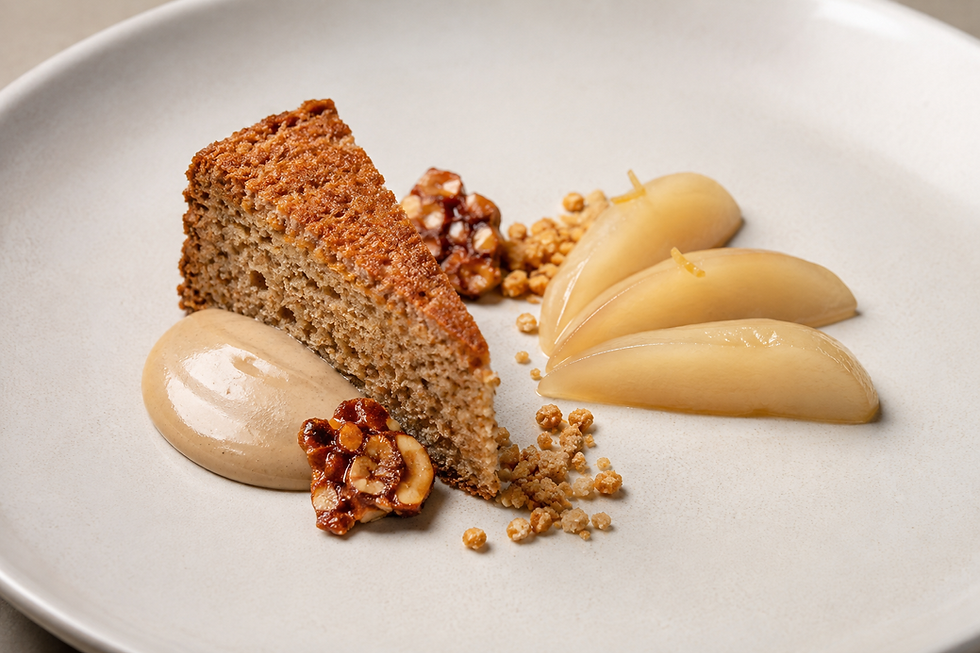
Serve on plain white or pale stoneware plates at room temperature, never warmed, and lay each wedge on its side rather than standing it up, since the crumb is too soft to hold a vertical face. A spoonful of unsweetened whipped cream beside it is all it wants. No sauce, no dusting, nothing over the crown: the glossy nuts are the decoration.
Professional Technique
The batter of a milk cake is deliberately fluid, because milk is what makes the crumb, and fluid means low viscosity. A batter with low viscosity cannot hold anything in suspension. A hazelnut is far denser than the mixture around it and starts to descend the moment it is folded in, and it keeps descending in the oven, because the first minutes of heat thin the batter further before it begins to set. By the time the structure can grip a nut, the nuts are on the base of the pan.
Two corrections work, both mechanical. The first is to toss the nuts in a tablespoon of the recipe's own flour before folding them in. The flour takes up the film of oil and moisture on each nut and leaves a dry powdery surface that catches on the batter instead of slipping through it. Friction does the work, which is why the coat must be thin and dry and why the excess is shaken off. The second is to keep half the nuts out of the batter and scatter them over the surface at the twenty minute mark, once the top has set enough to carry them.
The fault is easy to read. Cut the cooled cake and look at the vertical face: a dense gritty band in the bottom third with a clean, empty top half is the signature, and it is not careless mixing. Size decides how fast it happens, because the speed at which a particle falls through a fluid rises with the square of its radius. A halved nut sinks roughly four times more slowly than a whole one, and nuts chopped to the size of a lentil barely move. Whole nuts must be coated; chopped small, they stay where you put them.
Texture and Moisture Control
Judge the finished batter by how it behaves on the spatula. It should fall in an unbroken ribbon that sinks back into the surface and disappears in about three seconds. Slower than that and the cake bakes dense and dry; faster and it is too loose to carry anything, nuts included. The warm milk and butter go in last and in two additions for the same reason: poured in at once onto a mixture that has only just come together, they drop the whole bowl to a thin liquid there is no way back from.
The oven has to be fully up to 340°F (170°C) before the pan goes in, because a milk cake that starts in a cool oven spreads before it climbs and finishes flat. Doneness is a narrow window. A skewer in the centre should come out with fine damp crumbs stuck to it, not clean. A skewer that comes out clean means the crumb has already given up the moisture that made the cake worth baking, and no filling will put it back. Ten minutes in the pan afterwards lets the edges firm enough to take their own weight on the rack.
Professional Mise en Place
The cream is made first and looks after itself, the nuts are divided before anything is mixed, and the batter is the only thing that happens under pressure. Once the eggs are whipped, flour to closed oven door should take four minutes.
Equipment and tools
9 inch (23 cm) round pan, 2 inches (5 cm) deep, base lined with parchment
Stand mixer or electric whisk, and a wide flexible spatula
Fine sieve for the dry ingredients and for shaking excess flour off the nuts
Long serrated knife, cooling rack, small pastry brush
Prepared ahead
Hazelnuts toasted, skinned and cooled, up to 3 days ahead in a sealed jar
Nuts in three lots: floured for the batter, whole for the surface, 10 for the crown
Gianduia cream, up to 3 days ahead, sealed container
Dry ingredients sifted together and covered
Milk and butter measured, ready to warm
Service setup
Oven at full temperature, shelf already in the middle position
Timer set for 20 minutes, surface nuts in a bowl beside the oven
Cake completely cool before cutting, cream at spreading consistency
Serrated knife wiped between cuts, plates at room temperature
Chef Tips
Taste one raw hazelnut before you commit the batch. Nuts this oily turn rancid quietly, and a stale one carries a paint like note through the whole cake that no amount of chocolate covers.
Line the base of the pan but leave the sides bare and ungreased. A soft batter needs something to climb, and a buttered wall gives it nothing to grip, so the cake rises in the middle and slumps at the edge. A thin knife run round the inside after the rest releases it cleanly.
If real gianduia is out of reach, build it: 4 oz (115 g) good milk chocolate plus 3 tbsp (60 g) pure hazelnut paste comes close. Never use a hazelnut flavoured bar, which gives aroma and no nut fat and sets hard.
Let the cream thicken at room temperature rather than hurrying it. It reaches spreading consistency in about two hours and stays smooth, and beating it back into line puts air where you do not want it.
Common Mistakes
Folding the nuts in straight from the bag. Their smooth oily surface gives the batter nothing to hold, so they slide to the base of the pan in the first minutes of baking. The tablespoon of flour is not optional.
Adding the milk cold. Cold milk seizes the melted butter into solid flecks and forces you to keep folding to disperse them, and that extra work is what turns a tender crumb rubbery. Warm it to about 110°F (43°C), no hotter.
Opening the oven before twenty minutes. The surface has not set, so the draught drops the centre and any nut added sinks without trace. Wait for the timer, then open once, scatter and close.
Baking hotter to save time. Above 355°F (180°C) the crown colours and sets while the middle is raw, and a cake with this much milk gives no margin. Keep to 340°F (170°C) and trust the skewer, not the clock.
Cutting the layers while the cake is warm. A warm milk crumb tears under the knife instead of slicing. Let it reach room temperature completely, however long that takes.
Wine Pairing
Brachetto d'Acqui DOCG: Piedmont's own sweet red, lightly sparkling and only 5 to 6 percent alcohol, from vineyards an hour from the hazelnut groves. The carbon dioxide and the rose and wild strawberry aromatics lift the fat of the gianduia cream off the palate, and the sweetness never makes the cake taste flat. Serve cold, around 46°F (8°C).
Moscato d'Asti DOCG: The same hills, a different register. Low in alcohol, faintly frothy, with peach, elderflower and sage over a clean acidic finish that cuts the butter in the crumb. Its sweetness sits alongside the milk and vanilla rather than competing with the cocoa, which makes it the easiest of these across a whole slice.
Moscato di Scanzo DOCG: A rare sweet red from dried grapes in Lombardy, with dried rose, tobacco leaf and plum over a genuine tannic frame. Cocoa solids need tannin beside them or they read as bitter, and this supplies it while staying sweet enough to hold level with the filling. A small glass at 57°F (14°C).
Vin Santo del Chianti Classico DOC: Aged oxidatively in small barrels for years, so it arrives with dried fig, orange peel, almond and a distinct walnut note. Those aromas run alongside the toasted hazelnut instead of contrasting with it, and the acidity under all that sugar stops a rich slice from settling heavily.
Recioto della Valpolicella DOCG: Sweet, from dried corvina, but built on sour cherry acidity and a firm tannic spine rather than sugar alone. Choose it when the wine should answer the chocolate rather than the nut: its dried fruit depth meets the weight of the cocoa and adds no sweetness the cake lacks.
Storage & Reheating
Keep the finished cake under a dome or an inverted bowl at cool room temperature and eat it within 2 days, which is when the crumb is at its best. Refrigerate it only if the kitchen is genuinely warm, and then stand it out for 40 minutes before serving. Cut slices, wrapped, keep 3 days in the refrigerator.
For longer storage, freeze the cake unfilled: wrap the cooled layers in two layers of film and freeze up to 1 month, then thaw still wrapped and fill on the day. Do not freeze it once the cream is in. The gianduia cream on its own keeps 5 days in a sealed container in the refrigerator; stir it before spreading. Never warm a slice in a microwave, which collapses the crumb and splits the filling.
Nutrition
Per serving, based on 10 slices:
Calories: 465 kcal
Total Fat: 28 g
Saturated Fat: 10 g
Trans Fat: 0 g
Unsaturated Fat: 17 g
Cholesterol: 75 mg
Sodium: 175 mg
Total Carbohydrates: 46 g
Fiber: 3 g
Total Sugars: 26 g
Added Sugars: 21 g
Protein: 9 g
Lactose: 2 g
Principal micronutrients: vitamin E, manganese, copper, magnesium, phosphorus, iron
These figures are estimates and move with the gianduia you use, since brands differ widely in sugar and in hazelnut content.



Comments