
Italian Trentino Crispy Potato Cake | Tortel di Patate
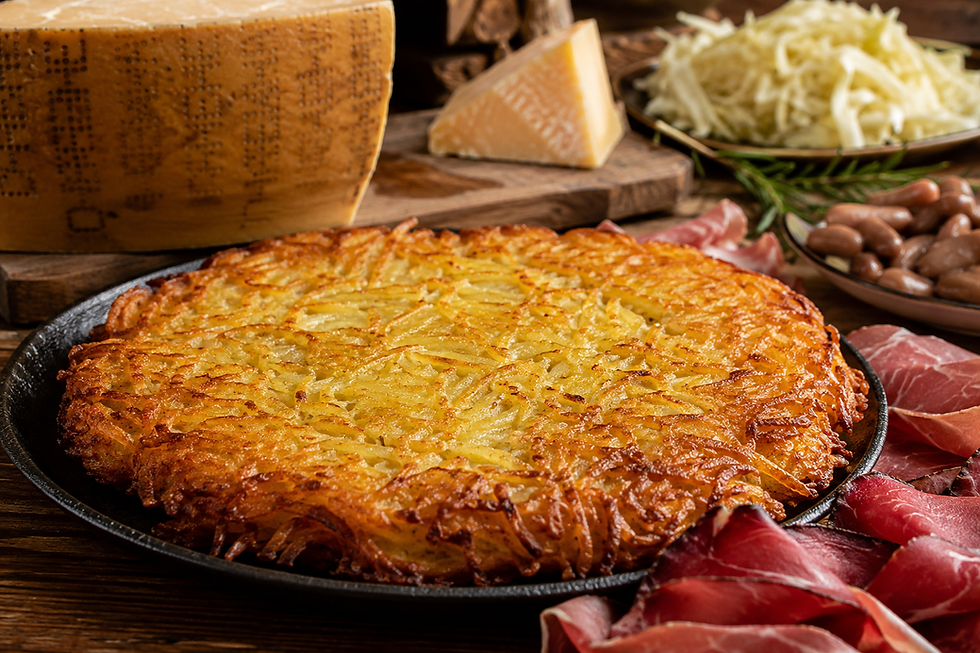
The tortel di patate is not a potato cake in the way the rest of Europe understands one. There is no boiling, no mashing, no egg binding it together. Raw potatoes are grated, wrung out hard by hand, dressed with a little flour and salt, and dropped straight into hot fat. What comes out three minutes later is a thin lacy disc, golden and shattering at the rim, soft and faintly sweet in the middle.
It belongs to the Val di Non, the long valley in western Trentino better known abroad for its apples, and it is eaten there the way other places eat bread. It arrives piled on a wooden board, and alongside it go slices of lucanica sausage, soft mountain cheese, cured speck and a bowl of sauerkraut. The tortel supplies the fat, the crunch and the sweetness that the salt and the acid of everything else are measured against.
Everything difficult here happens in the first five minutes, before any heat is involved. Potatoes grated raw release water and starch at the same time, and the whole technique turns on removing the first while keeping the second. Get it wrong and the mixture either steams into a soggy pancake or falls apart in the fat.
Yield: 8 tortel, serving 4 as a contorno. Prep: 25 minutes. Cook: 30 minutes. Total: about 55 minutes. Difficulty: intermediate. Course: contorno. Region: Trentino Alto Adige, Val di Non.
The Story
The potato reached Trentino late, near the end of the eighteenth century, and the Val di Non took to it faster than almost anywhere else in the Alps. The reason was soil. The terraces above Cles, Romallo, Revo and Fondo sit on light sandy ground that drains fast and warms quickly, which suits a potato far better than a cereal, and in a valley where wheat was scarce the potato quietly replaced it.
The name is local dialect for a small cake, and until well into living memory the tortel was cooked in strutto, rendered pork lard, because that is what a farmhouse had. Frying was the fastest way to turn a cheap root into something filling with the smallest amount of fuel, and the same pan of fat did several batches in a row. It was food for the filo, the long winter evenings spent in the stable where the animals kept the room warm.
It is still a communal dish. Romallo, in the heart of the valley, holds a sagra dedicated to the tortel every autumn, where the discs come out of enormous pans of hot fat and go onto boards with lucanica, cheese and kraut. That pairing is the giveaway: Alpine food with a foot in two worlds, Italian in its plainness and Austrian in what surrounds it.
Ingredients
For the tortel
Starchy potatoes such as Russet or Agria, peeled, 2 lb (900 g)
All purpose flour, 3 tbsp (24 g)
Fine sea salt, 1 1/4 tsp (7 g)
Freshly ground black pepper, 1/4 tsp
For frying
Rendered pork lard, strutto, 1 1/2 cups (300 g), or sunflower oil, 1 1/2 cups (350 ml)
For serving the traditional way
Lucanica trentina or other coarse fresh pork sausage, 10 oz (285 g)
Sauerkraut, drained, 1 1/2 cups (300 g)
Soft mountain cheese such as Casolet or young Asiago, 5 oz (140 g)
Speck, thinly sliced, 3 oz (85 g)
Flaky salt, for finishing
Preparation
Step 1. Choose and peel the potatoes
Work with a floury variety, Russet in the United States or Agria and Kennebec where you can find them. Waxy potatoes hold their water inside the cell and will not bind. Peel them and keep them whole and dry until the moment you grate, because potatoes left standing in water absorb more of it and you will only have to force it back out.
Step 2. Grate on the coarse holes
Use the largest holes of a box grater, the ones that give ribbons about an eighth of an inch thick, not the fine rasping side. Long ribbons tangle into each other and build the open lacy structure the tortel needs, while a fine grate turns the potato into a wet paste that fries dense and heavy.
Step 3. Squeeze out the water, keep the starch
Pile the gratings into a clean kitchen towel, gather it and twist hard over a bowl until no more liquid comes out. This is the decisive step. Then leave the collected liquid to stand for two minutes: a chalky white layer of pure potato starch settles at the bottom. Pour the water away, scrape that starch out and stir it back into the grated potato. You have removed the moisture and kept the glue.
Step 4. Dress the mixture
Scatter the flour, salt and pepper over the gratings and toss with your fingertips, lifting rather than stirring, until everything is lightly coated. Three tablespoons for two pounds is enough. Flour here is insurance, not batter: it catches residual surface moisture so the fat does not spit, and it crisps. Move quickly, because the mixture darkens and weeps if it stands.
Step 5. Bring the fat to temperature
Melt the lard or heat the oil in a wide heavy skillet to a depth of about a quarter of an inch, and bring it to 340°F (170°C). Check with a thermometer, not by eye. Below 320°F (160°C) the potato absorbs fat and stays pale; above 360°F (180°C) the outside colours before the middle has cooked.
Step 6. Shape the tortel in the pan
Take a loose handful of the mixture, about 3 oz (85 g), lay it into the fat and flatten it with the back of a fork into a disc roughly five inches across and no more than a quarter of an inch thick. Do not compact it: the ribbons should sit against each other with gaps between them, so the fat runs through and crisps the interior surfaces too. Fry two at a time at most.
Step 7. Fry, turn once and drain standing up
Give the first side 3 to 4 minutes, until the rim is deep gold and the disc lifts cleanly from the pan, then turn once and give the second side 2 to 3 minutes. Turn only once. Lift the tortel out and stand it on its edge in a rack, so fat runs off both faces instead of collecting underneath. Season with flaky salt while the surface is still hot and eat within minutes.
Plating
In the Val di Non the tortel never sees a plate. It goes onto a warm wooden board, several discs overlapping, with the sausage grilled and cut into lengths, the sauerkraut in a bowl to one side, the cheese in thick pieces and the speck loosely draped. Everyone builds each mouthful themselves. Warm the board briefly in a low oven first, because cold wood pulls the heat out of a thin fried disc in seconds.
For a restaurant service, treat the tortel as a single component rather than a pile. One disc per person, set slightly off centre on a warm plate, with a quenelle of sauerkraut behind it and a piece of grilled lucanica against the edge. Shave the cheese over the hot surface at the pass so it softens without melting into a sheet. It is served hot, never warm, and the plates go out as they are made.
Professional Technique
The recipe rests on one piece of understanding: a raw grated potato is mostly water held inside cell walls, with starch granules suspended in it. Squeezing ruptures those cells and lets the water out, and the starch that leaves with it is the only binder the dish has. Most cooks pour that liquid away, then wonder why the mixture will not hold and add egg and more flour, which turns a tortel into a rosti. Returning the settled sediment gives you a binder chemically identical to the potato itself.
The second technique is the deliberate refusal to compact. Almost every potato pancake in the European repertoire is pressed tight; the tortel is not. Loose ribbons with air between them give the hot fat a route into the middle of the disc, so the interior surfaces fry rather than steam. That is what produces a cake crisp all the way through instead of crisp outside and pasty inside, and it explains the thinness: a quarter of an inch is the point at which fat can still penetrate, at half an inch it cannot.
Texture and Moisture Control
Two enemies pull in opposite directions. Too much residual water and the potato steams inside the fat, the surface never dries and the disc absorbs oil instead of shedding it. Too little starch and the ribbons refuse to knit, so the tortel breaks up when the spatula touches it. Wringing hard addresses the first, reclaiming the settled starch the second.
Timing is part of moisture control too. Grated potato keeps releasing liquid as it stands and it oxidises, turning grey and then pink at the edges. The mixture should go into the fat within ten minutes of being dressed with flour. To stage a batch, hold the wrung gratings dry in a covered bowl and add the flour and salt only as each tortel goes into the pan, because salt draws water out of raw potato immediately.
After frying, everything depends on air. A tortel laid flat on paper traps steam against its underside and loses the crackle in ninety seconds. Standing it on edge on a rack lets both faces breathe. Never stack them, never cover them, never hold them in a closed drawer.
Professional Mise en Place
Because the mixture cannot be prepared in advance, everything else must be. The accompaniments are made ahead and held, and the last twenty minutes belong entirely to the pan.
Equipment and tools
Box grater with large holes, or a food processor with the coarse shredding disc
Two clean cotton kitchen towels for wringing, plus a wide mixing bowl
Wide heavy skillet, cast iron or carbon steel, and a probe thermometer
Slotted spatula and a cooling rack set over a tray
Warm wooden serving board if you are serving the traditional way
Prepared ahead
Sauerkraut warmed with a little of its own liquid, up to 2 days ahead
Lucanica grilled or pan roasted and held warm, on the day
Speck sliced and cheese cut, covered and kept cool, on the day
Potatoes peeled and kept whole, dry and covered, no more than 1 hour ahead
Flour, salt and pepper weighed into a small bowl ready to scatter
Service setup
Fat at 340°F (170°C) with the thermometer left in the pan
Rack and tray beside the stove, flaky salt within reach
Grate, wring and dress one batch at a time, never the whole quantity
Two tortel in the pan at once as a hard limit
Plates or board warm and waiting before the first disc goes in
Chef Tips
Weigh the potatoes after peeling, not before. Two pounds unpeeled leaves you noticeably short once the skin and any green patches are gone, and the ratio of flour to potato matters more here than in almost any other fried preparation. Even slightly over floured, the mixture loses its lace and fries into a solid round.
Keep a second towel dry and clean. Wringing two pounds of potato soaks the first one completely, and a saturated cloth stops removing water halfway through the job, which is why the second half of a batch often fries worse.
If you can find strutto from a good butcher, use it and do not dilute it with oil. It fries cleaner, and the flavour it leaves on the surface is what makes the tortel taste of the valley rather than of a pan. Strain it through a fine mesh sieve when it cools and it will serve you two or three more times.
Test the fat with a single ribbon of potato before committing a whole disc. It should bubble immediately and steadily, with small fast bubbles rather than a violent boil, and colour in about forty seconds. If it browns in fifteen seconds, pull the pan off the heat for a minute.
Common Mistakes
Grating on the fine side of the box grater. Fine gratings release far more liquid, tangle into a paste and fry into a dense disc with no open structure. The tortel needs long coarse ribbons to trap air and let fat work its way through the middle.
Throwing away the potato liquid. The white sediment underneath it is the starch that binds the whole thing, and discarding it is why so many cooks resort to eggs and extra flour. Let the liquid stand two minutes, pour off the water and stir the sediment back in.
Rinsing the grated potato. Running water over the gratings to stop them browning washes the surface starch away and guarantees a mixture that will not hold in the fat. Work quickly and fry within ten minutes instead, which solves discolouration without costing you the binder.
Pressing the tortel flat and tight. A compacted disc gives the fat no route in, so the centre steams while the outside fries and you get a cake crisp on two faces and pasty between them. Flatten gently with a fork and leave visible gaps between the ribbons.
Frying too cool or crowding the pan. Both do the same damage: the temperature falls, the potato absorbs fat instead of shedding it, and the tortel comes out heavy and greasy. Hold the fat at 340°F (170°C) and never put more than two discs in at once.
Salting the mixture long before frying. Salt pulls water out of raw potato within minutes, so a bowl seasoned and left standing sits in liquid and everything you gained by wringing is lost. Season immediately before frying, and again on the surface afterwards.
Wine Pairing
Teroldego Rotaliano DOC: Grown on the gravel plain of the Campo Rotaliano at the mouth of the Val di Non, this is the local red and the most geographically exact answer on the list. It carries dark cherry fruit, a firm line of acidity and tannins that are present but fine grained, which is what you want against fried pork fat: enough grip to clear the palate, not enough to clash with the sweetness of the potato.
Trentino Marzemino DOC: A lighter, softer Trentino red from the Vallagarina with a violet and red plum perfume and very modest tannin. Its low astringency is the point here: it lets the delicate sweetness of the grated potato stay audible instead of burying it, while the acidity still cuts the lard. It is also the right weight for the lucanica, which is fresh sausage rather than cured.
Trento DOC: The metodo classico of the mountains, made mostly from Chardonnay grown at altitude, and the most effective option if the frying is what you want to address. The bead scrubs the palate clean between mouthfuls and the high mountain acidity slices straight through the fat, while the bread and hazelnut notes from lees ageing pick up the toasted rim of the tortel.
Alto Adige Santa Maddalena DOC: Schiava from the hills above Bolzano, pale in colour, low in tannin and faintly almondy on the finish, traditionally drunk with exactly this kind of Alpine plate. Served cool, at about 55°F (13°C), it behaves like a red with the refreshment of a white, which is what a board of sausage, speck, cheese and sauerkraut actually needs.
Alto Adige DOC Lagrein: The choice when the speck and the smoked elements of the plate dominate. Lagrein is deeper and more structured than the others here, with dark berry fruit, a savoury edge and a bitter twist on the finish that stands up to cured pork and to the sourness of the kraut. Pick a bottling with little or no new oak.
Storage & Reheating
The honest answer is that a tortel di patate does not store. It is at its best within three minutes of leaving the fat and noticeably worse after twenty, and nothing recovers the texture fully. Plan the quantity to be eaten, and fry a second batch during the meal rather than frying everything in advance.
For leftovers, cool them completely on a rack, never covered while warm, then stack them with parchment between each disc and refrigerate in an airtight box for up to 2 days. Reheat only in dry heat: a rack in a 400°F (200°C) oven for 5 to 6 minutes, or a hot dry skillet for about 90 seconds a side. Never use a microwave, which turns the starch soft and the surface leathery in seconds.
Nutrition
Per serving, based on 4 servings of 2 tortel each, without the sausage, cheese and speck:
Calories: 385 kcal
Total Fat: 20 g
Saturated Fat: 8 g
Trans Fat: 0 g
Unsaturated Fat: 11 g
Cholesterol: 19 mg
Sodium: 690 mg
Total Carbohydrates: 46 g
Fiber: 4 g
Total Sugars: 2 g
Added Sugars: 0 g
Protein: 6 g
Lactose: 0 g
Principal micronutrients: potassium, vitamin C, vitamin B6, magnesium, iron
These figures are estimates. Fat absorption varies a great deal with the temperature of the pan, and a tortel fried at the correct 340°F (170°C) takes up considerably less than one fried cool. Serving it the traditional way with lucanica, cheese and speck roughly doubles the calories and the sodium.


Comments