
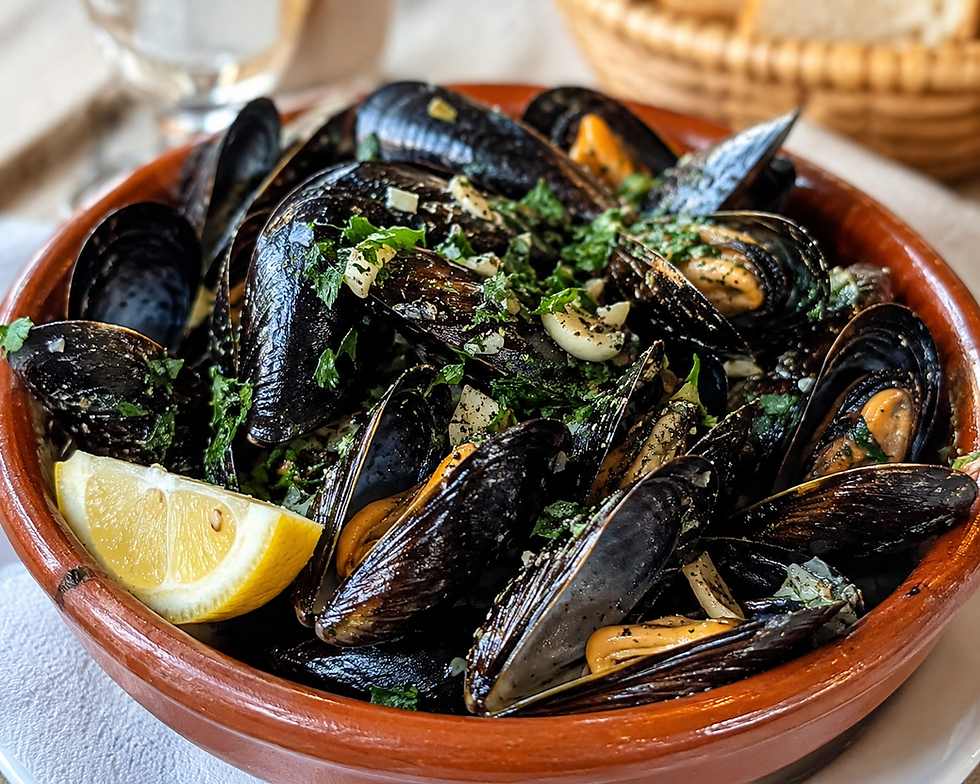
Taranto Mussel Soup | Zuppa di Cozze alla Tarantina

Zuppa di cozze alla tarantina is a soup in name only. There is no broth made in advance, no stock, no fish trimmings and no water. The liquid in the bowl is the water the mussels themselves release when they open, sharpened with white wine, loosened with tomato and driven by garlic and chilli. Everything else is bread.
Taranto has a claim to this dish no other city can make. The Mar Piccolo, the shallow inner lagoon the old town sits on, has farmed mussels since antiquity, and the cozza nera tarantina grown there is plump, sweet and less salty than open sea mussels because of the freshwater springs feeding the basin. A soup built entirely on mussel liquor only works when the mussels are that good.
The technique is about restraint and about one step most recipes leave out: straining the liquor the mussels give up, twice, before it goes near the tomato. Skip it and the bowl carries grit. Do it properly and you get a bright red broth with a clean marine edge no fish stock could imitate.
Yield: 4 servings as a main course. Prep: 45 minutes. Cook: 25 minutes. Total: about 1 hour 10 minutes. Difficulty: intermediate. Course: primo piatto. Region: Apulia, the city of Taranto and the Ionian coast.
The Story
Mussel farming in Taranto is old enough to appear in Roman sources, and the reason is geographic rather than cultural. The Mar Piccolo is a shallow basin fed by underwater freshwater springs the locals call citri, which keep salinity low and the water rich in the plankton mussels feed on. That grows a mussel with a fuller body and a sweeter taste than one raised in open sea, and the city has built part of its economy around it for two thousand years.
The soup is what fishermen and mussel farmers ate at the end of a shift, and the structure shows it. Everything in it was pulled out of the water that morning or already in the kitchen: garlic, oil, chilli, a splash of wine, tomatoes in season and bread gone hard two days earlier. The bread is not a garnish. It is why the dish counts as a meal rather than a snack, and in the poorest versions it filled more of the bowl than the mussels did.
Alla tarantina means with tomato and chilli, and the distinction matters in southern Italy. Naples has the impepata di cozze, mussels with black pepper and lemon and no tomato at all, and the two are routinely confused on menus outside their home cities. In Taranto neither the tomato nor the peperoncino is optional, and the soup is eaten in summer when both mussels and tomatoes are at their best.
Ingredients
For the mussels
Live mussels in the shell, cozze nere if you can find them, 4 1/2 lb (2 kg)
Coarse sea salt for the soaking water, 1 tbsp (15 g)
For the soup base
Extra virgin olive oil, 1/3 cup (80 ml)
Garlic cloves, thinly sliced, 4
Fresh red chilli, seeded and sliced, 1, or dried peperoncino, 1 tsp
Dry white wine, 3/4 cup (180 ml)
Datterini or pomodorini, halved, 12 oz (350 g)
Tomato passata, 1/2 cup (120 ml)
Flat leaf parsley, finely chopped, 1/2 cup (20 g)
Freshly ground black pepper, to taste
For the bread
Country bread, at least one day old, 8 thick slices
Garlic clove, halved, 1
Extra virgin olive oil, 2 tbsp (30 ml)
For finishing
Extra virgin olive oil, 2 tbsp (30 ml)
Flat leaf parsley leaves, whole, 12
Lemon, cut into wedges, 1
Freshly ground black pepper, to taste
Preparation
Step 1
Check the mussels. Tip them into a colander and go through them one at a time. A live mussel is closed, or closes within a few seconds when you tap it. Any shell that stays open after tapping goes in the bin, and so does any that feels unusually heavy, which means it is full of sand. Discard broken shells too. This sorting is the only guarantee the finished soup is safe.
Step 2
Scrub and debeard. Pull the byssus, the fibrous beard, sharply towards the hinge rather than the point, so you do not tear the flesh inside. Scrape off barnacles with the back of a knife and scrub each shell under cold water. Soak them 30 minutes in cold water with the coarse salt, which persuades them to spit out any sand, then lift them out rather than draining, leaving the grit behind.
Step 3
Build the base. Set a wide pan with a lid over medium heat, add the olive oil, the sliced garlic and the chilli and let them colour slowly for 3 to 4 minutes. The garlic should go pale gold and no further; brown garlic turns the whole soup bitter and there is no correcting it. This gentle start separates a base that tastes of sweet garlic from one that tastes scorched.
Step 4
Open the mussels. Raise the heat to high, tip in half the mussels and half the wine, cover at once and leave them 2 minutes. Shake the pan, then lift out every mussel that has opened with a spider. Give the stragglers another 30 seconds and no more, then repeat with the second half. Two batches keep the pan hot, so they open quickly rather than stewing while they wait.
Step 5
Strain the liquor. This step decides the dish. Pour everything left in the pan through a fine mesh sieve lined with damp muslin, leaving the last spoonful behind, then pass it through a second time. You should end with 1 1/2 to 2 cups (350 to 475 ml) of clear liquid. Taste it now: it is already salty, which is why no salt is added anywhere in this recipe.
Step 6
Shell most of the mussels. Leave one third in the shell for the bowls and pick the rest out, dropping the meat into the strained liquor so it stays moist. Discard every empty shell and any mussel that refused to open. Cover and set aside; they are already cooked and must not meet heat again until the last thirty seconds.
Step 7
Make the tomato broth. Wipe the pan, return it to medium high heat with the halved tomatoes and cook 4 minutes, pressing so they collapse. Add the passata and the strained liquor, bring to a simmer and reduce 8 to 10 minutes, until it lightly coats a spoon and the raw tomato edge has gone. Stir in most of the parsley and plenty of black pepper, then taste before considering salt.
Step 8
Toast the bread and finish. Griddle the slices on both sides until dry and marked, rub one side of each with the cut garlic and brush with olive oil. Bring the broth back to a bare simmer, slide in all the mussels, shelled and unshelled, and give them 30 seconds only, moving the pan rather than stirring. Take it off the heat the moment the shells are hot to the touch.
Plating
Use deep wide bowls and warm them properly, to around 140°F (60°C), because this soup is eaten slowly and loses heat fast once the bread is in. Set one slice of toasted bread in the bottom of each bowl, garlic side up, and press it down so it starts drinking the broth immediately.
Ladle the broth and the shelled mussels over the bread, then arrange the mussels still in their shells on top, open side up, so each holds a little broth. Six or seven per bowl is right. Lean the second slice against the rim, untouched by the liquid, for the diner to use as a spoon.
Finish with the whole parsley leaves, a thread of raw olive oil and a turn of black pepper. A lemon wedge goes on the side rather than in the soup, so each person decides. Put an empty bowl on the table for the shells and serve immediately; this will not wait.
Professional Technique
The whole dish rests on treating the mussel liquor as a finished stock rather than waste. Two kilos of mussels release close to two cups of intensely flavoured liquid, already seasoned by the sea, and it is the entire savoury backbone of the soup. Straining it twice through damp muslin, and leaving the last spoonful in the pan, removes the sand and shell fragments that would otherwise sit in every mouthful. Nothing else supplies depth, which is why it cannot be rushed.
The second technique is cooking the mussels twice and only just. They open in two minutes and are done at that moment; every extra minute shrinks them and squeezes water out. Pulling them as they open, holding them in their own strained liquor and returning them for thirty seconds at the end keeps them plump while the broth gets its ten minutes of reduction. Cooking tomato with the mussels still in the pan is the commonest way this dish is ruined.
The third is the garlic, which sets the character of the base. Sliced rather than chopped, it releases its sugars slowly and holds its shape, so it can stay in the soup instead of being fished out. Taken only to pale gold over medium heat, it stays sweet. The chilli goes in at the same moment, because capsaicin is fat soluble and needs the oil to spread its heat evenly through the broth rather than sitting in hot pockets.
Texture and Moisture Control
Mussel flesh is a muscle with very little connective tissue, so it goes from tender to rubbery in under a minute of extra heat. The visual cue is reliable: at doneness the meat is plump and still fills its shell, and the frill around the edge is separate and orange. Meat that has shrunk away from the shell is already overcooked, and no broth restores it. Two minutes, plus thirty seconds at the end, is the total cooking time for the mussel.
The broth sits between a soup and a sauce. Reduced too little it is watery and the tomato tastes raw; reduced too far it becomes a thick condiment the bread cannot absorb evenly. Eight to ten minutes at a steady simmer is right, and the test is a spoon lifted from the pan: the liquid should coat the back thinly and then run off. Since the liquor carries salt, reduction concentrates it, which is why tasting comes after reduction.
Bread is the third texture and the hardest to hold. Day old country bread with an open crumb absorbs broth without dissolving; fresh soft bread turns to paste within a minute. Grilling dries the surface and builds a crust that slows absorption, and rubbing raw garlic across it works only while the slice is hot. Assemble at the last second, because the slice in the bottom of the bowl has about four minutes before it collapses.
Professional Mise en Place
The mussels can be cleaned and opened well ahead, which turns a stressful service into a five minute one. Only the bread and the final thirty seconds are last minute.
Equipment and tools
Wide pan with a tight lid, deep enough to hold 2 kg of mussels
Fine mesh sieve and a square of damp muslin
Spider skimmer and a large bowl for the opened mussels
Griddle pan or grill for the bread
Deep warmed bowls and a separate bowl for empty shells
Prepared ahead
Mussels scrubbed, debearded and soaked, up to 4 hours ahead, kept cold
Mussels opened, shelled and held in their liquor, up to 3 hours ahead
Liquor strained twice and refrigerated in a sealed jar
Garlic sliced, chilli cut and parsley chopped, on the day
Bread sliced thickly and left uncovered to dry further
Service setup
Tomato broth simmering and already reduced, held just below a simmer
Mussels at room temperature beside the stove, not fridge cold
Bread grilled, rubbed with garlic and oiled at the last moment
Bowls warmed to 140°F (60°C) at the pass
Lemon wedges, parsley and finishing oil within reach
Chef Tips
Buy mussels the day you cook them and keep them in the refrigerator in an open bowl under a damp cloth, never sealed in plastic and never sitting in fresh water. They are alive and they suffocate. A mussel that died before it reached the pan will not open, which is why unopened shells are discarded rather than prised apart.
Do not add salt at any stage without tasting first. Two kilos of mussels carry enough sea water to season the whole pan, and the liquor concentrates as the broth reduces. Nine times out of ten the finished soup needs nothing, and an oversalted mussel broth cannot be diluted without losing what justifies the dish.
If you can find them, use datterini rather than round cherry tomatoes. They carry more sugar and less water, so the broth reduces faster and tastes sweeter against the chilli. Out of season, good passata with a spoon of tomato paste beats poor fresh tomatoes every time.
Keep the lid on for the full two minutes when the mussels go in. Lifting it to look drops the steam that is doing the work, and the mussels at the bottom open while the ones on top stay shut, which is how you end up overcooking half the pan to rescue the other half.
Common Mistakes
Cooking the mussels in the tomato broth. Ten minutes of reduction with the mussels in the pan leaves them shrunken and tough. Open them separately, hold them in their liquor, and return them for the final thirty seconds only.
Not straining the liquor. Every mussel brings sand and shell grit, and it all settles in the pan. Two passes through damp muslin, leaving the last spoonful behind, is the only way to a clean bowl.
Browning the garlic. Garlic taken past pale gold turns acrid and that bitterness runs through the entire soup, because the oil it flavoured is the base of everything. Start it over medium heat and watch it.
Salting the soup. The liquor is already sea water and it concentrates as the broth reduces. Taste at the end, and in most cases add nothing.
Using fresh soft bread. It dissolves into paste within a minute of meeting the broth. Use country bread at least a day old, grill it dry on both sides, and put it in the bowl at the last moment.
Wine Pairing
Locorotondo DOC: The Pugliese white made an hour inland from Taranto, built on Verdeca and Bianco d'Alessano. Dry, light and faintly almondy, with quiet acidity that lets a tomato and chilli broth stay in charge. Serve it at 46°F (8°C), when its saline finish lines up with the mussel liquor.
Martina Franca DOC: From the same Valle d'Itria hills and largely the same grapes, but firmer and more mineral. That structure matters because the broth carries a third of a cup of olive oil, and a wine with grip cuts through it. The dry almond bitterness on the finish sits well against the chilli.
Salice Salentino DOC: Choose the rosato, from Negroamaro, the traditional Salento answer to tomato and seafood together. It has the red fruit to meet the tomato and enough acidity and salinity for the mussels, without the tannin a red would bring. Serve it at 54°F (12°C) and it holds up against the peperoncino.
Cirò Bianco DOC: Greco Bianco from the Ionian coast of Calabria, grown in the same sea and the same heat. Dry and broad rather than sharp, with citrus peel and a saline close, and that breadth suits a soup with bread in it. The pairing for anyone who finds the Valle d'Itria whites too lean.
Fiano di Avellino DOCG: The one to open if you want the pairing interesting rather than merely correct. Fiano has more body, a smoky hazelnut note and slow acidity that carries through a reduced tomato broth without being flattened. It handles the chilli better than lighter whites, which taste thin once the heat builds.
Storage & Reheating
Assembled bowls do not keep ten minutes, let alone a day, because the bread disintegrates. Store the components separately. The tomato broth with the shelled mussels in it keeps in an airtight container in the refrigerator for 24 hours and no longer, and mussels in the shell should be picked out and eaten the same day.
Reheat the broth on its own until it just simmers, then take it off, add the mussels and leave them 30 seconds in the residual heat. Never bring mussels back to a boil and never use a microwave; both turn them rubbery in seconds. Grill fresh bread for each serving, since old toast goes leathery.
The strained liquor freezes very well on its own in an ice cube tray and keeps 2 months as a base for another soup or a risotto. The tomato broth freezes acceptably for 1 month. Cooked mussels do not freeze, and shellfish reheated once should not be reheated again: eat them or discard them.
Nutrition
Per serving, based on 4 main course servings:
Calories: 540 kcal
Total Fat: 26 g
Saturated Fat: 4 g
Trans Fat: 0 g
Unsaturated Fat: 21 g
Cholesterol: 85 mg
Sodium: 1250 mg
Total Carbohydrates: 38 g
Fiber: 4 g
Total Sugars: 7 g
Added Sugars: 0 g
Protein: 34 g
Lactose: 0 g
Principal micronutrients: iron, vitamin B12, selenium, manganese, zinc, iodine
These figures are estimates. Sodium is the line that varies most, since it comes almost entirely from the mussels themselves and depends on where they were grown.




Comments