
Italian Bread Crust Roasted Sweet Onion | Cipolla Dolce in Crosta di Pane, Lievito Tostato, Aceto di Sherry e Santoreggia

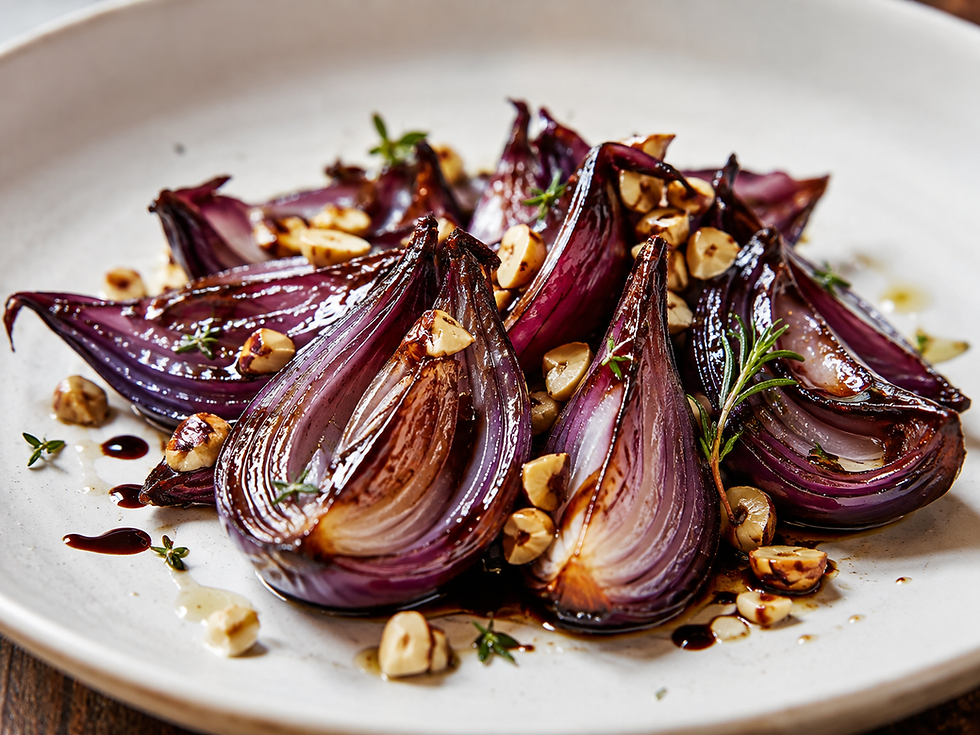
This dish treats a single sweet onion with the seriousness normally reserved for a piece of meat. The whole bulb is sealed inside a sheet of plain bread dough and baked until the dough becomes a hard dark shell. Inside that shell nothing evaporates: the onion cooks in its own steam and its own sugars, and what comes out after an hour is dense, glossy and deeply concentrated, its layers separating cleanly under a spoon.
Three elements sit around it. Toasted yeast, made by roasting fresh compressed baker yeast with butter until it turns the colour of hazelnut skin, brings a savoury bready depth that reads as umami without any animal product. A jus built from the onion trimmings and white wine, sharpened with Sherry vinegar, gives acidity and gloss. Summer savory, the herb Italians call santoreggia, cuts the sweetness with a peppery resinous edge.
The dish is simple but unforgiving in two places: the seal on the dough must be complete, and the vinegar must go in at the very end, off the heat. Everything else is patience. The dough is a cooking vessel rather than bread, though the baked shards are excellent over the plate.
Yield: 4 servings as a contorno or a vegetable first course. Prep: 30 minutes. Dough rest: 1 hour. Cook: 1 hour 15 minutes. Rest: 10 minutes. Total: about 3 hours. Region: central and southern Italy.
The Story
Cooking a whole vegetable inside a sealed casing is one of the oldest ideas in Italian country cooking. Onions were buried whole in the warm ash of a dying hearth and left overnight, a practice still remembered in central and southern Italy as cipolle sotto la cenere. The ash did what the dough does here: it excluded air, held a low even heat and forced the onion to cook in its own moisture. What emerged was sweet, silky and faintly smoky, eaten with oil, salt and vinegar. The bread crust is that technique moved into an oven.
The onion matters. The Cipolla di Giarratana grows on the Monti Iblei above Ragusa, an enormous flattened bulb that can pass a pound in weight and is so low in pungency it is eaten raw in salad. The Cipolla Rossa di Tropea is famous for its sugar and its violet colour, and Cannara in Umbria holds an onion festival every September. Any firm sweet variety suits this method, which concentrates whatever sugar is present and punishes a sharp watery one.
Santoreggia, summer savory, is the quiet member of the Italian herb garden. It grows wild on dry stony ground in the Marche and across the central Apennines, and for centuries it was the poor kitchen answer to black pepper. It is peppery, slightly bitter and resinous, close to thyme but sharper, with an old association with alliums. The Sherry vinegar is the one element from outside Italy, here because its oxidative nutty character sits against roasted yeast in a way no bright wine vinegar does.
Ingredients
For the onions
Sweet white onions, firm and unblemished, 4 medium, 7 to 8 oz each (200 to 225 g)
Extra virgin olive oil, 1 tbsp (15 ml)
Kosher salt, 1/2 tsp (3 g)
For the bread crust
Bread flour, 3 cups (360 g)
Whole wheat flour, 3/4 cup (90 g)
Lukewarm water at 95°F (35°C), 1 1/2 cups (355 ml)
Fine sea salt, 1 1/2 tsp (9 g)
Active dry yeast, 1 tsp (3 g)
Extra virgin olive oil, 1 tbsp (15 ml)
For the toasted yeast
Fresh compressed baker yeast, 1 oz (28 g)
Unsalted butter, 2 tbsp (28 g)
Vegetable stock, 2 tbsp (30 ml)
Sherry vinegar, 1/2 tsp (2.5 ml)
Fine sea salt, 1 pinch
For the onion jus
Onion trimmings and roots from the four onions, all of them
Leek, white part only, sliced, 1 small
Extra virgin olive oil, 1 tbsp (15 ml)
Dry white wine, 1/2 cup (120 ml)
Vegetable stock, 2 cups (475 ml)
Bay leaf, 1
Summer savory, 1 small sprig
Sherry vinegar, 1 tbsp (15 ml)
Cold unsalted butter, 1 tbsp (14 g)
For finishing
Fresh summer savory leaves, 2 tbsp picked
Extra virgin olive oil, 2 tsp (10 ml)
Flaky sea salt, to taste
Freshly ground black pepper, to taste
Shards broken from the baked bread shell, about 1/4 cup
Aged vegetarian hard cheese, finely grated, 2 tbsp (12 g), optional
Preparation
Step 1. Mix and rest the bread dough
Whisk the dry yeast into the lukewarm water at 95°F (35°C) until it clouds. Mix both flours and the salt, add the yeasted water and the oil, and knead six to eight minutes until smooth. The dough is deliberately firm and barely leavened, a tight jacket that will not tear around a bulb. Cover and rest one hour: it swells modestly, not double.
Step 2. Trim the onions and save every scrap
Peel away only the papery skin and the first dry layer. Trim the top but leave the root plate intact, because the root holds the layers together through the long bake. Reserve every trimming for the jus. Rub each onion with the oil and the kosher salt. Heat the oven to 375°F (190°C), rack in the lower third.
Step 3. Toast the yeast in butter
Crumble the fresh yeast into a small pale bottomed pan with the butter over low heat and stir constantly. It melts to a slurry, thickens, then colours. Keep stirring eight to ten minutes, until it is the colour of hazelnut skin and smells of toasted bread and broth. There is no recovering from burnt, so pull the pan the moment the colour is right, then loosen it with the stock and add the vinegar and a pinch of salt.
Step 4. Build and strain the onion jus
Sweat the trimmings and the sliced leek in the oil over medium heat for eight minutes without colour. Add the wine and reduce almost dry, then the stock, bay leaf and savory sprig. Simmer thirty minutes, strain through a fine sieve pressing the solids, then reduce to about half a cup of intense jus. Hold it warm: vinegar and butter go in at service, never before.
Step 5. Roll and seal the dough around each onion
Divide the dough into four and roll each piece into a round roughly 8 inches (20 cm) across and 1/8 inch (3 mm) thick, even all over. Set an onion root side down in the middle. Bring the dough up in overlapping folds, pressing each against the last and brushing water along the seams so they weld. Twist the excess at the top and press it flat. No gap, no pinhole.
Step 6. Bake the parcels and rest them
Set the parcels seam side up on a parchment lined sheet, well spaced so air circulates. Do not oil or glaze them: fat on the surface only makes the shell blister. Bake at 375°F (190°C) for one hour. The dough sets hard in fifteen minutes, then darkens to deep chestnut. Patch any venting seam with a scrap of dough. Rest ten minutes before opening.
Step 7. Crack the shells and finish the jus
Crack each shell with the back of a heavy knife: it should break in large plates, not shatter. Lift the onion out with a spoon, root plate underneath so the bulb stays whole, and pour any juice caught in the shell into the jus. Off the heat, whisk in the tablespoon of Sherry vinegar and taste, since the bulb is now far sweeter than it was raw. Then whisk in the cold butter until glossy, and never boil it again.
Step 8. Loosen the yeast paste and crisp the shards
Warm the yeast paste gently and loosen it with a spoonful of hot jus until spoonable but not runny. It should taste savoury, bready and slightly salty with the vinegar just underneath. Break the best fragments of shell into shards about two inches across and crisp them three minutes in the still warm oven.
Plating
Use warm shallow bowls rather than flat plates. The jus is loose and needs to pool, and a cold bowl chills the butter emulsion within a minute.
Spoon a tablespoon of yeast paste slightly off centre and drag the back of the spoon through it once into a short wide streak. Set the onion on it, root side down, so it stands upright. Do not cut into it in the kitchen: the guest should watch the layers separate.
Pour the jus around the base, never over the top, so the glossy amber surface stays visible. Two tablespoons a portion is right, and more turns the dish into a soup. Scatter the savory leaves, add black pepper, a few flakes of salt and a thread of oil. Stand two or three shards against the side. Serve at once: the contrast lasts about four minutes.
Professional Technique
The method rests on one principle: a sealed dough shell turns an open roast into a closed steam environment. In an open oven an onion loses water to the air and caramelizes on the surface. Inside the shell that water has nowhere to go. It becomes internal steam just above boiling, cooking the bulb evenly from every direction and condensing back into the layers as things cool, so the onion concentrates instead of drying.
The yeast toasting is a Maillard reaction driven deliberately. Fresh compressed yeast is roughly seventy percent water and rich in free amino acids. As the water cooks off in the butter those acids react with residual sugars and produce the same roasted savoury compounds a long meat stock gives. It needs low heat and constant movement, because high heat carbonizes the surface while the interior is still pale.
The third technique is timing the acid and the fat. Acetic acid is volatile and flashes off at simmering temperature, which is why a jus balanced at the stove tastes flat three minutes later. Adding the vinegar off the heat keeps the top notes, and the butter follows the same logic in reverse, since an emulsion mounted into boiling liquid breaks.
Texture and Moisture Control
The finished onion should give completely under a spoon while still holding its shape when lifted, and that comes from time at a moderate temperature rather than higher heat. At 375°F (190°C) the pectin between the layers breaks down slowly and evenly over an hour. Push the oven to 425°F (220°C) and the outer layers turn to slack puree while the core is still firm, and the shell cracks under the rapid steam pressure.
Moisture control is almost entirely about the seal. A perfect seal means zero net water loss and a dense juicy bulb. A pinhole means a slow bleed of steam, an onion papery at the edges and a soggy shell. Check every parcel before it goes in and again fifteen minutes into the bake.
The ten minute rest matters more than it looks. Straight from the oven the bulb is full of superheated steam under pressure, so opening it then lets the liquid run out and the layers slump. Ten minutes lets the moisture redistribute into the flesh. The jus needs the opposite discipline, reduced enough to coat a spoon but fluid enough to spread, and the shards go on last.
Professional Mise en Place
The dough, the jus base and the toasted yeast all hold well. The vinegar, the butter emulsion, the shards and the plating do not. Organising the station along that line is what makes four covers possible at once.
Equipment and tools
Heavy rimmed baking sheet and parchment
Rolling pin and a floured bench
Small pale bottomed pan for the yeast
Saucepan and fine mesh conical sieve for the jus
Digital scale, thermometer, whisk, four warmed bowls
Prepared ahead
Dough up to 24 hours ahead, back to room temperature before rolling
Onions trimmed and oiled, every trimming kept for the jus
Jus base strained up to two days ahead, reduced only halfway
Toasted yeast up to three days ahead, refrigerated airtight
Savory picked and held between damp paper towels
Service setup
Bowls warming, jus warm and unfinished, yeast paste warm and loose
Vinegar then cold butter into the jus once the onions are out of their shells
Bread shards crisped during the ten minute rest
All four bowls plated and sent together, since the dish waits badly
Chef Tips
Judge the toasted yeast by colour and smell, never by the clock. Hazelnut skin and a smell of warm bread is the target, and one shade past it is bitter beyond rescue.
Weigh the onions and choose four of the same size. A bulb an ounce heavier is still firm at the core when the others are done, and you cannot check inside a sealed shell.
Brush a little water on each dough fold as you wrap. It welds the layers into one sealed skin, and that is the difference between a juicy onion and a dry one.
Taste the jus after the vinegar and before the butter. Butter mutes acidity, so what tastes sharp at that point lands balanced, while something already balanced lands flat.
Common Mistakes
Rolling the dough too thick. A shell over 1/4 inch (6 mm) insulates so heavily the onion is still firm after an hour, and the extra dough traps raw paste against the bulb. Roll to the thickness of a coin.
Leaving a gap in the seal. Even a pinhole vents steam for an hour, so the onion dries at the edges and the shell goes soft where the liquid escapes. Overlap every fold, press firmly and brush with water.
Adding the vinegar to a simmering jus. The acid is volatile and most of the aroma is gone within a minute over heat, which is why the sauce tastes bright at the stove and merely sweet on the plate.
Cutting the root plate off. The root holds the concentric layers together, and without it the onion collapses into loose rings the moment it leaves the shell.
Using a sharp everyday cooking onion. The method concentrates whatever is already in the bulb, so a pungent watery onion comes out pungent and watery. Buy a firm sweet variety and weigh it.
Wine Pairing
Fiano di Avellino DOCG: The most complete match here. Fiano carries real weight and a waxy hazelnut character that speaks directly to the toasted yeast, while its firm acidity absorbs the Sherry vinegar without turning shrill. Its smoky almond finish stops the onion taking over the palate.
Verdicchio dei Castelli di Jesi Classico Riserva DOCG: A Riserva brings the structure and bottle age this dish needs. Its saline core cuts the onion sugar cleanly, and the bitter almond finish echoes the roasted edge of the yeast paste rather than fighting it. It is also a natural partner for savory, a Marche herb.
Collio Friulano DOC: Friulano is built on a bitter almond and green herb finish that is unusually good with resinous herbs like savory. It has enough body for a butter mounted jus and enough acidity to reset the palate. Serve it at 54°F (12°C), not colder.
Etna Rosso DOC: The red that works, because Nerello Mascalese on volcanic soil is pale, high in acidity and light enough in tannin to sit beside a vegetable without turning metallic against the vinegar. Its ashy mineral edge picks up the dark baked crust. Serve it at 57°F (14°C).
Alto Adige DOC Pinot Nero: The alternative red and a genuinely light one. Mountain Pinot Nero is red fruited with an earthy undertow and soft tannin, so the sweetness of the onion reads as fruit rather than sugar. Its acidity keeps the butter emulsion from feeling heavy. Serve it lightly chilled.
Storage & Reheating
The onions are best eaten the day they are baked but hold better than most vegetables because the shell protects them. Unopened parcels keep refrigerated up to two days. To serve, bring them to room temperature for thirty minutes and return them still sealed to a 325°F (160°C) oven for eighteen to twenty minutes. Reheating inside the shell is the only method that does not dry the bulb. Opened onions keep two days airtight and reheat covered with a spoonful of stock at 300°F (150°C) for ten minutes.
The jus base, reduced only halfway, keeps four days refrigerated and freezes for two months. Finish the reduction, the vinegar and the butter fresh each time, since a mounted butter sauce does not survive chilling. The toasted yeast paste keeps three days airtight and freezes for a month.
Do not freeze assembled parcels raw: the yeast keeps working as they thaw, the seal weakens and the shell splits in the oven. Raw dough alone freezes for a month. Keep the crisp shards in a dry airtight tin for two days and recrisp them before plating.
Nutrition
Per serving, based on 4 servings, counting the onion, the jus, the yeast paste and the finishing oil. Only the optional shards of the shell are counted.
Calories: 285 kcal
Total Fat: 14 g
Saturated Fat: 6.5 g
Trans Fat: 0.3 g
Unsaturated Fat: 6.8 g
Cholesterol: 27 mg
Sodium: 620 mg
Total Carbohydrates: 31 g
Fiber: 4 g
Total Sugars: 11 g
Added Sugars: 0 g
Protein: 7 g
Lactose: 0.4 g
Principal micronutrients: vitamin C, potassium, folate, vitamin B6, calcium, iron, manganese, thiamine and niacin
The dish contains wheat and milk, and the optional cheese adds more dairy. It becomes dairy free if the yeast is toasted in olive oil and the jus mounted with cold oil. These figures are estimates and depend on the size and sugar of the onions.


Comments