
Italian Aosta Valley Gratin Crepes | Crespelle alla Valdostana Gratinate

Crespelle alla Valdostana Gratinate are what an Aosta Valley kitchen does with a stack of thin crepes, a slice of cooked ham and a wedge of Fontina. Twelve crepes, folded rather than rolled, laid in a buttered dish under a loose bechamel and finished under a broiler.
The dish is judged on restraint. Too much sauce and it turns into a pudding, too little and the edges scorch. What should reach the table is a blistered crust over crepes that are still distinct from one another.
Yield: 4 first course servings, 12 crepes. Prep: 45 minutes. Batter rest: 1 hour. Bake: 20 minutes. Total: about 2 hours 15 minutes. Difficulty: intermediate. Course: primo. Region: Valle d'Aosta.
The Story
The crespella entered Italian cooking from France and settled most firmly in the Alpine north, where a thin egg batter cooked on a dry pan was a way of turning a little flour and a lot of milk into something substantial. In the Valle d'Aosta the pan was often the same one used for the fritters of Carnival, and the crespelle belonged to the same calendar: days when milk was plentiful and there was a reason to cook. The region has never had much wheat of its own. Flour came up the valley from the Piedmontese plain and was treated as an expensive import, which is why a Valdostana batter is thinner than a Breton one and why a single egg is asked to stretch further.
What makes the dish Valdostana is what goes inside it. Fontina DOP comes from the milk of Valdostana cows, worked raw within hours of milking and matured for at least three months in cool cellars and old mountain tunnels. It is the only cheese the region has ever needed, and it turns up in the fonduta, in the seupa, on polenta and here. The prosciutto cotto beside it is the newer element, arriving with the trade of the twentieth century, but it settled in quickly because a mountain filling wants salt and the cheese supplies almost none. Before the ham there was often nothing but cheese, or cheese and a spoonful of the previous day's sauce. The pairing that reads as classic today is barely a century old, which is normal for dishes people call traditional.
The gratin is the mountain half of the recipe. A wood oven in the Valle d'Aosta was lit for bread and for the long baked dishes that followed it, and a tray of filled crespelle went in when the heat was falling. That is still the temperature the dish wants: hot enough to brown the top, gentle enough that the sauce underneath never boils. Today it belongs to Sunday lunch and to the cold months, served as a primo before a meat course in Aosta, in Cogne and in the villages up the Valtournenche. Restaurants in Courmayeur put it on the winter menu because it is the one first course that suits a dining room full of people who have been outside since morning.
Ingredients
For the crespelle
All purpose flour, 1 1/4 cups (150 g)
Whole milk, 2 cups (480 ml)
Large eggs, 3
Unsalted butter, melted, 2 tbsp (28 g)
Fine sea salt, 1/2 tsp (3 g)
Clarified butter for the pan, about 2 tbsp (28 g)
For the bechamel
Whole milk, warmed, 3 cups (720 ml)
Unsalted butter, 3 tbsp (42 g)
All purpose flour, 3 tbsp (24 g)
Fine sea salt, 3/4 tsp (5 g)
Freshly grated nutmeg, 1 small pinch
Freshly ground white pepper, to taste
For the filling
Fontina DOP, rind removed, thinly sliced, 9 oz (255 g)
Prosciutto cotto, sliced 1/16 inch (1.5 mm), 7 oz (200 g)
Grated Parmigiano Reggiano, 1 oz (30 g)
For finishing
Unsalted butter for the dish, 1 tbsp (14 g)
Fontina DOP, cut in small dice, 2 oz (55 g)
Grated Parmigiano Reggiano, 1 1/2 oz (45 g)
Ask for the prosciutto cotto sliced around 1/16 inch (1.5 mm). Thicker slices stay a separate layer inside the fold and keep the cheese and the sauce from meeting. Buy Fontina DOP with the stamp on the rind: the young imitations release water instead of melting.
Preparation
Step 1

Mix the batter and cook the crespelle. Whisk the flour and salt with half the milk until smooth, then beat in the eggs, the remaining milk and the melted butter. Strain it and let it stand one hour at room temperature. Brush an 8 inch (20 cm) pan with clarified butter over medium heat, pour in a scant 1/4 cup (55 ml), swirl at once and cook 45 seconds, until the surface sets and the underside is pale gold. Turn, give it 20 seconds and stack. You want twelve crepes, thin and flexible, with no colour worth mentioning.
Step 2

Cook the bechamel and keep it loose. Melt the butter in a heavy saucepan, stir in the flour and cook the roux two minutes over low heat without letting it colour. Add the warm milk in three additions, whisking each one smooth before the next. Simmer eight minutes, stirring, then season with the salt, the nutmeg and white pepper. It should fall off the whisk in a thin ribbon and settle flat. This is not a lasagne bechamel: if it mounds on the spoon, whisk in warm milk 2 tbsp (30 ml) at a time until it runs.
Step 3
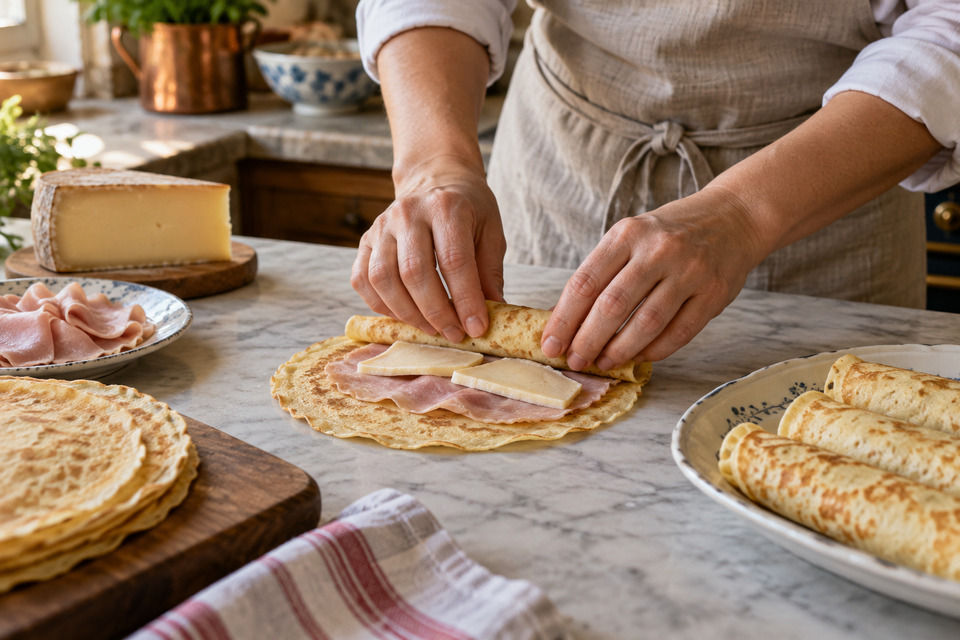
Fill and fold the crespelle. Lay a crepe on the board, spread 1 tbsp (15 ml) of bechamel over the lower half, cover it with a slice of prosciutto cotto trimmed inside the edge, then two thin slices of Fontina. Scatter a little grated Parmigiano. Fold the crepe in half, then in half again, into a loose quarter, and do not press. A folded parcel holds the cheese in pockets and lets the sauce reach the middle, while a tight roll compresses everything into one dense cylinder that bakes unevenly.
Step 4

Assemble the dish. Heat the oven to 400°F (200°C). Butter a shallow baking dish just large enough to take the parcels in a single overlapping row, and spread 3/4 cup (180 ml) of bechamel across the base. Set the folds in, point down, leaning against each other. Spoon the remaining sauce over them and leave the crests of the folds exposed, because those ridges are what will brown. Scatter the diced Fontina into the gaps rather than over the top, then the finishing Parmigiano across the whole surface.
Step 5

Bake, then gratinate. Bake on the middle shelf for 15 to 18 minutes, until the sauce is bubbling at the edges and the surface is set but still pale. Move the dish to the top shelf and switch to the broiler at full heat for 2 to 3 minutes. Stay in front of the oven. You are looking for dark blistered patches on the exposed ridges and nothing more: the moment the whole surface is evenly brown the crepes underneath have already begun to dry. Pull it out while the pale parts are still pale.
Step 6

Rest and serve. Let the dish stand five minutes before the first spoon goes in. Straight from the oven the bechamel is too fluid to hold a cut edge and a portion lifted then collapses into the dish. Five minutes lets the sauce set just enough to carry a clean square while the cheese inside is still stretching. Longer than eight minutes and the crust softens.
Plating
Serve straight from the baking dish onto hot plates. Cut down between the parcels with a small palette knife rather than a spoon, lift each fold from underneath with the layer of sauce that sits below it, and set three of them slightly overlapping, crests upward. The browned ridges have to stay on top and stay visible.
Three folded crespelle make a first course, four a main. Spoon a little of the sauce from the dish around the base of the parcels, never over them, so the crust stays dry. Finish with a grind of white pepper and nothing else: no parsley, no basil, no extra cheese on the plate. The dish is beige, and every attempt to decorate it has made it look worse.
Professional Technique
The question this dish turns on is how much liquid a crepe can absorb before it stops being a crepe. A crespella is a porous sheet, and in the oven it drinks the bechamel from both sides. Batter thickness is the control. Around one part flour to three parts milk by volume gives a sheet thin enough to take up sauce and still hold together. Thicken it and the fold stays dry in the middle, so the dish separates into pastry and sauce. Thin it further and the sheet tears at the crease.
The hour of rest is the second half of the same mechanism. Whisking raises gluten and leaves the starch granules only partly wetted, and a batter cooked at once gives a sheet that is elastic in the pan and closed on the surface. An hour of standing lets water reach the centre of every granule and lets the gluten relax, and the sheet that comes off the pan afterwards is softer, more evenly porous and far less likely to crack when it is folded.
The gratin is the third piece and it has to be high and brief for the same reason. Once the crepes are saturated, the only thing between a good dish and a dry one is how long the top surface sits under radiant heat. A broiler at full power blisters the exposed ridges in two minutes while the interior is still insulated by wet sauce. The same colour reached at 350°F (175°C) over fifteen minutes costs the crepes the moisture they have just absorbed. Short and fierce, and never from a cold start.
Texture and Moisture Control
Three textures have to arrive at the table together: a blistered crust on the ridges, crepes that are soft but still distinct, and a sauce that is fluid without being liquid. They fail in three different directions. The crust softens under steam if the dish is covered. The crepes fuse into one mass if the sauce is too thin. The sauce turns to paste if the bake runs long.
Moisture moves in one direction for the whole bake, from the sauce into the crepes, and the assembled dish has to reach a hot oven before that transfer gets ahead of the cooking. Twenty minutes between folding and oven is fine. Ninety is not: the crepes reach saturation cold, lose their edges and bake into a pudding. This is also why the parcels are folded and not rolled, and why the crests stay above the sauce line.
Temperature does the rest. The dish leaves the oven at around 195°F (90°C) in the centre and needs to fall to about 150°F (65°C) before it will cut cleanly, which is what the five minute rest is for. Plates must be hot: on a cold plate the bechamel stiffens at the edges within a minute.
Professional Mise en Place
Almost all of this can be staged in advance and none of it assembled in advance. Crepes, sauce and filling keep a day apart from each other, and once they are combined the clock starts.
Equipment and tools
8 inch (20 cm) crepe pan or low sided nonstick skillet
Heavy 2 quart (2 l) saucepan and a balloon whisk
Fine mesh sieve for the batter and the sauce
Shallow gratin dish, about 9 by 13 inches (23 by 33 cm)
Small palette knife and a 1/4 cup (55 ml) ladle
Prepared ahead
Crespelle cooked and stacked between parchment, up to 1 day refrigerated
Bechamel made 1 day ahead, refrigerated with the surface filmed
Fontina sliced and diced, kept cold and covered
Prosciutto cotto trimmed to the crepe, stacked between parchment
Parmigiano grated, filling and finishing amounts kept separate
Service setup
Oven at 400°F (200°C) with the broiler element already warm
Bechamel warm and slack, loosened with hot milk if it has set
Crepes at room temperature, never folded straight from the refrigerator
Buttered dish and sauced base ready, parcels assembled last
Plates hot, resting timer set to 5 minutes
Chef Tips
Measure the first ladle and then use the same one for every crepe. Identical thickness across twelve sheets is what makes the dish bake evenly, and judging it by eye produces two thick crepes that stay dry in the middle of the tray.
Check the batter again after its hour. It thickens as the flour hydrates, and a batter that was right at the start can be too heavy by the time you cook it. Loosen it with milk 1 tbsp (15 ml) at a time until it coats the back of a spoon thinly.
Put the folds point down. A parcel resting on its open edge lets the cheese run out into the sauce, and the dish ends up with a stringy base and hollow crespelle.
Stand at the oven for the broiler stage and do nothing else. Two minutes is the whole window, and the difference between the crust this dish is named for and a burnt tray is about twenty seconds.
Common Mistakes
Making a lasagne bechamel. A sauce thick enough to hold its shape cannot be drawn into the crepes, so the parcels stay dry inside while the surface bakes. It should run off the whisk.
Browning the crepes in the pan. They get a second cooking in the oven, and colour taken in the pan turns bitter and leathery under the broiler. Pale gold on one side is the target.
Drowning the dish in sauce. If the crests of the folds are submerged there is nothing left to blister and the gratin becomes a bake. Leave the ridges above the sauce.
Broiling from cold. Radiant heat browns a cold surface long before the inside is hot, so the top burns while the middle stays lukewarm. Bake first, broil last.
Assembling hours in advance. The crepes saturate at room temperature, lose their edges and bake into one mass. Twenty minutes between folding and oven is the outside limit.
Piling all the Fontina on the surface. Exposed to a broiler it seizes and weeps fat into the sauce. Most of it belongs inside the folds and in the gaps.
Wine Pairing
Valle d'Aosta Malvoisie: The dry version, not the fletri, and the closest the valley comes to a wine built for melted cheese. Its low acidity would be a liability anywhere else, but the weight and the faint pear and almond aromatics sit under the Fontina instead of cutting at it, and the bitterness on the finish answers the browned crust.
Valle d'Aosta Mayolet: A pale local red with almost no tannin and a red currant sharpness that behaves more like a white at the table. That is what a bechamel gratin wants: acidity to lift the butterfat and nothing astringent to argue with the milk proteins. Serve it at 57°F (14°C).
Valle d'Aosta Petite Rouge: The workhorse grape of the central valley, light and lightly peppery, with fine tannin and enough acidity to reset the palate. The pepper note runs into the white pepper and nutmeg in the sauce, and the modest alcohol keeps a rich first course from becoming the whole meal.
Valle d'Aosta Cornalin: For anyone who wants more structure. Darker fruit and a firmer tannic frame, which find the salt of the prosciutto cotto rather than the cheese, and a wild herbal edge that stands up to the blistered surface. The one bottle here that can follow the crespelle into a meat course.
Lugana DOC: The alternative from outside the region and the most flexible white here. Grown on the clay south of Lake Garda, it has more body than most Italian whites and a citrus and stone fruit line with real acidity behind it, which scrubs the butterfat off the palate where the Valdostana whites are too soft.
Storage & Reheating
Baked crespelle keep better than most gratins because the sauce protects them. Cover the dish once it is completely cold and refrigerate it up to 3 days. Unbaked parcels do not keep at all and should never be held overnight. Crepes and bechamel, stored apart, keep 1 day refrigerated, and the crepes freeze for a month stacked between parchment.
To reheat, cover the dish with foil and put it into a 325°F (165°C) oven for 20 minutes, then take the foil off and give it 2 minutes under the broiler to bring the crust back. Never use a microwave: it boils the sauce, drives water out of the crepes and leaves the cheese as separate oil and curd.
Freeze the baked dish only if you have to. It keeps 1 month and reheats as above after thawing overnight, though the crepes come back softer.
Nutrition
Per serving, based on 4 servings of 3 crespelle each:
Calories: 780 kcal
Total Fat: 46 g
Saturated Fat: 26 g
Trans Fat: 0.8 g
Unsaturated Fat: 18 g
Cholesterol: 240 mg
Sodium: 1450 mg
Total Carbohydrates: 45 g
Fiber: 1 g
Total Sugars: 14 g
Added Sugars: 0 g
Protein: 44 g
Lactose: 9 g
Principal micronutrients: calcium, phosphorus, vitamin A, vitamin B12, zinc, selenium
These figures are estimates. Sodium moves most, depending on how salty the prosciutto cotto is and how heavily the Fontina was brined.


Comments