

Italian Saffron Ricotta Gnocchi with Parmigiano Crust, Fried Sage and Hazelnuts | Gnocchi di Ricotta allo Zafferano con Crosta di Parmigiano, Salvia Fritta e Nocciole
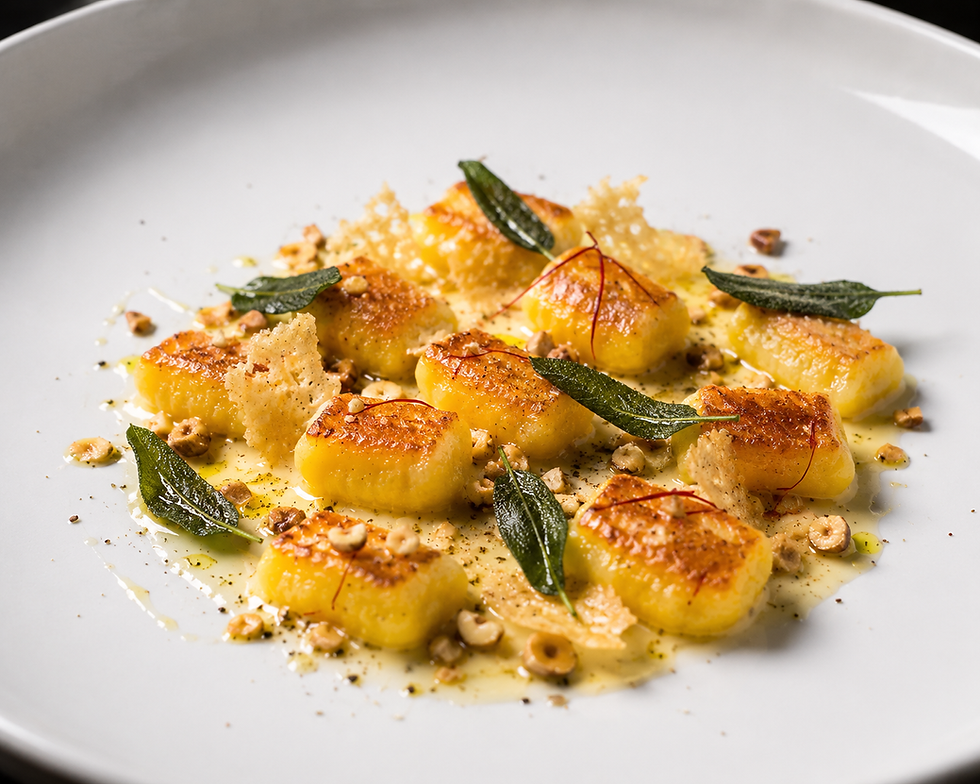
A ricotta gnocco is not a small potato dumpling. It is a soft cheese held together by the least flour that will do the job, so the recipe is really an exercise in how much you can leave out. Push the flour up and you get a competent dumpling that tastes of flour. Keep it down and you get something that collapses on the tongue, which is the only reason to make these.
The saffron goes into the dough rather than into a cream underneath it. Bloomed in a spoonful of hot water and folded in with the egg, it colours the interior and gives the whole gnocco a faint bitter honey note that a sauce alone cannot deliver. Everything that happens afterwards is built on top of that pale orange centre.
Then comes the part that turns a homely dish into restaurant work. The poached gnocchi are pan roasted in butter, and grated Parmigiano is dropped into the bare spaces of the pan so it melts, bubbles and sets into golden wafers welded to the dumplings. Fried sage and crushed Piedmont hazelnuts give three degrees of crunch against one very soft interior.
Yield: 4 servings. Drain: 4 hours or overnight. Prep: 40 minutes. Rest: 30 minutes. Cook: 25 minutes. Difficulty: advanced. Course: primo piatto. Region: northern Italy, with saffron by way of Venice.
The Story
Saffron arrived in the kitchens of northern Italy through the Rialto. For four centuries Venice held the western end of the spice route, and the galleys of the muda, the state convoys that sailed each year to Alexandria and Beirut, came back with pepper, cinnamon, ginger and saffron under armed escort. The cargo was unloaded, weighed and sold in a district of warehouses whose street names still record it, and the city took its cut before a thread moved inland.
The trade was run by a guild, the Arte degli Speziali, whose members were part merchant, part apothecary and part chemist. Spezieri were licensed, inspected and held to a written standard, and saffron was watched most closely of all, because it was the easiest thing to fake and the most profitable to fake well. Threads were cut with safflower or dyed fibre, or weighted with oil and honey to sell damp goods at dry prices. Venetian law treated that as fraud against the republic rather than against the customer.
From the Rialto the spice moved up the Po valley to Verona, Mantua, Milan and the cheese towns of Emilia, which is how a flower shipped from the Levant ended up colouring the food of a region that never grew it. That northern route is also why saffron sits so naturally beside butter, Parmigiano and sage rather than beside olive oil. The rest comes from the same landscape: sage grew at the kitchen door, and the Langhe supplied the finest hazelnut in Europe.
Ingredients
For the saffron ricotta gnocchi
Sheep milk ricotta, 16 oz (450 g), before draining
Italian 00 flour, 3/4 cup (90 g), plus a little for shaping
Egg, large, 1
Egg yolk, large, 1
Parmigiano Reggiano, finely grated, 2 oz (55 g)
Saffron threads, 1/8 tsp (0.15 g)
Hot water, 1 tbsp (15 ml), at 150°F (65°C)
Nutmeg, freshly grated, 1/4 tsp
Fine sea salt, 1/2 tsp (3 g)
Freshly ground white pepper, to taste
For the Parmigiano crust and garnish
Parmigiano Reggiano, finely grated, 2 oz (55 g)
Unsalted butter, 2 tbsp (28 g)
Piedmont hazelnuts, 2 oz (55 g)
Fresh sage leaves, medium, 16
Neutral frying oil, 1/3 cup (80 ml)
Fine sea salt, 1 pinch
For the finishing emulsion
Unsalted butter, 3 tbsp (42 g)
Light vegetable stock or gnocchi poaching water, 1/3 cup (80 ml)
Lemon juice, freshly squeezed, 1 tsp (5 ml)
Saffron threads, a few, for finishing
Extra virgin olive oil, a few drops per plate
Freshly ground black pepper, to taste
Preparation
Drain the ricotta and weigh what leaves
Set the ricotta in a fine mesh sieve over a bowl, cover it and leave it in the refrigerator at least 4 hours, ideally overnight. Weigh it going in and coming out. Good sheep milk ricotta gives up 2 to 3 oz (55 to 85 g) of whey, and if yours gave up almost nothing it was sold too wet and will need more flour than this recipe allows. The curd that remains should hold a fingerprint without weeping.
Bloom the saffron and cool it
Heat the tablespoon of water to about 150°F (65°C), hot to the finger but nowhere near boiling, crumble the threads into it and cover the cup for 20 minutes. The colour compounds are water soluble and come out completely at that temperature, while a boil drives off the aroma. Let the infusion cool to room temperature before it goes near the egg, or it sets the yolk on contact.
Sieve the curd, then fold rather than mix
Press the drained ricotta through a fine sieve with a plastic scraper so it falls in soft threads. This breaks the grain without smearing it, and smearing is what makes a ricotta dough gluey. Add the egg, yolk, Parmigiano, cooled saffron infusion, nutmeg, salt and white pepper, and fold with a spatula in wide slow strokes, about fifteen of them, until it is one colour and no more.
Add the flour in two stages and stop early
Scatter two thirds of the flour over the surface and fold it in, then judge. The mixture should be tacky and barely cohesive, closer to a thick batter than to a dough, and it should just hold a shape when scooped with two spoons. Add the rest only if it slumps flat. The flour is not an ingredient here, it is a consequence of how wet the ricotta was, so the listed quantity is a ceiling and not a target.
Cook one gnocco before committing the batch
Roll a single teaspoon of the mixture, drop it into barely simmering salted water and watch it for 90 seconds. It should rise, hold its edges and feel yielding all the way through. If it frays, fold in one more tablespoon of flour and test again. If it comes out firm and bouncy you have gone too far, so fold in a spoonful of fresh sieved ricotta. Nobody judges this dough by eye.
Shape, chill, then poach in still water
Flour the board lightly, roll the mixture into ropes 3/4 inch (2 cm) thick, cut 1 inch (2.5 cm) pieces and chill them on a floured tray 20 minutes. Poach in batches in salted water held just below a simmer, the surface trembling and never breaking. Give them 30 seconds after they rise, lift them onto a rack and let them steam dry a full 2 minutes. A wet gnocco never takes colour.
Fry the sage, toast the nuts, build the crust
Toast the hazelnuts at 325°F (165°C) for 8 to 10 minutes, rub off the skins in a cloth and crush them coarsely. Fry the sage in oil at the same temperature for 10 to 15 seconds, until the leaves go still and translucent, then drain them flat on paper and salt at once. Melt the 2 tablespoons of butter in a wide pan over medium high heat, lay the gnocchi in without crowding and leave them for 2 minutes. Scatter the second 2 oz (55 g) of Parmigiano into the bare spaces, let it bubble and set for about a minute, then slide some gnocchi onto those wafers so the cheese welds to them. Lift everything out, swirl the remaining butter with the stock and lemon juice into a glossy emulsion, and return the gnocchi for 20 seconds, crusted side up.
Plating
Use warm shallow bowls at about 130°F (55°C). The emulsion is butter held in a little stock and it tightens on a cold surface, while a hotter plate keeps working the butter after service and breaks it into a greasy ring. Spoon a small pool down first and set five or six gnocchi into it, crusted faces upward and never stacked, because anything resting on a Parmigiano wafer softens it within a minute.
Scatter the crushed hazelnuts around the gnocchi rather than over them, so they stay loose instead of sinking into the butter. Lean three or four fried sage leaves against the dumplings, whole and unbroken. Finish with two or three raw saffron threads, a few drops of good olive oil and a turn of black pepper. No extra cheese at the table: the crust carries all the Parmigiano the plate can hold.
Professional Technique
The signature technique is the frico crust built directly in the cooking pan. Grated Parmigiano dropped onto hot metal first melts, then loses its water in a rush of bubbles, and finally sets as the proteins and milk sugars brown together. The window is about 60 seconds wide. Too early and the cheese sticks to the pan instead of to the gnocco; too late and the sugars go past nutty into acrid. Laying the dumplings onto the wafer at the right moment fuses them into one object with two textures.
The second technique is the contradiction between poaching and roasting. Poaching sets the egg proteins gently and leaves the interior almost custardy, while pan roasting drives hard dry heat across the outside for a Maillard crust. They coexist only because of the rack in between: two minutes of steam drying removes the surface film of water, and until it is gone the pan is steaming the gnocco rather than browning it.
The third is the butter emulsion, which is not simply melted butter. Butter is about 16 percent water and 2 percent milk solids, and left alone in a hot pan it separates into fat and sediment. Adding stock and agitating disperses that fat into droplets held by the milk proteins and the starch carried over from the poaching water. Lemon juice sharpens the finish and helps it hold, and the emulsion must be used within a minute.
Texture and Moisture Control
Every failure of this dish is a moisture failure somewhere. Wet ricotta demands more flour, more flour means gluten, and gluten in a ricotta dumpling reads as rubber. That is why the draining is measured rather than guessed. The target interior is barely set, soft enough to break under a fork with no resistance at all.
Water also decides the crust. A poached gnocco leaves the pot carrying a film of liquid, and that film has to evaporate before the surface can climb above 212°F (100°C) and brown. A rack does it in 2 minutes; a colander does not, because the pieces sit in their own steam and rewet each other, and the difference is a pan full of pale dumplings stuck to the metal.
The crust itself is a dry element on a wet plate, losing the argument by the second. Assembly order is the only defence: sauce down first, gnocchi onto it crusted side up, nuts and sage last, plate to the table immediately. Fried sage has a working life of a few minutes once it meets butter, which is why it goes on the plate and never in the pan.
Professional Mise en Place
The draining runs overnight and the poaching can be done ahead, leaving only the roasting and the emulsion at the pass.
Equipment and tools
Fine mesh sieve and a scale for measuring the whey loss
Wide heavy skillet, large enough that the gnocchi never touch
Wire rack over a tray for steam drying the poached gnocchi
Slotted spoon, small pan for the sage, microplane for the cheese
Prepared ahead
Ricotta drained and weighed, up to 24 hours ahead, kept cold
Saffron infusion bloomed and cooled, up to 1 day ahead in a covered cup
Hazelnuts toasted, skinned and crushed, up to 2 days ahead in a sealed jar
Gnocchi shaped and chilled on a floured tray, up to 4 hours ahead
Gnocchi poached and steam dried, up to 1 hour ahead
Service setup
Poaching water held just below a simmer, never allowed to boil
Frying oil at 325°F (165°C) with sage leaves dried and ready beside it
Parmigiano grated in two separate bowls, dough and crust
Bowls warmed to 130°F (55°C), stock hot, lemon cut but not squeezed
Chef Tips
Buy sheep milk ricotta if you can find it. It is firmer, higher in fat and far less watery than the cow milk version sold in tubs, so it needs less flour and tastes of more. With cow milk ricotta, drain twice as long and expect to use all the flour listed.
Dry the sage leaves on a cloth before they go into the oil. A wet leaf spits, cools the oil and comes out limp, and the difference between a leaf that shatters and one that flops is entirely surface water.
Grate the crust Parmigiano finely and no more than an hour before service. Coarse shreds melt unevenly and leave holes, and cheese grated the day before dries out and browns in patches instead of setting as one sheet.
If the crust sticks to the pan rather than to the gnocchi, the heat was too low. Raise the flame rather than waiting longer, and use a heavy skillet that holds its temperature when cold dumplings land in it.
Common Mistakes
Starting with undrained ricotta. Every gram of whey left in the curd has to be paid for with flour, and the dough turns heavy long before it turns manageable. Drain overnight and confirm by weight.
Skipping the single test gnocco. The right flour quantity changes with every tub of ricotta, and 90 seconds of testing is the only way to find it. A whole batch dissolving in the pot is avoidable.
Boiling the gnocchi. A rolling boil tears these dumplings apart, since there is almost no gluten holding them together. The surface should tremble and never break.
Going straight from pot to pan. A wet surface steams instead of browning, so the gnocchi stay pale and glue themselves to the metal. Give them 2 minutes on a rack first.
Moving the gnocchi too soon in the pan. The crust needs a full 2 minutes of uninterrupted contact, and shaking the pan early tears off the layer that has just begun to set. Trust the colour at the edges.
Adding the Parmigiano crust to a crowded pan. Cheese needs bare hot metal to melt and set. In a packed pan there is nowhere for it to go and it coats the dumplings in a soft salty film.
Wine Pairing
Soave Superiore DOCG: Garganega grown on the volcanic hills east of Verona, on the road the spice took inland. It has more weight than ordinary Soave and finishes on a bitter almond note that answers the toasted hazelnut directly. The acidity cuts butter without ever tasting sharp against the saffron.
Lugana DOC: Turbiana from the clay flats at the southern end of Lake Garda, an unusually textured white with a faintly saline, almost creamy middle. That texture is the point: it sits alongside the soft ricotta interior rather than cutting against it, while enough acidity remains to keep the butter from dulling the palate.
Ribolla Gialla Collio DOC: A Friulian white with real grip and a green apple bite, from border hills that were Venetian territory for centuries. Its slightly phenolic edge is what makes it work against fried sage, meeting the herb on its own bitter terms. Serve it at 50°F (10°C).
Franciacorta DOCG: The metodo classico choice, and the most reliable partner for anything fried. Its fine persistent mousse lifts butter and cheese off the palate, and the bready character from long lees ageing runs alongside the browned Parmigiano. Choose a Brut, not an Extra Brut, which reads austere beside the saffron.
Alto Adige DOC Pinot Nero: For a red, a mountain Pinot Nero at 57°F (14°C). Its tannin is light enough not to clash with the cheese, and its earthy, faintly smoky fruit picks up the hazelnut and the sage at once. Anything more tannic strips the plate and leaves the interior tasting of nothing.
Storage & Reheating
Shaped raw gnocchi keep on a floured tray, covered, up to 4 hours in the refrigerator and no longer, since the flour goes on hydrating and the dough softens. Beyond that, freeze them: spread out on the tray, freeze solid, bag, keep 1 month and poach from frozen with 30 seconds more.
Poached gnocchi hold well, which is what makes this dish possible in service. Steam dry them, spread them on an oiled tray without touching, cover loosely and refrigerate up to 24 hours, then bring them to room temperature for 20 minutes before the pan. Never freeze them once poached: ice crystals wreck the soft interior.
The finished plate does not keep. To reheat leftovers, use a buttered pan over medium heat for about 2 minutes, crusted side down, and accept a softer crust and limp sage. Never a microwave, which turns the ricotta rubbery and the Parmigiano oily. Toasted nuts keep 2 days in a sealed jar; sage is always fried fresh.
Nutrition
Per serving, based on 4 portions:
Calories: 620 kcal
Total Fat: 42 g
Saturated Fat: 20 g
Trans Fat: 0.8 g
Unsaturated Fat: 19 g
Cholesterol: 185 mg
Sodium: 760 mg
Total Carbohydrates: 35 g
Fiber: 3 g
Total Sugars: 4 g
Added Sugars: 0 g
Protein: 27 g
Lactose: 3 g
Principal micronutrients: calcium 620 mg, phosphorus, vitamin A, vitamin B12, vitamin E, magnesium, selenium
Allergens: milk, egg, wheat gluten and tree nuts. These figures are estimates: most of the frying oil stays in the pan rather than on the sage, and the sodium depends almost entirely on how much Parmigiano ends up in the crust.


Comments