
Italian Salted Caramel Soufflé | Soufflé al Caramello e Sale Marino
Updated: Sep 14

A salted caramel soufflé is built on one decision: how dark you take the sugar. Stop at pale gold and the dessert tastes only sweet and faintly of warm milk. Take it to a deep russet amber, with the first thread of smoke rising off the pan, and the bitterness that seems reckless in the saucepan becomes the backbone of the dessert once it meets a cup of milk, three yolks and four whipped whites. Sea salt is there to sharpen that bitterness, not to make anything taste salty.
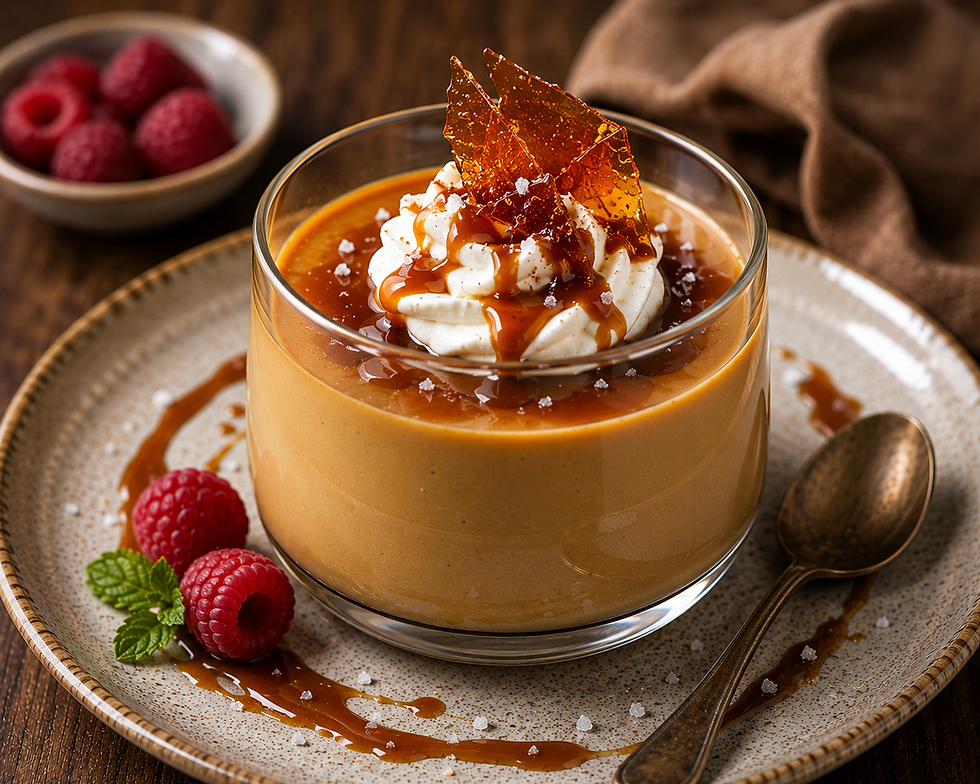
The base is a caramel pastry cream thickened with cornstarch rather than flour, which sets glossy and light and leaves the dessert naturally free of gluten. Whipped whites go in at the last moment, and the soufflé goes straight from the oven to the table with a burnished crown, a soft centre and three flakes of sea salt scattered on top. Nothing is poured over it.
Yield: 4 soufflés in 6 ounce (180 ml) ramekins. Prep: 30 minutes. Cook: 14 minutes. Total: about 50 minutes. Difficulty: advanced. Course: plated dessert.
The Story
The soufflé is French and the modern taste for salted caramel is Breton, but both halves of this dessert have been in the Italian pantry for a very long time. Crema al caramello, a pastry cream built on cooked sugar instead of vanilla, has been the quiet alternative to crema pasticcera in northern pasticcerie for generations, used to fill choux and layer sponge. Sale marino is older still: the pans of Trapani in Sicily and Molentargius outside Cagliari have been worked by hand since antiquity, and their flaked crystals are damp, mineral and nothing like refined table salt. The two only became a single named flavour after Henri Le Roux began selling his salted butter caramels in Quiberon in the late 1970s, and from there it entered restaurant pastry everywhere.
What Italian kitchens did with it was characteristically restrained. The French reading leans on salted butter and a great deal of cream; this one keeps the dairy to a single cup of whole milk, thickens with cornstarch, and treats the salt strictly as seasoning. Half a teaspoon of flakes in the entire base is enough to make the caramel taste more like itself, in the way a pinch of salt on a ripe tomato is not there to be tasted. The result sits comfortably beside the classic soufflés on an Italian dessert menu, built on the same old discipline of cooked sugar and beaten whites.
Ingredients
For the ramekins
Unsalted butter, softened, 1 tbsp (14 g)
Granulated sugar, 2 tbsp (25 g)
For the caramel base
Granulated sugar, 1/3 cup (67 g)
Whole milk, 1 cup (240 ml), warmed to 150°F (65°C)
Egg yolks, large, 3
Cornstarch, 2 tbsp (16 g)
Unsalted butter, 1 tbsp (14 g)
Pure vanilla extract, 1 tsp (5 ml)
Flaky sea salt, 1/2 tsp (2 g)
For the meringue
Egg whites, large, at room temperature, 4 (about 4 1/2 oz, 130 g)
Cream of tartar, 1/4 tsp (1 g)
Granulated sugar, 3 tbsp (38 g)
For finishing
Flaky sea salt, 3 or 4 crystals per soufflé
Warm caramel sauce, optional, 1/4 cup (60 ml), served alongside
Preparation
Step 1
Prepare the ramekins. Brush four 6 ounce (180 ml) ramekins with the softened butter in vertical strokes, from the base up over the rim, so the batter has a ladder to climb. Add the 2 tablespoons of granulated sugar, roll each dish to coat the inside completely, tap out the excess and chill them. Horizontal brush strokes are the commonest reason a soufflé rises crooked.
Step 2
Cook the dry caramel. Warm the milk to about 150°F (65°C) and keep it in a spouted jug beside the stove, because everything from here happens in seconds. Scatter the 1/3 cup of sugar in a thin even layer across a heavy pale bottomed stainless pan over medium heat and leave it until the edges liquefy. Then swirl the pan, never stir, until the colour moves through straw to gold to a deep russet amber at roughly 350°F (175°C). A dark or nonstick pan hides that colour until the sugar is already bitter.
Step 3
Loosen the caramel with warm milk. Off the heat, pour the milk in three additions, standing back from the violent steam and whisking hard between them. The caramel seizes into hard lumps on contact and this is normal: return the pan to low heat and whisk for a minute or two until every piece has dissolved.
Step 4
Thicken the base. Whisk the yolks and cornstarch smooth, temper with a ladle of the hot caramel milk, then return everything to the pan. Cook over medium heat, whisking into the corners, until it boils and thickens to a glossy cream, about 90 seconds, and stop there: a gel held at a hard boil for four or five minutes breaks down and thins, and a thin base will never support a meringue. Off the heat beat in the butter, the vanilla and the 1/2 teaspoon of flaky salt, film the surface and cool to about 100°F (38°C).
Step 5
Whip the meringue. Wipe the bowl and whisk with a paper towel dampened in white vinegar and dry them completely, since any trace of fat costs you half the rise. Start the room temperature whites on medium speed until they are opaque and foaming, add the cream of tartar, then rain in the 3 tablespoons of sugar a spoonful at a time. Take it to firm medium peaks: a peak that stands when the whisk is lifted and bends at the very tip, still glossy and wet.
Step 6
Fold the two together. Whisk the cooled base smooth first, with real vigour, because a cornstarch custard sets into a firm block as it cools and cannot be folded in that state. Thirty seconds returns it to a slack ribboning cream. Stir a third of the meringue in hard to loosen it, then fold the rest in two additions with a wide spatula: down through the centre, along the bottom, up the side, quarter turn, repeat. Stop the moment the last white streak disappears.
Step 7
Fill and bake. Fill the chilled ramekins level with the rim, sweep the tops flat with an offset palette knife and run a thumb around the inside edge to cut a clean channel, so the batter releases from the ceramic instead of clinging. Wipe any smear off the rims, where caramel scorches black. Bake at 400°F (205°C) on a heavy sheet preheated in the lower third of the oven for 12 to 14 minutes, and do not open the door for the first 10.
Step 8
Read the rise and serve at once. The soufflé is ready when it stands an inch and a half above the rim with a domed, slightly cracked crust, the surface has turned from wet to matte, and a gentle nudge moves the centre as one soft mass. Smell is the most reliable signal: at ten minutes the oven smells of hot milk, at thirteen distinctly of toasted sugar. This batter colours faster than a vanilla soufflé because its sugar is already cooked, so a burnished mahogany crown is correct.
Plating
The composition is a single tall column of amber brown, so keep the plate almost empty and let the height do the work. Pale matt ceramic suits it better than dark slate. Set each ramekin on a folded napkin so it does not skate, and add the three or four flakes of sea salt only now, at the pass. Salt scattered before baking dissolves into the batter and draws moisture out of the crust, and the crackle of an undissolved crystal against a soft interior is the point of the finish.
Skip confectioners sugar entirely, since a dessert built on cooked sugar gains nothing from a raw one dusted on top. Serve with a long teaspoon so the guest can reach the bottom of the ramekin, where the base is denser and carries most of the salt. If you are sending warm caramel sauce, send it in a small jug and tell the table to break the crown first and pour into the opening: a spoonful poured over an intact crust drives the soufflé down like a collapsed roof.
Professional Technique
The defining technique here is the dry caramel. Cooking sugar without water is faster, gives a deeper and less cloying flavour, and is far less prone to crystallising than most cooks expect, provided the sugar goes in as a thin even layer and is swirled rather than stirred. A spoon dragged through cooking sugar carries crystals up the side of the pan and seeds the whole batch. The target is a temperature, roughly 350°F (175°C), but the reliable cue is colour read against pale metal, which is why the pan matters as much as the heat.
The second technique is turning that caramel into a stable soufflé base. Caramelised sugar has lost much of its capacity to sweeten and gained acidity and bitterness, so it cannot simply be folded into a standard pastry cream. It is rehydrated with warm milk, then set with yolks and cornstarch into a gel firm enough to hold air and slack enough to fold. Cornstarch is chosen over a flour panade deliberately: it gelatinises quickly, sets translucent rather than pasty, and gives a cleaner crumb under a flavour as assertive as burnt sugar. The cost is fragility, since the gel thins if it is boiled hard, which sets the 90 second limit on the base.
Texture and Moisture Control
Caramel is strongly hygroscopic, which governs almost every timing decision here. It pulls water out of the air and out of the batter around it, so a base left on the counter for an hour visibly loosens and a baked soufflé held under a lamp goes damp at the crust within minutes. That is why the finishing salt goes on after the bake, and why the ramekins are sugared and chilled rather than sugared at the last minute in a warm kitchen.
Temperature at the folding stage decides the rise. The base should be near 100°F (38°C): colder and it is too stiff to accept the whites without knocking the air out of them, hotter and it slackens the meringue on contact. In the oven the cornstarch structure sets softer than a flour and butter one, so this soufflé starts to fall within about a minute of leaving the heat. A slight sink at the very centre is correct and means the middle is still creamy; one that has stopped moving entirely has been overbaked and will eat dry at the edges.
Professional Mise en Place
Caramel gives you seconds, not minutes, so everything is staged before the sugar goes near the heat. Weigh the two quantities of sugar into separate dishes, since 1/3 cup for the caramel and 3 tablespoons for the meringue are not interchangeable.
Equipment and tools
Heavy pale bottomed stainless saucepan, so the colour of the sugar stays readable
Long handled whisk and an oven glove for the hand holding the pan
Stand mixer or hand mixer with a scrupulously clean bowl
Four 6 ounce (180 ml) straight sided ramekins and a pastry brush
Offset palette knife and a heavy baking sheet preheated with the oven
Prepared ahead
Ramekins buttered, sugared and chilled, up to 1 day ahead
Caramel base cooked, filmed and refrigerated, up to 2 days ahead
Eggs separated cold, whites brought to room temperature before whipping
Oven at 400°F (205°C) for a full 30 minutes with the sheet inside
Service setup
Warm milk in a spouted jug at the back of the stove
Yolks already whisked with the cornstarch, bowl steadied on a damp cloth
Butter, vanilla and the measured salt in small dishes within reach
Bowl of iced water in the sink to arrest the caramel if it runs away
Plates, napkins and the finishing salt laid out before the soufflés go in
Chef Tips
Take the caramel one shade darker than instinct allows. What tastes aggressively bitter in the pan is diluted by a cup of milk, three yolks and four whites, and a caramel pulled at pale gold disappears completely in the finished dessert. If you are unsure, taste a little set on a cold teaspoon: it should be assertive to the point of discomfort.
Use flaky sea salt and not fine table salt. The same half teaspoon of fine salt weighs roughly twice as much and dissolves instantly, so the dessert reads uniformly salty instead of carrying bright intermittent points against the sweetness.
Brown the finishing tablespoon of butter before beating it into the base. It costs two minutes, adds a nutty depth that sits naturally alongside cooked sugar, and changes nothing else. A tablespoon of dark rum stirred in at the same moment also sharpens the caramel without thinning the base.
If the caramel seizes into a solid lump when the milk goes in, do not throw it away: low heat and patient whisking dissolve it every time. The only unrecoverable caramel is one that has gone past amber into black and smells acrid, which no amount of dairy will rescue.
Common Mistakes
Pulling the sugar at gold. Nerve fails at the moment the caramel starts to smell right, and the result tastes sweet and vaguely of milk with no caramel character. Push to deep russet amber and trust the dilution that follows.
Adding cold milk to hot caramel. The sugar sets into a rock and the pan can crack. Warm the milk to about 150°F (65°C) and add it off the heat in three stages.
Boiling the cornstarch base too long. Past about 90 seconds the starch gel breaks down and the base thins into a custard that cannot hold a meringue. Thicken it briskly, then get it off the heat.
Whipping the whites to stiff dry peaks. A cottony meringue has lost the elasticity it needs to stretch in the oven, so it tears instead of expanding. Firm medium peaks, glossy and still wet, are what a starch set base needs.
Opening the oven door early. A drop in temperature during the first 10 minutes stalls the rise permanently and no extra baking recovers it. Watch through the glass and use the change in smell as the timer.
Wine Pairing
Vin Santo del Chianti Classico DOC: Long oxidative ageing in caratelli builds exactly the walnut, dried fig and burnt sugar notes the caramel already carries. Its acidity stays high under all that sweetness, which keeps the pairing from turning heavy.
Recioto di Soave DOCG: Dried Garganega gives candied apricot and almond with far more freshness than its density suggests, and that lift is what a soufflé needs. It is sweet enough to stand beside the dessert yet light enough that the salt on the crown still reads clearly.
Ramandolo DOCG: Verduzzo Friulano from the steep slopes above Nimis gives a honeyed wine with a faintly tannic grip, unusual in a dessert white. That grip cuts the dairy fat of the base, while acacia honey and orchard fruit meet the butterscotch edge of the caramel.
Malvasia di Bosa DOC: Aged under a film of yeast in the Planargia, it develops a nutty, bruised apple character that mirrors the bitterness of dark caramel rather than fighting it. Its saline finish picks up the sea salt on the crust, which no simple sweet Moscato can do.
Storage & Reheating
A baked soufflé cannot be stored, held or reheated: it is finished the moment it leaves the oven. The caramel base, however, improves for a night in the refrigerator as the burnt sugar notes settle. Keep it up to 2 days with film pressed onto the surface, then rewarm it to about 100°F (38°C) over barely simmering water and whisk it back to a smooth ribbon before folding. Never use a microwave, which overheats pockets and breaks the starch gel.
Filled unbaked ramekins can be frozen uncovered until firm, then wrapped for up to 2 weeks and baked from frozen at 400°F (205°C) for 18 to 20 minutes, accepting a rise about one quarter lower. Buttered and sugared ramekins hold a day in the refrigerator, separated whites keep 3 days covered, and leftover caramel sauce keeps 2 weeks in a sealed jar.
Nutrition
Per serving, based on 4 soufflés:
Calories: 265 kcal
Total Fat: 9 g
Saturated Fat: 4.5 g
Trans Fat: 0 g
Unsaturated Fat: 4 g
Cholesterol: 155 mg
Sodium: 330 mg
Total Carbohydrates: 38 g
Fiber: 0 g
Total Sugars: 32 g
Added Sugars: 29 g
Protein: 8 g
Lactose: 2.8 g
Principal micronutrients: calcium, choline, selenium, riboflavin, vitamin B12, vitamin A
These figures are estimates and exclude the optional caramel sauce. The dessert contains egg and dairy but no gluten, since it is thickened with cornstarch.


Comments